

If we cannot pay an ATO tax debt by its due date, the obligation does not disappear. Interest can accumulate and recovery action may follow. As tax preparation experts, we focus first on confirming the liability, identifying urgent legal risks and establishing what the business or individual can realistically afford. The objective is not simply to negotiate instalments. We need a repayment strategy that preserves financial viability without allowing new tax liabilities to build up.
What happens when an ATO tax debt remains unpaid?
We distinguish between an overdue payment and an overdue lodgement. A correctly lodged return can still produce an unpaid debt. Conversely, delaying a return because funds are unavailable can add penalties and uncertainty without solving the payment problem.
The ATO has several recovery options. We do not assume they occur in a fixed sequence or that every taxpayer receives the same period of informal contact.
| Possible consequence | What it means | Our response |
|---|---|---|
| General interest charge | Interest generally accrues on unpaid amounts | Check the calculation and assess repayment capacity |
| Refund offsets | Tax refunds or credits may be applied against outstanding debts | Avoid relying on an expected refund for operating expenses |
| Garnishee notice | The ATO may require a bank or another third party to pay money towards the debt | Review the notice and its immediate cash flow implications |
| Credit reporting | Eligible business tax debts may be disclosed if statutory conditions are satisfied | Respond promptly to any disclosure warning |
| Legal recovery | Proceedings may include bankruptcy action against an individual or winding-up action against a company | Obtain urgent accounting and legal advice |
Our tax preparation experts assess the actual notices and account history rather than predicting enforcement from the debt balance alone. Previous defaults, outstanding lodgements and the taxpayer’s engagement with the ATO can affect the position.
Interest continues, even under many payment plans
We generally expect the general interest charge, or GIC, to continue while a debt is being paid through an instalment arrangement. A payment plan does not automatically freeze interest or reduce the underlying tax.
GIC rates change quarterly and the charge compounds daily. We use the ATO’s published general interest charge rates when estimating the cost of repayment rather than relying on an old percentage.
For GIC and shortfall interest charge incurred on or after 1 July 2025, income tax deductions are no longer available. We therefore assess the full after-tax funding cost when comparing an ATO arrangement with other finance options. External borrowing is not automatically preferable, particularly if it requires personal guarantees or security over important assets.
We also separate interest from penalties. A failure-to-lodge penalty concerns late reporting, while GIC concerns unpaid amounts. Our explanation of when the ATO may remit overdue-return penalties covers that distinction in more detail.
How our tax preparation experts assess a repayment plan
Confirm the debt before negotiating
We reconcile the ATO account against lodged returns, BAS, assessments, payments and available credits. An apparent balance can include several obligations with different consequences, such as income tax, GST, PAYG withholding or superannuation guarantee charge.
For business owners with multiple entities, we identify the legal debtor for each amount. A company’s liability is not automatically interchangeable with a director’s personal debt or a family trust’s obligations.
We also check whether the amount is disputed. An objection does not ordinarily stop interest or recovery automatically, so any request to defer recovery needs separate attention.
Test affordability against future obligations
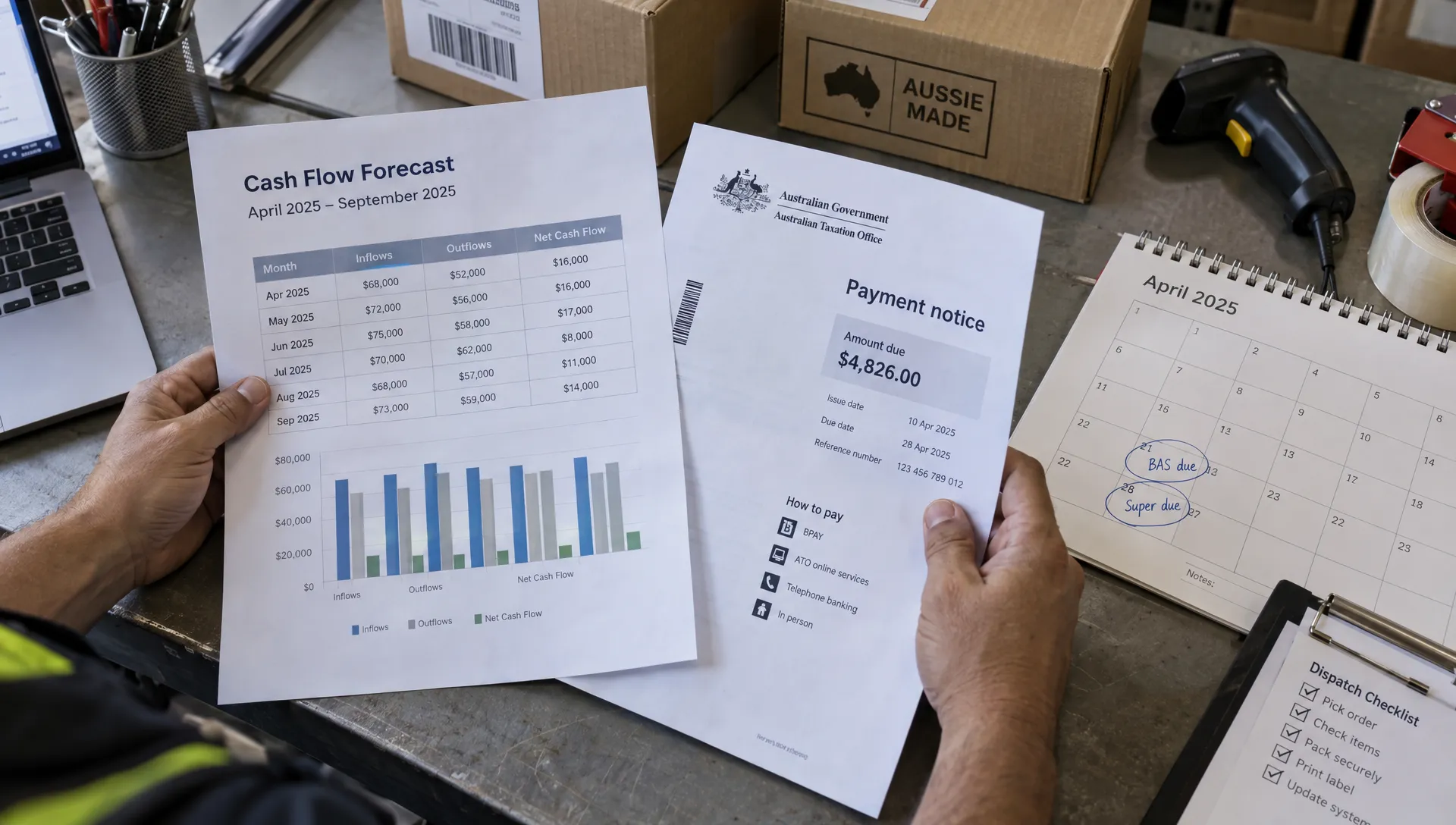
We build a short-term cash flow forecast, often covering the next 13 weeks, and extend it where the proposed repayment period requires a longer view. The forecast needs to allow for wages, essential suppliers, finance commitments and new tax liabilities.
We then test a slower-collections scenario. A proposal that works only if every customer pays on time is vulnerable to early default.
Our tax preparation experts look beyond the largest instalment available today. We assess whether repayments remain affordable when the next BAS, payroll cycle and superannuation obligations arrive. Where repayments depend on an asset sale or refinancing, we document realistic timing and a fallback position.
What assistance may be available?
An ATO payment arrangement
We can assess whether a payment arrangement is appropriate and prepare the supporting financial information. Depending on eligibility and complexity, arrangements may be available through online services or require direct discussion with the ATO.
The ATO may consider compliance history, the reason for the debt, financial information and the ability to meet both instalments and future obligations. Approval is not automatic, and larger or more complex proposals can require stronger evidence.
We use the ATO’s guidance on paying and managing tax debts as the starting point, then assess the circumstances of the particular account.
Interest or penalty remission
We may request remission where the facts support it, but we do not promise that the ATO will remove charges. Evidence can include the events that caused the delay, steps taken to reduce its impact and the timing of subsequent action.
Our tax preparation experts distinguish a documented remission case from a general request for leniency. Paying the principal debt or entering an arrangement does not, by itself, establish entitlement to remission.
Serious hardship relief
For eligible individuals, including some sole traders, we may assess whether release from certain tax liabilities on serious-hardship grounds is available. This is a specific statutory remedy, not a general business debt write-off.
Companies and trusts cannot use the individual serious-hardship release provisions. GST, PAYG withholding and superannuation guarantee charge are also generally outside this release mechanism.
We assess eligibility carefully before treating release as a realistic option. Commercial pressure, reduced profitability or a preference not to sell an asset does not automatically establish serious hardship.
Company directors need a separate risk assessment
We treat unpaid company taxes as more than an accounts-payable issue. Under the director penalty regime, directors can become personally liable for certain unpaid PAYG withholding, net GST and superannuation guarantee charge liabilities.
A director penalty notice involves a strict 21-day period linked to when the notice is legally given, not when the director eventually reads it. We recommend immediate legal advice rather than attempting to calculate the response deadline informally.
Late reporting can restrict the ways a director penalty may be remitted. In some circumstances, appointing an administrator or liquidator will not remove the penalty. A payment arrangement does not itself remit a director penalty or extend the notice deadline.
Our tax preparation experts therefore check both payment history and lodgement dates before recommending a response. We explain the broader reporting risks in our guide to late tax filing risks for directors.
We also consider solvency. If a company cannot pay debts as they fall due, continued trading can create additional legal exposure. An ATO instalment proposal is not a substitute for advice from a solicitor or registered insolvency practitioner where insolvency is suspected.
Credit reporting and garnishees can affect business continuity
We consider the consequences of recovery action before choosing a repayment strategy. A garnishee notice directed to a bank or customer can affect cash available for wages and essential suppliers. We need to understand what the notice requires rather than assume that informal negotiations have suspended it.
Business tax debt disclosure is also subject to statutory criteria. These include, among other requirements, eligible debts totalling at least $100,000 that have been overdue for more than 90 days and a lack of effective engagement with the ATO. Disclosure is not automatic for every business above that balance.
We treat a disclosure warning as urgent because credit reporting can affect access to finance and commercial relationships. A request for assistance is not necessarily the same as an accepted arrangement.
Our tax preparation experts confirm the status of negotiations, outstanding evidence and any enforcement notices. Written records matter: we retain the proposal, supporting assumptions and the ATO’s response so the business understands what has actually been agreed.
A repayment plan must work alongside the next BAS
We can illustrate the affordability problem with a hypothetical company owing $72,000. If it proposes principal repayments of $6,000 per month, the debt would take 12 months to clear before allowing for interest.
Suppose the company’s forecast shows only $4,500 per month available after operating costs and provision for new tax liabilities. The proposed arrangement is not sustainable. Ignoring the next BAS might make the initial instalments appear affordable, but it simply shifts the shortfall into a new debt.
We would first test faster debtor collection, reduced discretionary spending, an appropriate upfront payment and any credible refinancing or asset-sale options. We would then reassess whether the business can support the remaining debt at all.
Our tax preparation experts use this analysis to separate a temporary timing problem from a structural funding deficit. If the business consistently spends more than it generates, a longer repayment period alone will not restore financial health.
That is where compliance becomes a foundation for strategic advisory and corporate growth. Reliable figures allow us to identify which activities generate cash, which absorb it and whether expansion should pause while the balance sheet recovers.
How automated accounting helps prevent another debt cycle
We use AI-driven financial workflows with professional review to improve the speed and accuracy of the records supporting tax decisions. Automation does not negotiate away a debt, but it can reduce the reporting delays and manual processing errors that obscure the underlying problem.
We recommend authorised bank feeds, regular reconciliations and timely recording of GST and payroll liabilities where the accounting environment supports them. Real-time financial visibility depends on complete source data, reliable integrations and regular review, not simply installing software.
We also distinguish the bank balance from genuinely available cash. Funds needed for GST, PAYG withholding or superannuation should not be treated as surplus working capital.
Our tax preparation experts connect these records to forward-looking cash flow reviews. That allows us to identify a likely repayment shortfall before an instalment is missed and consider a revised proposal early. Professional judgement remains essential when interpreting exceptions, disputed transactions and unusual business events.
Frequently asked questions
Should we lodge returns if we cannot pay the resulting tax? We generally recommend meeting lodgement obligations even when payment is difficult. Lodging and paying are separate requirements. Delaying reporting can add penalties, leave the debt uncertain and increase director risk for relevant company obligations.
Can the ATO refuse a payment plan? Yes. We cannot guarantee acceptance. The ATO may require further financial evidence, a different proposal or payment through another available source. If a proposal is refused, we assess the reasons and available alternatives rather than assuming a smaller instalment will be accepted.
Does contacting an accountant stop ATO recovery? No. Engaging our team does not itself suspend interest, change a statutory deadline or prevent enforcement. We need to confirm whether the ATO has agreed to any hold or arrangement and identify notices requiring separate legal action.
Can we obtain help directly from the ATO? We can point taxpayers to ATO self-service guidance and payment support for straightforward matters. Professional assistance becomes more valuable where debts involve several entities, director exposure, disputed assessments or complex assets. Our tax preparation experts assess those interactions rather than treating every debt as a standard instalment request.
Can an ATO debt be written off simply because the business closes? We do not assume that closure extinguishes a debt. The outcome depends on the legal debtor, available assets, insolvency processes and any personal liabilities or guarantees. A sole trader’s business debts generally remain personal obligations.
Next steps: establish the debt, the deadline and the repayment capacity
We recommend bringing the latest ATO statements and notices, outstanding lodgement details, bank balances, aged receivables and payables, existing finance commitments and a list of forthcoming tax obligations to the first discussion. For directors, we also need any director penalty notices and relevant lodgement dates.
At Perfect Accounting & Tax Services, we combine 25 years of professional experience with AI-driven accounting processes to support clients across Australia, including integrated services in Adelaide, Sydney and Melbourne.
Our tax preparation experts can help assess the debt, develop an evidence-based repayment proposal and connect compliance with longer-term financial planning. Where legal or insolvency issues arise, we recommend specialist advice alongside the accounting work.
Contact our team for a consultation to discuss your ATO debt and how automated accounting workflows can improve visibility over upcoming commitments.