


A search for “tax company australia” can identify potential advisers, but it cannot establish whether a firm understands construction. We need evidence that an adviser can connect progress claims, retentions, subcontractor obligations and project costs with reliable tax planning. For builders, an accurate annual return is only one part of the engagement.
We approach the selection as a commercial decision. The right accounting relationship should help protect working capital, expose deteriorating job margins and support sustainable corporate growth. Below, we explain the construction-specific tests we would apply before appointing a firm.
What evidence should we request before shortlisting a firm?
We start with the financial risks in the building business, rather than a provider’s advertised refund outcomes. A residential contractor, commercial head contractor and property developer can have materially different accounting and tax requirements.
We use the following questions to distinguish construction expertise from general business tax services.
| Selection criterion | Evidence we would request | Commercial significance |
|---|---|---|
| Construction experience | An explanation of progress claims, variations, retentions and work in progress | More reliable project margins and income recognition |
| Registration and responsibility | Tax agent registration details and a named engagement lead | Clear accountability for tax advice and lodgements |
| Subcontractor compliance | A documented process for contractor records and reporting | Reduced exposure to reporting errors and missed obligations |
| Cash-flow planning | A sample forecast structure covering tax, payroll and project receipts | Earlier warning of funding pressure |
| Digital controls | An explanation of automated processing and human review | Faster information without uncontrolled coding errors |
| Advisory scope | Defined review meetings and decision-support deliverables | A connection between compliance and business strategy |
When choosing a tax company in Australia, we give greater weight to these demonstrated capabilities than to a low headline fee. We also ask which services are included, which require separate instructions and who remains responsible for unresolved issues.
How do we verify registration and construction experience?
We check the proposed tax agent through the Tax Practitioners Board public register. A business name containing “accounting” or “tax” is not, by itself, proof of registration. We confirm the registration relevant to the engagement and clarify who will provide advice and supervise the work.
We also distinguish tax agent services from BAS services. A BAS-focused engagement may address activity statements and related obligations without covering company income tax, restructuring or complex director transactions.
For industry competence, we ask the adviser to explain how they would investigate a profitable project that repeatedly runs short of cash. Their answer should consider payment timing, disputed variations, retention balances, supplier commitments and incomplete cost allocations. An answer limited to “reduce expenses” tells us little.
We expect a tax company in Australia serving builders to distinguish contract construction from developing property for sale. We also ask how the firm coordinates with legal advisers on contract disputes and with relevant specialists on state-based obligations. Accounting advice should recognise those boundaries rather than replace specialist advice.
Can the firm connect company tax with directors’ financial decisions?
We expect an adviser to explain the applicable company tax rate without assuming every small builder qualifies for the lower rate. Under the ATO’s company tax rate rules, eligible base rate entities generally pay 25%, while other companies generally pay 30%.
Eligibility includes aggregated turnover below $50 million and no more than 80% of assessable income being base rate entity passive income. We check connected entities and income composition rather than relying on the turnover of one company alone.
We then connect company tax with the owners’ position. Salary, dividends and shareholder loans have different consequences. We consider PAYG withholding, superannuation, available franking credits and potential Division 7A exposure before recommending how funds leave the company.
A capable tax company in Australia should also explain that sole traders and trusts do not simply adopt the company tax rate. Our broader guide to corporate tax rules for growing companies provides context, but the selection test is whether the adviser can apply those rules to the actual ownership structure.
How should we test the treatment of progress claims, retentions and GST?
We ask the prospective adviser to walk through a real contract, preferably one containing staged claims, variations and retention provisions. We want to understand how contractual entitlements become accounting entries, tax calculations and cash-flow assumptions.
Three figures need separate attention: revenue recognised, amounts invoiced and cash collected. We do not assume they are interchangeable. Retention balances require particular care because contractual entitlement, release conditions and payment timing can affect their treatment.
For GST, we confirm the accounting basis and applicable attribution rules. We do not assume that delayed payment automatically delays the GST obligation. We also check that supplier tax invoices support credits and that variations are captured correctly.
We expect a tax company in Australia to assess property development separately from construction services. GST treatment can differ for new residential premises, commercial property and existing residential property. The margin scheme is not an automatic concession; eligibility and documentation require specific review.
Finally, we ask how work in progress and estimated costs to complete are assessed. If the adviser simply accepts the bookkeeping profit without examining unfinished jobs, the resulting tax forecast may be commercially misleading.
Which subcontractor and payroll risks must the engagement cover?
We expect a documented process for subcontractor onboarding, including ABN verification, payment records and the information required for reporting. An ABN alone does not resolve whether a worker is an employee or contractor for every legal purpose.
For businesses meeting the relevant conditions, we check whether a Taxable payments annual report is required. Building and construction businesses commonly need to assess this obligation, with the report generally due on 28 August. We reconcile reportable payments against the ledger rather than compiling them from memory at year end.
We separately examine PAYG withholding, superannuation and payroll tax. Some contractors can attract superannuation obligations, including under rules covering contracts principally for labour. State and territory payroll tax contractor provisions require their own analysis, particularly for businesses operating across jurisdictions.
When assessing a tax company in Australia, we also ask how missing ABNs, worker classification concerns and overdue obligations are escalated. We want exceptions identified during the year, not discovered after an ATO enquiry. Current payment deadlines and reporting requirements should be built into the operating calendar.
How do we compare “tax company australia” results on automation and controls?
We look beyond whether a firm uses cloud accounting. The stronger question is whether its workflow produces dependable, timely information at project level.
Our AI-driven processes support faster processing, greater consistency and more timely financial visibility. We pair automation with professional review because software can misread an invoice, duplicate a transaction or allocate a cost to the wrong job. Faster processing only helps when the underlying data is reliable.
We ask prospective providers how they handle duplicate invoices, missing GST details, unusual director expenses and uncoded subcontractor payments. We also ask whether project codes remain consistent across purchasing, payroll and management reporting. Without that consistency, an apparently precise dashboard can still report the wrong margin.
Data protection deserves equal attention. We check access permissions, multi-factor authentication, approval controls and arrangements for sensitive information such as TFNs. Our guide to evaluating tax providers’ data security and defensible tax work explains those checks in more detail.
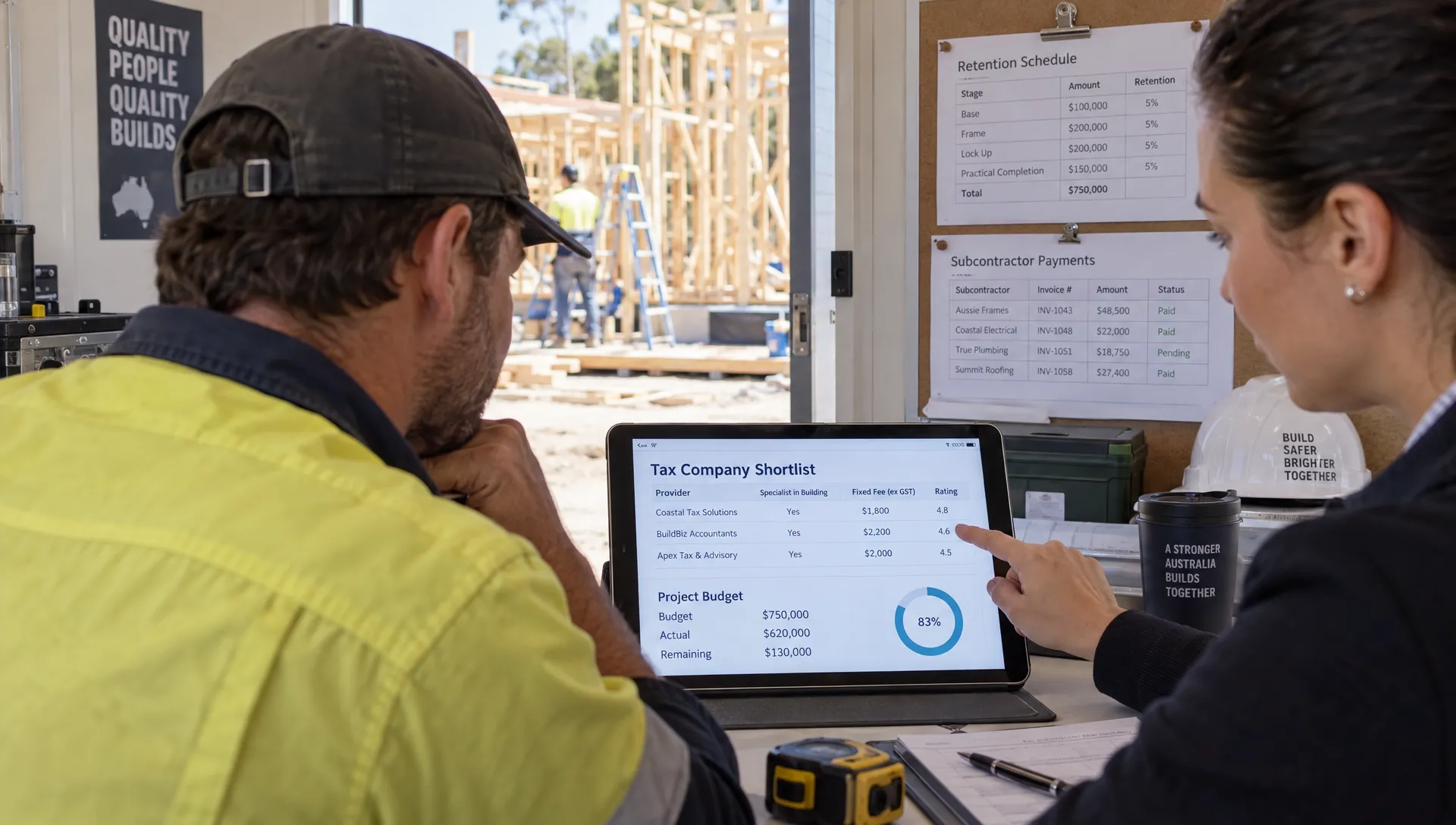
We judge digital transformation by the decisions it enables: identifying an underpriced variation, forecasting a BAS payment or recognising that a profitable contract will still require temporary funding.
How should we assess deductions, equipment purchases and FBT?
We ask the adviser to distinguish legitimate deductions from spending that merely reduces the bank balance. Buying equipment solely to obtain a deduction can weaken working capital, even where the expenditure qualifies for a tax concession.
For vehicles, tools and plant, we review ownership, business use, finance arrangements and the applicable depreciation rules. Instant asset write-off thresholds and eligibility settings can change, so we require confirmation for the relevant income year rather than relying on an old article or sales promotion.
We apply the same discipline to director benefits. A service such as medically supervised weight-management care illustrates why we separate the nature of a service from its Australian tax treatment. Company payment does not automatically establish deductibility or an FBT exemption. We assess private purpose, the recipient and any employment connection.
A suitable tax company in Australia should explain these distinctions clearly. We expect advice on both the tax treatment and the cash-flow effect, with supporting records retained before deductions or benefits are reported.
What should the engagement fee actually include?
We compare written scopes, not fee totals in isolation. A lower annual price may exclude precisely the work a builder needs during a difficult project or an expansion.
We ask for clear responsibility and frequency for each deliverable.
| Deliverable | What we clarify before signing |
|---|---|
| Bookkeeping and reconciliations | Which accounts are reconciled and how unresolved items are handled |
| BAS and income tax | Which entities and obligations are included |
| Construction reporting | Whether work in progress, retentions and job margins receive review |
| Payroll and subcontractors | Which processing, reporting and advisory tasks are covered |
| Strategic advisory | Whether cash-flow forecasts and management meetings are included |
| ATO correspondence | Whether enquiries, reviews and audit assistance attract additional fees |
| Transition and exit | Who controls records, software access and handover arrangements |
We compare “tax company australia” search results more effectively when each shortlisted firm prices the same scope. We also clarify response expectations, the review process for urgent decisions and the information our team must supply. An engagement works best when responsibilities are explicit on both sides.
Can we use a practical scenario to test strategic capability?
We recommend giving each shortlisted firm the same hypothetical building-business scenario. For example, management accounts show a $180,000 project margin, but the forecast omits $60,000 of remaining subcontractor costs. A separate retention balance is not expected to be collected until after the next BAS payment.
We would expect the adviser to separate the issues. The missing costs affect the forecast margin, while the retention affects cash availability. Neither issue can be resolved simply by applying a company tax percentage to the original $180,000 figure.
We then ask what information is needed before recommending action. A useful response should cover contractual commitments, recoverable variations, supplier payment dates, tax liabilities and available funding.
This exercise helps us identify a tax company in Australia that can convert bookkeeping into strategic advisory. We are testing whether the firm can challenge incomplete information, identify the commercial consequences and recommend a proportionate response, rather than produce an impressive-looking report.
What questions do builders commonly ask before appointing an adviser?
Should we choose a local firm or a national team? We prioritise construction expertise, accessibility and coordinated advice. Local knowledge matters for state-based obligations, while integrated national support helps businesses operating across borders. We ask how both needs will be addressed within one engagement.
What records should we prepare for an initial review? We assemble recent returns and BAS, financial statements, current contracts, progress claims, retention schedules, subcontractor details, payroll records and equipment finance documents. We also prepare a list of entities, outstanding ATO matters and upcoming commercial decisions.
Can we change advisers during the financial year? We can generally arrange a transition during the year, but we first confirm outstanding lodgements, access permissions, record ownership and responsibility for unfinished work. We plan the handover around critical deadlines rather than assuming everything transfers automatically.
Should the firm guarantee tax savings? We treat unconditional guarantees cautiously. We expect a tax company in Australia to explain available options, supporting evidence, commercial trade-offs and risks. A defensible recommendation is more valuable than a promised outcome that ignores the facts.
What next steps can we take with our team?
We suggest beginning with a focused review of the business rather than an immediate software change or restructure.
- Define the exposure: We identify the most pressing issues across project margins, cash flow, subcontractors and tax obligations.
- Prepare the evidence: We bring contracts, financial records and current forecasts together for a construction-specific assessment.
- Agree the scope: We distinguish routine compliance from the strategic advisory required to support corporate growth.
- Set the workflow: We establish reporting responsibilities, review points and appropriate automation controls.
At Perfect Accounting & Tax Services, we bring 25 years of professional experience to accounting, tax and strategic advisory. We support clients across Australia through integrated service capabilities in Adelaide, Sydney and Melbourne.
We invite builders, company directors and business owners to contact our team for a consultation. We can discuss the business’s priorities and how our AI-driven accounting workflows can support more accurate information, faster processing and better financial decisions.