

Dealing with the Australian Taxation Office (ATO) is rarely just an administrative task. For business owners, company directors, trustees and high-net-worth individuals, the way you respond to the ATO can affect cash flow, penalties, audit exposure, director risk and long-term financial strategy.
Whether you are responding to a BAS query, managing a tax debt, correcting a late return or preparing for an ATO review, the same principle applies: act early, respond accurately and keep control of the narrative.
Many professionals search for “tax office aus” when they need urgent help, but the real challenge is not finding the ATO. It is knowing how to engage with the ATO without triggering avoidable costs, delays or compliance escalation.
Below, we outline the practical steps we use when helping clients across Australia, including Adelaide, Sydney and Melbourne, deal with the ATO in a structured, compliant and commercially sensible way.
Why ATO communication should be handled strategically
The ATO uses extensive data-matching, Single Touch Payroll reporting, bank interest data, property records, superannuation information and third-party reporting to identify inconsistencies. This means many ATO enquiries are not random. They often arise because something in your lodgements, records or external data does not align.
For a business, that inconsistency may involve GST turnover, PAYG withholding, contractor payments, superannuation, Division 7A loans, trust distributions or omitted income. For investors and high-net-worth individuals, it may involve capital gains, rental property deductions, foreign income, crypto assets or private company arrangements.
The ATO’s published guidance makes it clear that taxpayers are expected to keep proper records and take reasonable care when preparing tax returns and activity statements. The ATO record keeping guidance is a useful starting point, but in practice, strong records are only one part of the equation.
A strategic response also requires:
- Understanding the exact issue the ATO is raising
- Confirming whether the ATO data is correct
- Reviewing the tax law position before replying
- Providing evidence in a clear, organised format
- Considering cash flow, penalties and future compliance risk
When we work with clients, we treat ATO engagement as a risk management exercise, not a simple correspondence task.
The most common costly mistakes when dealing with the ATO
Most ATO problems become expensive because they are handled too late or too casually. The following mistakes are particularly common among growing businesses, directors and investors managing complex affairs.
| Mistake | Why it becomes costly | Better approach |
|---|---|---|
| Ignoring ATO letters or portal messages | Deadlines may pass, penalties may accrue and matters may escalate | Review every ATO communication promptly and diarise response dates |
| Responding before checking the facts | Inaccurate answers can create further questions or expose new issues | Reconcile records first and respond with evidence |
| Lodging late because records are incomplete | Late lodgement penalties and interest may apply | Lodge on time where possible and maintain digital records throughout the year |
| Treating tax debt as a low-priority creditor | The ATO has strong debt recovery powers and can issue director penalty notices in certain cases | Engage early and negotiate based on realistic cash flow |
| Making voluntary disclosures without advice | Poorly framed disclosures may increase exposure or miss penalty reductions | Review the full position before approaching the ATO |
| Relying on manual bookkeeping | Errors in GST, payroll and income recognition may compound across periods | Use automated workflows with human review |
The key is not to panic. The ATO generally responds better to taxpayers who are organised, transparent and proactive. However, transparency does not mean rushing to provide incomplete or poorly considered information.
Step 1: Verify the ATO communication is legitimate
ATO impersonation scams remain a serious issue. Before acting on a phone call, SMS, email or payment demand, confirm that the communication is genuine.
The ATO provides guidance on how to verify or report a scam. In our experience, this is especially important for directors, payroll managers and finance teams who may receive urgent-looking messages about unpaid tax, TFN issues or refunds.
A legitimate ATO interaction should be verified through secure channels such as ATO online services, Online services for business, your registered tax agent or direct contact using contact details published on the ATO website. Avoid clicking links in unexpected emails or text messages.
If a communication is genuine, save a copy, record the date received and identify the response deadline. ATO matters should be managed through a controlled workflow, not ad hoc inbox handling.
Step 2: Identify what the ATO is actually asking for
ATO correspondence can appear broad, but there is usually a specific risk area behind it. Before responding, determine whether the ATO is asking about:
- A lodgement obligation, such as an overdue tax return, BAS or FBT return
- A payment issue, including unpaid income tax, GST, PAYG withholding or superannuation
- A discrepancy between your return and third-party data
- A review of deductions, income, GST credits or payroll obligations
- A formal audit, objection, amended assessment or penalty decision
This distinction matters because each category requires a different response strategy. For example, a BAS discrepancy may be resolved through transaction-level reconciliation, while an audit involving trust distributions or private company loans may require legal and tax technical analysis.
We generally begin by mapping the ATO request against the client’s lodgement history, accounting records, bank data, payroll reports and prior-year tax positions. This allows us to separate genuine errors from explainable timing differences or ATO data mismatches.
Step 3: Reconcile before you respond
One of the most expensive mistakes is responding to the ATO based on assumptions. Before providing explanations, reconcile the underlying numbers.
For businesses, this may include reviewing:
- GST collected and GST credits claimed
- BAS lodgements compared with profit and loss reports
- PAYG withholding compared with Single Touch Payroll reporting
- Superannuation guarantee obligations and payment dates
- Contractor payments and Taxable payments annual report obligations
- Loan accounts, director drawings and related-party transactions
For individuals and investors, this may include reviewing capital gains, rental property expenses, dividend income, managed fund tax statements, foreign income and private health insurance details.
This is where digital systems create a material advantage. Our AI-driven accounting workflows help identify anomalies across bank feeds, ledger coding, GST classifications and payroll data before they become ATO issues. Automation does not replace professional judgement, but it gives us faster visibility and a cleaner evidence base.
The result is a stronger response. Instead of replying with broad explanations, we can provide reconciled figures, supporting documents and a clear technical position.

Step 4: Do not ignore tax debt
Tax debt should be managed with the same discipline as bank debt, supplier debt or investor obligations. Ignoring ATO debt can lead to general interest charge, garnishee action, disclosure to credit reporting bureaus in certain circumstances and director penalty notices for some company debts.
The ATO provides information about payment plans and support options. However, a payment plan should not be based on optimism. It should be based on cash flow forecasts, current liabilities and realistic trading conditions.
Before approaching the ATO about a tax debt, we usually assess:
- Total ATO liabilities by account and tax type
- Upcoming BAS, PAYG, income tax and superannuation obligations
- Current debtor collections and creditor pressure
- Working capital requirements
- Whether the business is solvent and able to trade responsibly
- Whether directors face personal exposure for company tax debts
For company directors, timing is critical. If PAYG withholding, GST or superannuation guarantee charge liabilities are involved, you should seek professional advice promptly. Director penalty rules are complex and can have personal consequences.
A well-supported ATO payment arrangement can preserve cash flow and reduce escalation risk. A poorly prepared arrangement can fail quickly and damage credibility.
Step 5: If you made an error, correct it properly
Errors happen. The question is how quickly and accurately they are corrected.
The ATO has guidance on correcting GST errors and amending returns. In some cases, voluntary disclosure can reduce penalties, particularly where the disclosure is made before the ATO commences review activity.
However, voluntary disclosure should be prepared carefully. A disclosure should explain what happened, quantify the error, identify the affected periods and provide a clear correction method. It should also consider whether the issue affects other taxes, such as income tax, GST, PAYG withholding, FBT or superannuation.
For example, an incorrectly classified contractor arrangement may not only affect GST credits. It may also raise PAYG withholding, superannuation guarantee and payroll tax considerations, depending on the facts and state-based rules.
We recommend reviewing the broader tax profile before making any correction. Fixing one lodgement while leaving related issues unresolved may simply invite further scrutiny later.
Step 6: Keep records that can withstand review
The ATO generally expects taxpayers to keep records for five years, although some records may need to be kept longer depending on the transaction, asset or structure. Good records should explain what occurred, when it occurred, who was involved and how the tax position was calculated.
For business owners and directors, effective records include more than invoices and receipts. They include contracts, bank statements, payroll reports, superannuation payment confirmations, board minutes, loan agreements, trust resolutions, asset registers and working papers.
For property investors, records should support acquisition costs, borrowing costs, repairs, improvements, rental income, depreciation schedules and capital gains tax calculations.
For high-net-worth individuals, additional documentation may be needed for private company arrangements, family trusts, offshore assets, SMSFs, philanthropic structures and inter-entity loans.
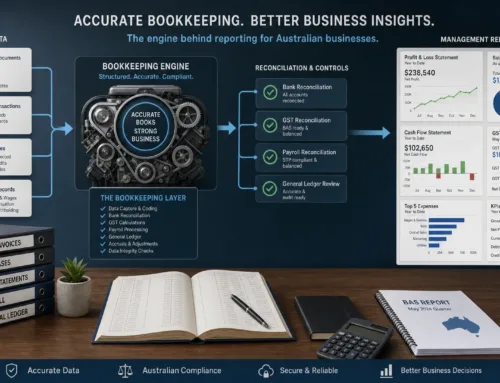
Our approach is to build record keeping into the operating system of the business. Cloud accounting, document capture, automated coding, approval workflows and real-time dashboards make compliance less reactive. More importantly, they turn bookkeeping into a foundation for strategic advisory, tax planning and corporate growth.
Step 7: Know when to engage a registered tax agent
Not every ATO matter requires specialist intervention. Routine queries can often be resolved quickly if the records are clean. However, professional support is strongly recommended when the issue involves material tax, multiple years, complex structures or potential penalties.
You should consider engaging a registered tax agent or specialist adviser if you are dealing with:
- An ATO audit or formal review
- Significant tax debt or a failed payment arrangement
- Late tax returns across multiple years
- Director penalty notices or company solvency concerns
- Trust distributions, Division 7A or related-party loans
- SMSF compliance issues
- Property development, capital gains or GST margin scheme questions
- Cross-border income, foreign investors or expats
- Payroll, superannuation guarantee or contractor classification issues
A registered tax agent can communicate with the ATO on your behalf, review the technical position, prepare amended lodgements and manage deadlines. Where legal advice is required, we can also work alongside appropriately qualified legal professionals.
The objective is not to create distance between you and the ATO. It is to ensure the communication is accurate, complete and strategically sound.
Step 8: Use technology to prevent future ATO problems
The best ATO strategy is prevention. Modern tax compliance is increasingly data-driven, and businesses relying on manual spreadsheets are exposed to avoidable risk.
AI and automation can materially improve compliance quality by identifying unusual transactions, missing invoices, GST coding errors, payroll anomalies and late superannuation payments. When combined with experienced accounting oversight, automation gives directors and business owners better control over their financial position.
| Compliance area | Traditional risk | Technology-enabled control |
|---|---|---|
| BAS preparation | GST errors discovered after lodgement | Real-time GST coding checks and reconciliation |
| Payroll | PAYG and superannuation issues identified late | Automated payroll reporting and exception alerts |
| Tax planning | Decisions made after year-end | Forecasting and scenario modelling during the year |
| ATO queries | Slow document retrieval | Centralised digital records and audit-ready workpapers |
| Cash flow | Tax debts discovered after liabilities build up | Live dashboards and rolling cash flow forecasts |
For growth-focused businesses, this is where compliance becomes strategic. Clean financial data supports better tax planning, funding decisions, pricing, hiring, acquisitions and succession planning.
We do not view automation as a cost-cutting tool alone. We view it as a way to give decision-makers faster visibility and reduce the risk of costly tax surprises.
Step 9: Prepare carefully for an ATO audit or review
If the ATO commences a review or audit, your first response is critical. Do not provide a rushed explanation or send large volumes of unfiltered documents. A better approach is to establish scope, review the relevant records and respond in an organised manner.
A structured audit response should include:
- A clear understanding of the tax periods under review
- Identification of the taxes involved
- A document request register
- Reconciled workpapers for the relevant accounts
- A timeline of key events
- A technical position on disputed issues
- A record of all ATO communications
Tone also matters. ATO officers are more likely to progress matters efficiently when they receive organised evidence and direct answers. Defensive or vague responses often increase scrutiny.
If the ATO issues an amended assessment or penalty decision that you disagree with, objection rights may be available. Time limits apply, so advice should be obtained promptly. The ATO provides information on disputing or objecting to decisions, but the strength of an objection depends heavily on evidence and technical analysis.
Step 10: Align ATO management with broader business strategy
ATO compliance should not sit in isolation from business strategy. If your business is growing, restructuring, seeking finance, expanding interstate or preparing for sale, tax compliance becomes part of enterprise value.
A buyer, lender or investor will often look closely at BAS lodgements, tax debts, payroll compliance, superannuation payments, related-party balances and historical tax positions. Unresolved ATO issues can delay transactions, reduce valuations or create warranty risks.
For property developers, construction firms, medical practices, technology companies, hospitality groups, logistics businesses and professional service firms, the tax profile can also shape cash flow and risk appetite. The same applies to SMSF trustees, family groups and high-net-worth investors with complex structures.
Our team supports clients across Australia with integrated accounting, tax and advisory capabilities in Adelaide, Sydney and Melbourne. This national perspective is important for groups operating across state borders, managing multiple entities or dealing with both federal tax and state-based compliance obligations.
A practical ATO response framework
When a client comes to us with an ATO issue, we use a disciplined framework to move from uncertainty to control.
| Stage | What we do | Strategic outcome |
|---|---|---|
| Triage | Verify the ATO communication and identify deadlines | Prevent missed responses and escalation |
| Diagnosis | Review lodgements, ledgers, bank data and ATO accounts | Identify the true source of the issue |
| Reconciliation | Match accounting records to tax returns, BAS and payroll data | Build an evidence-based position |
| Response | Prepare clear ATO correspondence or disclosure | Reduce ambiguity and manage risk |
| Negotiation | Discuss payment plans, remission or resolution options where appropriate | Protect cash flow and credibility |
| Prevention | Implement automated workflows and reporting controls | Reduce future ATO exposure |
This framework is especially valuable when the issue is urgent. It ensures the response is fast, but not careless.
Frequently Asked Questions
What should I do first if I receive a letter from the ATO? Verify that the communication is genuine, note the response deadline and review the exact issue raised. Do not ignore it, and do not respond before checking your records.
Can the ATO negotiate a payment plan? In many cases, the ATO may consider a payment arrangement, but it must be realistic and supported by your cash flow position. Businesses should also remain current with new lodgement and payment obligations.
Should I call the ATO myself or use a tax agent? For simple matters, you may be able to contact the ATO directly. For audits, significant tax debts, late lodgements, director risk or complex structures, we recommend using a registered tax agent.
Will voluntary disclosure reduce penalties? It may reduce penalties in some circumstances, especially if made before ATO review activity begins. The disclosure should be accurate, complete and supported by evidence.
How can automation help with ATO compliance? Automation can improve GST coding, payroll accuracy, document capture, reconciliations and real-time reporting. When combined with professional review, it reduces error risk and gives business owners better financial visibility.
Next steps: how we can help
If you are dealing with the ATO, the most important step is to regain control before the matter escalates. Our team at Perfect Accounting & Tax Services brings 25 years of professional experience across tax, accounting, audit response, strategic advisory and digital transformation.
We help businesses, directors, investors and high-net-worth individuals across Australia, including Adelaide, Sydney and Melbourne, manage ATO correspondence, late lodgements, tax debt, BAS issues, payroll compliance, SMSF matters and complex tax planning.
We also help clients modernise their accounting workflows through AI-driven automation, giving them faster reporting, stronger controls and better visibility over tax obligations before problems arise.
If you have received an ATO letter, have overdue lodgements or want to strengthen your compliance systems, contact our team for a confidential consultation. We can help you assess the risk, respond strategically and build a cleaner, more resilient financial framework for the future.