

A tax return is more than an annual formality. For business owners, company directors, investors and high-net-worth individuals, it is a structured financial statement to the ATO that confirms how income, deductions, tax offsets and credits translate into a refund, a tax debt or a carried-forward position.
When people search for “tax return what is it”, they often want a simple definition. The more strategic answer is this: a tax return is a compliance document, but it is also a financial health check. It reveals whether your records are accurate, your tax planning is proactive, and your business has the right systems to support growth.
In our work with clients across Australia, including Adelaide, Sydney and Melbourne, we treat tax returns as the end result of a much broader financial process. The quality of the return depends on the quality of the bookkeeping, payroll, BAS, asset records, loan documentation and advisory work behind it.
What is a tax return in Australia?
A tax return is a formal lodgement with the Australian Taxation Office that reports assessable income, allowable deductions, tax offsets, PAYG credits and other relevant tax information for a financial year.
For most Australian taxpayers, the financial year runs from 1 July to 30 June. The return allows the ATO to calculate whether the taxpayer has:
- Paid the correct amount of tax
- Overpaid tax and is entitled to a refund
- Underpaid tax and has an amount payable
- Outstanding compliance matters that require attention
For individuals, a tax return may include salary and wages, investment income, rental property income, capital gains, work-related deductions, donations, private health insurance information and Medicare levy adjustments.
For companies, trusts, partnerships and SMSFs, the return is more detailed. It may include business income, trading stock, depreciation, director loans, distributions, franking credits, related-party transactions, GST interactions, payroll obligations and capital gains tax events.
The ATO’s tax return guidance explains the basic lodgement process for individuals, while business entities must consider broader reporting and governance obligations.
Who needs to lodge a tax return?
Not every person or entity has the same lodgement requirements. However, many Australians and Australian entities must lodge a return where they earn taxable income, operate a business, hold investments or have specific reporting obligations.
| Taxpayer type | Common tax return considerations |
|---|---|
| Employees and professionals | Salary, allowances, deductions, investment income, Medicare levy, HELP debts |
| Sole traders and freelancers | Business income, expenses, GST status, motor vehicle costs, home office costs, superannuation |
| Companies | Company income, deductions, Division 7A, loans, depreciation, tax losses, franking account activity |
| Trusts | Distributions, beneficiary statements, capital gains, streaming, trustee resolutions |
| Partnerships | Partnership income, partner shares, business deductions, GST and payroll links |
| SMSFs | Fund income, member balances, pension compliance, contributions, investment records |
| Property investors | Rental income, interest deductions, repairs, depreciation, capital works, CGT records |
The obligation to lodge is not always obvious. For example, a company may need to lodge even if it has not traded. A high-income individual may need to lodge due to investment income, capital gains or private health insurance adjustments. An SMSF must generally lodge an annual return and meet audit requirements.
This is why we recommend confirming lodgement obligations before the due date, particularly where a business has changed structure, acquired property, sold assets, expanded interstate or received foreign income.
What information goes into a tax return?
A well-prepared tax return draws from multiple financial systems and source documents. The return itself is the final output, but the accuracy depends on the underlying evidence.
For business owners and directors, the most important inputs often include accounting records, bank transactions, invoices, loan statements, asset registers, payroll records, superannuation records, BAS lodgements and year-end reconciliations.
For individuals with complex affairs, the relevant documents may include annual payment summaries or income statements, dividend statements, managed fund tax statements, rental property schedules, cryptocurrency transaction reports, foreign income records and capital gains calculations.
The ATO receives significant pre-fill data from employers, banks, health funds, share registries and government agencies. However, pre-fill information is not a substitute for professional review. It can be incomplete, delayed or misclassified, especially for business owners, investors and people with multiple income sources.
Why does a tax return matter?
A tax return matters because it affects compliance, cash flow, lending capacity, risk management and long-term wealth strategy. It is not simply about whether you receive a refund.
It confirms your compliance position
The ATO expects taxpayers to lodge accurate returns by the required due dates. Late lodgement, incorrect reporting and unsupported deductions can lead to penalties, general interest charge and increased scrutiny.
For company directors, compliance has a governance dimension. Tax debts, unpaid superannuation, inaccurate BAS lodgements and payroll errors can affect director risk and business reputation. A properly prepared tax return helps identify these issues before they become larger problems.
It influences cash flow
Tax outcomes directly affect cash flow. A refund can release working capital, while a tax payable requires planning. For growing businesses, tax liabilities often increase as profitability improves. Without forecasting, this can create stress even when the business is performing well.
We often see profitable businesses run into difficulty because tax planning happens too late. A tax return prepared after year-end is necessary, but real control comes from monitoring profit, PAYG instalments, GST, payroll tax exposure and superannuation obligations throughout the year.
It supports financing and investment decisions
Banks, lenders, investors and business buyers often rely on tax returns and financial statements to assess income, profitability and serviceability. For property investors and business owners, clean tax records can support finance applications and strategic acquisitions.
A tax return that aligns with management accounts, BAS lodgements and bank activity gives external stakeholders greater confidence. In contrast, inconsistent records can slow down lending, due diligence and business sale processes.
It creates a foundation for strategic advisory
A tax return shows what happened. Advisory work interprets what should happen next.
Once the return is prepared, we can assess trends in margins, overheads, debt levels, asset purchases, tax structures and working capital. That information can support decisions about business expansion, restructuring, succession planning, SMSF strategy, investment holding entities and risk management.
This is where accounting moves from compliance to corporate growth.
Tax return vs BAS: what is the difference?
A tax return and a Business Activity Statement are related, but they are not the same.
A BAS is generally used to report GST, PAYG withholding, PAYG instalments and other obligations during the year. A tax return reports annual income tax outcomes after the financial year ends.
| Lodgement | Main purpose | Common frequency | Typical users |
|---|---|---|---|
| Tax return | Reports annual taxable income and calculates final tax position | Annual | Individuals, companies, trusts, partnerships, SMSFs |
| BAS | Reports GST, PAYG withholding and PAYG instalments | Monthly, quarterly or annually depending on circumstances | GST-registered businesses and employers |
| Payroll reporting | Reports employee wages, PAYG withholding and superannuation data | Ongoing through Single Touch Payroll | Employers |
| SMSF annual return | Reports SMSF tax and regulatory information | Annual | SMSF trustees |
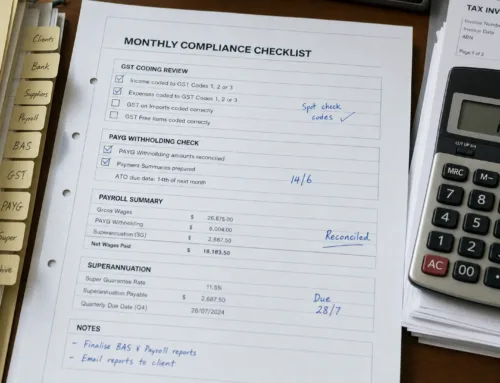
For businesses, BAS preparation should never be treated as isolated data entry. If GST coding, payroll allocation or director payments are handled incorrectly during the year, the annual tax return becomes harder, slower and riskier.
Our preferred approach is to use automated accounting workflows, bank feeds, document capture and AI-supported exception checks throughout the year. This improves BAS accuracy and creates cleaner year-end tax data.
Common tax return mistakes we see
Even sophisticated taxpayers can make errors when systems, documentation and advice are not aligned. Common issues include claiming deductions without evidence, mixing private and business expenses, overlooking capital gains tax events, incorrectly treating contractors, failing to reconcile GST, and not recording director loans correctly.
Property investors can also encounter issues with repairs versus capital improvements, interest apportionment, depreciation schedules and loan redraws. SMSF trustees may face problems with contribution caps, pension minimums, related-party transactions or investment strategy documentation.
For businesses, one of the most expensive mistakes is treating tax as an annual event. By the time the return is being prepared, some planning opportunities may already be limited. For example, timing of asset purchases, trust distributions, superannuation contributions and bad debt write-offs usually requires action before 30 June.
The ATO record-keeping rules make it clear that businesses need reliable records to support their tax position. From our perspective, good records are also the raw material for better decision-making.
How digital transformation improves tax return accuracy
Modern tax compliance is increasingly data-driven. The ATO has expanded data matching across payroll, banks, property, shares, cryptocurrency platforms and government sources. That means errors are more visible than they were a decade ago.
For business owners, digital transformation is no longer optional. Automated accounting systems can reduce manual processing, improve transaction coding, centralise supporting documents and provide real-time visibility over profit, GST, payroll and tax liabilities.
Our team uses AI-driven processes to help identify anomalies, missing records and classification issues earlier. Human review remains essential, particularly for judgement-based tax matters, but automation improves speed and consistency.
This combination is powerful. Automation handles volume and pattern recognition. Experienced accountants handle interpretation, tax law, commercial judgement and strategic planning.

When should you start preparing your tax return?
The best time to prepare for a tax return is before the financial year ends. This is especially important for companies, trusts, SMSFs, property investors and high-income individuals.
A strong year-end process should include reviewing profit, checking debtors and creditors, reconciling GST, confirming superannuation payments, reviewing asset purchases, assessing tax losses, considering trust distribution resolutions and identifying any capital gains tax events.
For individuals with simpler tax affairs, preparation may begin after income statements are finalised and pre-fill data is available. However, anyone with business income, investments, rental properties, foreign income or capital gains should take a more proactive approach.
Registered tax agents may have access to extended lodgement programs for eligible clients. However, extensions should not be confused with planning. A later lodgement date does not remove the need to forecast tax liabilities and maintain records during the year.
What happens after a tax return is lodged?
After lodgement, the ATO processes the return and issues a notice of assessment for individuals and some entities. The notice confirms the tax outcome, including any refund or amount payable.
For businesses, the post-lodgement stage should trigger a review. We recommend assessing whether the result matched expectations, whether PAYG instalments are appropriate, whether cash flow forecasts need updating and whether the accounting system produced reliable year-end data.
If the ATO asks questions or initiates a review, the quality of documentation becomes critical. Good tax governance means being able to explain and substantiate positions, not just lodge forms.
How we approach tax returns strategically
We see the tax return as one component of a broader financial management system. Our process is designed to help clients lodge accurately while improving visibility, governance and decision-making.
For business owners and directors, this typically means connecting bookkeeping, BAS, payroll, tax planning and advisory into one integrated workflow. For investors and high-net-worth individuals, it means aligning tax compliance with asset protection, cash flow, estate planning considerations and long-term wealth strategy.
Across Adelaide, Sydney, Melbourne and nationally, our team supports clients with corporate and SME accounting, advanced tax planning, SMSF compliance, virtual CFO services and AI-enabled workflow automation.
The objective is not simply to complete a return. The objective is to convert financial data into a strategic asset.
Practical next steps before lodging
Before your next tax return is prepared, we recommend taking a structured approach. This reduces errors and gives your adviser the information needed to identify planning opportunities.
- Confirm your lodgement obligations for all individuals and entities in your group
- Reconcile bank accounts, loans, GST, payroll and superannuation records
- Review asset purchases, disposals and depreciation schedules
- Separate private, business and investment expenses clearly
- Gather evidence for deductions, rental properties, capital gains and foreign income
- Check whether your accounting software is producing reliable real-time reports
- Speak with your adviser before 30 June if restructuring, distributions or major transactions are being considered
These steps are simple, but they have a material effect on accuracy, turnaround time and tax planning quality.
Frequently Asked Questions
What is a tax return in simple terms? A tax return is a formal report lodged with the ATO that shows your income, deductions, tax offsets and credits for a financial year. The ATO uses it to calculate whether you receive a refund or have tax payable.
Is a tax return the same as a BAS? No. A BAS reports obligations such as GST, PAYG withholding and PAYG instalments during the year. A tax return reports annual taxable income and final income tax outcomes.
Do companies need to lodge tax returns if they made no profit? In many cases, yes. A company may still have a lodgement obligation even if it made a loss or did not trade. The correct position depends on the company’s circumstances and ATO requirements.
Can I rely only on ATO pre-fill data? We do not recommend relying only on pre-fill data if you have business income, investments, rental properties, capital gains, foreign income or complex deductions. Pre-fill data may be incomplete or may not reflect the correct tax treatment.
Why should I use a tax adviser instead of lodging myself? A tax adviser can help identify risks, ensure deductions are supported, manage complex structures and connect compliance with broader planning. For business owners and investors, the value often lies in strategy, not just lodgement.
How we can help
If your tax return is treated as a once-a-year task, you may be missing opportunities to improve cash flow, reduce risk and make better commercial decisions. We help clients build a stronger financial operating system, where bookkeeping, BAS, payroll, tax planning and advisory work together.
Our team provides expert tax and accounting services across Australia, with integrated support in Adelaide, Sydney and Melbourne. We combine experienced professional judgement with AI-driven automation to improve accuracy, speed and real-time financial visibility.
If you are a business owner, company director, investor or high-net-worth individual, we invite you to contact our firm for a consultation. We can review your current tax position, assess your accounting workflows and show you how automated financial systems can support compliance, strategic advisory and corporate growth.