

Business owners rarely miss tax deductions because they do not care about tax. They miss them because the evidence is scattered across bank feeds, personal cards, inboxes, payroll files, project platforms, and supplier portals.
That is a systems problem, not just a tax problem.
When we review tax deductions in Australia for growing businesses, the most valuable opportunities often sit in ordinary transactions that were coded incorrectly, treated as private by default, or not reviewed before 30 June. The objective is not to push the boundaries. It is to identify legitimate, ATO-compliant deductions that improve cash flow, strengthen records, and support better business decisions.
Below are the deductions our team sees business owners, company directors, and high-net-worth individuals commonly overlook, along with the records and strategic considerations that matter.
The core ATO test for business deductions
Before looking at specific deductions, we start with the fundamentals. Under ATO guidance on business deductions, a business expense generally needs to be connected to earning assessable income, not private or domestic in nature, and supported by adequate records.
For companies, trusts, partnerships, and sole traders, the same commercial discipline applies: the deduction must have a business purpose, the timing must be correct, and private use must be apportioned.
The practical rules are straightforward:
- Keep invoices, receipts, contracts, logbooks, diary notes, and working papers for at least five years where required.
- Separate business and private use, especially for vehicles, phones, internet, home office costs, and travel.
- Treat GST correctly, because if you claim a GST credit in your BAS, the income tax deduction is generally for the GST-exclusive amount.
- Distinguish immediate deductions from capital expenses that must be depreciated over time.
- Review deductions before 30 June, because timing can affect whether a deduction falls into the current financial year.
This is where digital record-keeping becomes critical. Our AI-driven accounting workflows help clients improve transaction classification, flag unusual GST coding, match source documents, and identify deductible patterns earlier in the year, rather than after the opportunity has passed.
1. Prepaid expenses and annual subscriptions
Prepaid expenses are frequently missed because they look like ordinary supplier payments. Common examples include annual software subscriptions, insurance premiums, professional memberships, cloud storage, domain renewals, and service retainers.
For small business entities, certain prepaid expenses may be immediately deductible if the eligible service period is 12 months or less and ends in the next income year. Larger businesses may need to apportion the deduction over the relevant service period.
The strategic point is timing. If your business renews insurance, SaaS tools, industry licences, or data platforms close to year-end, review whether the payment has been correctly treated. A simple coding error can defer a valid deduction unnecessarily.
2. Bad debts that have genuinely been written off
Unpaid invoices can affect cash flow twice. First, you do not get paid. Second, if the income has already been recognised, you may still be carrying the tax impact unless the debt is properly reviewed.
A bad debt deduction is not automatic simply because an invoice is overdue. The debt generally needs to be genuinely bad, previously included in assessable income, and written off in your accounts before year-end.
We often recommend a structured debtor review before 30 June. This review should identify:
- Invoices that are commercially unrecoverable.
- Evidence of collection attempts.
- Insolvency, dispute, or abandonment indicators.
- Board, director, or management approval to write off the debt.
For businesses with large debtor ledgers, automation can materially improve this process. Aged receivables analysis, payment pattern review, and exception reporting can help directors make faster, better-documented decisions.
3. Superannuation paid on time
Superannuation is one of the most important deductions to manage by date, not intention. Employer super contributions are generally deductible when paid, provided the contribution reaches the employee’s super fund by the required time and other conditions are met.
For the 2025-26 financial year, the super guarantee rate is 12%. The ATO super payment due dates are strict, and late payments can create both compliance and deductibility issues.
Business owners often miss deductions because they process super too close to 30 June. Payment through a clearing house can take time. If the contribution does not reach the fund before year-end, the deduction may not fall into the intended financial year.
For company directors and family businesses, this is also a governance issue. Super should be reconciled to payroll, Single Touch Payroll reporting, and cash flow forecasts. We treat super as part of the broader financial control environment, not just a payroll task.
4. Motor vehicle expenses with proper apportionment
Vehicles remain one of the most reviewed deduction areas. The opportunity is real, but so is the ATO scrutiny.
Business owners commonly underclaim when they use a personal vehicle for genuine business travel, or overclaim when they fail to separate private use. The correct approach depends on the structure, ownership, and usage pattern.
The ATO guidance on motor vehicle expenses covers methods and record requirements. In practice, useful records include logbooks, odometer readings, fuel receipts, finance documents, service invoices, insurance, registration, and toll records.
For companies, vehicle use can also trigger FBT considerations. A deduction may be available, but the FBT outcome can change the total tax position. That is why we review motor vehicles across income tax, GST, BAS, FBT, payroll, and director usage rather than in isolation.
5. Home office and remote work costs
Many business owners work from home after hours, between client meetings, or while managing interstate operations. Yet home office deductions are often ignored because they feel too small or difficult to calculate.
For sole traders and home-based businesses, deductible costs may include a business portion of electricity, internet, phone, depreciation on office furniture, stationery, and occupancy costs in limited circumstances. For employees and directors, reimbursement arrangements, allowances, and FBT treatment need careful structuring.
The ATO working from home expenses rules require adequate evidence. Diaries, timesheets, floor area calculations, and itemised bills may all be relevant depending on the claim method.
The strategic issue is not only the deduction. If your leadership team is working remotely, the business may also need stronger document management, cyber controls, workflow automation, and approval processes. A home office deduction can reveal a broader operational need.
6. Professional fees, tax advice, and strategic advisory costs
Professional fees are often miscoded as general administration or excluded because they relate to planning rather than day-to-day operations.
Depending on the nature of the advice, businesses may be able to deduct costs for accounting, bookkeeping, tax return preparation, BAS support, payroll compliance, audit assistance, legal review, business consulting, and financing advice. Some costs may be capital in nature, particularly where they relate to acquiring, disposing of, or restructuring a business or asset.
This distinction matters. A virtual CFO engagement that supports cash flow forecasting, performance reporting, board packs, KPI design, and growth planning may be deductible where connected to ongoing business operations. By contrast, legal or advisory fees linked to a capital transaction may need different treatment.
We recommend coding advisory fees by purpose, not only by supplier. That gives directors clearer visibility over compliance costs, growth investment, financing activity, and transaction-related expenditure.
7. Training, conferences, and industry education
Training deductions are often missed by professional services firms, trade businesses, medical practices, technology companies, and creative agencies.
If education maintains or improves skills used in the current business, or is directly connected to income-producing activities, it may be deductible. Examples include industry conferences, CPD programs, software training, cyber security workshops, leadership development, technical courses, and professional seminars.
The risk is claiming education that is too remote from the current business activity or relates to a new income-earning field. For directors and owners, the commercial rationale should be documented. A short file note explaining how the training supports current business operations can be valuable if reviewed later.
For technology-focused businesses, we also look at whether training supports automation, AI adoption, data governance, and system implementation. These are not just staff development costs. They can be part of a broader digital transformation strategy.
8. Software, automation, and cloud technology
Digital tools are now core operating infrastructure. Yet subscriptions are often spread across personal cards, app stores, and department-level accounts, which makes them easy to miss.
Common deductible technology costs may include accounting software, CRM platforms, project management tools, cybersecurity subscriptions, cloud storage, e-commerce plugins, payment gateway fees, website hosting, digital signing tools, AI workflow tools, and data analytics platforms.
The tax treatment depends on whether the cost is subscription-based, capital in nature, bundled with implementation, or part of a larger software development project. Some expenses may be immediately deductible. Others may need to be depreciated or treated under specific software rules.
This is an area where automation delivers a direct tax benefit. When supplier feeds, card transactions, and invoice capture are integrated, deductible digital spend becomes visible in real time. That improves both tax accuracy and management reporting.
9. Depreciating assets and small business concessions
Business owners frequently miss deductions for assets because they assume the full cost is either immediately deductible or not deductible at all. The correct treatment sits in between.
Assets such as laptops, tools, machinery, medical equipment, cameras, furniture, phones, and commercial appliances may need to be depreciated over their effective life. Eligible small businesses may access simplified depreciation rules, including pooling and instant asset write-off where legislated conditions are met.
The ATO simplified depreciation rules should be checked carefully because thresholds and eligibility rules can change. Temporary full expensing has ended, so relying on outdated rules can create material errors.
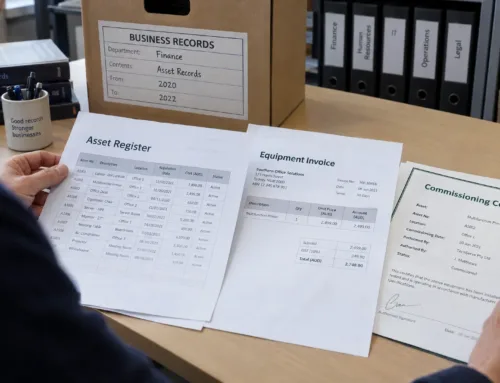
We recommend maintaining an asset register that includes purchase date, cost, GST treatment, business use percentage, location, depreciation method, and disposal details. For multi-site businesses in Adelaide, Sydney, Melbourne, and regional operations, asset tracking is especially important.
10. Repairs, maintenance, and replacement costs
Repairs are often deductible when they restore an asset to its previous condition. Improvements are generally capital and may need to be depreciated or added to the cost base of an asset.
This distinction is significant for property investors, construction firms, hospitality groups, manufacturers, clinics, and transport operators. Replacing a broken part may be deductible. Upgrading to a materially better system may be capital.
The timing also matters. Repairs that relate to damage existing at the time an asset was acquired can be treated differently from repairs arising during your ownership and business use.
We usually ask three questions: what was the asset like before the work, what changed after the work, and why was the work performed? The answers determine whether the cost is a repair, improvement, replacement, or capital project.
11. Bank fees, interest, and borrowing costs
Financing costs are regularly underclaimed, especially where businesses use multiple loans, credit cards, overdrafts, equipment finance, or director-funded arrangements.
Potential deductions may include business loan interest, merchant fees, account keeping fees, payment platform charges, line fees, and certain borrowing expenses. However, the purpose of the borrowing is critical. If a loan funds both business and private use, the interest must be apportioned.
For high-net-worth individuals and private groups, we also review related-party loans, Division 7A exposure, trust distributions, and director loan accounts. A deduction for interest is only one part of the overall risk profile.
Accurate loan coding supports more than tax compliance. It improves debt visibility, covenant monitoring, cash flow planning, and capital allocation decisions.
12. Insurance premiums
Insurance is a common missed deduction because policies are renewed annually and sometimes paid from personal accounts.
Deductible business insurance may include professional indemnity, public liability, cyber insurance, management liability, workers compensation, business interruption, commercial vehicle insurance, landlord insurance for income-producing property, and equipment cover.
Life insurance, trauma insurance, and income protection require careful review because deductibility depends on ownership, purpose, and policy structure. For business owners, the tax outcome should be aligned with asset protection, succession planning, and estate planning.
13. Marketing, website, and client acquisition costs
Marketing costs are generally deductible where incurred to promote the business. This may include advertising, SEO, social media campaigns, photography, copywriting, design, sponsorships, signage, email marketing platforms, and lead generation services.
Website costs need more analysis. Hosting, maintenance, and content updates may be deductible. Larger website builds, e-commerce platforms, and custom software functionality may be capital or subject to specific depreciation treatment.
For growth-focused businesses, this is where tax and strategy intersect. Marketing spend should not only be deductible. It should be measurable. We prefer to connect marketing costs to revenue channels, customer acquisition cost, conversion rates, and gross margin, so the deduction is part of a broader performance conversation.
14. FBT-exempt work-related items
Fringe Benefits Tax is often viewed only as a risk area. It can also be an opportunity when structured correctly.
Certain portable electronic devices and work-related items may be exempt from FBT where conditions are met. This can include items such as laptops, tablets, mobile phones, protective clothing, tools of trade, and computer software used primarily for work.
The details matter. The item must be connected to employment duties, and duplicate items can create issues unless an exception applies. For small businesses, there may be broader flexibility in some circumstances.
A proper FBT review before year-end can identify deductible costs, exempt benefits, reportable fringe benefits, and areas where salary packaging could be improved.
15. Industry-specific deductions
Generic deduction lists often fail because industries operate differently. A veterinary clinic, SaaS company, residential property investor, civil construction firm, and medical specialist practice will not have the same deduction profile.
Here are examples we commonly review:
| Business type | Deductions often missed | Key evidence to retain |
|---|---|---|
| Tradies and construction firms | Tools, protective equipment, vehicle running costs, licences, safety training | Invoices, logbooks, site records, licence renewals |
| Medical and allied health practices | Professional indemnity, CPD, clinical software, equipment depreciation | Membership records, training certificates, asset register |
| E-commerce businesses | Platform fees, freight, packaging, payment gateway charges, product photography | Supplier invoices, platform reports, merchant statements |
| Property investors and landlords | Repairs, agent fees, loan interest, insurance, quantity surveyor reports | Rental statements, loan documents, work descriptions |
| Technology and SaaS companies | Cloud infrastructure, developer tools, cyber security, R&D-related records | Subscription invoices, project records, technical documentation |
| Professional services firms | CPD, professional memberships, research tools, home office costs | Membership invoices, diaries, usage records |
The key is building a deduction framework around how your business actually earns income. That is why our team reviews the operating model first, then the general ledger.
Common traps that reduce valid deductions
The biggest deduction risk is not missing one invoice. It is having a weak system that produces unreliable numbers.
We regularly see these issues:
- GST being claimed in the BAS and again included in the income tax deduction.
- Private expenses paid by a company and posted to deductions instead of a director loan account.
- Entertainment expenses claimed without considering FBT and deductibility limits.
- Capital improvements incorrectly treated as repairs.
- Superannuation accrued but not paid on time.
- Motor vehicle deductions claimed without logbooks or proper business-use evidence.
- Software and asset purchases coded inconsistently across multiple entities.
The ATO increasingly relies on data matching, industry benchmarks, and digital records. A deduction strategy must therefore be defensible, not just optimistic.
How automation helps capture deductions earlier
A modern accounting workflow should do more than record history. It should detect risk, highlight opportunities, and give directors real-time financial visibility.
Our AI-driven approach to accounting and tax workflow helps businesses move from reactive tax preparation to proactive financial management. Well-designed automation can assist with supplier recognition, recurring subscription detection, GST coding review, document matching, payroll reconciliation, and exception reporting.
This matters because missed deductions usually occur at the point of capture. If a receipt is lost, a supplier is miscoded, or a personal card is not reviewed, the deduction may never reach the tax return.
For businesses operating across Adelaide, Sydney, Melbourne, and nationally, integrated systems also reduce inconsistency between locations. The same chart of accounts, approval rules, BAS coding, payroll process, and reporting framework can support both compliance and corporate growth.
Practical next steps before 30 June
As we approach 30 June 2026, business owners should prioritise deductions that depend on timing, evidence, and management decisions.
We recommend the following actions:
- Review unpaid debtors: Identify genuinely bad debts and document write-off decisions before year-end.
- Process superannuation early: Allow enough time for contributions to reach employee funds before 30 June.
- Check prepaid expenses: Review annual subscriptions, insurance, memberships, and licences for correct timing.
- Update asset registers: Capture acquisitions, disposals, business-use percentages, and depreciation treatment.
- Reconcile loans and director accounts: Confirm interest deductibility, private use, and Division 7A implications.
- Review FBT exposure: Assess vehicles, entertainment, reimbursements, and work-related items before lodgement.
- Clean up digital records: Match invoices, receipts, supplier statements, and BAS coding before final tax work begins.
These steps are not only about reducing tax. They create cleaner data for forecasting, funding discussions, board reporting, and strategic advisory.
Frequently Asked Questions
What tax deductions do Australian business owners most often miss? Commonly missed deductions include prepaid expenses, bad debts, software subscriptions, professional fees, home office costs, motor vehicle expenses, super paid on time, insurance, borrowing costs, and industry-specific training.
Can I claim expenses paid from my personal account? Yes, if the expense is genuinely business-related and properly documented. However, it should be reimbursed or recorded correctly in the business accounts to avoid confusion with private expenditure or director loans.
Are software and AI tools deductible in Australia? Many software subscriptions and digital tools are deductible where used for business purposes. Larger implementation projects, custom software, or capital assets may require different tax treatment, so the invoice and purpose should be reviewed.
Can a company claim home office expenses for a director? It depends on the arrangement. A director may be reimbursed for properly substantiated work-related costs, but payroll, FBT, and company record-keeping must be considered. Sole traders and companies are treated differently.
How long should business tax records be kept? Businesses generally need to keep records for five years. The ATO record-keeping requirements explain what records must be retained and how they should be stored.
How we can help
Our team at Perfect Accounting & Tax Services helps business owners, company directors, and high-net-worth individuals identify legitimate deductions, strengthen compliance, and build more strategic financial systems.
We support clients across Australia, with integrated service capability in Adelaide, Sydney, and Melbourne. Our work covers tax planning, BAS, payroll, bookkeeping, virtual CFO advisory, SMSF compliance, audit support, and AI-driven accounting workflow automation.
If you want more than a year-end tax return, we can help you build a financial operating system that captures deductions accurately, improves reporting speed, and gives you better visibility over cash flow and growth decisions.
Contact Perfect Accounting & Tax Services to book a consultation and learn how our automated accounting workflows can support your next stage of growth.