
EOFY is where tax compliance, cash flow discipline and strategic decision-making converge. For company directors, the work done before 30 June can influence tax payable, dividend capacity, funding conversations, ATO risk and the quality of financial data used for the next growth cycle.
As a corporate tax accountant, we do not view EOFY as a single lodgement deadline. We treat it as a structured review of the company’s operating performance, tax profile, governance controls and future plans. The earlier this review begins, the more options a director usually has.
This is especially important for businesses operating across Adelaide, Sydney, Melbourne and other Australian markets, where payroll, state-based obligations, property holdings, growth funding and group structures can create different compliance pressure points. Our role is to turn EOFY from a reactive clean-up into a strategic advisory process supported by accurate, automated financial workflows.
Why EOFY tax review is not just about the company tax return
A company tax return is the final output. The review before EOFY is where most of the value is created.
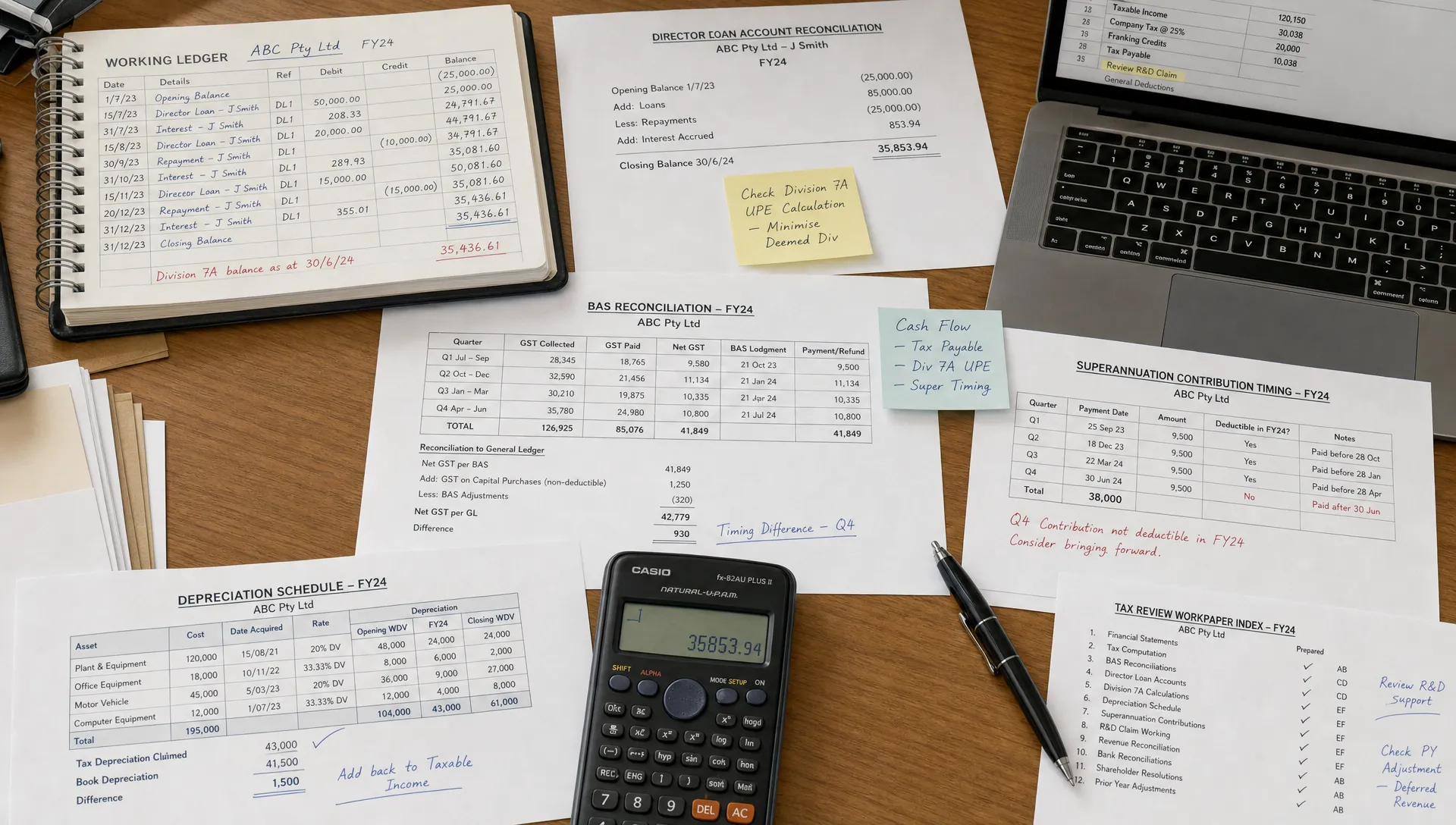
Before 30 June, we assess whether the company’s accounting data reflects commercial reality, whether deductions are properly supported, whether GST and BAS reporting aligns with the general ledger and whether director or shareholder arrangements create hidden tax exposure. We also consider how the company’s tax position affects working capital, lending capacity and investment decisions.
For many Australian companies, the tax rate is either 25% for eligible base rate entities or 30% for other companies. That rate matters, but it is only one part of the analysis. The better question is whether the company’s tax outcome is accurate, defensible and aligned with the board’s broader plans.
Directors who want a deeper planning framework can also review our guide on company taxes in Australia for directors, which expands on several EOFY timing issues.
1. Profit position, taxable income and cash flow impact
The first review is the gap between accounting profit and taxable income. These numbers are rarely identical.
A corporate tax accountant will examine revenue, expenses, depreciation, provisions, non-deductible items and timing differences. We also assess whether management accounts are current enough to support decisions before 30 June, not months after the opportunity has passed.
This review should answer practical questions:
- Is the company likely to have a tax payable position or a loss?
- Are PAYG instalments aligned with actual profitability?
- Will tax payments place pressure on working capital?
- Should the business adjust pricing, debtors, stock purchasing or capital expenditure before year end?
- Is there a sufficient cash reserve for GST, PAYG withholding, superannuation and income tax?
We often see growing companies focus heavily on revenue while underestimating the cash impact of tax liabilities. EOFY planning gives directors time to forecast commitments, model scenarios and avoid a tax bill becoming a funding shock.
This is where tax compliance becomes a strategic cash flow exercise. Our approach to tax-efficient accounting that improves cash flow is built on the same principle: accurate tax data should help management make better commercial decisions.
2. GST, BAS and revenue recognition
GST errors often begin long before the company tax return is prepared. They arise from incorrect tax codes, mixed-use expenses, property transactions, imported services, refunds, deposits, rebates, inter-entity charges or timing differences between accounting systems and BAS lodgements.
Before EOFY, we reconcile BAS lodgements to the general ledger and balance sheet control accounts. We also review whether GST has been reported on the correct basis, whether transactions have been coded correctly and whether any adjustments are required before the June BAS is finalised.
Revenue recognition also needs attention. Companies with retainers, staged contracts, unearned income, work in progress or long-term projects should not rely only on bank receipts. We review whether income has been recognised in the correct period and whether the tax treatment matches the underlying contract.
For businesses in construction, consulting, software, medical services, logistics, e-commerce or property development, this can materially affect both GST and income tax.
3. Deductions, accruals and substantiation
A deduction is only useful if it is allowable, correctly timed and supported by evidence. Before EOFY, we review deductions that commonly attract ATO attention, including contractor payments, motor vehicle expenses, travel, entertainment, professional fees, repairs, software subscriptions, interest and home office arrangements for company employees or directors.
We also check accrued expenses. If a company has incurred a liability before 30 June but has not yet paid it, the deductibility may depend on the legal obligation, documentation and the nature of the expense. The same applies to provisions, which are not automatically deductible simply because they appear in the accounts.
Legal and professional fees deserve careful classification. Some are deductible, some are capital in nature and some relate to private or shareholder matters. Where a company has interstate or overseas legal exposure, tax advice should be coordinated with qualified local legal advisers. For example, Australian groups dealing with US property, estate or litigation matters may need separate advice from a jurisdiction-specific firm such as Clair Gjertsen Weathers PLLC for New York and Connecticut legal matters, while our role remains focused on the Australian tax and accounting consequences.
Substantiation is increasingly digital. We encourage companies to keep supplier invoices, contracts, loan agreements, receipts and board approvals in structured cloud records. AI-driven document capture can reduce manual errors, but the tax judgement still needs experienced review.
4. Director loans, shareholder balances and Division 7A
Division 7A remains one of the most important EOFY review areas for private companies. Loans, payments or forgiven debts involving shareholders, associates or related entities can be treated as unfranked dividends if not managed correctly.
Before 30 June, we review director loan accounts, shareholder current accounts, trust distributions, unpaid present entitlements, intercompany balances and related-party payments. The goal is to identify whether a complying loan agreement, repayment strategy or dividend planning is required.
A corporate tax accountant should not leave Division 7A until after year end. By that stage, some options may be limited. Proper review can help directors distinguish between genuine business transactions, drawings, reimbursements, wages, dividends and loans.
We also examine whether personal expenses have been paid through the company. Even where the amounts are small individually, recurring private expenses can distort financial reports and create tax exposure.
5. Payroll, PAYG withholding and superannuation
Payroll errors have become easier for regulators to detect through Single Touch Payroll and superannuation data matching. Before EOFY, we review PAYG withholding, payroll categories, employee allowances, bonuses, leave accruals, termination payments and superannuation obligations.
Superannuation needs particular care. To claim a deduction in the relevant income year, contributions generally need to be received by the employee’s super fund by 30 June, not merely processed by the employer on that date. Directors should allow enough time for clearing house processing.
We also review whether contractors may create superannuation guarantee, payroll tax or workers compensation exposure. The employee versus contractor distinction is not determined by the invoice label alone. The actual working arrangement matters.
For groups with employees across multiple states, payroll tax thresholds, grouping rules and state-based obligations may also need review. A company operating in Adelaide, Sydney and Melbourne can have a more complex payroll profile than a single-location business.
6. FBT and employee benefits
The FBT year ends on 31 March, but EOFY is still an important time to connect FBT outcomes with income tax, payroll reporting and management accounts.
We review motor vehicles, car parking, entertainment, meal benefits, employee reimbursements, living-away-from-home allowances, salary packaging and reportable fringe benefits. We also check whether employee contributions have been properly recorded and whether GST credits have been treated correctly.
FBT can affect company tax deductions, employee payment summaries and director remuneration planning. When benefits are provided informally, the cost is often underestimated. A structured review helps directors decide whether benefits should continue, be documented differently or be replaced with more transparent remuneration.
7. Fixed assets, depreciation, stock and work in progress
EOFY is the right time to clean up the fixed asset register. We review additions, disposals, scrapped assets, private use, finance arrangements and depreciation methods. We also check whether invoices and finance contracts support the tax treatment adopted.
Asset purchases should be commercially justified, not made simply to chase a deduction. A deduction may reduce taxable income, but it still requires cash outflow. We model the impact on tax, cash flow and future depreciation so directors can make decisions based on net financial benefit.
Trading stock and work in progress also need attention. Obsolete stock, damaged stock, stocktake adjustments and valuation methods can affect taxable income. For professional services, construction, design, software and project-based firms, work in progress may be a significant EOFY adjustment.

8. Losses, financing and group structures
Where a company has tax losses, we review whether those losses can be carried forward and used. This may require consideration of ownership continuity, business continuity and integrity rules. Changes in shareholding, new investors, restructures or business pivots can affect the outcome.
Financing arrangements are also reviewed before EOFY. Interest deductibility, loan purpose, refinancing, security arrangements and related-party funding should be clearly documented. Larger groups may need to consider more complex rules, including debt deduction limitations and transfer pricing where cross-border dealings exist.
For corporate groups, we review intercompany transactions, management fees, service agreements, loans, cost allocations and consolidation issues where relevant. The ATO expects related-party dealings to have commercial substance, not just journal entries created at year end.
9. Trusts, companies and high-net-worth structures
Many private groups use a combination of companies, trusts, SMSFs, property entities and investment vehicles. Before EOFY, we review how profits, distributions, dividends, loans and capital gains flow through the structure.
This is particularly important for high-net-worth individuals, family-owned businesses, property investors and business owners preparing for succession or sale. A decision made in one entity can affect tax outcomes in another.
We look at whether trust distribution resolutions are prepared on time, whether corporate beneficiaries create Division 7A issues, whether franking credits are being used effectively and whether cash movements match the tax position.
A corporate tax accountant should also consider whether the structure still serves its purpose. A structure that worked for a start-up may not be appropriate for a scaling company, property group or business preparing for external investment.
10. ATO risk, audit readiness and data quality
ATO review activity is increasingly data-led. Income tax returns, BAS, STP, taxable payments reporting, superannuation data and third-party information can be compared more efficiently than in the past.
Before EOFY, we review the company’s risk profile from the ATO’s perspective. That includes unexplained income movements, GST inconsistencies, director loan balances, unusual deductions, late lodgements, unpaid tax debts, payroll mismatches and related-party transactions.
The objective is not to be overly conservative. The objective is to make defensible claims, supported by evidence and consistent reporting. Our article on company tax return errors that trigger ATO attention outlines several common issues directors should address before lodgement.
Digital record-keeping is central to audit readiness. We use automation to identify anomalies, reconcile accounts faster and maintain cleaner supporting records. AI can flag unusual entries, missing invoices and coding inconsistencies, while our team applies professional judgement to the tax position.
EOFY review checklist for company directors
The following table summarises the core areas we review before EOFY and the strategic value behind each one.
| Review area | What we examine | Strategic outcome |
|---|---|---|
| Profit and taxable income | Management accounts, timing differences, tax rate, PAYG instalments | Better cash flow forecasting and fewer tax surprises |
| GST and BAS | GST codes, BAS reconciliations, control accounts, adjustments | Reduced ATO mismatch risk |
| Director loans | Shareholder accounts, Division 7A exposure, repayments, dividends | Cleaner governance and fewer deemed dividend issues |
| Payroll and superannuation | STP, PAYG withholding, super timing, bonuses, contractor treatment | Stronger compliance and accurate labour cost reporting |
| FBT | Vehicles, entertainment, salary packaging, employee contributions | Better remuneration planning and correct tax treatment |
| Assets and stock | Fixed asset register, depreciation, disposals, stocktake, WIP | Accurate deductions and reliable balance sheet values |
| Group structures | Intercompany loans, trust distributions, related-party charges | Better tax planning across entities |
| ATO readiness | Evidence, reconciliations, unusual transactions, lodgement history | Lower review risk and faster response if queried |
How automation changes the EOFY process
Traditional EOFY work often involved waiting for documents, manually coding transactions and discovering issues after 30 June. That approach is no longer adequate for directors who need real-time visibility.
Our AI-driven accounting workflows allow us to move much of the review forward. Bank feeds, invoice capture, rules-based coding, exception reporting and automated reconciliations help identify issues earlier. This improves speed and accuracy, but it does not replace professional judgement.
The real value comes from combining automation with advisory interpretation. We can see whether gross margin is shifting, whether debtor days are deteriorating, whether GST liabilities are trending higher or whether payroll costs are outpacing revenue. That insight supports decisions before EOFY, rather than simply explaining outcomes after lodgement.
For directors, this means EOFY becomes a management tool. It can inform funding, hiring, asset investment, dividend policy, restructuring, risk management and succession planning.
When should directors start the EOFY review?
Ideally, the first EOFY review should begin in the March quarter, with a second review closer to June. Complex groups, property developers, companies with related-party loans and businesses planning major transactions should start earlier.
A corporate tax accountant needs time to review the facts, request missing documents, model scenarios and implement decisions properly. Last-minute planning often leads to rushed records, limited options and avoidable risk.
If the company has late lodgements, unpaid ATO debt, incomplete bookkeeping or unresolved BAS issues, the review should begin immediately. Cleaning up historical data can take longer than directors expect, especially where payroll, GST and related-party accounts are involved.
Frequently asked questions
What does a corporate tax accountant do before EOFY? We review taxable income, GST, BAS, payroll, superannuation, FBT, Division 7A, asset deductions, stock, trust distributions, ATO risk and cash flow. The aim is to finalise a compliant position while giving directors time to make informed commercial decisions before 30 June.
Is EOFY tax planning only relevant for large companies? No. SMEs, family-owned companies, professional practices, property groups and start-ups can all benefit. The complexity may differ, but the principles are the same: accurate data, correct tax treatment, clear documentation and proactive cash flow planning.
Can a company claim superannuation paid after 30 June? Generally, employer superannuation contributions are deductible in the income year in which they are received by the employee’s super fund. Processing a payment on 30 June may not be enough if the fund receives it later, so timing should be managed carefully.
Why does Division 7A matter before EOFY? Division 7A can treat certain loans, payments or forgiven debts to shareholders or associates as unfranked dividends. Reviewing these balances before EOFY gives directors more time to manage repayments, documentation and dividend planning.
How does AI improve EOFY accounting? AI-driven workflows can identify missing documents, coding anomalies, reconciliation issues and unusual transactions faster than manual review alone. We still apply professional judgement, but automation gives directors cleaner data and earlier visibility.
Next steps before 30 June
Directors should not wait for the annual company tax return to discover issues. Before EOFY, we recommend taking the following actions:
- Finalise management accounts to the latest available month and review expected taxable income.
- Reconcile GST, BAS, payroll, superannuation and balance sheet control accounts.
- Review director loans, shareholder payments and related-party balances.
- Confirm asset purchases, disposals, stock values and work in progress.
- Check whether records support all material deductions and tax positions.
- Model cash flow for income tax, GST, PAYG withholding, superannuation and loan commitments.
How we can help
At Perfect Accounting & Tax Services, we support Australian companies, directors and high-net-worth individuals with EOFY tax planning, corporate accounting, BAS, payroll, Division 7A reviews, FBT, SMSF matters and strategic advisory.
Our team brings 25 years of professional experience and combines technical tax knowledge with AI-driven automation. We help clients across Adelaide, Sydney, Melbourne and broader Australia move from reactive compliance to real-time financial visibility.
If you want your EOFY review to support corporate growth, not just tax lodgement, contact our team for a consultation. We can assess your current accounting workflow, identify tax risks and show how automated reporting can give you faster, cleaner and more strategic financial insight.