
A tax accountant in Australia should be qualified in two ways: legally authorised to provide tax agent services and commercially capable of protecting your financial position. For business owners, company directors and high-net-worth individuals, that second part matters just as much as the registration certificate.
In our work with clients across Adelaide, Sydney, Melbourne and broader Australia, we see a clear divide. A competent tax accountant can prepare a compliant return. A strategic tax accountant can interpret the numbers, identify risk early, improve cash flow and turn compliance data into better decisions.
This guide explains the core tax accountant requirements in Australia, the qualifications to verify before you engage an adviser and the practical capabilities that distinguish a serious tax professional from a lodgement-only operator.
The first requirement: TPB registration
In Australia, anyone who provides tax agent services for a fee or reward must be registered with the Tax Practitioners Board, commonly known as the TPB. This is the non-negotiable starting point.
A registered tax agent can generally prepare and lodge income tax returns, provide tax advice, deal with the ATO on your behalf and advise on tax liabilities, obligations and entitlements. A BAS agent has a more limited scope, usually covering BAS, GST, PAYG withholding, payroll-related reporting and other BAS services. A BAS agent is not the same as a registered tax agent.
Before appointing anyone, we recommend checking the TPB public register. Search the individual adviser and the firm. If a practice says your work is supervised by a registered agent, ask who holds the registration and who signs off on advice.
This distinction is especially important for companies, trusts, SMSFs, property investors and cross-border structures. If the advice affects income tax, CGT, GST, FBT, Division 7A, trust distributions or tax residency, the professional responsible for that advice should be appropriately registered and experienced.
What qualifications does the TPB look for?
The TPB has several pathways for tax agent registration. The exact pathway can vary, but the core themes are consistent: relevant education, approved Australian tax law study, commercial law knowledge and practical experience.
In practical terms, a well-qualified tax accountant will usually have some combination of the following:
- A degree or postgraduate qualification in accounting, commerce, business or a related discipline
- Board-approved study in Australian taxation law
- Board-approved study in commercial law
- Relevant supervised experience in tax, accounting or advisory work
- Professional indemnity insurance that meets TPB requirements
- Ongoing continuing professional education
- Compliance with the TPB Code of Professional Conduct
The technical point is simple. A tax accountant should not merely understand accounting entries. They should understand the Australian tax system, ATO administration, entity structures, business law principles and the commercial consequences of tax decisions.
For example, the correct treatment of a director loan is not just a bookkeeping issue. It may raise Division 7A, fringe benefits tax, deductibility, cash flow and governance questions. A registered and experienced tax accountant will recognise those connections before the ATO or your bank does.
Tax accountant, BAS agent, bookkeeper or tax preparer: what is the difference?
Many businesses use several finance professionals, and each role can be valuable. The issue is knowing where one role ends and another begins.
| Role | Typical scope | When it is suitable | Key limitation |
|---|---|---|---|
| Bookkeeper | Data entry, reconciliations, invoices, receipts, basic payroll processing | Day-to-day transaction management | May not be authorised to provide tax agent or BAS agent services unless registered |
| BAS agent | BAS, GST, PAYG withholding, payroll reporting and related advice | Regular GST and payroll compliance | Cannot provide full income tax advice unless also registered as a tax agent |
| Tax preparer | Preparation of simple tax returns, where properly authorised | Straightforward individual lodgements | May lack broader business advisory capability |
| Registered tax accountant | Income tax, GST, CGT, FBT, structures, ATO representation and strategic tax advice | Businesses, investors, directors, trusts and complex personal affairs | Quality still depends on experience, systems and professional judgement |
If you are deciding who should handle your lodgement, our comparison of tax preparers vs accountants in Australia explains the practical difference in more detail.
For a sole trader with a simple return, a registered tax preparer may be adequate. For a company director managing payroll, GST, asset purchases, shareholder loans and growth decisions, we would normally expect a registered tax accountant with broader advisory capability.
Professional memberships that add confidence
TPB registration is the legal baseline. Professional membership can add another layer of discipline, training and accountability.
In Australia, relevant professional affiliations may include Chartered Accountants Australia and New Zealand, CPA Australia or the Institute of Public Accountants. These organisations generally require members to meet education standards, complete ongoing professional development and follow professional and ethical obligations.
Professional membership is not a substitute for TPB registration. A person can hold an accounting qualification or professional membership but still need TPB registration to provide tax agent services for a fee. We treat membership as a positive signal, not the sole proof of competence.
For business owners, the better question is not only, “Are you qualified?” It is, “Are you qualified for the kind of tax risk we actually carry?”
A family trust with investment properties, a medical practice with service entity arrangements, a construction business with subcontractor reporting and a technology startup issuing employee share options all need different technical depth.
Specialist qualifications and permissions for complex matters
A strong tax accountant should also know when additional licensing or specialist expertise is required. This is critical for high-net-worth individuals, SMSF trustees, foreign investors and business owners with regulated assets.
SMSF advice is a useful example. Tax accountants can advise on tax consequences and compliance matters within their scope, but SMSF audits require an ASIC-registered SMSF auditor. Financial product advice may require an Australian Financial Services Licence or an authorised representative arrangement. Legal advice should be handled by a solicitor.
A capable adviser does not blur these boundaries. They coordinate the right experts and keep the tax strategy aligned with the commercial objective.
For property investors, cross-border tax is another area where general experience is not enough. Australian residents are generally taxed on worldwide income, subject to relevant rules and treaty considerations. If you are assessing offshore assets, such as comparing Dubai property investment opportunities, your Australian tax accountant should consider foreign income, CGT, residency, financing, record keeping and exchange rate issues before you commit capital.
This is where tax qualifications become practical risk management. The accountant must understand not only the form you lodge, but the commercial pathway that created the tax outcome.
What business owners should expect beyond formal qualifications
Formal qualifications tell you whether someone is allowed to practise. They do not tell you whether the advice will be strategic, timely or commercially useful.
Over 25 years, our team has found that the strongest tax accountants for business clients share five practical capabilities.
They understand tax as a year-round management function
A tax accountant should not appear only in June or at lodgement time. For businesses, tax outcomes are created throughout the year through pricing, wages, director drawings, asset purchases, debt levels, stock management and entity decisions.
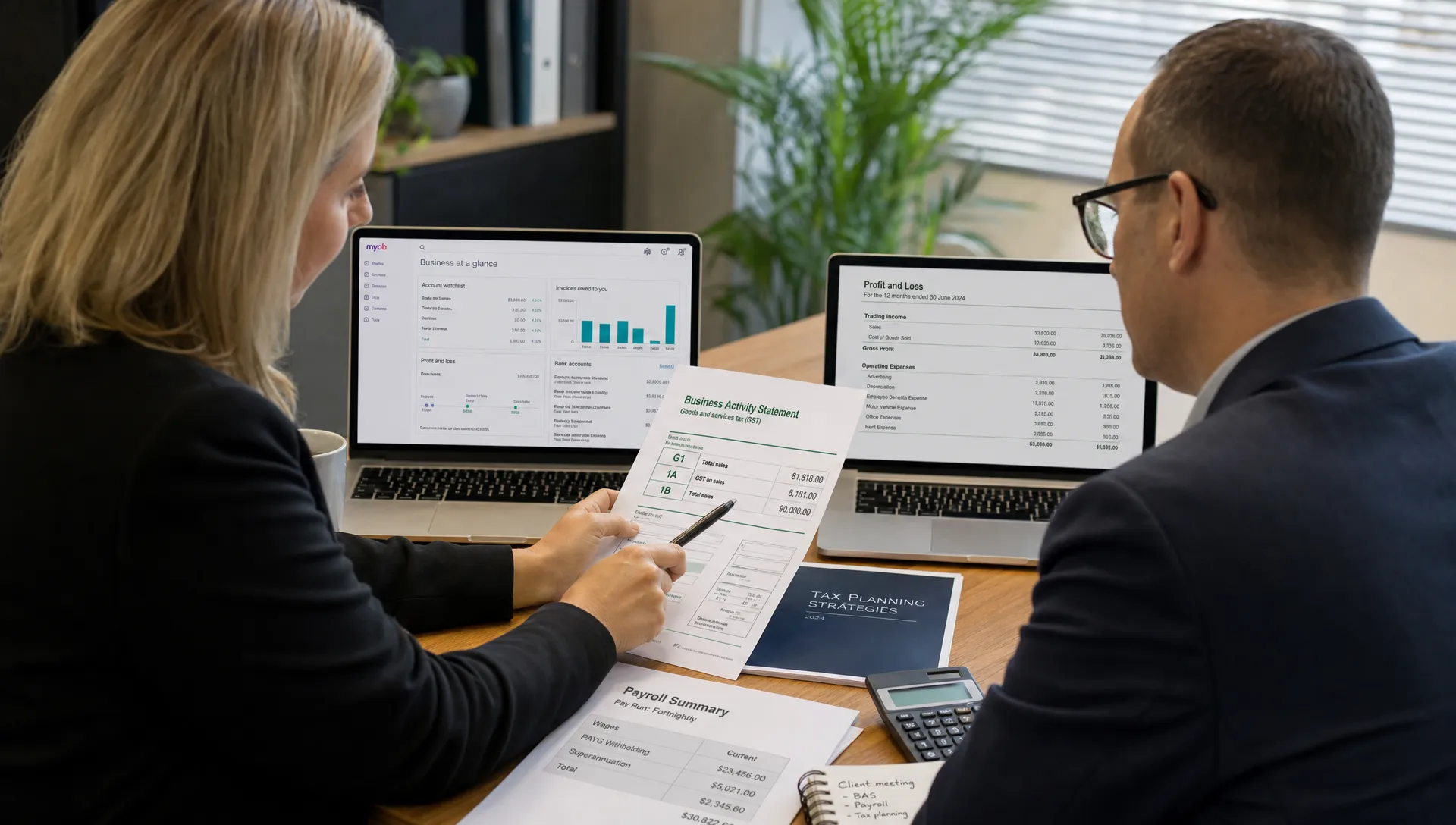
A serious adviser reviews BAS, GST, PAYG withholding, superannuation, payroll, FBT exposure and profit trends before problems become expensive. We explore this year-round view in our article on what a business tax accountant should be reviewing.
This approach gives directors better control. It also reduces the risk of rushed decisions at tax time, when the options are narrower and the cash impact is already locked in.
They can interpret financial data, not just process it
Compliance work depends on accurate data, but advisory work depends on interpretation. Your accountant should be able to explain what your gross margin, wage ratio, tax instalments, debtor days and working capital position are saying about the business.
For a growing company, the right question may not be, “How do we reduce tax this year?” It may be, “How do we manage tax, cash flow and reinvestment so the business can scale safely?”
That is the strategic pivot we focus on. Bookkeeping and compliance form the foundation, but the end goal is better financial health and sustainable corporate growth.
They are competent with ATO systems and digital reporting
Australian tax compliance is now highly digital. Single Touch Payroll, online services for agents, electronic lodgement, data matching, eInvoicing developments and cloud accounting integrations all affect the quality of your compliance position.
A qualified tax accountant should understand how digital records flow through your systems and into ATO reporting. This includes GST coding, payroll categories, superannuation obligations, contractor reporting, asset registers and private use adjustments.
Our AI-driven workflows are designed to improve accuracy and speed by identifying anomalies, missing documentation and unusual account movements earlier. We still apply professional judgement, but automation helps us review larger volumes of data with better consistency and real-time visibility.
They understand industry-specific tax risk
Different industries create different tax issues. A hospitality group will have payroll, superannuation, GST, tip treatment and cash control risks. A construction firm may need to manage subcontractor reporting, work-in-progress, retentions and equipment financing. A SaaS company may need to consider R&D, revenue recognition, contractor arrangements, employee share schemes and international expansion.
The accountant does not need to have worked with every business type in Australia. They do need enough commercial maturity to ask the right questions and identify where specialist review is required.
They communicate advice in decision-ready language
Directors and investors do not need pages of technical tax law without a conclusion. They need clear advice that explains the issue, the options, the likely tax effect, the commercial trade-off and the documentation required.
Good tax advice is precise. It should leave a clear audit trail and help you make a decision with confidence.
Questions to ask before appointing a tax accountant
A short conversation can reveal a great deal about whether a tax accountant is properly qualified for your needs. We recommend asking practical questions rather than relying on titles alone.
| Question | Why it matters |
|---|---|
| Are you registered with the TPB as a tax agent, and under what name? | Confirms legal authority to provide tax agent services |
| Who will review and sign off on our work? | Identifies whether a senior professional is accountable |
| What experience do you have with our entity structure and industry? | Tests whether the adviser understands your actual risk profile |
| How do you manage BAS, GST, payroll and superannuation compliance throughout the year? | Shows whether the firm is proactive or lodgement-only |
| What technology and automation do you use to detect errors? | Reveals the quality of the workflow and data controls |
| How do you communicate tax planning opportunities before year end? | Confirms whether advisory is embedded in the service model |
| What are your engagement terms and fee basis? | Reduces disputes and clarifies scope |
For a more detailed preparation guide, our article on questions to ask at a free tax accountant consultation can help you structure the discussion.
Red flags that a tax accountant may not be suitable
Qualifications are important, but warning signs often appear in the way an adviser operates. We would be cautious if you encounter any of the following:
- They cannot be found on the TPB register where tax agent services are being provided
- They promise a guaranteed refund before reviewing your records
- They encourage deductions without evidence or a clear tax basis
- They do not provide an engagement letter or defined scope
- They treat BAS, GST, payroll and income tax as disconnected tasks
- They do not ask about your structure, finance arrangements or growth plans
- They rely on manual processes without clear review controls
- They are difficult to contact outside lodgement season
For business owners and investors, the cost of poor advice is rarely limited to an incorrect return. It can include ATO penalties, interest, cash flow pressure, lost financing opportunities, director exposure and avoidable restructuring costs.
How AI and automation are changing the qualification standard
Digital capability is not yet a formal tax accountant qualification in the same way as tax law study or TPB registration. Commercially, however, it is now a practical requirement for serious businesses.
Modern accounting systems generate large volumes of data. Bank feeds, payroll systems, point-of-sale platforms, inventory systems, e-commerce channels and ATO reporting all need to reconcile. Manual review alone is too slow and too exposed to inconsistency for many growing businesses.
We use AI-driven automation to support three outcomes: cleaner records, faster exception detection and better advisory visibility. For example, automated checks can flag unusual GST coding, duplicated supplier payments, inconsistent payroll categories, missing tax invoices or expense patterns that need review.
The technology does not replace professional judgement. It gives our accountants a stronger evidence base and allows us to spend more time on interpretation, planning and strategic advice.
For clients operating across Adelaide, Sydney, Melbourne or multiple states, this integrated approach is especially valuable. It gives management a unified view of tax, cash flow and compliance rather than disconnected local files.
What qualification level is appropriate for your situation?
The more complex your affairs, the higher the standard should be. A simple employee return with standard deductions does not require the same depth as a multi-entity business group. A high-net-worth family with trusts, property, investments and succession planning needs an adviser who can coordinate tax, accounting, estate considerations and asset protection discussions with other professionals.
As a guide, we would expect a higher level of expertise if you have:
- A company, trust, partnership or SMSF structure
- GST registration and quarterly or monthly BAS obligations
- Employees, contractors or payroll tax exposure
- Director loans, shareholder drawings or related-party transactions
- Investment properties, development projects or commercial property
- Foreign income, foreign assets or residency issues
- Crypto, employee share schemes or startup equity arrangements
- ATO debt, late lodgements, audit activity or amended assessments
In these situations, tax accountant requirements should be assessed against risk, not only price. The cheapest option may be suitable for a simple return, but it can be expensive when the structure is complex.
Frequently asked questions
Does a tax accountant need to be registered in Australia? Yes, if they provide tax agent services for a fee or reward, they generally need to be registered with the Tax Practitioners Board. The firm or supervising practitioner responsible for the tax advice and lodgement should be identifiable on the TPB register.
Is a BAS agent the same as a tax accountant? No. A BAS agent can assist with BAS, GST, PAYG withholding, payroll reporting and related BAS services. A registered tax agent has a broader scope that generally includes income tax returns and tax advice.
Are CA ANZ, CPA Australia or IPA memberships enough? They are valuable professional indicators, but they do not replace TPB registration for tax agent services. We recommend checking both professional membership and TPB registration where tax advice is involved.
What qualifications should a business tax accountant have? A business tax accountant should have TPB registration, Australian tax law knowledge, commercial law understanding, relevant business advisory experience and strong digital accounting capability. For complex groups, experience with GST, FBT, payroll, trusts, Division 7A and ATO engagement is important.
How can I verify a tax accountant’s credentials? Search the TPB public register, ask for the adviser or firm’s registration details, confirm who reviews your work, request an engagement letter and ask about relevant experience with your industry, structure and compliance obligations.
Next steps: how we can help
Choosing a tax accountant is not just an administrative decision. It is a governance decision that affects compliance, cash flow, growth and risk management.
At Perfect Accounting & Tax Services, our team combines 25 years of Australian tax and accounting experience with AI-driven workflows that improve accuracy, speed and financial visibility. We support businesses, directors and high-net-worth clients across Australia, with integrated capability across Adelaide, Sydney and Melbourne.
We can help you assess your current accounting arrangements, identify compliance gaps, automate your bookkeeping and reporting processes, manage BAS, GST, payroll and superannuation obligations and build a tax strategy that supports corporate growth.
If you want a qualified, technology-enabled tax advisory partner, contact Perfect Accounting & Tax Services to arrange a consultation and learn how our automated accounting workflows can strengthen your financial position.