
A free consultation with a tax accountant should do more than confirm whether they can lodge your return. For a business owner, company director or investor, it should reveal whether the adviser can interpret risk, improve systems, identify planning opportunities and support long-term financial decisions.
If you searched for tax accountant free consultation near me, location is only one part of the decision. In Australia, tax advice must be grounded in ATO compliance, Tax Practitioners Board registration, BAS and GST accuracy, payroll obligations, superannuation rules and entity-specific planning. A nearby accountant may be convenient, but the stronger question is whether they can provide strategic advice across the financial year, not only at lodgement time.
Our team approaches an initial consultation as a diagnostic session. We want to understand the commercial reality behind the numbers, the quality of the financial data and the decisions the client needs to make next. The right questions help you assess whether an accountant is simply preparing forms or building a stronger financial operating model for your business and personal wealth.
What a Free Tax Accountant Consultation Should Achieve
A free consultation is not usually the place for detailed written tax advice. It is an opportunity to test fit, capability and process. For complex matters, a responsible accountant will avoid giving definitive advice before reviewing source documents, entity structures, prior year returns and relevant ATO correspondence.
That distinction matters. A valuable consultation should help you clarify the scope of work, the immediate risks, the documents required and the likely pathway forward. If your business involves employees, contractors, intercompany loans, trusts, SMSFs, property holdings or cross-state operations, the accountant should be asking structured questions before offering conclusions.
We recommend entering the meeting with a commercial mindset. You are not only asking, “Can you do my tax return?” You are asking, “Can you help us reduce compliance risk, improve reporting quality and use tax planning as part of a broader growth strategy?”
For a deeper pre-lodgement checklist, our guide on what to cover in a tax consultation before you lodge explains the financial records, reconciliations and tax issues that should be reviewed before a return is submitted.
Start With Credentials and Regulatory Standing
Before discussing deductions or tax savings, confirm whether the accountant is legally authorised to provide tax agent services in Australia. Tax agent registration is regulated by the Tax Practitioners Board, and this should be non-negotiable if you want advice that affects your ATO obligations.
Ask direct questions such as:
| Question to ask | Why it matters |
|---|---|
| Are you a registered tax agent in Australia? | Only registered tax agents can charge a fee for tax agent services. |
| Who will actually review and sign off on our work? | You need to know whether a senior adviser or junior processor is handling key decisions. |
| Do you have experience with our entity type? | Companies, trusts, partnerships, sole traders and SMSFs have different risk profiles. |
| How do you manage professional standards and quality control? | Strong firms use review processes to reduce errors before lodgement. |
A credible adviser should answer these questions clearly. If the response is vague, or if the consultation focuses only on “maximum refunds” without discussing substantiation and compliance, treat that as a warning sign.
Ask How They Will Understand Your Business Model
Tax outcomes are shaped by the way a business actually operates. An e-commerce retailer, a construction contractor, a medical practice, a software company and a property investor may all report income and expenses, but the underlying risks are different.
We believe a proper consultation should explore revenue streams, contract terms, working capital cycles, debt funding, asset ownership, employee structures and future plans. For example, a company director scaling operations in Sydney may need payroll, GST, Division 7A and cash flow advice. A property investor in Adelaide may need CGT, negative gearing, land tax coordination and depreciation review. A Melbourne creative agency may need contractor classification, GST, software subscriptions and international income analysis.
If the accountant does not ask how the business makes money, they cannot properly advise on tax planning. The numbers in your accounting software are only the output. The business model explains the risk.
Questions About Tax Lodgement and ATO Compliance
Compliance should be efficient, but it should never be treated casually. The ATO has strong data matching capabilities across wages, bank interest, dividends, cryptocurrency exchanges, property transactions, superannuation and Single Touch Payroll. In 2026, the quality of your digital records matters more than ever.
Ask your potential accountant how they will review completeness of income, deductibility of expenses and consistency between your tax return, BAS, payroll records and financial statements. A strong adviser should be able to explain their review process without overwhelming you with technical language.
Useful questions include:
| Area | Consultation question |
|---|---|
| Income | How will you check that all assessable income has been captured? |
| Deductions | What evidence do we need before claiming business expenses? |
| GST | How do you identify GST coding errors before BAS lodgement? |
| Payroll | Do you reconcile STP, wages, PAYG withholding and superannuation? |
| Director issues | Do you review loans, drawings, dividends and Division 7A exposure? |
| ATO contact | How do you handle ATO queries, amended assessments or payment arrangements? |
These questions reveal whether the accountant takes a systems-based approach or simply enters figures at year end.
Questions About BAS, GST, Payroll and Superannuation
For many businesses, the most costly issues do not arise from the annual tax return. They arise from incorrect BAS reporting, GST coding mistakes, missed superannuation deadlines, payroll classification errors and poor cash flow planning around tax liabilities.
We advise business owners to ask how the accountant will monitor obligations during the year. If your business employs staff, uses subcontractors or pays directors, this is especially important. Payroll and superannuation errors can create financial, legal and reputational consequences.
Ask whether the accountant reviews BAS data before lodgement or simply lodges what the bookkeeping file produces. Ask how they identify GST claimed on non-creditable expenses, private-use adjustments, motor vehicle claims and mixed-purpose costs. If you operate across multiple locations, including Adelaide, Sydney and Melbourne, ask how they coordinate state-based payroll tax considerations, workers compensation interfaces and reporting consistency.
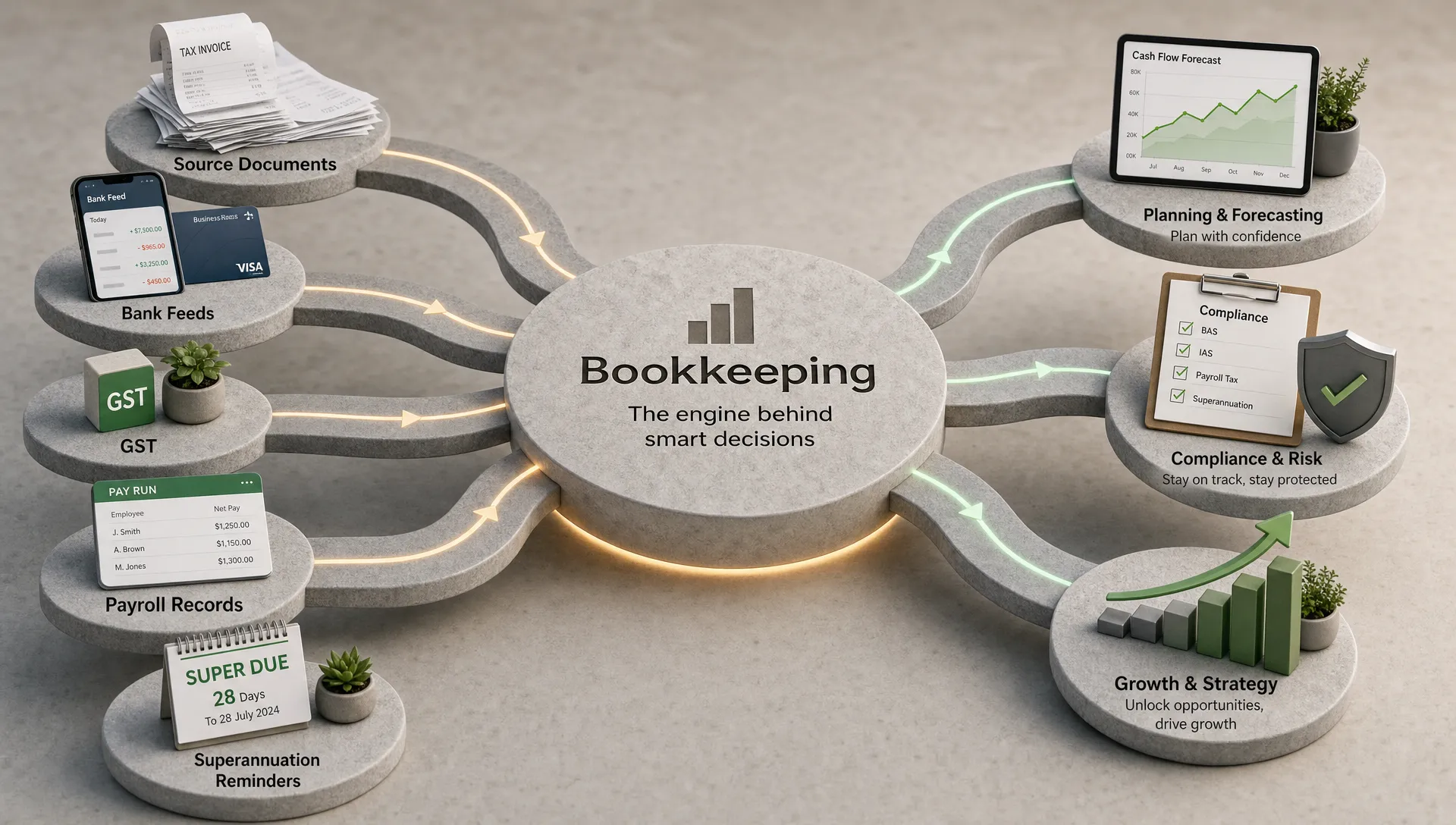
A good consultation should make one point clear: bookkeeping is not an administrative afterthought. Clean books are the foundation for tax planning, management reporting, finance applications and strategic advisory.
Ask How Technology and AI Improve Accuracy
Modern tax advice depends on timely and reliable data. If an accountant relies entirely on manual processes, delayed reconciliations and once-a-year reviews, you may not have the visibility required to make strong decisions.
Our team uses AI-driven automation and digital workflows to help improve speed, accuracy and real-time financial visibility. In a consultation, we recommend asking how the firm uses technology to reduce duplicate data entry, detect anomalies, streamline document collection and identify issues before lodgement.
This is not about replacing professional judgement. It is about using automation so senior advisers can focus on interpretation, strategy and risk. AI can help flag unusual movements in expense categories, missing documents, inconsistent GST treatment or late reconciliations. A qualified accountant still needs to assess context, commercial purpose and tax law.
Questions to ask include:
| Technology area | What to ask |
|---|---|
| Cloud accounting | Which systems do you work with, and how do you maintain data quality? |
| Automation | How do you reduce manual processing and duplicate entries? |
| Reporting | Can we access timely profit, cash flow and tax position insights? |
| Document capture | How do you collect receipts, invoices, loan statements and payroll records? |
| Review controls | What checks are performed before BAS or tax lodgement? |
If an accountant cannot explain their digital workflow, you may find yourself dealing with slow communication, incomplete records and avoidable rework.
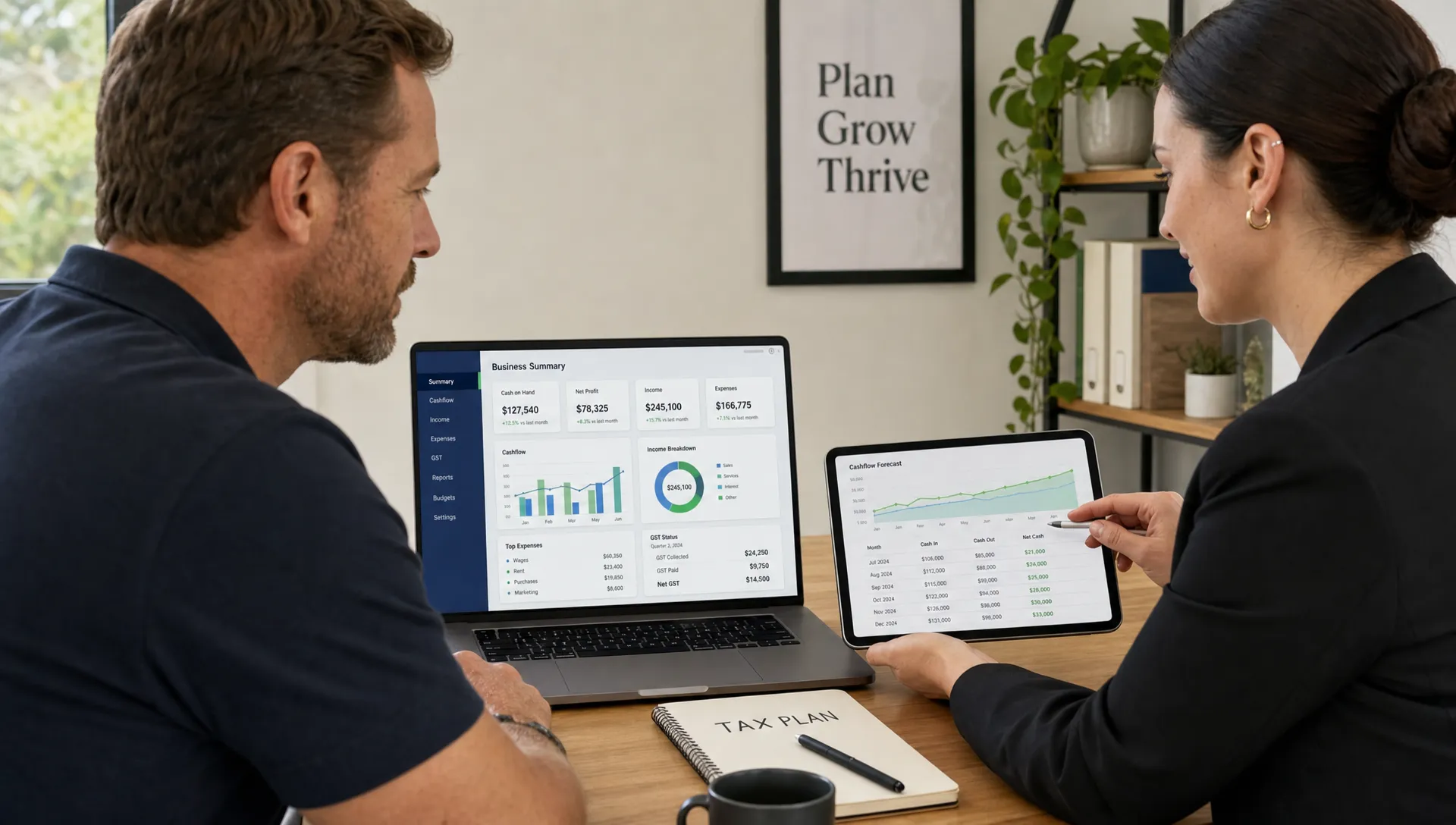
Questions About Strategic Tax Planning
A consultation should not focus only on the tax return already due. It should also consider the decisions that will affect future tax outcomes. Strategic planning may involve entity structure, asset protection, timing of income and deductions, superannuation strategies, CGT concessions, trust distributions, debt structuring, succession planning or preparation for sale.
Ask the accountant what they would review outside tax season. A reactive accountant may only contact you when the return is due. A strategic adviser should help you plan before 30 June, assess cash flow before BAS deadlines and review performance during the year.
We recommend asking:
| Strategic issue | Question to raise |
|---|---|
| Business growth | How should our tax planning change as revenue and headcount increase? |
| Entity structure | Is our current structure still appropriate for risk, profit extraction and growth? |
| Cash flow | How do you forecast tax liabilities so we are not surprised by payments? |
| Investment assets | How do you manage CGT, depreciation and income allocation issues? |
| Exit planning | What should we review before selling a business or transferring assets? |
| Advisory cadence | How often should we meet outside lodgement season? |
This is where the consultation becomes more valuable. The right accountant should connect compliance work to corporate growth, capital allocation and wealth protection.
Our article on when a tax professional becomes a strategic advantage explores this shift from transactional lodgement to proactive advisory in more detail.
Questions for Your Industry and Asset Profile
Industry knowledge matters because tax risk is often sector-specific. A construction business may need advice on contractor arrangements, project costing and equipment finance. A SaaS company may need R&D, revenue recognition and employee share scheme support. A property developer may need GST margin scheme analysis, finance structuring and CGT planning. A healthcare business may need payroll, contractor agreements, practice management reporting and private-use adjustments.
If you operate a healthcare or professional services practice, it can help to ask whether the accountant understands appointment-based revenue, equipment purchases and patient payment workflows used by providers such as a family dental clinic in Geelong. The point is not that every business is identical. The point is that industry context changes the questions an accountant should ask.
High-net-worth individuals and family groups should also ask about investment entities, trusts, estate planning coordination, SMSF compliance and intergenerational wealth transfer. An accountant should know when to collaborate with financial advisers, solicitors and finance professionals while staying within their professional scope.
If you are comparing advisers, our guide on how to choose a tax accountant in Australia outlines the registration, technical and communication factors that should influence your decision.
Questions About Late Returns, ATO Debt and Audits
If you have overdue returns, unpaid BAS, director penalty notices, ATO payment plans or audit concerns, raise them early in the consultation. Withholding difficult information only delays the solution.
Ask how the accountant approaches historical clean-up work. They should request prior year returns, ATO integrated client account records, BAS history, payroll records, bank statements and correspondence. They should also be realistic about penalties, interest, documentation gaps and negotiation options.
Important questions include:
| Situation | Question to ask |
|---|---|
| Late tax returns | What is the safest sequence for bringing lodgements up to date? |
| ATO debt | Can you help us assess payment plan options and cash flow impact? |
| Audit risk | How do you prepare supporting documentation for ATO review? |
| Poor records | What reconstruction work is required before lodgement? |
| Director exposure | Are there unpaid PAYG withholding or superannuation obligations we need to address? |
A strong adviser will not minimise the issue to win your business. They will help you understand the risk, then create a practical pathway to restore compliance.
Questions About Fees, Scope and Communication
Free consultations can become frustrating when scope is unclear. Before engaging an accountant, ask what is included, what is excluded and how additional advisory work is priced. This is especially important for businesses with multiple entities, trusts, employees or property portfolios.
Ask whether the fee includes BAS review, tax planning meetings, bookkeeping support, payroll advice, management reporting or ATO correspondence. Ask who your main contact will be and how quickly you can expect responses during peak tax periods.
You should also clarify whether the accountant provides once-a-year tax lodgement or ongoing advisory support. Both models can be valid, but they serve different needs. A sole trader with simple affairs may only need annual support. A growing company, SMSF trustee, property developer or high-net-worth family group usually needs more structured advice.
Red Flags During a Free Consultation
A free consultation is as much about what the accountant avoids as what they says. Be cautious if the adviser promises a result before reviewing documents, focuses only on refunds, dismisses substantiation requirements or cannot explain their review process.
Other warning signs include poor understanding of Australian tax terminology, no clear tax agent registration, limited questions about your business model and no interest in bookkeeping quality. If the accountant treats technology as irrelevant, that may also limit your ability to access timely financial insights.
The best consultations feel structured. The adviser listens carefully, identifies the key risks, explains the next step and avoids making unsupported claims. You should leave with more clarity, not more confusion.
How to Prepare Before the Consultation
Preparation helps the accountant give more useful guidance. You do not need every document perfectly organised for an initial discussion, but you should have enough information to explain your situation accurately.
Bring or have access to:
- Your ABN, TFN and entity details where relevant.
- Prior year tax returns, BAS and financial statements.
- Current accounting software access or exported reports.
- ATO letters, payment plans or audit correspondence.
- Payroll, superannuation and contractor records.
- Details of loans, leases, major assets and related entities.
- A list of planned changes, such as hiring, expansion, acquisition or sale.
For business owners, we also recommend preparing three management questions. For example, “Are our margins strong enough to support hiring?”, “Are we setting aside enough for tax?” or “Is our current structure still appropriate?” These questions move the consultation from historical reporting to strategic advisory.
A Practical Question Framework to Use
If you want a concise structure, use this framework during the consultation:
| Stage | Key question |
|---|---|
| Credentials | Are you registered and experienced with our structure and industry? |
| Compliance | What tax, BAS, payroll or superannuation risks should we review first? |
| Data quality | How clean are our records, and what needs to be fixed before lodgement? |
| Planning | What decisions can we make before year end to improve our tax position? |
| Technology | How will automation improve accuracy, speed and reporting visibility? |
| Advisory | How will you support us throughout the year, not only at lodgement time? |
| Fees | What is included, what is excluded and how is ongoing advice priced? |
This framework works whether you are a sole trader, company director, property investor, SMSF trustee or multi-entity business group. It keeps the discussion focused on outcomes rather than generic tax talk.
Frequently Asked Questions
Is a free tax accountant consultation really free? Often, yes, but scope matters. A free consultation usually covers fit, broad issues and next steps. Detailed written advice, tax modelling or document review may require a paid engagement.
What should I avoid asking in a first consultation? Avoid asking for definitive tax advice without providing documents. A responsible accountant should review records before giving firm conclusions on deductions, GST treatment, CGT, Division 7A or entity structuring.
Should I choose the closest tax accountant near me? Proximity can be useful, but capability is more important. With secure digital workflows, our team can support clients across Australia, including Adelaide, Sydney and Melbourne, while maintaining strong communication and compliance oversight.
Can an accountant help if I have overdue tax returns or ATO debt? Yes. A registered tax agent can help assess overdue lodgements, ATO payment options and record reconstruction requirements. The earlier you address the issue, the more options you usually have.
How does automation improve tax accounting? Automation helps reduce manual errors, speed up document collection, identify unusual transactions and provide more timely reporting. Professional judgement is still essential, but better data allows better advisory decisions.
Next Steps: Turn the Consultation Into a Strategic Advantage
A free consultation should help you decide whether an accountant can protect compliance, improve financial visibility and support better business decisions. The most valuable advisers do not treat tax as a once-a-year event. They use accurate records, smart systems and strategic planning to strengthen financial health.
Our team at Perfect Accounting & Tax Services supports businesses, directors, investors and high-net-worth individuals across Australia, with integrated capabilities in Adelaide, Sydney and Melbourne. We combine 25 years of professional experience with AI-driven workflows to streamline bookkeeping, BAS, payroll, tax planning and advisory support.
If you are preparing for a consultation, bring your questions and your commercial objectives. We will help you identify the key risks, clarify the documents required and show how automated accounting workflows can give you faster, more accurate financial insight.
Contact Perfect Accounting & Tax Services to arrange a consultation and learn how our tax, accounting and strategic advisory team can support your next stage of growth.