
Most business owners do not outgrow tax compliance. They outgrow reactive tax advice.
At a certain level of complexity, a tax professional is no longer simply the person who lodges an income tax return or BAS. The right adviser becomes part of the decision-making architecture of the business, shaping how cash flow is managed, how risk is controlled, how structures are reviewed, and how growth is funded.
For company directors, property investors, family groups and high-net-worth individuals, this shift is critical. ATO scrutiny is increasingly data-driven, business models are more digital, and tax decisions now intersect with payroll, superannuation, FBT, GST, financing, succession and cross-border activity.
The strategic advantage comes from moving tax advice upstream, before decisions are locked in.
Compliance is the baseline, not the destination
Compliance still matters. Income tax returns, BAS, PAYG withholding, GST, payroll, superannuation and record-keeping must be accurate, complete and lodged on time.
However, compliance is only the foundation. It tells the ATO what has already happened. Strategic advice helps business owners decide what should happen next.
In Australia, tax administration is becoming more integrated and data-rich. Single Touch Payroll, bank feeds, accounting software, contractor reporting, superannuation data and ATO data-matching all reduce the margin for error. The ATO can compare what a business reports against third-party information far more efficiently than in the past.
That means tax planning cannot be treated as an annual event. It must be embedded into monthly reporting, board decisions and cash-flow forecasting.
The Tax Practitioners Board also makes it clear that businesses should verify whether an adviser is registered to provide tax agent or BAS services. Registration is not just a credential. It is part of a professional framework designed to protect clients and maintain tax system integrity.
When a tax professional becomes strategic
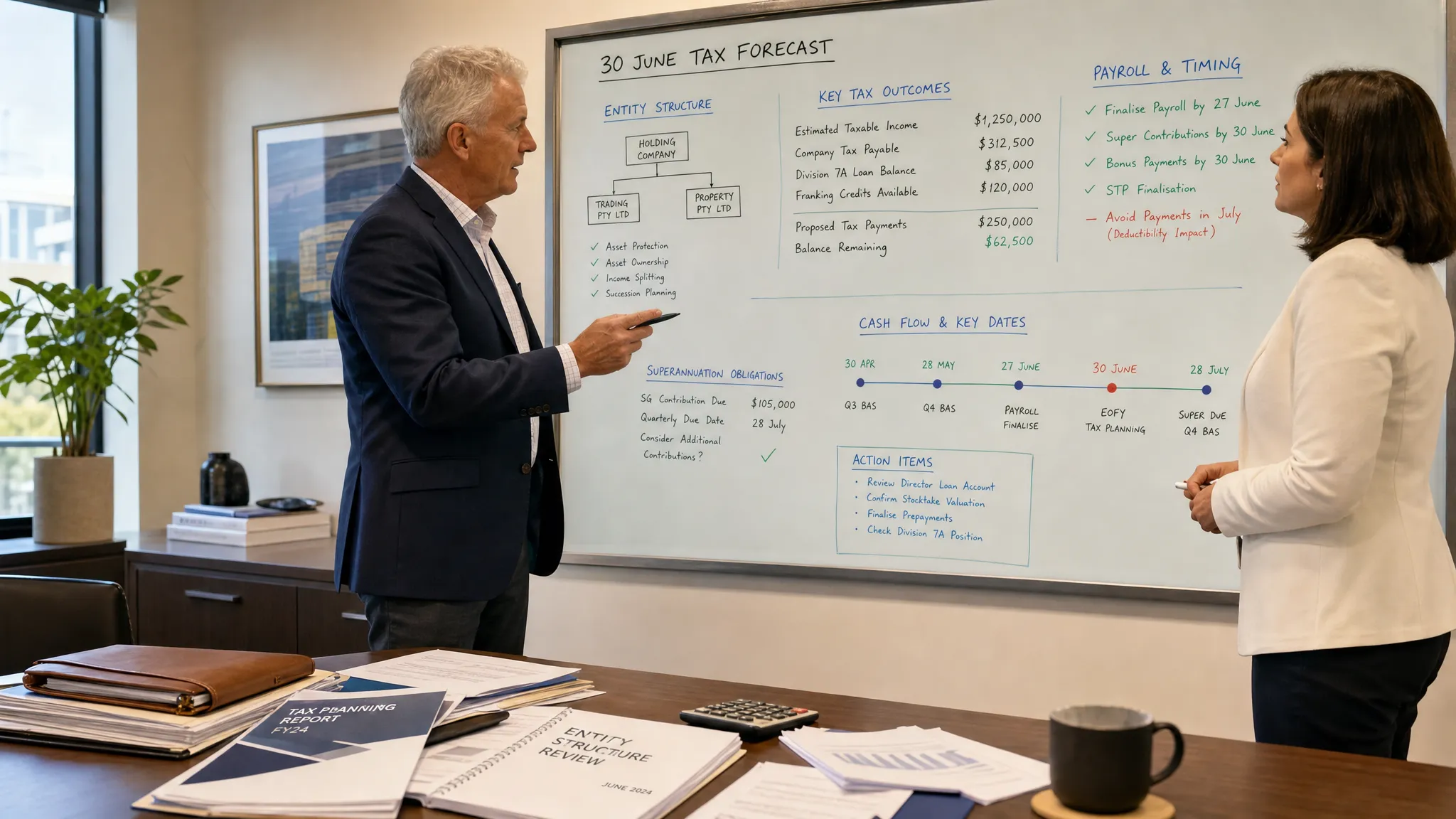
A tax professional becomes a strategic advantage when they help you make better decisions before lodgement, investment, hiring, restructuring or expansion.
This is where we see the greatest difference between basic compliance support and advisory-led accounting.
| Business area | Reactive compliance approach | Strategic tax professional approach |
|---|---|---|
| Tax lodgement | Prepare returns after year-end | Forecast tax positions before 30 June and manage cash flow |
| BAS and GST | Lodge activity statements based on historical records | Reconcile GST monthly and identify margin, pricing or cash-flow issues early |
| Payroll and super | Process wages and superannuation obligations | Review payroll risk, contractor classifications, FBT exposure and super timing |
| Business structure | Use the existing entity indefinitely | Assess whether a company, trust, partnership or group structure still fits the risk and growth profile |
| Capital investment | Record asset purchases after the fact | Model tax, depreciation, GST and financing implications before committing funds |
| ATO enquiries | Respond when an issue arises | Maintain evidence, governance and documentation that reduce audit exposure |
| Growth planning | Focus on annual profit | Link tax, working capital, funding, dividends and director remuneration to growth strategy |
| Exit or succession | Address tax consequences late | Plan CGT, small business concessions, Division 7A and family group issues early |
The strategic value is not in producing more reports. It is in interpreting financial data so directors and owners can act with confidence.

The warning signs that tax needs board-level attention
Many businesses call a tax adviser only when there is a deadline, a problem or an ATO letter. By then, the available options may be narrower.
We recommend elevating tax to a strategic agenda item when any of the following apply:
- Revenue is growing, but cash flow feels tighter than expected.
- BAS payments, PAYG instalments or superannuation obligations are creating periodic pressure.
- Directors are unsure whether wages, dividends, loans or trust distributions are being handled correctly.
- The business operates across states, locations or related entities.
- You are hiring staff, engaging contractors or expanding payroll.
- You are considering asset purchases, finance, property investment or a business acquisition.
- You have retained profits, related-party loans or unpaid present entitlements.
- You are planning to sell, restructure, raise capital or bring in new shareholders.
- You have received ATO correspondence, fallen behind on lodgements or need audit support.
For directors, these are not just tax issues. They are governance issues. Tax debts, unpaid superannuation and inaccurate reporting can affect cash flow, finance applications, director risk and business valuation.
The strategic layers a tax professional should bring
A high-value tax relationship is built on layers. Each layer strengthens decision quality and reduces preventable risk.
1. Accurate financial data
Without accurate data, tax planning becomes guesswork.
The ATO’s record-keeping guidance reinforces the importance of keeping records that explain transactions and support claims. For growing businesses, this should go beyond storing invoices. It should include reconciled bank accounts, clear GST treatment, reliable payroll records, asset registers, loan schedules and documented private-use adjustments.
Our view is direct: bookkeeping is not administration. It is the control layer that makes advisory possible.
When data is clean, we can forecast profit, estimate tax, review working capital, identify anomalies and advise before issues compound.
2. Tax planning linked to cash flow
Tax planning is often misunderstood as minimising tax at all costs. That is not a sustainable strategy.
Effective planning balances tax efficiency, cash-flow resilience, commercial objectives and ATO risk. For example, a deduction may reduce taxable income, but if the purchase weakens working capital or adds unnecessary debt, it may not be a sound business decision.
We assess tax in context. That includes GST timing, PAYG instalments, company tax, trust distributions, Division 7A, FBT, superannuation, asset write-offs and director remuneration.
The goal is not simply a lower tax bill. The goal is a stronger financial position.
3. Entity and structure review
A structure that worked at start-up may not be appropriate once the business has employees, intellectual property, multiple owners, property exposure or retained profits.
We regularly see businesses operating through structures that no longer align with their risk profile or growth plans. Common issues include poor separation between trading risk and assets, inefficient profit distribution, undocumented related-party arrangements, and structures that create unnecessary complexity without strategic benefit.
A structure review should consider:
- Asset protection and commercial risk.
- Tax efficiency and profit extraction.
- GST, payroll tax and superannuation implications.
- Succession, sale or investment readiness.
- Administration cost and governance burden.
This is especially important for family-owned businesses, professional services firms, property groups, technology companies and cross-state operations.
4. Governance and evidence
Good tax governance is not only for large corporates. SMEs, private groups and high-net-worth individuals also need defensible records and clear decision trails.
This matters when claiming deductions, paying directors, distributing trust income, managing loans, treating workers as contractors, applying CGT concessions or responding to ATO questions.
A strategic tax professional helps build the evidence file before it is needed. That may include meeting minutes, loan agreements, logbooks, valuation support, payroll classifications, asset registers, GST reconciliation reports and working papers for significant tax positions.
When an ATO review occurs, well-organised evidence can materially change the tone, speed and outcome of the process.
5. Digital transformation and real-time visibility
The role of the tax professional has changed because the tools have changed.
AI-driven automation can now streamline coding, reconciliations, document capture, exception reporting and workflow management. Used properly, automation does not replace professional judgement. It improves the quality and timeliness of the information on which judgement is based.
Our team uses digital workflows to reduce manual processing, identify irregularities earlier and give clients clearer visibility across tax, cash flow and performance. For business owners operating in Adelaide, Sydney, Melbourne or across multiple locations, that visibility is a major advantage.
Instead of waiting for year-end accounts, directors can work from current numbers. That supports better decisions on hiring, debt, inventory, pricing, dividends, capital expenditure and expansion.
Why this matters more in 2026
By 2026, Australian businesses are operating in an environment where tax, technology and governance are tightly connected.
Several themes are especially relevant for directors and owners:
- The ATO continues to rely heavily on digital data and third-party reporting.
- Superannuation compliance is under greater scrutiny, with payday super scheduled from 1 July 2026.
- ATO interest charges are no longer deductible from 1 July 2025, making tax debt management more expensive.
- Labour models are more complex, especially where contractors, remote teams and gig-based arrangements are used.
- Property, crypto, foreign income and online business revenue are easier for the ATO to identify through data-matching.
- Banks, investors and acquirers increasingly expect clean financial records and credible forecasts.
This environment rewards proactive financial management. It penalises businesses that rely on late reconciliations, informal records or year-end tax clean-ups.
If your business has moved beyond simple transactions, your accounting model should move beyond simple compliance.
Practical examples of strategic tax advice
The value of a strategic tax professional is often clearest in real commercial scenarios.
A growing professional services firm
A consulting firm may appear profitable on paper, but cash flow can deteriorate if PAYG instalments, GST, wages, superannuation and director drawings are not modelled properly. We would review monthly management accounts, set tax reserves, assess remuneration options and identify whether the existing structure still supports growth.
A property investor or developer
Property groups need careful treatment of GST, income versus capital classification, interest deductibility, holding structures, development risk and CGT. A late review can be costly because contractual and financing decisions are often difficult to unwind.
A technology or SaaS company
Digital businesses may need advice on revenue recognition, contractor arrangements, R&D tax incentive eligibility, employee share schemes, international customers, software development costs and investor readiness. Clean financial systems can also improve reporting credibility for capital raising.
A family business preparing for succession
Succession can trigger income tax, CGT, stamp duty and control issues. A strategic adviser helps map ownership, loans, trusts, retained profits and asset transfers before family or commercial negotiations begin.
In each case, the tax work is only one part of the value. The broader advantage is clearer decision-making.
What to expect from a strategic tax relationship
A mature advisory relationship should be structured, not ad hoc.
At a minimum, business owners and directors should expect regular reviews of profit, tax obligations, cash flow, payroll, superannuation, GST, debtors, creditors, capital expenditure and balance sheet risk.
For more complex businesses, the advisory cadence may include monthly management reporting, quarterly tax forecasting, annual structure reviews, board-level reporting, KPI analysis and virtual CFO support.
This is where our work often connects with broader strategic advisory. Tax becomes one input into decisions about pricing, margins, funding, staffing, asset protection and expansion.
If you are assessing whether your current adviser is still appropriate, our guide on choosing tax services that support business growth outlines a practical framework. For company directors, our article on company tax planning in Australia also explains why tax governance should be managed throughout the year.
Questions to ask your tax professional
Before appointing or reviewing an adviser, ask questions that reveal whether they are operating as a processor or a strategic partner.
- Are you registered with the Tax Practitioners Board for the services we need?
- How often will you review our tax position before year-end?
- How do you assess GST, payroll, superannuation and FBT risk?
- Can you help us forecast tax payments and protect cash flow?
- Do you review our structure as the business grows?
- How do you use automation to improve accuracy and reporting speed?
- What evidence should we maintain for ATO reviews or audits?
- Can you support directors across Adelaide, Sydney, Melbourne and other Australian locations?
The answers should be specific. A strategic adviser should be able to explain process, judgement and commercial relevance, not just lodgement deadlines.
Frequently Asked Questions
What does a tax professional do in Australia? A tax professional may assist with tax returns, BAS, GST, PAYG withholding, tax planning, ATO correspondence, payroll-related tax issues and business advisory. If they charge for tax agent or BAS services, they should be appropriately registered with the Tax Practitioners Board.
When should a business owner move beyond basic tax preparation? A business should seek strategic tax support when it has employees, GST obligations, multiple entities, property interests, director loans, trust distributions, foreign income, rapid growth, tax debt, ATO contact or plans to restructure, sell or raise capital.
Can accounting automation replace a tax professional? No. Automation improves speed, accuracy and visibility, but professional judgement is still required to interpret tax law, assess risk, structure transactions and advise on commercial decisions. The best outcomes come from combining digital workflows with experienced advisory.
How often should directors review their tax position? We recommend at least quarterly reviews for active businesses, with more frequent reporting where cash flow is tight, payroll is significant, growth is rapid or the business operates across multiple entities or locations.
Can a tax professional help with ATO audits or overdue lodgements? Yes. An experienced adviser can help review records, prepare responses, communicate with the ATO, correct errors and establish systems to reduce future compliance risk. Early action is usually better than waiting for escalation.
Next steps: turn tax compliance into a strategic asset
If tax is only reviewed at lodgement time, opportunities are missed and risks are discovered late. A stronger approach is to build a financial operating system that connects compliance, automation, forecasting and advisory.
We recommend the following next steps:
- Review your current tax risk profile: Identify overdue lodgements, GST issues, payroll gaps, superannuation timing, director loan balances, trust distributions and documentation weaknesses.
- Clean up the data layer: Ensure bank accounts, accounting software, payroll systems, invoices, receipts and asset records are reconciled and accessible.
- Build a forward tax forecast: Estimate income tax, GST, PAYG instalments, superannuation and FBT obligations before they affect cash flow.
- Assess your structure: Confirm that your entities, asset ownership, profit distribution and governance arrangements still support your growth strategy.
- Adopt automation carefully: Use AI-driven workflows to reduce manual processing, improve accuracy and create real-time visibility, while retaining professional review over key judgements.
How we can help
At Perfect Accounting & Tax Services, we support business owners, company directors and high-net-worth individuals across Australia with integrated tax, accounting and strategic advisory services.
With 25 years of professional experience, our team combines technical tax expertise with AI-driven automation to improve accuracy, streamline workflows and provide clearer financial visibility. We work with clients in Adelaide, Sydney, Melbourne and nationally across corporate accounting, BAS, payroll, tax planning, SMSF compliance, audit support and virtual CFO advisory.
If you want your tax professional to do more than lodge returns, speak with our team. We can review your current position, identify risk areas and show you how automated accounting workflows can support better decisions and stronger growth.
Contact Perfect Accounting & Tax Services to arrange a consultation and take a more strategic approach to your tax and financial management.