
For high-income Australians, tax is rarely just an annual lodgement task. It is a recurring strategic decision that affects cash flow, investment returns, business structures, asset protection, retirement planning and ATO risk.
When income rises, small errors become expensive. A missed capital gains tax calculation, poorly timed superannuation contribution, unsupported deduction, incorrect trust distribution or unmanaged Division 293 exposure can materially change the outcome. That is why individual tax services for high-income earners should do more than prepare a return. They should convert financial complexity into a structured, defensible and forward-looking tax position.
Our team approaches individual tax through the lens of compliance, automation and strategic advisory. We work with professionals, company directors, investors, business owners and high-net-worth families across Australia, including Adelaide, Sydney and Melbourne, to help turn tax reporting into a stronger foundation for financial health.
Why high-income tax affairs are different in Australia
High-income earners face the same income tax system as other individuals, but the consequences are amplified. The top marginal tax rate applies from taxable income above $190,000 for Australian residents in the 2025-26 income year, with the Medicare levy generally applying in addition. For current rate bands, we recommend reviewing our summary of tax rates in Australia for 2026 alongside the ATO’s published individual income tax rates.
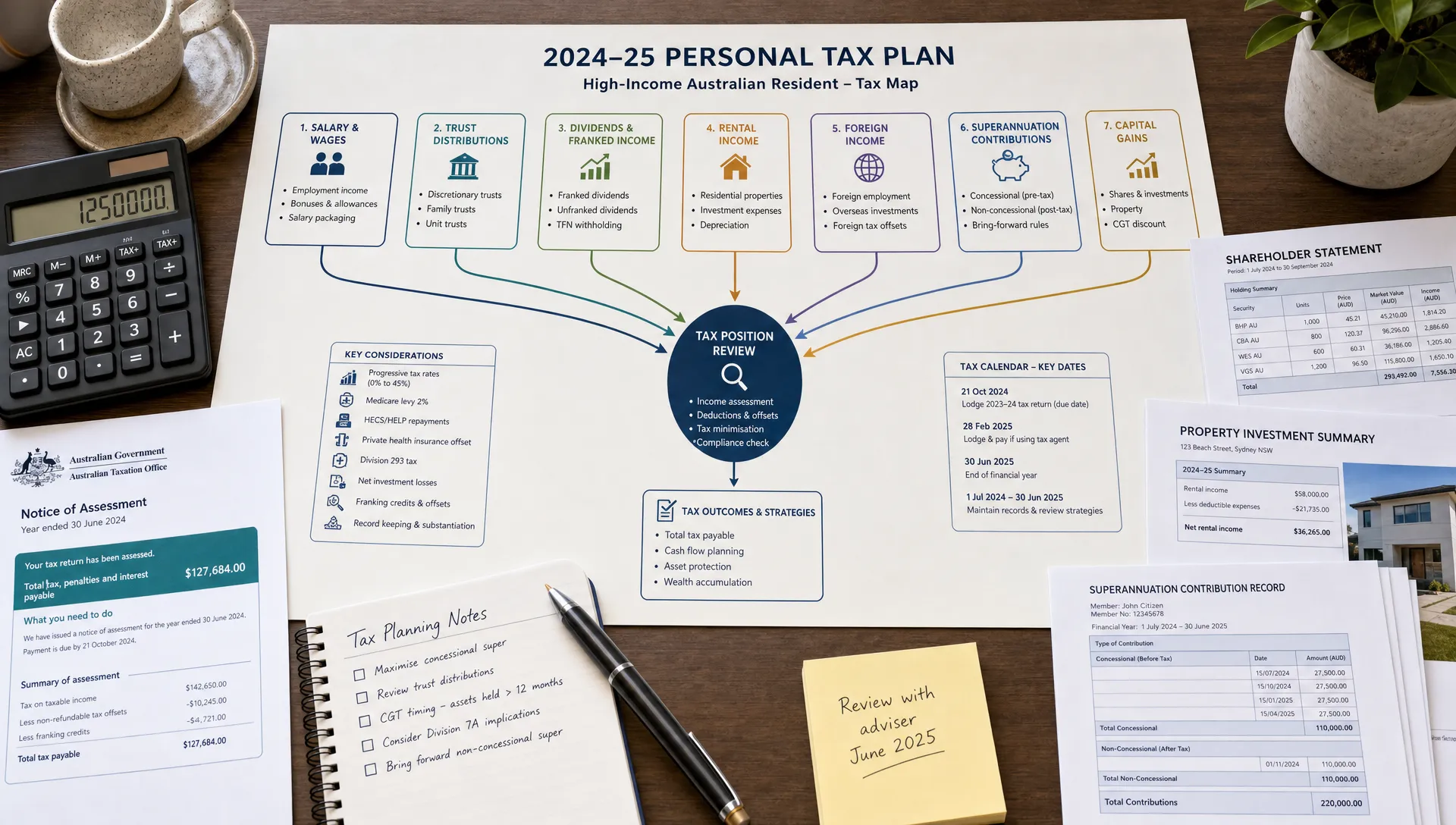
The technical challenge is not simply the rate. High-income Australians often have multiple income sources, including salary, director fees, trust distributions, dividends, rental income, managed fund distributions, foreign income, employee share scheme interests, crypto disposals and capital gains. Each item can have different timing rules, documentation requirements and planning opportunities.
ATO visibility has also increased. Data matching, pre-fill reporting, property transaction data, share registry information, Single Touch Payroll, superannuation reporting and financial institution records now give the ATO a more complete view of individual taxpayers. This does not remove the need for professional judgement. It increases the importance of accurate classification, clean records and a clear explanation trail.
What individual tax services should cover for high-income earners
A high-quality individual tax engagement starts before the tax return is drafted. We first identify what has changed during the year: income mix, asset purchases and disposals, refinancing, business interests, family arrangements, overseas movements, superannuation contributions and major life events.
From there, the work becomes more strategic. We assess tax exposure, documentation strength, timing opportunities and the interaction between personal, business and investment structures.
| Tax area | Why it matters for high-income Australians | What strategic individual tax services should do |
|---|---|---|
| Employment and director income | PAYG withholding may not cover total tax where other income is significant | Review total projected tax, PAYG instalments and cash flow planning |
| Investment property | Interest, repairs, depreciation and private use can create compliance risk | Classify deductions correctly and maintain ATO-ready evidence |
| Capital gains tax | Asset disposals can trigger large one-off tax liabilities | Model timing, cost base, discounts, losses and ownership structure |
| Superannuation | Contribution caps and Division 293 can affect after-tax wealth | Plan concessional contributions, carry-forward opportunities and tax impact |
| Trusts and companies | Distributions, dividends and loans can create complex tax consequences | Align tax outcomes with governance, documentation and commercial purpose |
| Foreign income | Australian tax residents generally report worldwide income | Review residency, foreign tax credits, exchange rates and reporting obligations |
This is where individual tax services become valuable for high-income Australians. The objective is not aggressive tax minimisation. The objective is accurate reporting, legally available optimisation and a tax position that can withstand scrutiny.
Key planning areas that high-income Australians should not leave until lodgement
1. Personal income, PAYG instalments and cash flow
A common issue for high-income earners is underestimating tax payable where income is not fully covered by PAYG withholding. This often affects consultants, medical specialists, lawyers in private practice, IT professionals, real estate agents, high-performing employees with bonuses and directors receiving mixed remuneration.
PAYG instalments can also become misaligned when income changes sharply. A strong adviser will not wait until lodgement to identify the problem. We prefer to forecast the tax position during the year, so clients can manage cash flow and avoid surprises.
For company directors, remuneration planning can involve salary, directors fees, dividends, superannuation and retained earnings. This should be considered together with company tax obligations, Division 7A risk and commercial cash requirements. Directors can also benefit from reviewing our guidance on company tax planning in Australia where personal and corporate tax decisions overlap.
2. Investment property and debt structuring
Many high-income Australians hold residential or commercial property. Tax outcomes often depend on details that are easy to overlook: the purpose of borrowing, whether repairs are truly repairs or capital improvements, how ownership is split, whether the property has been used privately and whether interest has been redrawn for non-income-producing purposes.
The ATO expects deductions to be supported by records. Its guidance on deductions individuals can claim reinforces the need for substantiation, a direct connection to assessable income and apportionment where expenses have mixed use.
Individual tax services help by reviewing the transaction history, loan structure, rental statements, agent reports, depreciation schedules and capital works records. This reduces the risk of overclaiming or underclaiming and creates a cleaner record base for future CGT calculations.
3. Capital gains tax on shares, property, crypto and business interests
Capital gains tax can be one of the largest tax events for high-income individuals. The timing of disposal, asset cost base, ownership period, capital losses, transaction costs and eligibility for concessions all matter.
The ATO’s capital gains tax guidance highlights that CGT is triggered by events such as selling assets, transferring ownership and certain trust distributions. For sophisticated investors, the issue is often not whether CGT applies. It is how the gain is calculated, whether records are complete and whether the disposal fits the wider wealth strategy.
We often see CGT complexity around:
- Investment property sales after periods of private use or absence
- Share portfolios with dividend reinvestment plans and partial disposals
- Crypto assets held across multiple exchanges or wallets
- Employee share scheme interests and vesting events
- Business exits involving shares, units, goodwill or earn-out arrangements
The best outcomes usually come from modelling before disposal, not after the contract is signed.
4. Superannuation, Division 293 and retirement strategy
Superannuation is a powerful tax planning tool, but high-income earners need to navigate caps and additional tax carefully. Concessional contributions are generally taxed at a concessional rate within super, but excess contributions and Division 293 tax can change the position.
Division 293 tax can apply where income and concessional super contributions exceed the relevant threshold, currently $250,000. The ATO explains the rules in its Division 293 tax guidance. This is particularly relevant for executives, specialists, business owners and professionals with large employer contributions or salary sacrifice arrangements.
A strategic tax adviser should review concessional contributions, unused carry-forward concessional cap opportunities where eligible, total super balance, spouse contribution strategies and the timing of contributions before 30 June.

5. Trusts, private companies and family wealth structures
High-income Australians often hold assets or operate businesses through discretionary trusts, unit trusts, companies or SMSFs. These structures can be useful, but they require governance discipline.
Trust distribution resolutions, unpaid present entitlements, beneficiary tax profiles, private company loans, Division 7A, reimbursement agreement risk and commercial purpose all need careful review. Tax planning should not be separated from legal documentation and cash movement.
In our view, the most effective family wealth structures have three characteristics: clear records, consistent decision-making and commercial substance. Tax services should support those outcomes rather than create short-term arrangements that increase future risk.
6. Foreign income, residency and globally mobile professionals
Australian tax residents generally need to report worldwide income. High-income individuals may have offshore employment income, foreign dividends, overseas rental properties, foreign pensions, US share plans, dual residency issues or international business interests.
The complexity increases when foreign tax has already been withheld. Foreign income tax offsets, exchange rates, treaty positions and residency facts need to be reviewed carefully. For expatriates, digital nomads, founders and executives moving between countries, early advice is essential because residency outcomes depend on facts, not labels.
How AI-driven tax workflows improve accuracy and visibility
High-income tax work depends on the quality of data. If income statements, brokerage reports, loan statements, trust distribution minutes, rental summaries and receipts are incomplete, tax advice becomes reactive and slow.
This is where digital transformation changes the process. Our team uses AI-assisted and automated workflows to streamline document collection, reconcile financial data, identify anomalies and improve review efficiency. The value is not merely speed. The value is better visibility before decisions are locked in.
For example, automation can help flag missing investment income, duplicated deductions, inconsistent GST treatment for business-related expenses, unusual expense movements or gaps in rental property evidence. Human judgement remains essential, particularly for interpretation, structuring and ATO risk assessment. However, technology allows our advisers to spend more time on strategy and less time chasing fragmented records.
For business owners and directors, integrated accounting workflows also connect personal tax planning with bookkeeping, BAS, payroll, superannuation and management reporting. That connection is important because personal tax outcomes are often driven by business decisions made months earlier.
When myTax may not be enough
The ATO’s myTax system is efficient for straightforward situations. However, high-income Australians often have too many moving parts for a purely self-managed approach. Pre-fill data is useful, but it does not decide whether an expense is deductible, whether a loan split is correctly apportioned, whether a capital gain has been calculated accurately or whether a trust distribution has been documented properly.
If your affairs include significant investment income, business interests, rental properties, foreign income, employee share schemes, crypto, trusts, SMSFs or late lodgements, professional support usually provides more than convenience. It provides governance and risk control. We have explained this distinction in more detail in our guide on when to use myTax and when to get help.
A practical year-round tax plan for high-income Australians
The strongest individual tax outcomes are built throughout the year. We encourage clients to treat tax planning as a quarterly discipline, not a June panic or October lodgement exercise.
| Timing | Strategic focus | Practical action |
|---|---|---|
| July to September | Review prior-year outcomes | Identify tax drivers, update PAYG instalments and clean up records |
| October to December | Forecast current-year taxable income | Model bonuses, distributions, investment income and likely deductions |
| January to March | Review structures and asset plans | Assess refinancing, CGT events, FBT exposure and business remuneration |
| April to June | Finalise pre-30 June decisions | Consider super contributions, donations, asset disposals and trust resolutions |
| After year end | Prepare and document | Reconcile records, confirm third-party data and lodge with supporting evidence |
This approach supports better cash flow, stronger ATO readiness and clearer investment decisions. It also gives high-income individuals time to act lawfully before the year closes.
What to look for in individual tax services
High-income Australians should assess tax advisers on capability, not convenience alone. The adviser should understand the interaction between personal tax, business tax, asset ownership, superannuation and wealth transfer. They should also have strong systems for documentation, secure data handling and deadline management.
We suggest looking for:
- Australian tax expertise with experience in high-income and complex matters
- A proactive planning process before 30 June
- Strong understanding of companies, trusts, SMSFs and investment structures
- Digital workflows that improve accuracy and reduce administrative drag
- Clear communication around risk, assumptions and documentation requirements
- National capability if your assets, businesses or advisers operate across states
Our team supports clients across Australia with integrated service capability in Adelaide, Sydney and Melbourne. That national reach matters when personal wealth, corporate interests and property holdings cross jurisdictions.
Frequently Asked Questions
Are individual tax services only useful at tax return time? No. For high-income Australians, the greatest value usually comes before year end. Early planning can help manage PAYG instalments, superannuation contributions, CGT timing, trust distributions, documentation and cash flow.
Can a tax adviser reduce tax for high-income earners legally? A tax adviser can help identify lawful deductions, timing strategies, structuring considerations and contribution opportunities. The focus should be compliant optimisation, not artificial schemes or unsupported claims.
Do high-income Australians face more ATO scrutiny? Higher income does not automatically mean an audit, but complex income sources, large deductions, investment property claims, trust distributions, foreign income and data mismatches can increase review risk. Strong records and clear reasoning are essential.
How does automation improve individual tax services? Automation helps collect, reconcile and review data faster. It can reduce manual errors, identify missing information and give advisers more time to focus on tax strategy, risk and financial planning decisions.
When should high-income individuals seek advice before 30 June? Ideally, advice should begin by March or April. This leaves time to review taxable income, superannuation caps, investment disposals, donations, trust resolutions and cash flow before the financial year closes.
Next steps: turn personal tax into a strategic advantage
If your income, assets or business interests have reached a level where tax feels reactive, it is time to move from annual lodgement to structured advisory. The right individual tax services can help you reduce risk, improve cash flow visibility and make better decisions before tax consequences become fixed.
Our team at Perfect Accounting & Tax Services brings 25 years of professional experience, Australian tax expertise and AI-driven automation to support high-income individuals, directors, investors and business owners. We help clients across Adelaide, Sydney, Melbourne and broader Australia build tax workflows that are accurate, compliant and strategically useful.
To review your personal tax position, strengthen your records or explore automated accounting workflows, contact our team through Perfect Accounting & Tax Services and book a consultation. We will help you move beyond tax filing and build a smarter framework for long-term financial health.