
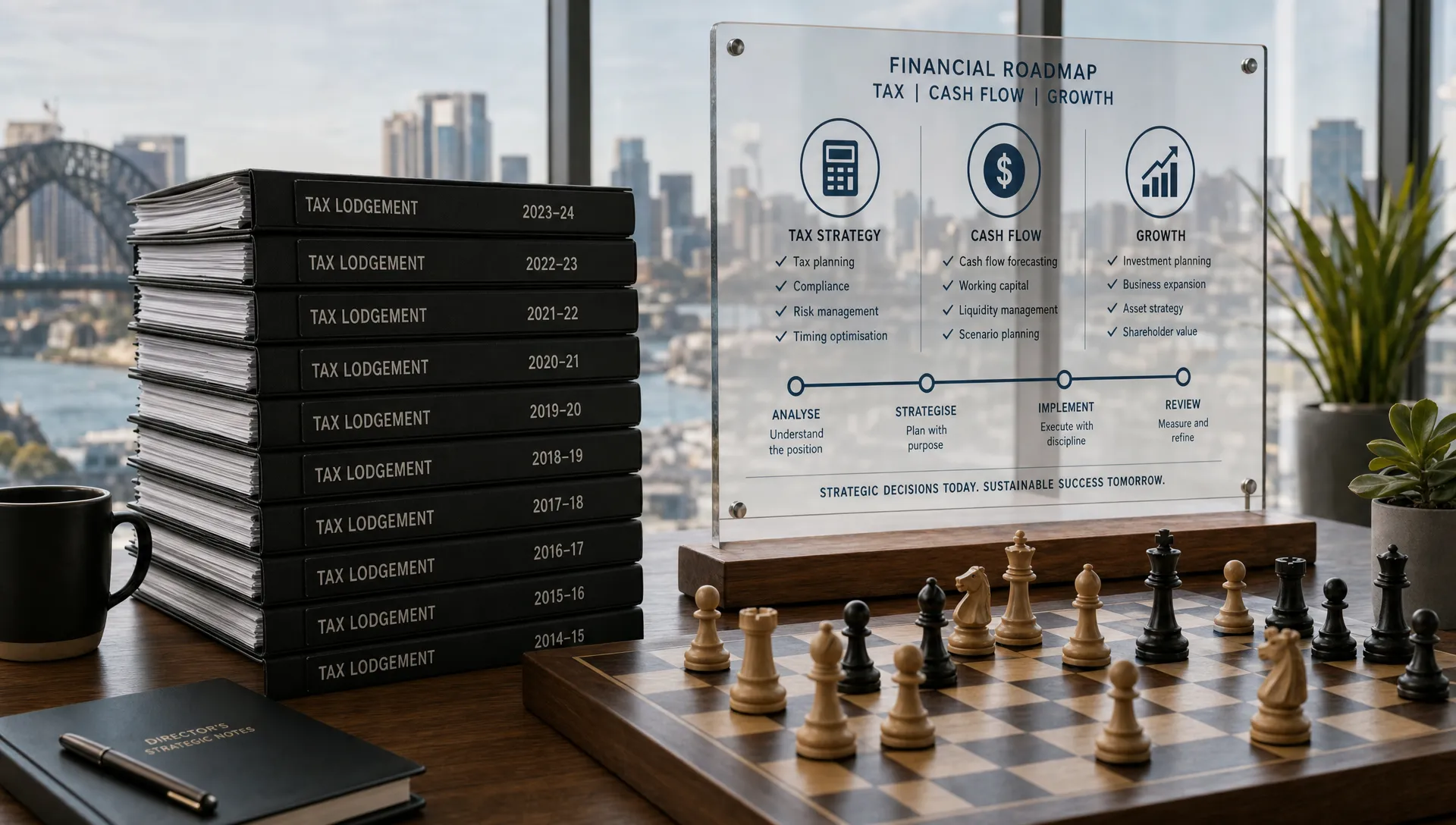
Corporate tax advisory should do more than calculate a year-end tax bill. For Australian companies, directors and high-net-worth business owners, the right adviser should protect compliance, improve cash flow, support growth decisions and reduce the risk of costly ATO attention.
We see effective corporate tax advisory as a strategic function. It connects tax, accounting data, governance, forecasting, entity structure and commercial decision-making. When those areas work together, tax planning becomes a tool for stronger financial health rather than a last-minute compliance exercise.
Below is our practical framework for assessing corporate tax advisory services in Australia.
Start with registration, governance and Australian tax depth
The first requirement is non-negotiable: your adviser should be appropriately qualified and authorised to provide tax agent services in Australia. Before appointing a firm, directors should verify registration through the Tax Practitioners Board public register. Registration alone does not guarantee strategic capability, but it confirms the adviser is operating within the Australian tax agent framework.
For corporate groups, technical depth matters. Your adviser should understand company tax, GST, BAS, PAYG withholding, payroll, Superannuation Guarantee, FBT, Division 7A, trust distributions, shareholder loans, CGT, restructures and ATO review activity. They should also understand how those areas interact.
For example, a director remuneration decision is not just a payroll issue. It can affect PAYG withholding, superannuation, company cash flow, personal marginal tax rates, FBT exposure and retained earnings. Strong corporate tax advisory identifies those connections before decisions are made.
The ATO publishes guidance on areas such as company tax rates, but applying the rules correctly requires a detailed understanding of your entity, income profile and governance records.
Look for commercial thinking, not just technical answers
A technically correct answer can still be commercially weak. The best corporate tax advisers ask how the business makes money, where cash is tied up, what risks the directors are carrying and what growth plans are being funded.
A SaaS company, property developer, medical specialist group, logistics operator and family-owned manufacturer may all operate through companies, but their tax risk profiles are very different. Revenue recognition, stock, work in progress, contractor arrangements, payroll tax, equipment finance, intellectual property, investor funding and related-party transactions all require different treatment.
We look for advisory conversations that move beyond “what can we deduct?” and into questions such as:
- Is the entity structure still fit for growth, asset protection and succession?
- Are BAS, GST and payroll systems producing reliable real-time data?
- Is taxable profit being forecast before 30 June, not after year-end?
- Are director loans, shareholder drawings and related-party balances properly documented?
- Are upcoming acquisitions, divestments or capital investments being modelled before commitments are made?
This is where a tax professional can become a genuine strategic asset. We discuss this broader shift in our article on when a tax professional becomes a strategic advantage.
Require proactive planning before year-end
Corporate tax advisory should operate on a forward calendar. If the first detailed conversation happens after 30 June, many valuable planning opportunities may already be lost.
A proactive adviser should review profit, cash flow and tax exposure progressively throughout the year. This is particularly important for companies with uneven revenue, project-based income, rapid hiring, expansion across states or significant capital expenditure.
| Advisory timing | What should be reviewed | Strategic value |
|---|---|---|
| Monthly or bi-monthly | Management accounts, cash flow, debtor trends, payroll and GST coding | Early detection of margin pressure, compliance errors and tax funding needs |
| Quarterly | BAS, GST reconciliations, PAYG instalments, superannuation obligations and director balances | Cleaner compliance and fewer surprises at lodgement time |
| Pre-31 March | FBT exposure, motor vehicles, employee benefits and salary packaging arrangements | Better documentation before the FBT year closes |
| Pre-30 June | Taxable income forecast, deductions, depreciation, director remuneration and trust distributions | Informed decisions before the financial year ends |
| Post-year-end | Final accounts, company tax return, governance records and next-year planning | Stronger reporting and improved advisory cycle for the next year |
The adviser should also explain assumptions clearly. Directors should know which strategies are low-risk, which require documentation and which may need legal input or specialist advice.
Assess the quality of accounting data and automation
Corporate tax advice is only as reliable as the financial data behind it. If bookkeeping is delayed, BAS reconciliations are inconsistent or payroll records are incomplete, the advisory process becomes reactive and risk increases.
Modern corporate tax advisory services should use cloud accounting, secure digital document capture, bank feed reconciliation, structured review workflows and AI-assisted data processing where appropriate. Automation should not replace professional judgement. It should remove repetitive manual work so advisers can focus on analysis, exceptions and strategy.
Our team uses AI-driven automation to help improve accuracy, speed and visibility across accounting workflows. The benefit for directors is practical: cleaner ledgers, faster reporting, earlier issue detection and more useful conversations about cash flow, tax and growth.
This is also why compliance work should be viewed as a foundation for advisory. BAS, payroll, GST and reconciliations are not isolated admin tasks. They are the data infrastructure that supports forecasting, funding decisions, profitability analysis and corporate governance. If you are reviewing providers, our guide on choosing tax services that support business growth expands on this point.

Confirm their approach to ATO risk management
The right adviser should help you manage ATO risk before it becomes a dispute. This requires more than lodging on time. It requires clean records, defensible positions, written advice, supporting documentation and awareness of areas that commonly attract scrutiny.
Corporate tax risk often arises from patterns rather than one isolated mistake. A company may have technically lodged its returns, but still carry exposure through mismatched GST reporting, poor substantiation, inconsistent payroll records, incorrect contractor treatment or undocumented director transactions.
| Risk area | What a strong adviser should check |
|---|---|
| Income reconciliation | Sales, bank deposits, merchant receipts, platform income and declared revenue align |
| GST and BAS | GST coding is consistent, adjustments are documented and BAS balances reconcile to the ledger |
| Payroll and superannuation | Wages, PAYG withholding, STP reporting and Superannuation Guarantee obligations are accurate |
| Division 7A | Director and shareholder loans are identified, documented and managed within the rules |
| FBT | Motor vehicles, entertainment, car parking and employee benefits are reviewed before lodgement |
| Substantiation | Invoices, contracts, loan agreements and working papers support key tax positions |
We have written separately about company tax return errors that trigger ATO attention, and many of those issues can be prevented with disciplined advisory processes.
For higher-risk matters, the adviser should be able to represent you professionally, prepare evidence, communicate with the ATO and keep directors informed of options and likely outcomes.
Check whether the advice connects tax, cash flow and growth
Tax planning should not sit outside business strategy. A company can reduce taxable income in a way that weakens cash flow, complicates funding or damages future sale value. Conversely, a company can pay more tax than necessary because directors did not have enough visibility to make timely decisions.
A strong corporate tax adviser should help directors understand the cash impact of tax. This includes PAYG instalments, GST liabilities, payroll obligations, loan repayments, dividend decisions and retained earnings. In growth businesses, these issues directly affect hiring, inventory, technology investment and expansion capacity.
This is where virtual CFO thinking becomes valuable. Corporate tax advisory should inform management reporting, scenario modelling, funding readiness and board-level decision-making. For example, before entering a new market or acquiring equipment, directors should understand the tax treatment, cash flow impact, financing options and compliance obligations.
The strategic question is not simply “How do we minimise tax?” A better question is “How do we optimise tax, cash flow and risk in line with the company’s growth plan?”
Review entity structure and related-party complexity
Corporate tax advisory becomes more important as structures become more complex. Many Australian business owners operate through a combination of companies, trusts, SMSFs, investment entities and property holdings. Each layer creates additional tax and governance considerations.
Your adviser should be able to review whether the structure still supports your objectives. This may include business growth, asset protection, succession planning, investor entry, debt funding, sale preparation or family wealth management. Where legal advice is required, your tax adviser should coordinate with your solicitor rather than work in isolation.
Common areas requiring careful review include:
- Company and trust profit distribution strategy.
- SMSF investment compliance and related-party restrictions.
- Property development versus long-term investment treatment.
- Inter-entity loans, management fees and service arrangements.
- Sale of business assets, shares or units.
- Cross-border income, foreign ownership and Australian residency issues.
For high-net-worth individuals and family groups, the advisory lens should extend beyond the company tax return. It should consider the total tax position across business, investment and personal structures.
Expect national capability with local context
Many businesses now operate across multiple jurisdictions. A company may be headquartered in Adelaide, employ staff in Sydney, engage contractors in Melbourne and sell nationally through digital channels. That creates practical compliance issues beyond the annual company tax return.
Payroll tax is administered by states and territories, and thresholds and grouping rules can vary. WorkCover obligations, state-based duties, property taxes and local industry requirements may also need to be considered. A corporate tax adviser should be able to identify when these issues are relevant and coordinate advice across the full operating footprint.
Our integrated service capabilities support clients across Australia, with on-the-ground understanding in Adelaide, Sydney and Melbourne. For directors managing cross-state operations, that combination of national oversight and local context is critical.
Demand clear communication and board-ready reporting
Directors should not have to decode tax advice. Good advice should be technically sound, but also practical, documented and decision-ready.
Before appointing a corporate tax adviser, ask how they communicate recommendations. Do they provide written advice with assumptions? Do they quantify options? Do they explain ATO risk? Do they show the cash flow impact? Do they distinguish between compliance requirements and strategic recommendations?
Board-ready advisory should include:
- A clear summary of the issue and commercial context.
- The recommended treatment and alternative options.
- Tax, cash flow and compliance implications.
- Evidence required to support the position.
- Timing, responsibilities and next actions.
This type of communication improves governance. It also helps directors make decisions with confidence, particularly when dealing with investors, lenders, auditors or the ATO.
Questions to ask before appointing a corporate tax adviser
A short initial consultation can reveal a great deal about the quality of an advisory firm. We recommend asking direct questions that test both technical and strategic capability.
- Are you a registered tax agent in Australia, and who will be responsible for reviewing our work?
- How do you approach tax planning before 30 June?
- What systems do you use to improve accounting accuracy and real-time visibility?
- How do you review BAS, GST, payroll, superannuation and FBT risk?
- Can you support companies operating across Adelaide, Sydney, Melbourne or other Australian locations?
- How do you document advice and manage ATO queries or reviews?
- Do you provide virtual CFO or strategic advisory support beyond compliance?
- How will you help us convert tax and accounting data into better growth decisions?
The answers should be specific. Vague promises about “maximising deductions” are not enough for directors managing serious commercial risk.
Frequently Asked Questions
What are corporate tax advisory services? Corporate tax advisory services help companies plan, manage and optimise tax outcomes while staying compliant with Australian tax law. They can include company tax planning, GST and BAS review, FBT, payroll and superannuation compliance, Division 7A management, structuring, ATO risk management and strategic financial advice.
When should a company engage a corporate tax adviser? Ideally, a company should engage an adviser before major decisions are made. This includes expansion, investor funding, business acquisition, asset purchase, restructuring, succession planning, sale preparation or any period of rapid growth. Waiting until tax return time often limits available options.
How is corporate tax advisory different from bookkeeping? Bookkeeping records transactions. Corporate tax advisory interprets the financial data, identifies tax risks, forecasts liabilities and supports better commercial decisions. High-quality bookkeeping and BAS compliance create the data foundation for stronger advisory work.
Can automation improve corporate tax advice? Yes, when used correctly. AI-driven automation can improve document processing, reconciliation speed, exception detection and reporting visibility. Professional judgement remains essential, but automation gives advisers cleaner data and more time to focus on strategy.
Do multi-state businesses need specialised corporate tax advice? Often, yes. Businesses operating across states may face payroll tax, employment, property, duty and reporting considerations that vary by location. Companies with activity in Adelaide, Sydney, Melbourne or multiple regions should ensure their adviser can manage national obligations with local context.
How we can help
At Perfect Accounting & Tax Services, we provide corporate tax advisory services designed for Australian companies, directors and high-net-worth individuals who need more than basic compliance.
Our team brings 25 years of professional experience across accounting, taxation and strategic advisory. We combine technical tax expertise with AI-driven automation to improve workflow accuracy, reporting speed and real-time financial visibility. That allows us to turn bookkeeping, BAS, GST, payroll and company tax compliance into a stronger platform for corporate growth.
We support clients across Australia, including integrated advisory capabilities in Adelaide, Sydney and Melbourne. Whether you are managing a growing SME, a national operating group, a property structure, a professional practice or a complex family business, we can help you assess risk, improve tax planning and strengthen financial decision-making.
If you are reviewing your current advisory arrangements, contact our team for a consultation. We can help you understand where your tax, accounting and automation workflows are working well, where risk may be building and how a more strategic advisory model can support your next stage of growth.