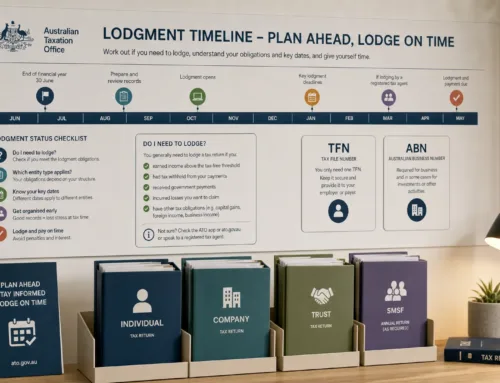

Preparing an individual tax return in Australia becomes significantly more strategic when income is spread across businesses, investments, property, trusts, foreign sources, crypto assets, employee share schemes or company structures. At that point, the return is no longer a simple annual compliance task. It becomes a consolidated financial position that the ATO can test against payroll data, bank interest, managed fund reports, property records, brokerage statements, BAS activity and international information exchange.
We approach complex individual returns as a diagnostic process. The goal is not merely to lodge on time. The goal is to report accurately, defend the position with evidence, optimise legitimate deductions and use the return as a foundation for stronger cash flow planning, investment decisions and corporate growth.
For business owners, directors and high-net-worth individuals, this preparation should start well before the lodgement deadline. ATO pre-fill data is useful, but it is not a complete review. It often arrives late, can contain mismatches and may not capture the context behind complex transactions.
What makes an individual return complex?
A complex individual tax return is usually defined by more than the number of income sources. Complexity arises when income has different tax treatments, timing rules, documentation standards or ATO risk indicators.
Common examples include:
- Sole trader or freelance income reported alongside salary or director fees
- Rental property income, refinancing, repairs, depreciation and private-use apportionment
- Dividends, franking credits, managed fund distributions and AMMA statements
- Trust distributions, partnership income or beneficiary entitlements
- Capital gains from shares, property, crypto assets or business assets
- Foreign income, foreign tax credits and Australian tax residency issues
- Employee share scheme interests, RSUs, options or startup equity
- Contractor income affected by personal services income rules
- SMSF-related personal contributions, pension phase issues or related-party arrangements
- Late returns, amended returns or ATO review activity
The ATO’s guidance on income you must declare makes clear that Australian tax residents generally need to report worldwide income. For complex income, the key question is not simply “Did we receive money?” It is “What is the correct character, timing, source, offset and evidence for this amount?”
Start with residency, structure and the income map
Before we prepare the numbers, we map the taxpayer’s position. This is essential because the same transaction can be taxed differently depending on residency status, ownership structure and whether income is derived personally or through an entity.
Tax residency is the first checkpoint. Australian residents are generally taxed on worldwide income, while foreign residents are generally taxed only on Australian-sourced income. Temporary residents may receive different treatment for certain foreign income. Residency is fact-sensitive, particularly for expatriates, globally mobile executives and individuals who split time between Australia and overseas.
Next, we identify the legal owner of each asset and income stream. For example, rental income may belong to one spouse, both spouses, a trust or a company. Dividends may be held personally or through a family trust. Business income may be generated personally, by a company or by a partnership. The individual return must align with the underlying legal and tax structure.
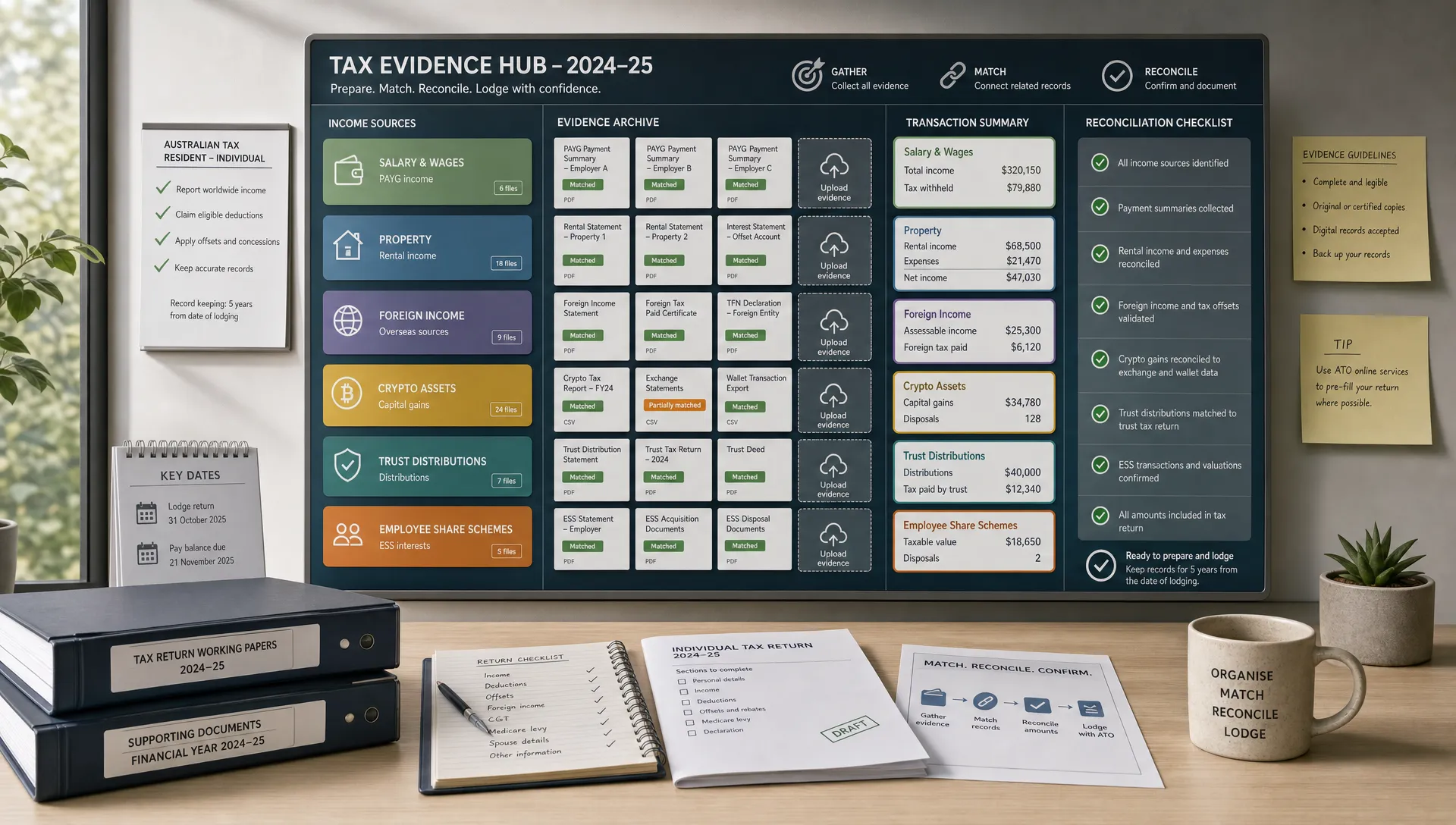
Finally, we build an income map. This is a practical schedule showing each income source, its supporting documents, its tax treatment and any related deductions. We use this map to identify gaps before lodgement, not after the ATO issues a query.
If your return involves multiple entities, loans, trusts, property or offshore income, document quality becomes critical. We have covered the evidence framework in more detail in our guide on which tax documents matter most for complex returns.
Build a source-of-truth document pack
For complex returns, we do not rely solely on bank transactions or ATO pre-fill data. We build a source-of-truth document pack that supports both income and deductions.
| Income or issue | Key records to gather | Preparation risk if missed |
|---|---|---|
| Salary, director fees and allowances | Income statement, PAYG withholding, allowance details, salary packaging or reportable fringe benefits | Incorrect offsets, Medicare levy surcharge impacts or HELP repayment calculations |
| Sole trader or consulting income | Invoices, bank feeds, BAS records, GST reconciliations, expense ledger, asset register | Double-counting GST, missing income or claiming private expenses |
| Rental property | Agent statements, loan statements, depreciation schedules, repair invoices, council rates, insurance, settlement statements | Incorrect interest claims, capital vs repair errors or missed cost base items |
| Shares and managed funds | Dividend statements, franking credits, AMMA statements, brokerage reports | Mismatched distributions, omitted capital gains or franking credit errors |
| Trusts and partnerships | Distribution statements, tax statements, resolutions, financial accounts | Incorrect beneficiary income, timing errors or unexplained variances |
| Foreign income | Foreign payslips, broker statements, foreign tax paid, exchange rates, treaty analysis | Omitted worldwide income or incorrect foreign income tax offset |
| Crypto and digital assets | Exchange reports, wallet records, transaction history, AUD values, staking or reward records | CGT miscalculations, missing disposals or unsupported cost bases |
| Employee share schemes | ESS statement, grant documents, vesting dates, exercise dates, sale records | Incorrect taxing point or duplicated capital gain |
This document pack is more than a compliance file. It creates the basis for advisory work. When records are complete, we can identify tax planning opportunities, cash flow risks, asset performance trends and structural issues that may need attention before the next 30 June.
Reconcile income before calculating deductions
A frequent error in complex individual returns is focusing on deductions before the income position is fully reconciled. We reverse that process. Income reconciliation comes first because deductions are often tied to the nature and ownership of the income.
For business owners and sole traders, we reconcile invoiced revenue, bank receipts, BAS activity and debtor movements. If GST applies, we ensure income is correctly reported net or gross according to the tax schedule being prepared. We also review whether income should be treated as personal services income, business income or income of another entity.
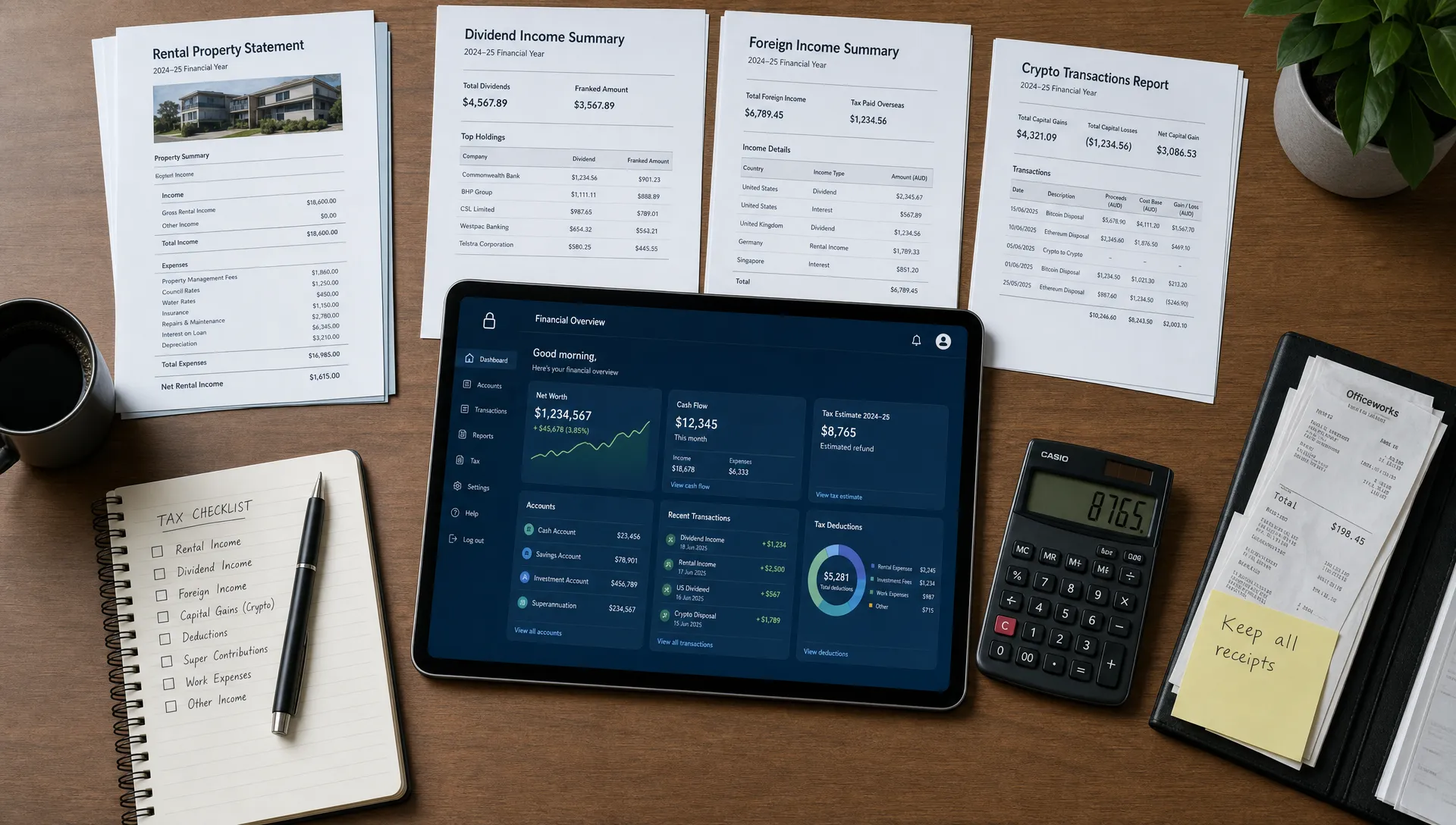
For investors, we compare broker summaries with dividend statements, managed fund tax statements and ATO pre-fill data. Managed fund distributions can include foreign income, capital gains, tax-deferred amounts, franking credits and cost base adjustments. These details cannot be reconstructed reliably from a bank deposit alone.
For property investors, we reconcile gross rent, management fees, loan interest, capital works, repairs, insurance and ownership percentages. We also review whether a property has been used privately, refinanced, renovated or converted between main residence and investment use. Each of these facts can affect deductibility or future CGT.
For foreign income, we review residency, source, foreign tax paid and currency conversion. US income, in particular, requires careful handling because the existence of a US form or withholding tax does not automatically determine the Australian tax treatment. We have a dedicated article explaining what Australian residents need to report for US income where this issue is central.
Calculate capital gains with precision
Capital gains tax is one of the most common pressure points in a complex individual return. A disposal can occur when an asset is sold, transferred, gifted, converted, swapped or otherwise dealt with. For crypto assets, even exchanging one token for another can trigger a CGT event.
We start with the transaction date, ownership details and asset type. Then we reconstruct the cost base. This may include purchase price, brokerage, legal fees, stamp duty, certain holding costs and capital improvement costs, depending on the asset and circumstances. For property, we also check whether depreciation or capital works deductions have affected the cost base.
The CGT discount may be available where the asset has been held for at least 12 months and the taxpayer is eligible. However, the discount is not a substitute for evidence. The ATO can request acquisition records, contract notes, settlement statements and cost base calculations.
Employee share schemes create another layer. If shares or rights have already been taxed under ESS rules, the later CGT calculation needs to avoid double-counting. We review ESS statements and sale records together, not separately.
Review deductions, offsets and private-use apportionment
Once income is reconciled, deductions can be assessed strategically. For complex income, the test is not whether an expense feels business-related. The issue is whether it has the required connection to assessable income, whether it is capital or revenue in nature, and whether any private component has been excluded.
For professionals and business owners, common deduction areas include motor vehicle expenses, home office costs, professional memberships, insurance, accounting fees, software subscriptions, travel and asset depreciation. These claims must align with substantiation rules and should be supported by diaries, invoices, logbooks, usage records or digital audit trails where required.
Home-based entrepreneurs and consultants should be particularly careful. A home office claim may be legitimate, but the method selected must match the records held. Motor vehicle claims require similar discipline, especially where the vehicle is used for both business and private purposes.
For high-income individuals, we also review Medicare levy surcharge exposure, private health insurance details, HELP or study loan repayment impacts, reportable fringe benefits, reportable employer super contributions and Division 293 tax considerations. These items do not always feel like “income”, but they can materially change the final assessment.
Superannuation deductions also require careful timing. Personal deductible contributions generally require a valid notice of intent and acknowledgement from the fund before the deduction is claimed. We review contribution caps, employer contributions and carry-forward concessional contribution availability before making assumptions.
Check entity distributions, loans and director positions
Many complex individual returns are connected to companies, trusts or partnerships. The individual return should never be prepared in isolation from those entities.
For company directors, we review salary, director fees, dividends, shareholder loans and any benefits provided by the company. Division 7A issues can arise where private company funds are used by shareholders or associates without appropriate loan documentation or repayment arrangements. FBT can also affect the broader tax position where cars, entertainment, living-away-from-home arrangements or other benefits are involved.
For trusts, we review distribution resolutions, beneficiary statements and the trust’s tax return position. A mismatch between the trust accounts and the individual return can create avoidable ATO correspondence. Where a family group includes multiple entities, the individual return becomes part of a wider governance framework.
For partnerships, we reconcile the individual’s share of income, deductions, credits and losses. We also review whether the partnership structure still supports commercial objectives, particularly where the business has grown, added employees or taken on higher risk.
This is where compliance becomes strategic advisory. A return may reveal that the current structure no longer fits the client’s asset protection, cash flow, succession or growth objectives.
Use automation to reduce risk and improve visibility
Complex returns benefit significantly from digital transformation. Manual spreadsheets can work in limited cases, but they become fragile when income comes from multiple platforms, entities and asset classes.
Our team uses AI-driven automation and structured review workflows to improve accuracy, speed and real-time financial visibility. This does not replace professional judgement. It strengthens it. Automation helps classify transactions, identify anomalies, reconcile data sources and highlight missing records before lodgement.
For business owners, this means the individual return can be connected to live bookkeeping, BAS, payroll, superannuation and management reporting. For investors, it means income data can be reviewed against broker reports, property statements and entity distributions. For directors, it means personal tax planning can be connected to company cash flow, remuneration strategy and corporate compliance.
The result is a better tax return and a better decision-making system. Instead of discovering problems at lodgement time, we can address them throughout the year.
Conduct a pre-lodgement review
Before lodging a complex individual return, we recommend a structured pre-lodgement review. This is where we test the return from the ATO’s perspective and from the client’s strategic perspective.
Key review questions include:
- Does the income reconcile to ATO pre-fill, bank records and third-party statements?
- Are all foreign income sources and foreign tax credits supported?
- Have capital gains been calculated using complete cost base records?
- Are deductions supported and correctly apportioned for private use?
- Do trust, company and partnership amounts match the related entity records?
- Have Medicare levy surcharge, HELP, FBT and superannuation items been reviewed?
- Will the assessed tax payable create cash flow pressure or PAYG instalment changes?
This review is particularly important for late tax filers, individuals expecting a large tax bill, taxpayers with audit history and professionals planning major transactions. If the return highlights structural or cash flow issues, we prefer to identify them before lodgement rather than respond reactively after assessment.
For complex matters, a consultation before lodgement often saves time and reduces risk. Our article on what to cover in a tax consultation before you lodge provides a useful framework for that discussion.
Common mistakes to avoid
The most expensive mistakes in complex individual returns are rarely mathematical. They are usually classification, timing or evidence errors.
One common mistake is treating ATO pre-fill as complete. Pre-fill data may omit foreign income, crypto disposals, private transactions, trust details or late-issued managed fund statements. Another mistake is claiming deductions from bank descriptions alone without invoices or usage evidence.
We also see issues where taxpayers report trust or partnership income before the entity return is finalised. This can create mismatches and amendments. Similarly, property investors sometimes claim renovation costs as repairs when the expenditure is capital in nature.
Crypto investors often underestimate the volume of CGT events. A portfolio with hundreds or thousands of trades requires transaction-level data, not a year-end estimate. Employees with share schemes may also miss the difference between ESS income and later capital gains.
The best defence is a disciplined preparation process, supported by automation, professional review and clear records.
Frequently Asked Questions
Can I use myTax for a complex individual return in Australia? myTax may be suitable for straightforward salary and basic deduction returns. For complex income involving business activity, property, trusts, foreign income, CGT, crypto or employee share schemes, professional review is usually advisable because the risk is often in classification and evidence, not data entry.
Do Australian residents need to report foreign income? In general, Australian tax residents must report worldwide income, including foreign wages, dividends, interest, rental income, business income and capital gains. Foreign tax paid may be relevant to a foreign income tax offset, but it does not automatically remove the Australian reporting obligation.
What records should I keep for capital gains? Keep purchase and sale contracts, brokerage statements, legal fees, stamp duty records, improvement costs, ownership details and any evidence affecting the cost base. For crypto assets, retain exchange exports, wallet records, transaction dates and AUD values.
When should I start preparing a complex tax return? Ideally, preparation should begin before 30 June, especially where super contributions, asset sales, trust distributions, director remuneration or tax planning decisions are involved. After year-end, records should be finalised as soon as key statements become available.
Can automation replace an accountant for complex tax work? No. Automation improves speed, consistency and visibility, but complex tax work still requires professional judgement. We use AI-driven workflows to enhance review quality, identify anomalies and support strategic advice, not to remove technical oversight.
Next steps: prepare with governance, not guesswork
A complex individual return should give you more than a notice of assessment. It should provide clarity on income quality, investment performance, business cash flow, tax exposure and future planning opportunities.
Our team at Perfect Accounting & Tax Services supports individuals, business owners, directors and high-net-worth clients across Australia, with integrated capabilities in Adelaide, Sydney and Melbourne. We combine 25 years of professional accounting experience with AI-driven automation to streamline records, improve reconciliation and turn compliance into a platform for strategic advisory.
If your next return includes complex income, do not wait until lodgement pressure forces rushed decisions. Contact our firm for a consultation and learn how our automated accounting workflows can help you prepare an accurate, ATO-ready return while improving your broader financial visibility.