
A late tax return is rarely just an administrative inconvenience. For business owners, company directors, property investors and high-net-worth individuals, it can affect finance applications, ATO risk ratings, cash-flow planning, director exposure and even future growth decisions.
For anyone dealing with a late tax return in Australia, the safest response is not simply to rush a return into the ATO portal. Speed matters, but accuracy, evidence and sequencing matter more. We approach late lodgements as a controlled recovery project: identify the exposure, rebuild the records, reconcile the numbers, lodge with confidence and stabilise the payment position.
This article is general guidance only. Late tax matters can escalate quickly, particularly where companies, trusts, GST, payroll, Superannuation Guarantee or multiple prior years are involved. Professional advice should be obtained before lodgement where the facts are complex.
Why a late tax return deserves a controlled recovery plan
The ATO now has extensive data-matching capability. Income from employers, banks, share registries, managed funds, property platforms, Single Touch Payroll, cryptocurrency exchanges and some sharing economy platforms may already be visible to the ATO before a return is lodged.
That data visibility is useful, but it also raises the standard of care. If a late return is prepared from incomplete records or rushed assumptions, the return may create a second problem: an inaccurate lodgement that later requires amendment, explanation or audit support.
We usually see three risks in late lodgement matters.
First, there is compliance risk. The ATO can apply failure to lodge penalties, interest on unpaid tax and firmer collection action where obligations remain outstanding.
Second, there is commercial risk. Overdue tax returns may delay bank lending, business sales, refinancing, government tendering, immigration matters, investor due diligence or personal wealth structuring.
Third, there is strategic risk. When records are behind, management reporting is usually behind as well. Business owners lose visibility over margins, tax liabilities, GST, payroll obligations and working capital. Catching up is therefore not just about filing tax. It is about restoring financial control.
Step 1: Identify every overdue obligation before lodging anything
A safe recovery starts with a full lodgement map. Many taxpayers focus only on the income tax return, but the real exposure may sit across BAS, GST, PAYG withholding, payroll, Superannuation Guarantee, FBT, trust distribution minutes or SMSF obligations.
The ATO account should be reviewed before any return is lodged. This helps confirm which years are outstanding, whether default assessments or estimated liabilities exist, whether debt has been referred for collection and whether lodgement concessions or tax agent program dates may apply.
If ATO contact has already commenced, the communication strategy matters. Before calling, writing or making commitments, it is worth reviewing our guidance on dealing with the ATO without costly mistakes so that the response is factual, documented and controlled.
| Obligation | Commonly affected taxpayers | Why it matters |
|---|---|---|
| Individual tax return | Directors, sole traders, investors, professionals | Needed to finalise taxable income, Medicare levy, offsets and investment reporting |
| Company tax return | SMEs, corporate groups, startups, family companies | Affects retained earnings, franking accounts, losses and director risk |
| Trust tax return | Family trusts, unit trusts, property trusts | Distribution resolutions and beneficiary reporting must be consistent |
| BAS and GST | GST-registered businesses | GST errors often flow into income tax errors and cash-flow exposure |
| PAYG withholding and STP | Employers and closely held payees | Payroll reporting must align with wages, tax withheld and super obligations |
| Superannuation Guarantee | Employers | Late or unpaid super can trigger Superannuation Guarantee Charge obligations |
| FBT return | Employers providing vehicles or benefits | Benefits may be missed when record-keeping is delayed |
This mapping exercise prevents a common mistake: lodging one return while leaving related obligations unreconciled. For example, a company tax return should not be finalised until BAS sales, GST coding, payroll, director loan accounts and year-end journals have been checked.
Step 2: Rebuild the evidence file
Late lodgements often fail because the records are fragmented. Bank statements may be missing, accounting software may not be reconciled, payroll may not match STP, and invoices may sit across email inboxes, cloud drives and old devices.
Our priority is to create an evidence file that can support the return if the ATO asks questions later. For complex returns, that file should include bank statements, loan statements, dividend and managed fund tax statements, rental property records, business invoices, payroll reports, super records, asset purchase documents, trust resolutions and prior-year working papers.
The quality of the document base is especially important for companies, trusts, SMSFs and investment entities. We have outlined the key records in more depth in our article on which tax documents matter most for complex returns.
A practical rule applies: if a deduction, loss, GST credit or tax position cannot be substantiated, it should not be treated casually simply because the return is overdue. Late does not mean lower evidentiary standards. In fact, late lodgements can attract more attention because they may indicate poor governance or incomplete books.
Step 3: Reconcile before you lodge
A late return should be reconciled against external data before lodgement. We do not want the ATO to be the first party to identify mismatches.
For individuals and investors, this means checking pre-fill information, salary and wages, interest, dividends, trust distributions, managed fund statements, rental property schedules and capital gains tax events. For business owners, it means reconciling sales to BAS, payroll to STP, super to clearing house or fund records, and bank movements to the profit and loss statement.
The most important reconciliations are often not complicated, but they must be disciplined.
| Reconciliation area | What we compare | Common issue found in late returns |
|---|---|---|
| Income tax vs BAS | Reported sales, GST-free income and adjustments | Turnover differs between BAS and annual accounts without explanation |
| Payroll vs STP | Wages, PAYG withholding and employee records | Wages claimed in accounts do not match STP finalisation |
| Superannuation | Payroll reports vs actual super payments | Super accrued but not paid by the due date |
| Bank feeds | Bank transactions vs accounting ledger | Personal expenses, duplicate entries or missing income |
| Director loans | Company payments vs Division 7A records | Private payments coded incorrectly or not documented |
| Rental property | Agent statements, loan interest and expenses | Interest, repairs or private-use adjustments not properly separated |
This step is where digital transformation delivers real value. AI-assisted transaction review, bank feed automation and anomaly detection can help identify missing items, unusual coding and year-to-year inconsistencies faster than manual review alone. However, technology does not replace professional judgement. It accelerates the review so that our team can focus on tax treatment, governance and strategy.
Step 4: Understand penalties, interest and payment risk
The ATO may apply a failure to lodge on time penalty where returns or reports are lodged late. The ATO explains that this penalty is generally calculated by reference to penalty units for each 28-day period, or part period, that the document is overdue, up to a maximum number of penalty units for many taxpayers. Higher multipliers can apply to larger entities. The penalty unit amount is set under Commonwealth law and indexed from time to time, so the dollar amount can change.
The ATO's current explanation is available in its guidance on failure to lodge on time penalties.
If tax is payable, the ATO may also charge General Interest Charge on unpaid amounts. The ATO publishes guidance on interest it charges, and rates can change quarterly.
The key strategic point is this: lodgement and payment are separate problems. If a taxpayer cannot pay the full amount immediately, it is usually still better to lodge accurate returns and then address the debt position through a payment arrangement or structured negotiation. Delaying lodgement because funds are not ready can compound the compliance issue.
Penalty remission may be possible in some circumstances, especially where there are valid reasons, strong compliance history, illness, natural disaster, system failure, agent transition issues or other factors beyond the taxpayer's control. The remission request should be evidence-based and professionally framed. Emotional explanations without supporting documents rarely produce the best outcome.
Step 5: Lodge strategically, not emotionally
When several years are overdue, sequencing matters. Later-year returns may depend on earlier-year losses, opening balances, depreciation schedules, franking account movements, trust distributions, Division 7A balances or capital gains tax cost bases.
For this reason, we prefer to lodge in a controlled sequence after the historical position has been reconstructed. If prior-year returns contain errors, amendments may be required before later years are finalised. If the ATO has issued default assessments, a more technical response may be needed.
A rushed lodgement can also lock in poor tax positions. We often see taxpayers omit legitimate deductions because they are anxious to lodge quickly, or claim unsupported deductions because they are trying to reduce a tax debt. Both approaches are unsafe. The correct path is to lodge the strongest defensible return, supported by records and clear working papers.

Specific risks for companies, trusts and high-net-worth investors
Late tax returns become more sensitive when business structures or significant assets are involved.
For companies, the review should include director loans, shareholder payments, Division 7A implications, depreciation, trading stock, bad debts, tax losses, GST reconciliation and payroll compliance. Directors should also be mindful that unpaid PAYG withholding, GST and Superannuation Guarantee Charge can create director-level exposure in certain circumstances.
For trusts, distribution resolutions, beneficiary entitlements and unpaid present entitlements need careful review. A late trust return prepared without checking the trust deed, resolutions and beneficiary tax positions can create avoidable tax and compliance problems.
For property investors and developers, the distinction between capital works, repairs, borrowing costs, interest, private use, vacant land rules and revenue account treatment can be material. Late records often hide errors in loan splitting, redraws, refinancing and mixed-purpose borrowings.
For high-net-worth individuals, the issue is often aggregation. One late return may involve private companies, family trusts, SMSFs, managed investments, employee share schemes, foreign income, cryptocurrency, capital gains and philanthropic structures. The catch-up plan should be coordinated across the entire wealth structure, not handled as isolated forms.
This is where professional tax return filing services become strategic rather than administrative. We have discussed this distinction in our article on when tax return filing services make strategic sense.
How automation makes the catch-up process safer
Late tax work used to be heavily manual: gather files, review bank statements line by line, reconstruct ledgers and prepare returns after weeks of back-and-forth. That approach still requires professional judgement, but modern tools make the process faster and more reliable.
Our AI-driven workflows help streamline document capture, transaction classification, exception review and reconciliation. This gives our team better visibility over missing data, duplicate entries, coding anomalies and unusual movements across years.
The advantage is not simply speed. The deeper benefit is decision quality. Once the historical records are clean, we can produce management insights, identify cash-flow patterns, assess tax provisioning and advise on future structure. Compliance becomes the foundation for strategic advisory and corporate growth.
For a business owner, that shift is significant. Catching up on a late return should not end with a lodged form. It should leave the business with cleaner books, better reporting rhythms, improved tax governance and a forward-looking plan.
A practical late tax return catch-up checklist
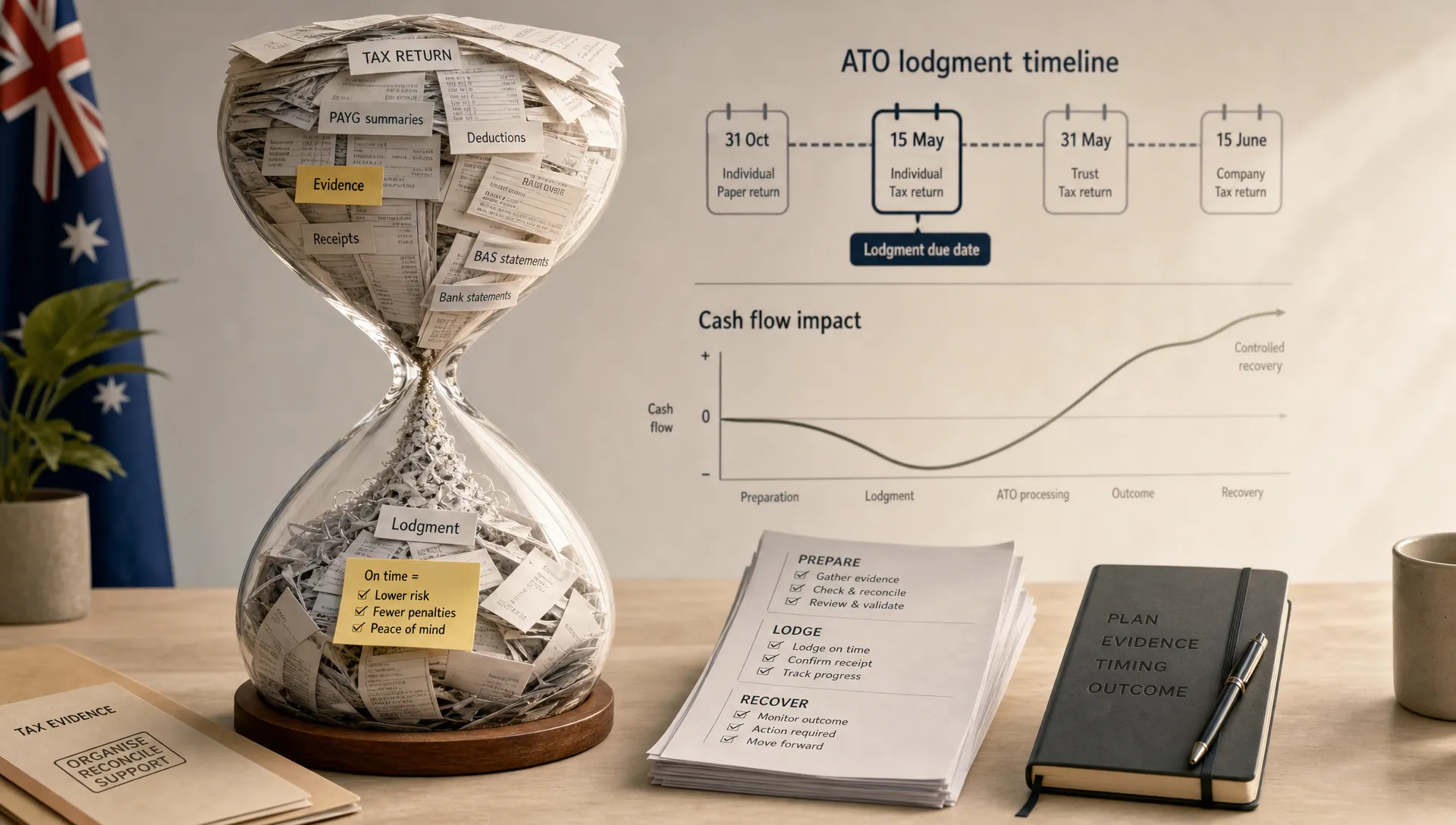
Before lodging, we recommend working through a structured checklist. The exact documents will depend on the taxpayer and entity type, but the following framework applies to most business and investment matters.
- Confirm every outstanding ATO lodgement obligation, including income tax, BAS, FBT, payroll and super-related items.
- Download or obtain full bank, loan, credit card, payroll, investment and property records for the relevant years.
- Reconcile accounting software to bank statements and investigate unreconciled transactions.
- Compare BAS turnover to annual income and identify GST coding issues.
- Match wages, PAYG withholding, STP finalisation and superannuation records.
- Review director loans, trust distributions, private-use adjustments and related-party transactions.
- Prepare a tax debt and cash-flow forecast before lodgement where tax is likely payable.
- Lodge returns in the correct sequence and keep working papers that support all material positions.
- Consider a remission request or payment arrangement where penalties, interest or debt are expected.
- Implement automated bookkeeping and reporting workflows so the issue does not recur.
The final point is often the most valuable. A late lodgement pattern is usually a systems issue, not just a taxpayer behaviour issue. If reporting, bank feeds, document capture, payroll review and BAS preparation are automated properly, annual tax becomes a controlled process rather than a crisis.
Frequently Asked Questions
What happens if I lodge a late tax return in Australia? The ATO may process the return, assess any tax payable or refund due, and consider penalties or interest depending on the circumstances. If multiple obligations are overdue, the ATO may also withhold refunds until other lodgements are brought up to date.
Should we lodge if we cannot pay the tax immediately? In many cases, yes. Lodgement and payment are separate issues. Accurate lodgement can reduce compliance escalation, while the debt can then be managed through cash-flow planning, payment arrangements or ATO negotiation.
Can the ATO remit late lodgement penalties? The ATO may remit penalties where there are reasonable grounds and supporting evidence. A remission request should explain the cause of the delay, the corrective action taken and why future compliance risk has been addressed.
Is myTax suitable for a late return? myTax may be suitable for simple employee returns with complete records. It is usually less appropriate where there is business income, GST, rental property, capital gains, trusts, companies, foreign income, cryptocurrency or several overdue years.
How many years should we catch up at once? This depends on the ATO account, the taxpayer structure and the quality of records. Where multiple years are overdue, we usually reconstruct and review the full sequence first, then lodge in the order that produces the most accurate and defensible outcome.
Will a late tax return automatically trigger an audit? Not automatically. However, late lodgement can increase ATO attention if the return contains mismatches, unsupported deductions, unpaid tax, inconsistent BAS reporting or related-party issues. Quality control before lodgement is the best risk reduction strategy.
Next steps: catch up safely and rebuild control
If a tax return is late, the safest time to act is now. The objective is not to panic-lodge. The objective is to lodge accurately, manage ATO exposure and convert the catch-up process into stronger financial governance.
Our team supports clients across Australia, with integrated service capability in Adelaide, Sydney and Melbourne. We assist business owners, company directors, investors and high-net-worth individuals with late tax returns, BAS clean-ups, payroll reconciliation, ATO communication, penalty remission support, tax debt planning and automated accounting workflows.
We also look beyond the overdue return. Once the backlog is resolved, we can help implement AI-driven bookkeeping, real-time reporting, tax planning and Virtual CFO support so compliance becomes a platform for better decisions and corporate growth.
If you need to catch up on a late return safely, contact Perfect Accounting & Tax Services to arrange a confidential consultation. We will review your ATO position, map the outstanding obligations and build a practical lodgement plan that protects both compliance and commercial outcomes.