

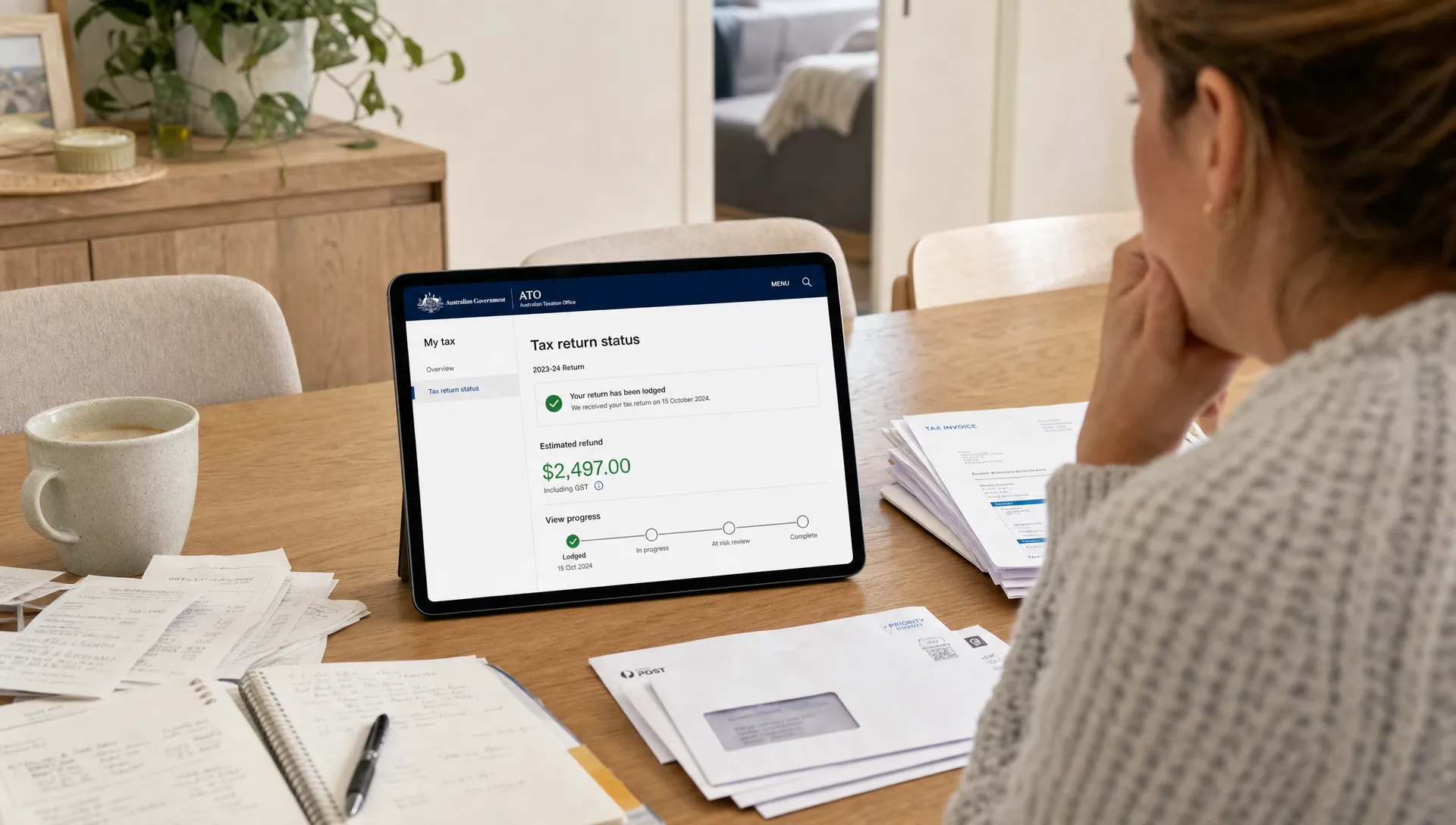
If you are searching “tax return when do you get it”, the practical Australian answer is this: most electronically lodged individual tax returns are processed by the ATO in about two weeks, but the actual refund date depends on lodgement quality, data matching, ATO review activity, debts and your nominated bank details.
Strictly speaking, you lodge a tax return and you may receive a tax refund if your credits, withholding and offsets exceed your final tax liability. For business owners, company directors and high-net-worth individuals, that distinction matters. A refund is not a bonus from the ATO. It is a cash flow outcome of how tax has been withheld, paid and reconciled across the year.
Our team looks at refund timing through a strategic lens. A fast refund is useful, but an accurate return, clean records and reliable cash flow forecasting are more valuable. That is especially true where your affairs include BAS, GST, PAYG instalments, trust distributions, rental property, capital gains, employee share schemes, SMSF interests or cross-state business activity.
“tax return when do you get it”: the usual ATO timeframe
The ATO states that most online tax returns are processed within about two weeks, while paper tax returns can take up to 10 weeks. You can confirm the current ATO guidance through its page on checking the progress of your tax return.
The timing starts when the ATO receives a valid lodged return, not when you begin gathering documents or send information to your accountant. If your return is incomplete, inconsistent or missing third-party information, the clock can effectively stretch because the ATO may need to verify data before issuing a Notice of Assessment.
| Lodgement situation | Usual processing expectation | Strategic comment |
|---|---|---|
| Electronic lodgement through myTax or a registered tax agent | Most are processed in about two weeks | Faster when pre-fill data is finalised and bank details are correct |
| Paper tax return | Up to 10 weeks | Slower and less efficient for business owners with complex schedules |
| Return with rental, CGT, foreign income, trusts or business income | No guaranteed timeframe | Data matching and manual review are more likely |
| Amended return | Often longer than an original online return | The ATO may need to revisit prior assessment data |
For a business owner asking “tax return when do you get it”, the answer is less about the date you sign the return and more about when accurate, reconciled data reaches the ATO.
Why some Australian tax refunds are delayed
ATO refund delays usually arise from risk signals or information gaps. The ATO receives data from employers, banks, health insurers, share registries, government agencies and other institutions. If your return does not align with that data, processing may slow while the ATO checks the discrepancy.
Common delay triggers include incorrect TFN details, old bank account information, undeclared income, mismatched PAYG withholding, private health insurance errors, HELP or Study Assist loan adjustments, outstanding ATO debts and unusual deduction claims. Existing tax debts or other government debts may also reduce or absorb a refund before cash reaches your account.
If the practical concern behind “tax return when do you get it” is working capital, we recommend planning for the refund as uncertain cash until the ATO has issued the Notice of Assessment and released payment. This is particularly relevant for directors who intend to use a refund for loan servicing, supplier payments, superannuation catch-up contributions or investment activity.
For SMEs, refund delays often point to a broader systems issue. Late bookkeeping, unreconciled bank feeds and BAS figures that do not align with the annual income tax return can all create unnecessary friction.
How to check your refund status without creating more risk
For anyone still thinking “tax return when do you get it” after lodgement, the most reliable status indicator is your ATO Online account through myGov or the update provided by your registered tax agent. The ATO’s progress status usually moves through stages such as received, in progress, balancing account and issued.
“Balancing account” generally means the ATO is calculating the final position between your assessed tax, credits, offsets and any other account balances. “Issued” means the Notice of Assessment has been finalised. After that, the refund should be directed to the nominated bank account, subject to bank processing times and any offsets for debts.
Avoid relodging the same return because a refund has not arrived. Duplicate lodgement can create confusion rather than speed. If the ATO requests information, respond promptly and precisely. Where the return was prepared by an adviser, keep all communication coordinated through that adviser so the ATO receives consistent information.
Timing is different for directors, investors and business owners
An employee with one income statement and standard deductions may receive a refund relatively quickly. A company director, property investor or business owner usually has more moving parts. The ATO may need to match dividends, interest, trust distribution statements, managed fund data, capital gains events, rental schedules and business income disclosures.

When a director or investor asks “tax return when do you get it”, we first look at the structure behind the return. A personal refund may be affected by company wages, director fees, Division 7A loan treatment, franked dividends, trust distributions and PAYG instalments. If the taxpayer also operates as a sole trader or partner, the individual return must reflect business schedules accurately.
For GST-registered businesses, the annual income tax return should also make sense when compared with BAS lodged during the year. GST itself is reported through BAS, but inconsistencies between BAS turnover and income tax disclosures can attract attention. This is why we treat compliance as a foundation for strategic advisory and corporate growth, not a once-a-year filing task.
Our article on small business tax return planning in Australia explains how early preparation improves cash flow and reduces unnecessary lodgement risk.
Lodging early can cost more than waiting
Many taxpayers rush to lodge in the first week of July because they want the refund quickly. That can backfire. Employers, banks, share platforms, private health insurers and government agencies progressively send information to the ATO during July. If you lodge before income statements and investment data are marked as tax ready, you may omit income or claim the wrong figure.
The question “tax return when do you get it” is best answered after the return is complete, not merely early. A premature return can lead to an amended assessment, ATO queries, repayment demands or interest charges. For high-income professionals and investors, the cost of correcting an inaccurate return can outweigh the benefit of receiving a refund a few days earlier.
If your affairs are genuinely simple, myTax can be efficient. If you have business income, multiple properties, crypto transactions, employee share schemes, foreign assets or trust distributions, professional review usually provides better control. We have covered that decision in more detail in our guide to when to use myTax and when to get help.
How automated accounting workflows reduce avoidable refund delays
When clients ask “tax return when do you get it”, our first response is to examine data quality. No accountant can force the ATO to process a refund faster, but clean digital records reduce preventable delays and improve the quality of the lodged return.
Our AI-driven processes help organise source documents, identify missing records, test transaction coding and compare income tax data with BAS, payroll, superannuation and management reporting. For business owners, this creates a more reliable lodgement pack and stronger real-time financial visibility. It also allows our advisory team to identify issues before lodgement, not after the ATO has queried the return.
This is where digital transformation becomes practical rather than theoretical. Automated workflows reduce manual handling, improve consistency and give directors clearer insight into tax liabilities, expected refunds and cash flow timing across the year. For businesses operating across Adelaide, Sydney and Melbourne, an integrated system also helps maintain consistent compliance standards across multiple locations.
What to do if your refund is overdue
If “tax return when do you get it” has already turned into a concern because the refund is overdue, start with the status in ATO Online or ask your tax agent to review the account. Check that your bank details are current, confirm whether the ATO has issued correspondence and look for outstanding debts that may have offset the refund.
Do not ignore older compliance issues. Outstanding prior-year returns, overdue BAS, unpaid PAYG withholding, superannuation issues or unresolved ATO debts can complicate the current year outcome. If you have several years outstanding, the strategy should be coordinated rather than reactive.
Our guide on when you need an accountant for back taxes in Australia explains the risks of delayed lodgement and how professional support can help stabilise the position.
Where the ATO has selected a return for review, the right response is evidence-based. Provide records that support the lodged figures, including invoices, bank statements, logbooks, payroll reports, dividend statements, rental records and contract documentation where relevant.
Frequently Asked Questions
If I search “tax return when do you get it”, what is the shortest Australian answer? Most electronically lodged tax returns are processed by the ATO in about two weeks, but your refund can take longer if the return is complex, information is missing or the ATO reviews the claim.
Does using a registered tax agent make the ATO pay my refund faster? A registered tax agent does not control ATO processing speed. The advantage is accuracy, better evidence, deadline management and fewer preventable errors that can slow assessment.
Can the ATO keep my refund? Yes, the ATO can apply a refund against existing tax debts and certain other government debts. You may receive a reduced refund or no cash payment if debts absorb the credit.
Should I lodge in early July to get my refund sooner? Not always. If income statements, bank interest, dividends, managed fund data or private health information are not finalised, early lodgement can create errors and later amendments.
Can a company receive a tax refund? Yes, a company may receive a refund where credits or PAYG instalments exceed its assessed income tax liability. Company refund timing depends on the accuracy of the company tax return and ATO account position.
Next steps: turn refund timing into financial visibility
A tax refund should not be treated as a surprise event. For directors, investors and growing businesses, it should be part of a broader tax planning, cash flow and compliance strategy.
Our team supports clients across Australia, with integrated advisory capability in Adelaide, Sydney and Melbourne. We combine 25 years of professional tax and accounting experience with AI-driven automation to improve lodgement accuracy, accelerate document workflows and give business owners clearer financial visibility.
If you are waiting on a refund, preparing a complex return or trying to modernise your accounting systems before the next tax cycle, contact Perfect Accounting & Tax Services for a consultation. We can review your current position, identify delay risks and show you how automated accounting workflows can turn tax compliance into a stronger platform for strategic growth.