
Back taxes are not a separate tax category in Australia. The term usually refers to overdue tax returns, unpaid income tax assessments, outstanding BAS, GST, PAYG withholding, superannuation guarantee issues, FBT obligations or old ATO debts that have not been properly resolved.
For a sole trader, company director, property investor or high-net-worth individual, back taxes can move from an administrative problem to a strategic risk. The issue is rarely just one missed lodgement. It is the combined effect of penalties, general interest charge, incomplete records, ATO data matching, cash flow pressure and, in company structures, potential director exposure.
This is when an accountant for back taxes becomes more than a form filler. We see the role as a recovery and control function: establish the facts, reconstruct the tax position, lodge accurately, negotiate with the ATO where appropriate and build a digital workflow so the same problem does not recur.
What back taxes mean in the Australian system
In Australian practice, back taxes can involve several obligations at once. A business may have income tax returns outstanding for two years, late BAS for multiple quarters, unpaid PAYG withholding, underpaid superannuation and missing records for motor vehicle, contractor or inventory expenses.
The ATO does not assess these issues in isolation. It has access to Single Touch Payroll data, bank interest, share trading data, property records, super fund reporting, contractor reporting and, increasingly, digital asset information. If your lodgements are behind, the ATO may already have enough third-party data to identify inconsistencies before you contact them.
Common back tax issues include:
- Overdue individual, company, trust, partnership or SMSF tax returns
- Outstanding BAS, GST and PAYG instalments
- PAYG withholding amounts deducted from employees but not paid
- Superannuation guarantee charge obligations for late or missed super
- FBT returns for vehicles, entertainment, housing or employee benefits
- Unreported capital gains from property, shares or crypto assets
- ATO payment arrangements that have defaulted
- Old debts accruing general interest charge
The technical detail matters. A late individual return with no business income is different from a company with unpaid GST and PAYG withholding. A property investor with CGT issues needs a different approach from an e-commerce business with cross-border sales and inventory records.
When you need an accountant for back taxes
You should involve a registered tax agent or an accountant working with a registered tax agent when the issue is beyond a single simple return. The more entities, years, tax types or ATO contact involved, the more value professional judgement provides.
| Situation | Why professional help matters |
|---|---|
| More than one tax return is overdue | Lodgements need to be sequenced correctly so each year uses the right opening balances, losses, depreciation and offsets. |
| BAS or GST is outstanding | GST errors can affect cash flow, ATO debt, supplier records and future reporting periods. |
| Payroll or superannuation is involved | PAYG withholding and super guarantee issues can create director risk and employee entitlement problems. |
| You have received ATO notices | Timeframes matter. A response should be factual, documented and aligned with the ATO’s process. |
| Records are missing or incomplete | Bank data, invoices, payroll files and digital records may need reconstruction before lodgement. |
| There are property, trust, company or SMSF structures | Errors can affect CGT, distributions, Division 7A, franking accounts or fund compliance. |
| You cannot pay the debt immediately | ATO payment arrangements need realistic cash flow modelling, not optimistic estimates. |
| Crypto or foreign income is involved | Reporting must consider acquisition dates, disposals, exchange rates, income character and residency. |
A simple salary and wage return may be manageable through myTax. A multi-year business position with GST, payroll and asset purchases is different. In that environment, the aim is not just to lodge. The aim is to restore compliance without creating avoidable tax, penalty or cash flow damage.
Why delay can become expensive
Late tax issues tend to compound. The first cost is often time: finding old records, confirming income, checking deductions and understanding what has already been reported to the ATO. The second cost is financial.
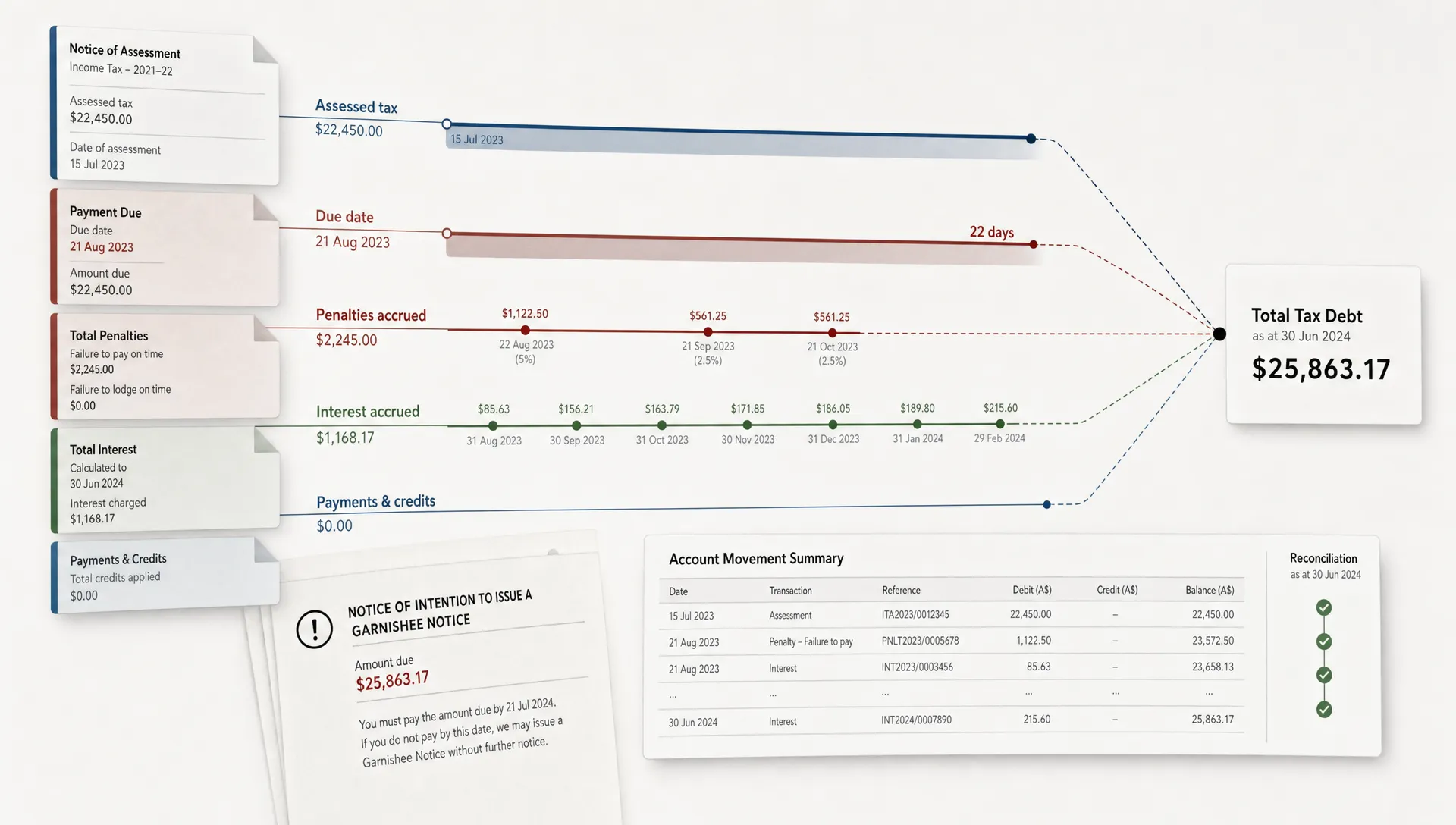
Failure to lodge penalties and interest
The ATO can apply failure to lodge penalties. These are generally calculated by reference to each 28-day period, up to a maximum number of penalty units depending on the entity and circumstances. Larger entities may face higher penalties.
Unpaid tax can also attract general interest charge, which compounds daily. In 2026, this deserves particular attention because interest incurred from 1 July 2025 under the ATO’s general interest charge and shortfall interest charge is no longer deductible. That can make unresolved ATO debt more expensive on an after-tax basis.
A professional can request remission of penalties or interest where there are grounds, but remission is not automatic. The case needs evidence, a credible explanation and a clear compliance plan.
Default assessments and data matching
If returns remain overdue, the ATO can issue a default assessment based on available information. That assessment may overstate taxable income because it may not include all allowable deductions, depreciation, losses or offsets.
Correcting a default assessment can be more demanding than lodging accurately in the first place. We prefer to take control before the ATO has to estimate the position.
Director and payroll exposure
For company directors, unpaid PAYG withholding, GST and superannuation guarantee charge can escalate. The director penalty notice regime can make directors personally liable in certain circumstances. Once a notice is issued, the timeframe for action can be short and the available options depend heavily on whether amounts were reported on time.
This is why back taxes for companies should be treated as a governance issue, not an administrative delay.
What an accountant actually does with back taxes
A good back tax engagement starts with diagnosis. We need to know what is outstanding, what data exists, what the ATO already knows and which lodgements carry the highest risk.
Our team uses structured accounting workflows and AI-assisted automation to accelerate document capture, transaction categorisation and exception review. That technology improves speed and visibility, but it does not replace professional tax judgement. We still test the logic, review tax treatment and consider the commercial context.
| Stage | What we review | Strategic outcome |
|---|---|---|
| ATO position review | Lodgement history, debts, payment arrangements, notices and account balances | Establish the exact compliance gap and immediate risk level. |
| Entity mapping | Individuals, companies, trusts, SMSFs, ABNs, GST registrations and payroll accounts | Identify connected obligations and avoid lodging one entity incorrectly. |
| Record reconstruction | Bank feeds, invoices, payroll files, loan statements, asset registers and contracts | Rebuild a defensible tax file where historical records are incomplete. |
| Tax technical review | GST, BAS, depreciation, CGT, PSI, Division 7A, FBT and superannuation | Reduce preventable errors and identify lawful deductions or adjustments. |
| Lodgement sequencing | Oldest returns, BAS periods, amendments and current-year obligations | Bring the file current without creating new inconsistencies. |
| ATO negotiation | Payment plans, remission requests and response to notices | Align repayment with realistic cash flow and documented compliance action. |
| Forward controls | Bank rules, cloud systems, BAS calendars, payroll checks and reporting dashboards | Turn compliance recovery into ongoing financial visibility. |
This workflow is especially valuable where the business has grown faster than its systems. Many back tax problems are not caused by intentional non-compliance. They arise because a founder, director or investor had no real-time view of GST, payroll, drawings, tax instalments or working capital.
Complex back tax cases require deeper tax analysis
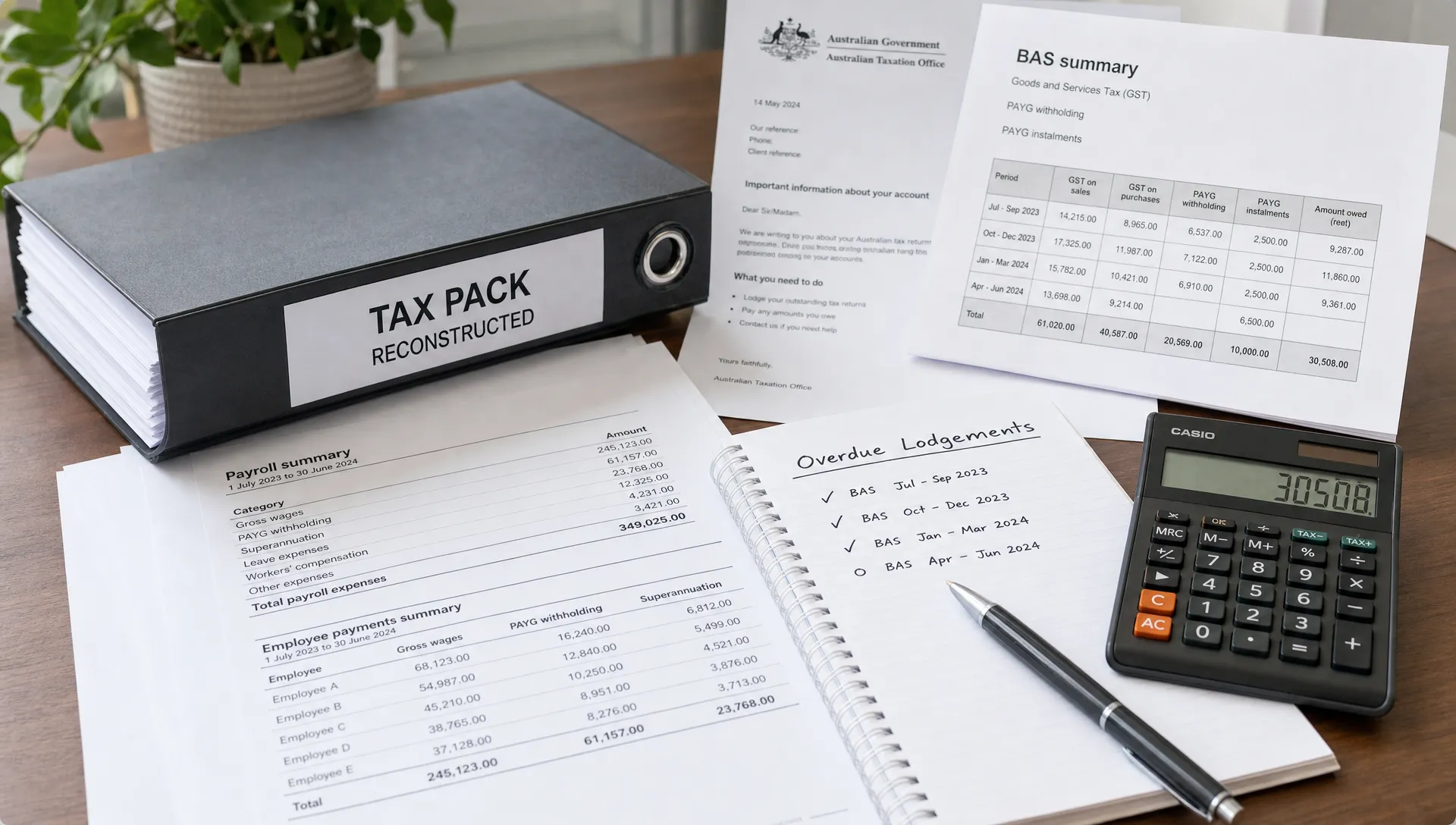
Some overdue lodgements are straightforward. Others require careful reconstruction and strategic judgement. These are the cases where we strongly recommend professional support.
Companies and growing SMEs
Company back taxes often involve income tax, BAS, PAYG withholding, superannuation, director loans and retained earnings. If the company has made loans or payments to shareholders or associates, Division 7A may also need review.
For SMEs, the compliance file is also a strategic data source. Once the historical position is corrected, we can use the same financial information to identify margin pressure, stock issues, payroll leakage, GST timing problems and growth constraints. This is where accounting becomes a foundation for corporate growth rather than a year-end chore.
If you are still managing obligations manually, our guide to tax for small business in Australia explains the core records owners should track before small errors become expensive.
Property investors and high-net-worth individuals
Property back taxes can involve rental income, repairs versus capital improvements, depreciation, borrowing costs, interest apportionment and CGT. For high-end renovations, mixed-use property or family trust structures, the tax treatment can be more nuanced than the bank statement suggests.
We also review whether losses, offsets or prior-year positions have been carried forward correctly. One error in an earlier year can distort later returns, especially where assets are sold or refinanced.
Crypto assets, mining and cross-border activity
Crypto tax problems usually come from poor records, not from the asset class itself. The ATO expects taxpayers to keep records of acquisition dates, disposal dates, wallet movements, exchange transactions, Australian dollar values and the purpose of holdings.
Mining adds another layer. Depending on the facts, mining rewards may be ordinary income, and equipment, hosting, electricity or related costs may need careful treatment. For clients involved in offshore infrastructure, including ASIC hosting or crypto mining infrastructure in the UAE, we also consider Australian tax residency, source of income, foreign exchange and whether the activity is conducted as a business or investment.
Cross-border crypto activity should never be treated as invisible. Australian residents are generally taxed on worldwide income, and the ATO continues to expand data matching in digital asset markets.
SMSFs and trusts
Back taxes involving SMSFs or trusts require discipline. A trust may have distribution minutes, beneficiary entitlements, streaming decisions and unpaid present entitlement issues. An SMSF may have investment, contribution, pension, residency or audit implications.
In these cases, the cost of a rushed lodgement can exceed the cost of taking time to lodge correctly.
What to prepare before engaging an accountant
The faster we can obtain quality information, the faster we can establish the true position. If your records are incomplete, do not delay contact until everything is perfect. We can usually begin with ATO access, bank data and core entity information.
Useful documents include:
- MyGov or ATO correspondence, including notices, statements of account and payment plan letters
- Prior-year tax returns and financial statements, if available
- Bank and credit card statements for each overdue period
- Sales invoices, receipts, supplier bills and loan statements
- Payroll records, STP reports, superannuation payment details and employee data
- BAS workpapers, GST reports and accounting software access
- Property purchase contracts, settlement statements and depreciation schedules
- Crypto exchange exports, wallet addresses and transaction histories
- Trust deeds, company registers, SMSF documents and asset registers
If you do not know what is missing, that is part of the work. A proper accountant will help identify gaps instead of expecting you to diagnose the whole file yourself.
How to decide whether your current process is the problem
Back taxes are often a symptom of a weak financial operating system. If lodgements are always late, BAS is always a surprise or tax debt is treated as a cash flow buffer, the business needs better controls.
For directors and owners, we assess several questions:
- Are bank feeds and accounting records reconciled monthly?
- Is GST visible before BAS is due?
- Are payroll, superannuation and PAYG withholding reviewed before deadlines?
- Are director drawings, loans and dividends tracked properly?
- Are capital purchases recorded with correct depreciation treatment?
- Is there a forecast for income tax, GST and superannuation cash flow?
This is where digital transformation becomes practical. Automated reminders, bank-feed rules, document capture, exception reports and management dashboards reduce the risk of late lodgement. More importantly, they give directors and owners current financial visibility.
If you are assessing whether your adviser has the right capability, our guide on how to choose a tax accountant in Australia covers registration, technology, communication and advisory support.
Accountant versus tax preparer for back taxes
Back taxes usually require more than basic preparation. A tax preparer may be suitable for simple lodgements where the data is complete and the risk is low. An accountant is more appropriate where the work involves reconstruction, BAS, GST, payroll, superannuation, company loans, trusts, property, crypto or ATO negotiation.
The distinction matters because overdue obligations affect future decisions. A director may need finance, a business sale, a restructure, a new entity, a dividend strategy or a payment plan. The historical tax file must support those decisions.
If you are unsure which level of support is appropriate, our comparison of tax preparers and accountants explains when basic lodgement support may be enough and when deeper accounting advice is justified.
Frequently Asked Questions
Can an accountant reduce ATO penalties for back taxes? We can request remission of penalties or interest where there are valid grounds, but the ATO decides whether to approve it. A stronger request usually includes evidence, a clear explanation, corrective action and a credible plan to stay compliant.
Should I lodge old tax returns if I cannot pay the debt? In most cases, yes. Lodgement and payment are separate issues. Lodging can stop failure to lodge penalties increasing and gives a clearer basis for negotiating a payment arrangement with the ATO.
How far back can the ATO require tax returns? The ATO can require overdue returns for prior years where you had an obligation to lodge. The exact years depend on your personal or business circumstances, income, entity type and ATO records.
Can I use myTax for back taxes? myTax may be suitable for simple individual returns. If you have business income, GST, payroll, rental property, crypto assets, trusts, companies, SMSF matters or ATO notices, professional support is usually safer.
What if my records are missing? We can often reconstruct records using bank statements, accounting software, supplier invoices, payroll data, contracts and ATO information. The goal is to create a defensible position, not to estimate without support.
Is an ATO payment plan enough? A payment plan helps only if the lodgements are accurate and future tax obligations are under control. We review cash flow, current-year tax and BAS obligations so a payment plan does not fail after a few months.
Next steps: bring your tax position under control
If you have overdue tax returns, BAS, GST, payroll or ATO debt, the worst option is silence. The best option is a controlled review that establishes the facts, prioritises risk and creates a path back to compliance.
Our team supports business owners, directors, investors and high-net-worth individuals across Australia, with integrated service capability in Adelaide, Sydney and Melbourne. We combine 25 years of professional accounting experience with AI-driven workflows to improve accuracy, speed and real-time financial visibility.
We can help you review your ATO position, reconstruct records, lodge overdue obligations, negotiate with the ATO where appropriate and implement automated accounting processes so tax compliance becomes a platform for better financial management.
To discuss your back tax position confidentially, contact Perfect Accounting & Tax Services and arrange a consultation with our team.