
Tax lodgement should be the final step in a disciplined advisory process, not the first serious review of your numbers. For business owners, directors and high-net-worth individuals, effective tax consultation services should test the commercial reality behind the return, identify ATO risk areas and translate compliance data into forward-looking decisions.
We approach pre-lodgement work as a control point. Before a tax return, BAS reconciliation or company account goes to the ATO, our team wants to know whether the figures are complete, the positions are defensible and the outcome supports the client’s wider financial strategy. That is where modern tax advice moves beyond form filling.
Why a pre-lodgement consultation matters
The ATO receives increasingly detailed information through Single Touch Payroll, bank reporting, superannuation funds, government agencies, investment platforms and digital marketplaces. For many taxpayers, the question is no longer whether the ATO can see an inconsistency. The question is whether you have identified it first and can explain it with proper records.
A sound consultation before lodgement should cover three objectives:
- Confirm that all income, deductions, GST, payroll and investment records are complete.
- Test tax positions against Australian tax law, ATO guidance and available substantiation.
- Use the final numbers to guide cash flow, debt management, profit improvement and future structuring.
This is also why we do not treat bookkeeping as a low-level administrative task. Clean books give directors and owners the evidence base for decisions. If you want a deeper view of what advisory should look like beyond basic lodgement, our article on what an expert tax adviser should really deliver expands on that strategic standard.
Start with entity structure and tax registrations
Before any tax return is lodged, your adviser should confirm that the return reflects the correct legal and commercial structure. A sole trader, company, discretionary trust, unit trust, partnership or SMSF may all produce different tax outcomes from the same underlying activity.
For companies and family groups, the consultation should also consider whether transactions between entities have been recorded correctly. Director loans, trust distributions, management fees, inter-entity charges and asset transfers can create tax issues if they are reviewed only after lodgement.
| Area to review | What should be checked before lodgement | Why it matters |
|---|---|---|
| Entity structure | Sole trader, company, trust, partnership, SMSF or group structure | Determines tax rates, reporting obligations and planning options |
| Registrations | ABN, TFN, GST, PAYG withholding, FBT and relevant state obligations | Reduces missed lodgements and incorrect reporting |
| Related-party balances | Director loans, trust entitlements and inter-entity accounts | Helps manage Division 7A, trust compliance and cash extraction risks |
| Ownership changes | New shareholders, unit transfers, business sales or restructures | May affect CGT, losses, asset protection and control |
For high-net-worth clients, we also review how business entities interact with personal investments, property holdings, family trusts and estate planning objectives. A tax return cannot be assessed in isolation when the family group is the real economic unit.
Confirm income completeness across every channel
A strong tax consultation should challenge whether all income has been captured, not simply accept the ledger balance. This is especially important for businesses with multiple revenue streams, merchant facilities, online sales platforms, government grants, rental receipts, investment income or cross-border payments.
For example, a professional practice may receive income through patient payments, private health fund receipts, third-party finance providers and government benefit schemes. A health practice such as a Gold Coast dentist may need its accounting workflow to distinguish treatment revenue, payment plan receipts, equipment finance and claim-related deposits so that income, GST treatment and cash flow reporting remain accurate.
The same principle applies to e-commerce operators, consultants, tradies, property investors and software businesses. Marketplace deposits, Stripe or PayPal receipts, subscription revenue, foreign exchange differences and deferred income should all be reconciled to source data before lodgement.
Your adviser should ask for evidence that supports the full income picture, including bank reconciliations, debtor reports, POS summaries, platform statements, rental statements, dividend and distribution statements, crypto transaction reports where relevant and loan drawdown records.
Test deductions for timing, evidence and commercial purpose
Deductions are not valuable if they cannot survive review. Pre-lodgement tax consultation services should test whether expenses are deductible, whether they belong in the correct income year and whether they are supported by documentation.
The review should cover recurring expense categories such as motor vehicle costs, travel, training, subscriptions, software, insurance, interest, repairs, professional fees and home-based work arrangements. For business clients, we also look closely at depreciation, asset purchases, prepayments, bad debts, staff costs and contractor payments.
A common issue is the distinction between repairs and capital improvements. A landlord repairing damage to restore an asset may have a different tax outcome from a property owner improving or upgrading the asset. Likewise, a business buying equipment must consider whether the cost is immediately deductible, depreciable or subject to specific small business rules for the relevant income year.
The consultation should also identify expenses with mixed private and business use. Motor vehicles, mobile phones, home internet, travel and entertainment need a defensible apportionment method. In our view, a conservative and well-documented claim is usually more valuable than an aggressive claim that creates audit exposure.
Reconcile GST, BAS, payroll and superannuation
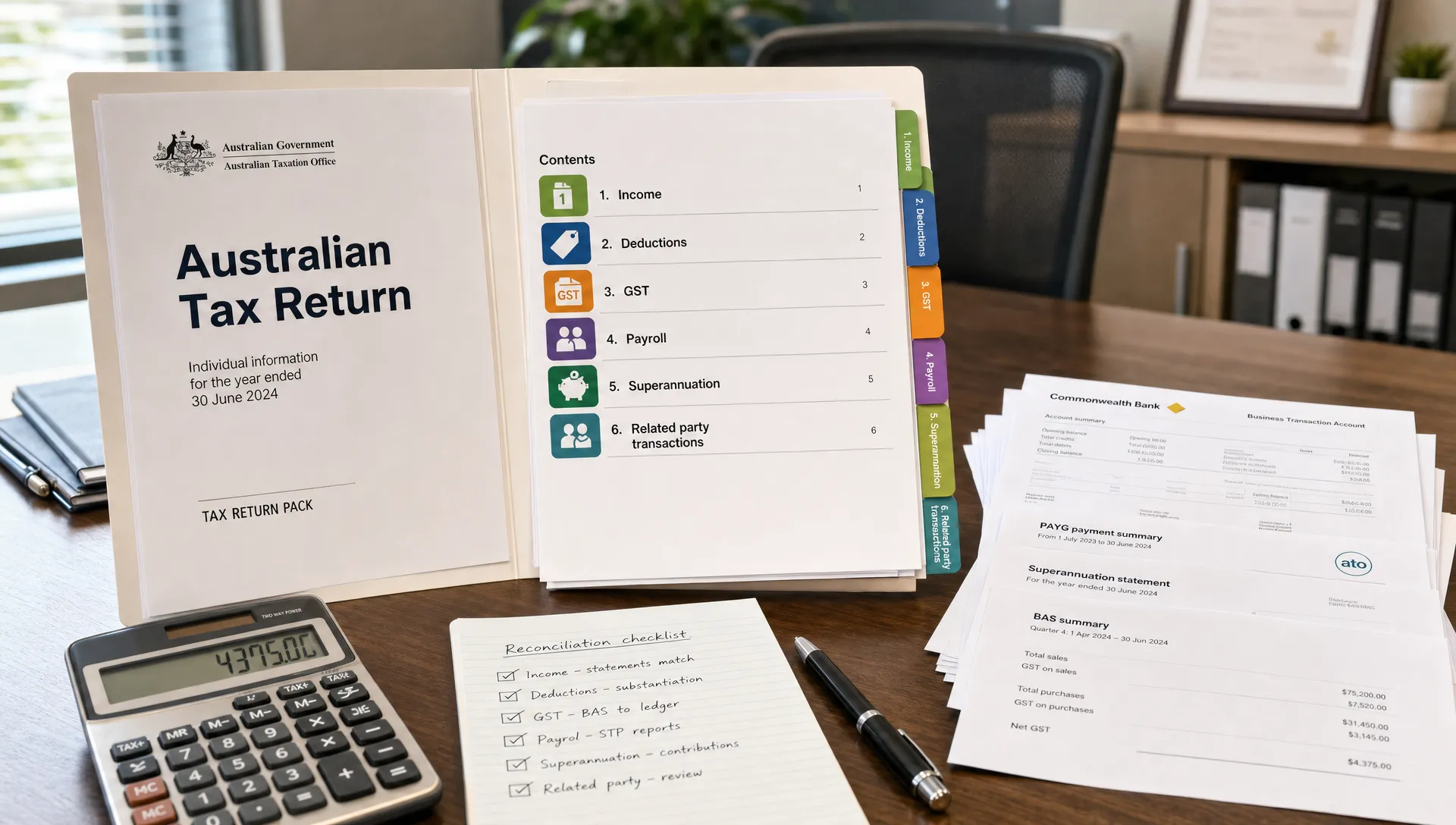
For GST-registered businesses, the annual tax return should not be prepared separately from BAS history. Your adviser should compare the profit and loss statement to BAS lodgements and investigate differences in GST turnover, GST-free income, input tax credits and capital purchases.
Payroll also requires careful review. Wages should reconcile to Single Touch Payroll records, PAYG withholding, superannuation obligations and workers compensation classifications where relevant. Superannuation is particularly important because late or incorrectly paid super can lead to Superannuation Guarantee Charge issues, penalties and non-deductible amounts in certain circumstances.
| Compliance area | Pre-lodgement question | Common risk if missed |
|---|---|---|
| GST | Do BAS lodgements reconcile to annual accounts? | Overclaimed credits, underreported sales or incorrect GST treatment |
| PAYG withholding | Do payroll records match STP finalisation? | Employee income mismatches and ATO queries |
| Superannuation | Were obligations calculated and paid correctly? | SG Charge exposure, penalties and employee disputes |
| FBT | Were cars, entertainment, benefits and employee arrangements reviewed? | Unreported fringe benefits and incorrect deductions |
| Contractors | Are workers correctly classified? | Payroll tax, superannuation and PAYG withholding exposure |
This review is not only about avoiding penalties. Accurate BAS, payroll and superannuation reporting gives owners a clearer view of gross margins, labour cost, productivity and cash requirements. We discuss this broader role in our guide on what a small business tax accountant should help you improve.

Review owners, directors and personal tax interactions
For directors and business owners, the company tax return is only part of the picture. Pre-lodgement consultation should also consider how business profits have been extracted and how those amounts affect personal tax.
This includes salaries, director fees, dividends, trust distributions, loan repayments, expense reimbursements and private use of company assets. Where a private company has made loans or payments to shareholders or associates, Division 7A needs careful attention before the position becomes difficult to unwind.
For high-net-worth individuals, the consultation should also assess investment income, capital gains, negative gearing outcomes, foreign income, foreign tax offsets, employee share schemes, SMSF interactions and family trust distributions. These items often cross multiple tax returns, so the sequence of lodgement matters.
A practical adviser should also explain what can still be improved after 30 June and what cannot. Some planning opportunities must occur before year end. Others, such as certain elections, depreciation treatment, trust distribution documentation review and substantiation cleanup, may still be addressed before lodgement if the facts support the position.
Identify ATO risk areas before the ATO does
Good tax consultation services should include a risk review. This is not about creating fear. It is about understanding where your return may attract attention and preparing the evidence in advance.
ATO risk indicators can include unusually high deductions compared with income, inconsistent GST reporting, large private-use claims, unexplained deposits, poor record keeping, recurring losses, related-party transactions, cash income gaps, late lodgement history or mismatches with third-party data.
Your adviser should be able to tell you which positions are low risk, which are reasonable but need documentation and which should be reconsidered before lodgement. We prefer to document key positions in a working paper or evidence pack, particularly for larger businesses, directors, property investors and clients with complex structures.
This approach is also valuable if you are seeking finance, preparing for investment, negotiating a business sale or dealing with an ATO review. Clean tax files support commercial credibility.
Use automation to improve accuracy and speed
Modern tax advice should be supported by technology, but not replaced by it. Our AI-driven processes help us review large volumes of financial data faster, identify anomalies and improve the consistency of reconciliations. Bank feeds, cloud ledgers, digital document capture and workflow automation reduce manual handling, but professional judgement remains essential.
For clients across Adelaide, Sydney, Melbourne and wider Australia, this means we can work with real-time data rather than waiting for a year-end information dump. We can identify missing invoices, unusual expense patterns, unreconciled payments and GST coding issues earlier in the process.
The best outcome is not simply a faster tax return. It is better visibility. When automation gives owners reliable numbers sooner, the consultation can focus on decisions: cash flow, tax instalments, funding, staffing, margins, investment timing and growth strategy. That is the shift from compliance to strategic advisory.
If you are evaluating whether your current process is sufficiently modern, our overview of what to expect from modern tax filing services may help you benchmark the service level.
Convert the final tax position into a forward plan
A pre-lodgement consultation should not end with the amount payable or refundable. The final tax position should feed directly into the next financial year.
We generally want to discuss upcoming PAYG instalments, ATO payment arrangements if required, expected GST liabilities, working capital pressure, finance covenants, director remuneration, asset purchases, hiring plans and profit improvement opportunities. For growing businesses, we may also consider whether the current entity structure still supports scale, risk management and succession planning.
This is where tax data becomes a management tool. If your return shows margin compression, rising labour cost, slow debtor recovery or increasing reliance on short-term debt, the tax consultation should bring those issues to the surface. Compliance tells you what happened. Advisory helps determine what should happen next.
Questions to ask before you lodge
Before signing a tax return, BAS reconciliation or company financial statement, directors and owners should be comfortable asking direct questions. A good adviser should welcome them.
- Have all income sources been reconciled to bank, platform and third-party data?
- Do deductions have adequate records and a clear business connection?
- Have GST, BAS, STP, PAYG withholding and superannuation been cross-checked?
- Are director loans, trust distributions and related-party transactions correctly recorded?
- Are there any positions likely to attract ATO attention?
- What tax payments, instalments or cash flow issues should we plan for next?
- What can our accounting data tell us about profitability and growth?
If the discussion stops at “sign here”, the consultation is too narrow.
Frequently Asked Questions
What should tax consultation services include before lodgement? They should include a review of entity structure, income completeness, deductions, GST, BAS, payroll, superannuation, owner transactions, investment income, ATO risk areas and forward cash flow planning.
Is a pre-lodgement consultation only necessary for companies? No. Sole traders, trusts, property investors, SMSF trustees, directors and high-net-worth individuals can all benefit from a structured review before lodging with the ATO.
Can tax planning still happen after 30 June? Some planning must occur before year end, but a pre-lodgement review can still improve accuracy, documentation, elections, reconciliations and risk management where the underlying facts support the tax position.
How does automation improve tax consultation? Automation helps reconcile data faster, detect anomalies and reduce manual errors. Our team then applies professional judgement to tax positions, governance and strategic planning.
Should BAS and payroll be reviewed before lodging an income tax return? Yes. BAS, GST, STP, PAYG withholding and superannuation records should be reconciled against annual accounts so that the tax return reflects a complete and consistent financial position.
Next steps: lodge with confidence and use the numbers strategically
Before you lodge, your tax consultation should give you more than a completed return. It should give you clarity on your compliance position, confidence in your records and a practical plan for the year ahead.
Our team at Perfect Accounting & Tax Services supports business owners, directors and high-net-worth individuals across Australia, with integrated service capability in Adelaide, Sydney and Melbourne. We combine 25 years of professional experience with AI-driven accounting workflows to improve accuracy, speed and real-time financial visibility.
If you want your next lodgement to become a strategic control point rather than a year-end scramble, contact our team for a consultation. We can review your tax position, identify key risks and show you how automated accounting workflows can support stronger financial decisions throughout the year.