
A small business tax accountant should do far more than lodge an annual tax return. In 2026, the real value is in improving the financial health of the business throughout the year, from BAS accuracy and cash flow discipline to payroll governance, tax planning, automation and growth decisions.
We see the strongest outcomes when tax compliance becomes a source of commercial intelligence. If your accountant is only reviewing the numbers after year-end, you are receiving history. If they are improving your systems, forecasting your obligations and advising before decisions are made, you are receiving strategy.
For Australian business owners, company directors and high-net-worth individuals with business interests, that distinction matters. A capable small business tax accountant should help you reduce risk, improve visibility and make better decisions before the ATO, the bank or the market forces the issue.
The real benchmark: measurable improvement
A good accountant should not simply ask, “What happened last year?” They should help you answer more valuable questions, such as:
- Are our margins improving or deteriorating?
- Are GST, PAYG withholding and superannuation being funded on time?
- Are director drawings, loans and related-party transactions under control?
- Are we structured appropriately for growth, risk and succession?
- Are we using automation to reduce errors and improve real-time visibility?
At a practical level, the work should improve the quality of your financial data, the predictability of your tax obligations and the confidence behind your business decisions.
| Area your accountant should improve | What that looks like in practice | Strategic outcome |
|---|---|---|
| Financial data quality | Clean reconciliations, correct GST coding, reliable source documents | Better decisions based on current numbers |
| BAS and GST compliance | Regular checks before lodgement, not rushed reviews at deadline | Lower ATO risk and fewer cash flow shocks |
| Tax planning | Profit forecasts, timing reviews and structure advice before 30 June | More controlled tax outcomes |
| Payroll and superannuation | PAYG withholding, STP and Superannuation Guarantee checks | Reduced director and employer risk |
| Cash flow | Tax reserves, debtor monitoring and payment planning | Stronger working capital discipline |
| Structure and governance | Review of entities, loans, trusts and director obligations | Better growth, succession and asset protection planning |
| Automation | AI-assisted bookkeeping workflows and exception alerts | Faster processing and fewer manual errors |
Improve the quality and speed of your financial data
Your accountant cannot provide high-quality tax advice from low-quality records. The first improvement should be data discipline.
That means your accounting system should be structured properly from the start. The chart of accounts should reflect how the business actually operates. GST tax codes should be applied consistently. Bank feeds should be reconciled promptly. Source documents should be captured and retained in a way that supports ATO substantiation requirements.
We increasingly use AI-driven processes to streamline these workflows. Automation can help classify transactions, identify missing invoices, flag unusual movements and speed up reconciliation. However, automation is not a substitute for professional judgement. It is most powerful when combined with a tax accountant who understands your business model, industry risk and reporting obligations.
For example, an e-commerce retailer, a building contractor and a medical specialist may all be “small businesses” for tax purposes, but their reporting risks are very different. Inventory, deposits, subcontractor costs, private use adjustments, payroll and financing arrangements need to be reviewed through the lens of the actual business.
If you are still making decisions from spreadsheets, unreconciled bank accounts or year-old profit reports, your accountant should be helping you modernise the workflow. Clean data is the foundation for Strategic Advisory.
Improve BAS, GST and ATO compliance before issues compound
BAS lodgement should not be treated as a quarterly administrative task. It is a recurring test of whether the business is recording income, expenses, GST, PAYG withholding and payroll correctly.
A strong small business tax accountant should review the patterns behind each BAS. Are GST-free and input-taxed supplies treated correctly? Are motor vehicle and entertainment expenses coded appropriately? Are wages, superannuation and PAYG withholding reconciling to payroll reports? Are deposits, prepayments and merchant settlements being captured accurately?
These questions matter because ATO systems increasingly compare data across Single Touch Payroll, BAS lodgements, income tax returns, taxable payments annual reports, bank data and industry benchmarks. Errors that once stayed hidden until year-end can now trigger review activity much earlier.
We recommend a rolling compliance rhythm. BAS should be reviewed in the context of the year-to-date profit position, cash flow forecast and upcoming tax liabilities. This allows business owners to avoid surprises and directors to act before small issues become expensive problems.
For a deeper record-keeping framework, our guide on tax for small business in Australia explains the key items owners should track throughout the year.
Improve cash flow, not just tax payable
Many businesses focus too narrowly on reducing tax. In our view, the better objective is optimising after-tax cash flow.
A tax deduction is only valuable if the spending makes commercial sense. Buying equipment solely to reduce tax can damage working capital if the asset does not improve productivity, revenue or capacity. Similarly, delaying invoices, accelerating expenses or drawing funds without planning can create GST, PAYG, superannuation and income tax pressure later.
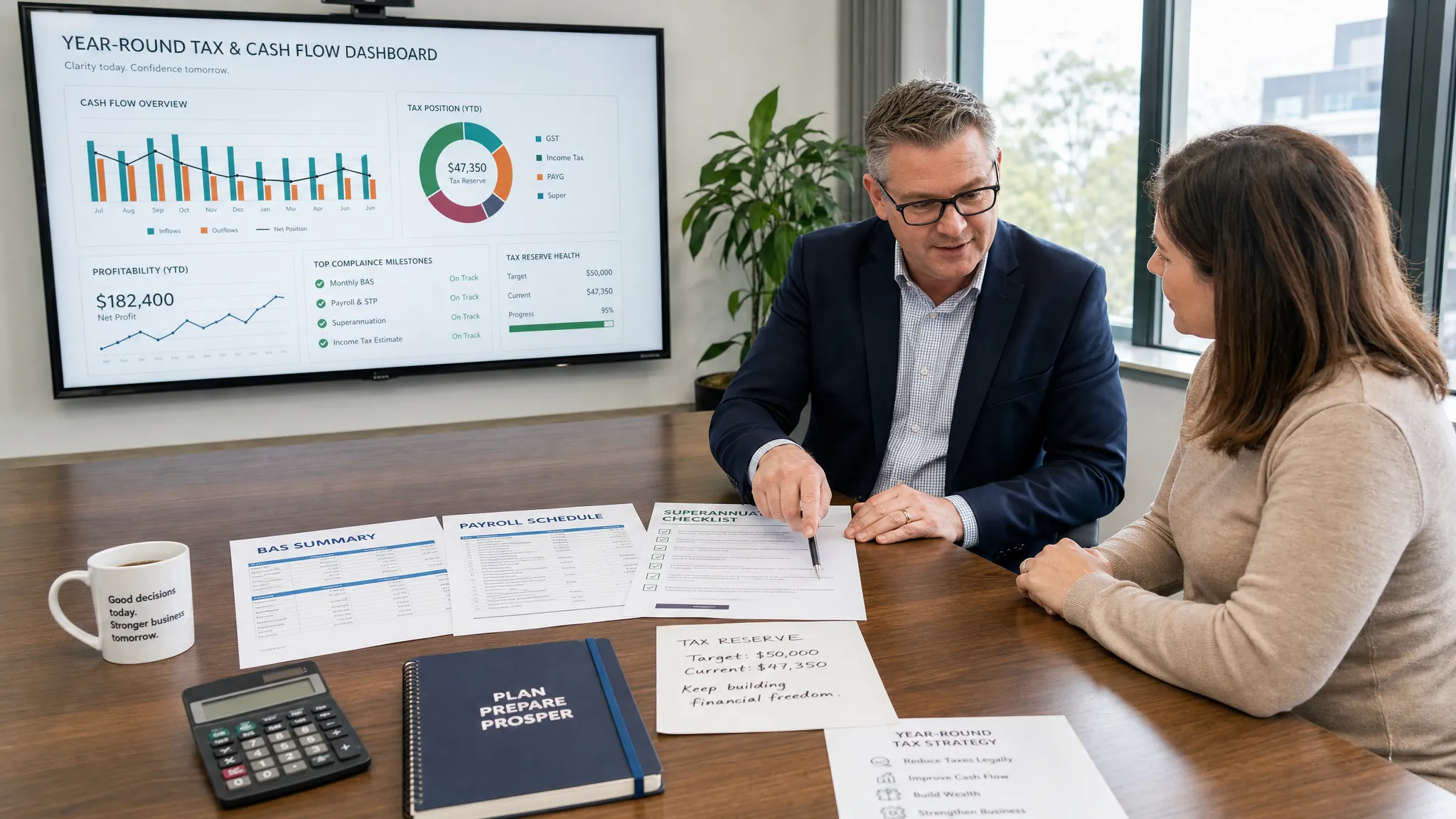
Your accountant should help you forecast tax before the obligation arrives. This includes estimating income tax, GST, PAYG instalments, PAYG withholding, superannuation and, where relevant, FBT or payroll tax. For companies and trusts, the forecast should also consider director remuneration, distributions, retained profits and Division 7A risk.
Cash flow advice should be practical. We often recommend separate tax reserve accounts, monthly tax estimates and rolling 13-week cash flow forecasts for growing businesses. For seasonal businesses, construction firms, hospitality groups and professional practices, timing can be the difference between controlled growth and constant stress.
The improvement is not simply paying less tax. It is knowing what is coming, funding obligations properly and making expansion decisions with clear visibility.
Improve deduction strategy and evidence
A good accountant should help you claim what you are legally entitled to claim, while keeping the evidence strong enough to withstand ATO scrutiny.
This is where judgement matters. The tax treatment of an expense is not always obvious from the bank description. Repairs may be deductible, while improvements may need to be capitalised and depreciated. Motor vehicle costs may require logbook evidence. Home office claims need a clear method. Contractor payments may have reporting obligations. Travel and entertainment expenses need commercial context.
For example, a café, accommodation provider or property investor may need to distinguish between maintenance, appliance repairs and capital improvements. General operational resources such as the PHX Appliance Fix Blog can help non-technical staff describe appliance issues more clearly, but the tax treatment still needs to be assessed under Australian tax principles and supported by invoices, photos, work orders and supplier descriptions.
Your accountant should improve the documentation process, not just review receipts after the event. We prefer systems that capture the invoice, business purpose, GST treatment and approval trail at the time of purchase. This reduces risk and makes year-end tax planning far more efficient.
Improve your structure and director discipline
Business structure should not be set and forgotten. A sole trader structure may be appropriate at the beginning, but it may become inefficient or risky as revenue, staff, assets and contractual exposure increase.
A small business tax accountant should help you review whether your current structure still suits your objectives. This may include sole trader, company, trust, partnership or group structures. The right answer depends on profit levels, risk profile, asset ownership, family circumstances, financing plans and long-term exit intentions.
For company directors, governance is especially important. Director loans, private expenses paid by the company, unpaid present entitlements and related-party transactions can create serious tax issues if they are not managed correctly. Division 7A is a common risk area for private companies, particularly where directors treat company funds as personal cash flow.
The accountant’s role is to create discipline before year-end. That may involve setting director salaries, dividends, loan agreements, repayment plans, trust distribution resolutions and documentation processes. It may also involve coordinating with legal advisers where asset protection, estate planning or shareholder agreements are involved.
We view structure as a strategic growth tool, not merely a tax arrangement.
Improve payroll, superannuation and workforce risk
Payroll errors can be more damaging than many business owners realise. Incorrect PAYG withholding, late superannuation, poor contractor classification and weak payroll records can expose the business to ATO attention, Fair Work issues and director-level consequences.
Your accountant should help reconcile wages, PAYG withholding, superannuation and Single Touch Payroll reporting. They should also identify when contractor arrangements need closer review, especially where contractors work like employees in substance.
With Payday Super commencing from 1 July 2026, employers need to prepare for a more frequent superannuation payment environment. This increases the importance of payroll system accuracy, cash flow planning and timely employee data. Businesses that currently treat superannuation as a quarterly cash flow item should review their processes now.
For growing businesses across Adelaide, Sydney, Melbourne and regional Australia, workforce compliance can become complex quickly. State-based payroll tax thresholds, remote teams, allowances, bonuses, motor vehicles and salary packaging can all affect the broader tax position.
A good accountant should not replace your employment lawyer or HR adviser, but they should identify financial and tax risks early.
Improve profitability through management reporting
Tax returns show historical profit. Management reporting shows what is driving that profit.
Your accountant should help you move beyond a basic profit and loss statement. For many businesses, the more useful insights come from margins by product, job, client, location, consultant or project. This is where accounting becomes advisory.
We often see businesses with growing revenue but weakening cash flow. The cause may be poor pricing, slow debtors, under-recovered labour, stock shrinkage, excessive subcontractor costs or unprofitable service lines. These issues may not be visible in an annual tax return, but they can be identified through well-designed monthly reporting.
A strategic accountant should help answer questions such as:
- Which customers or services are genuinely profitable?
- Are gross margins aligned with wage and supplier cost increases?
- Is the business carrying too much stock or work in progress?
- Are debtors being collected quickly enough?
- Should the business hire, outsource, lease equipment or invest in automation?
This is where our Virtual CFO work often begins. Once the compliance data is clean, we can convert it into forward-looking advice for growth, funding and operational improvement.
Improve readiness for finance, growth and exit
If you plan to seek finance, bring in investors, acquire another business or prepare for sale, your accounting records need to be stronger than “good enough for tax”.
Banks, investors and buyers look for reliable financial statements, clean reconciliations, defensible margins, manageable debt, clear tax lodgement history and evidence that the business can operate without excessive owner dependency. Weak records can reduce valuation, delay finance approvals or create due diligence concerns.
Your accountant should help prepare the business before the opportunity arises. That means cleaning up balance sheet accounts, documenting related-party loans, reviewing asset registers, reconciling GST and payroll accounts, and presenting normalised earnings where appropriate.
For businesses scaling across states, the accountant should also consider multi-jurisdiction compliance issues such as payroll tax, workers compensation, contractor reporting and local operating structures. Our integrated team supports clients across Australia, with practical service capability in Adelaide, Sydney and Melbourne.
Improve your use of AI and automation
Automation is no longer optional for serious business owners. Manual bookkeeping, delayed reconciliations and paper-based approvals slow down decision-making and increase the risk of error.
The right accountant should help you adopt technology in a controlled way. That does not mean automating every process immediately. It means identifying the highest-risk and highest-volume workflows first, then building reliable systems around them.
In practice, this may include automated invoice capture, bank reconciliation support, recurring transaction rules, digital approval workflows, payroll integrations, exception reporting and real-time financial visibility. AI can help identify anomalies, but the accountant must still interpret the result and advise on tax consequences.
We see automation as a way to elevate the accountant’s role. When less time is spent chasing receipts and correcting coding errors, more time can be spent on planning, forecasting and strategic decisions.
When should you upgrade your small business tax accountant?
You may need a more strategic accountant if tax time always feels reactive, if BAS lodgements are rushed, or if your profit and cash flow tell different stories. Other warning signs include unclear director drawings, late superannuation, poor debtor control, repeated ATO notices, expanding payroll, multi-entity structures, rapid revenue growth or plans to raise finance.
The earlier you upgrade the advisory relationship, the easier it is to correct the system. Waiting until an ATO review, finance application or business sale often makes the process more expensive and disruptive.
Before appointing an accountant, ask how they will improve your cash flow visibility, how often they will review GST and payroll accounts, how they approach tax planning before 30 June, what automation they use, and whether they can support strategic decisions beyond annual lodgement. Our article on choosing tax services that support business growth outlines a broader selection framework.
Frequently Asked Questions
What should a small business tax accountant do besides lodge returns? They should improve bookkeeping quality, BAS accuracy, GST treatment, payroll compliance, tax planning, cash flow forecasting, business structure and management reporting. Lodgement is only one part of the role.
How often should a small business accountant review the numbers? For most growing businesses, monthly review is preferable. Quarterly may be sufficient for simpler operations, but BAS, payroll, superannuation and cash flow should still be monitored before deadlines.
Can an accountant help reduce tax legally? Yes, but the best advice is planned early. Legal tax reduction may involve timing, structure, deductions, depreciation, remuneration planning and documentation. It should never rely on unsupported claims or artificial arrangements.
Is automation useful for small business tax accounting? Yes. Automation improves speed, consistency and visibility, especially in transaction capture, reconciliations and reporting. However, AI-assisted workflows still require professional review and Australian tax expertise.
When should a sole trader consider changing structure? A review is sensible when profit rises, risk increases, staff are hired, assets are accumulated or the owner wants to prepare for growth or sale. The decision should consider tax, legal, commercial and family objectives.
Next steps: turn compliance into strategic advantage
If your current accounting process only tells you what happened after the year is over, it is not doing enough. A modern small business tax accountant should help you improve the system, not simply process the outcome.
Our team can review your bookkeeping workflow, BAS and GST settings, payroll and superannuation processes, structure, tax planning approach and management reporting. We combine 25 years of professional experience with AI-driven automation to provide faster processing, stronger accuracy and clearer real-time visibility.
We support businesses and directors across Australia, including Adelaide, Sydney and Melbourne, with accounting, tax, Virtual CFO and strategic advisory services.
Contact Perfect Accounting & Tax Services to arrange a consultation and learn how our automated accounting workflows can help you improve compliance, cash flow and corporate growth.