
Whether a tax return is compulsory is not determined by job title alone. In Australia, the obligation depends on tax residency, income type, tax withheld, business structure, investment activity, and whether the ATO expects a lodgment for your TFN, ABN, company, trust, or SMSF.
For company directors, property investors, sole traders, and high-net-worth individuals, this is more than an annual compliance question. Lodgment is often the point where cash flow, tax planning, asset protection, Superannuation, GST, payroll, and business growth strategy intersect.
The ATO provides a useful Do I need to lodge a tax return? tool, but complex affairs require judgement. In our experience, the risk is not only failing to lodge when required. It is also lodging without understanding the broader financial consequences.
The strategic rule: lodgment is about more than the tax-free threshold
Many taxpayers start with the tax-free threshold. For eligible Australian resident individuals, the first $18,200 of taxable income is generally tax-free. However, that threshold does not settle every lodgment question.
You may still need to lodge if tax was withheld, you operated as a sole trader, you had reportable business or investment activity, you made a capital gain, you received foreign income, or you are connected to an entity that has its own reporting obligations.
If you want a deeper explanation of how the threshold works, our guide to the tax-free threshold in Australia explains why it is often misunderstood.
The practical point is this: tax return requirements in Australia are triggered by facts, not assumptions. A low-income year, a business loss, or a dormant company does not automatically mean no lodgment is required.
Quick guide: who generally must lodge a tax return?
The table below summarises common situations. It is not a substitute for advice, but it gives a useful starting framework.
| Taxpayer or entity | Is lodgment generally required? | Key reason |
|---|---|---|
| Australian resident individual with taxable income above $18,200 | Yes | Taxable income exceeds the tax-free threshold |
| Individual with PAYG tax withheld, even if income is below $18,200 | Yes | ATO generally requires lodgment where tax has been withheld |
| Sole trader with an ABN | Yes | Business income and deductions must be reported in the individual tax return |
| Company | Generally yes | Companies have separate tax return obligations from their directors and shareholders |
| Partnership | Generally yes | Partnership income and distributions must be reported, even though the partnership itself does not usually pay income tax |
| Trust | Generally yes | Trust income, losses, and beneficiary distributions must be disclosed |
| SMSF | Yes, in most cases | SMSFs lodge an annual return covering tax and regulatory reporting |
| Foreign resident with Australian-sourced income | Generally yes | Foreign residents are taxed on Australian-sourced income, subject to specific withholding rules |
| Individual with no taxable income, no tax withheld, no business, and no reportable events | May not need to lodge | A non-lodgment advice may still be required to close the ATO record for the year |
Individuals: the main lodgment rules
Australian residents for tax purposes
Australian tax residents are generally taxed on worldwide income. This includes salary, business income, investment income, rental income, foreign dividends, foreign pensions, capital gains, and some trust distributions.
An Australian resident individual will usually need to lodge if taxable income is above the tax-free threshold. Lodgment is also generally required if tax was withheld from wages, contractor payments, Centrelink payments, bank interest where no TFN was provided, or other payments.
For professionals and executives, pre-filled ATO data can be useful, but it is not a complete control system. Single Touch Payroll information, private health insurance data, dividends, managed fund statements, and bank interest may appear automatically, but timing delays and missing records are common. We always recommend checking source documents rather than relying solely on pre-fill.
Foreign residents, expats, and temporary residents
Foreign residents do not receive the Australian tax-free threshold. If they earn Australian-sourced income, such as Australian employment income, rental income from Australian property, business income, or capital gains from taxable Australian property, they may need to lodge.
Some income, such as certain interest, dividends, and royalties, may be subject to final withholding tax instead of annual return reporting. However, the rules are technical. Residency, visa status, double tax agreements, and the source of the income must be reviewed carefully.
This is especially important for expats, foreign investors, digital nomads, and business owners operating across jurisdictions. A residency error can affect not only income tax, but also Medicare levy, CGT, foreign tax offsets, and reporting of offshore assets.
Employees, directors, and professionals
Employees commonly need to lodge where income exceeds the threshold or PAYG tax has been withheld. Directors and senior professionals often have added complexity, including directors fees, allowances, bonuses, reportable fringe benefits, employee share scheme discounts, salary sacrifice, and deductible work-related expenses.
The ATO increasingly matches data from employers, banks, insurers, share registries, property transactions, and digital platforms. For that reason, the real issue is not whether the ATO can see a number. It is whether your return explains the number accurately and supports the tax position you are claiming.
Business owners and entities: structure changes the obligation
Business taxpayers need to think beyond the individual tax return. A business may have income tax, BAS, GST, PAYG withholding, Superannuation, payroll tax, FBT, ASIC, and state-based obligations. The annual tax return is only one part of the governance framework.
Sole traders
A sole trader generally must lodge an individual tax return that includes business income and deductions, even if the business made a loss or income was below the tax-free threshold.
This includes consultants, tradies, content creators, e-commerce sellers, gig economy workers, allied health practitioners, designers, and home-based entrepreneurs. Income from digital platforms, cash jobs, online stores, foreign clients, and marketplace sales should be reviewed.
For owners who want stronger systems, our guide to tax for small business in Australia explains the records that should be tracked throughout the year, not just at lodgment time.
Companies
A company is a separate legal and tax entity. Most companies must lodge a company tax return each year, including companies that made a loss. Directors should not assume that a company with minimal activity has no lodgment obligation.
Dormant companies require particular care. Depending on the circumstances, a return may still be needed, or the company may need to notify the ATO that a return is not necessary. We recommend confirming this before the due date rather than waiting for ATO follow-up.
Company tax returns also interact with Division 7A, shareholder loans, director drawings, retained earnings, franking accounts, and trust distributions. This is where compliance becomes strategic advisory. The return should confirm not only that tax is calculated correctly, but that the company’s financial position supports future growth, lending, investment, or exit planning.
Partnerships and trusts
Partnerships generally lodge a partnership tax return showing income, deductions, and each partner’s share of net income or loss. The partners then report their shares in their own returns.
Trusts generally lodge a trust tax return where there is income, deductions, capital gains, losses, or distributions. Beneficiaries must then report their entitlements in their own returns. Family trusts, unit trusts, property trusts, and investment trusts can create complex timing and distribution issues, especially where minutes, resolutions, loans, and unpaid present entitlements are involved.
SMSFs
SMSF trustees generally must lodge an SMSF annual return. This return combines income tax reporting, member contribution reporting, and regulatory information. An independent SMSF audit is required before lodgment.
SMSF lodgment is particularly important for trustees holding property, private company investments, related-party arrangements, pensions, or limited recourse borrowing arrangements. Late or inaccurate lodgment can create compliance risk with both tax and superannuation law.
Common situations that trigger tax return requirements in Australia
Some taxpayers focus only on salary income. That is too narrow. The following events commonly create lodgment obligations or make professional review advisable.
| Situation | Why it matters | Strategic view |
|---|---|---|
| PAYG tax was withheld | A return is generally required to finalise the year and claim any refund | Reconcile income statements before lodging |
| Rental property income | Rent, interest, repairs, depreciation, and borrowing costs must be reported correctly | Review cash flow, negative gearing, and CGT exposure |
| Capital gains or losses | CGT events may need to be reported, including property, shares, crypto, and business assets | Preserve capital losses and assess concessions early |
| Business loss | Losses must be reported and may be subject to non-commercial loss rules | Determine whether losses can be used now or deferred |
| Foreign income | Australian residents generally declare worldwide income | Check foreign tax offsets and treaty implications |
| Dividends, managed funds, and franking credits | Income and credits must be reported accurately | Review investment structure and after-tax returns |
| Employee share schemes | Discounts, deferred taxing points, and vesting events can be assessable | Align tax reporting with liquidity planning |
| GST-registered business activity | BAS reporting does not replace the annual income tax return | Reconcile GST, income tax, and accounting records |
| FBT or reportable fringe benefits | Benefits can affect adjusted taxable income and other obligations | Review packaging, vehicles, and director benefits |

When you may not need to lodge
Some individuals do not need to lodge an income tax return for a particular year. A common example is an Australian resident individual with taxable income below the tax-free threshold, no tax withheld, no business activity, no reportable fringe benefits, no capital gains, and no other ATO trigger.
However, doing nothing can leave the ATO expecting a return. In that situation, a non-lodgment advice may be appropriate. This tells the ATO that a return is not required for that year.
We often recommend formally closing the loop, especially for retirees, recent graduates, spouses with low income, individuals between jobs, and people who have recently ceased a business. It reduces avoidable ATO reminders and protects your compliance history.
There are also cases where lodgment is not compulsory but still valuable. For example, you may need to lodge to claim a refund of tax withheld, report and carry forward a capital loss, claim certain deductions, or reconcile prior-year ATO records.
Deadlines and timing: when lodgment is due
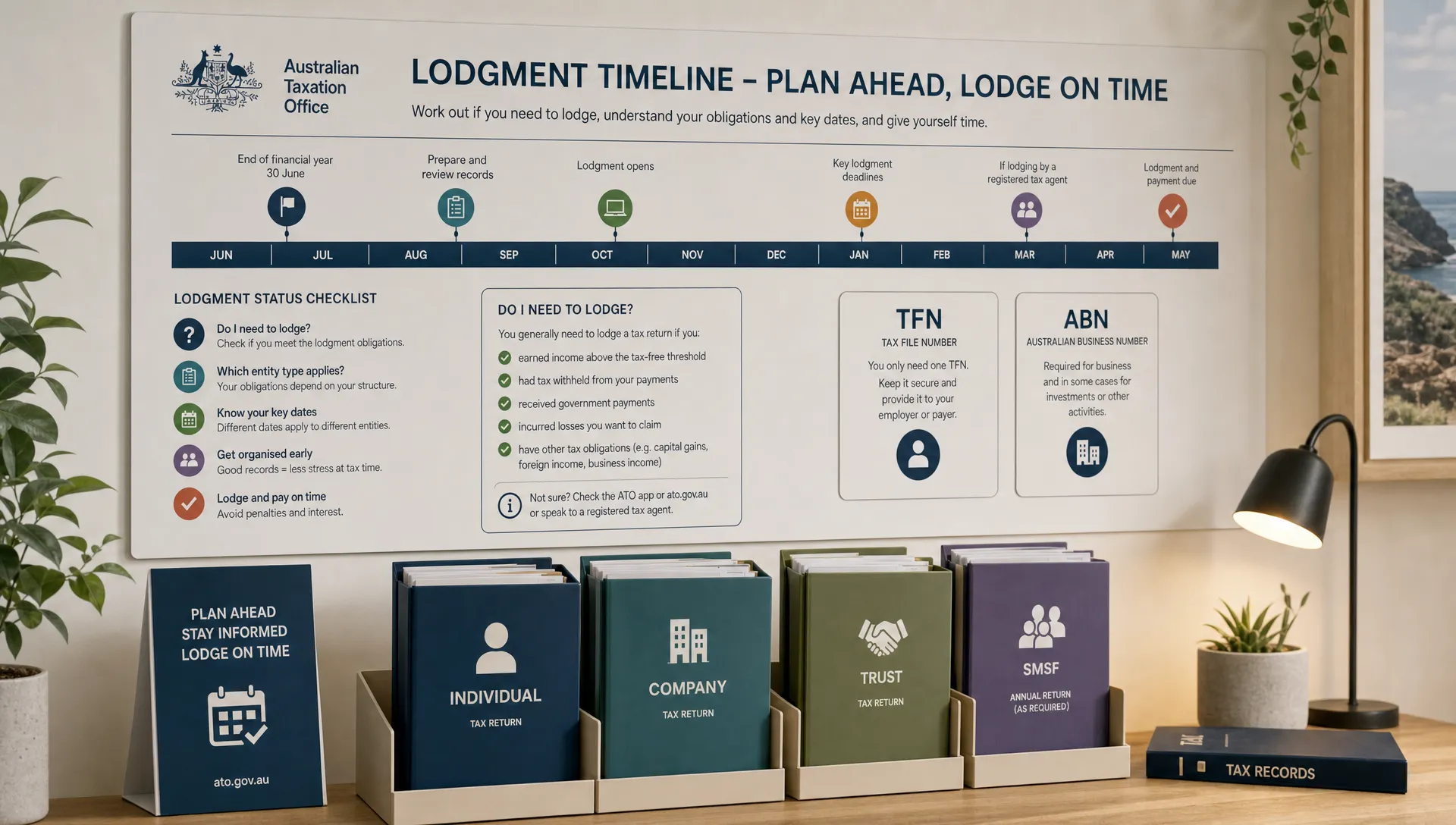
For individuals lodging their own tax return, the usual due date is 31 October after the end of the income year. If you use a registered tax agent, a later lodgment date may apply under the tax agent lodgment program, provided you are on the agent’s client list by the required date and your prior obligations are in order.
Businesses and entities may have different deadlines depending on entity type, turnover, prior lodgment history, and whether a registered tax agent is engaged.
| Obligation | Typical timing consideration |
|---|---|
| Individual self-lodgment | Usually due by 31 October |
| Individual tax agent lodgment | Later dates may apply under the registered tax agent program |
| Company tax return | Due date varies by company circumstances and agent status |
| Trust or partnership return | Due date varies and should be managed alongside beneficiary or partner returns |
| SMSF annual return | Due date depends on the fund’s circumstances and lodgment history |
| BAS | Usually monthly or quarterly, depending on GST and PAYG settings |
| FBT return | Separate FBT year, from 1 April to 31 March, with its own lodgment rules |
Late lodgment can lead to ATO penalties, interest, delayed refunds, finance complications, and increased audit risk. For business owners, the bigger cost is often strategic. Poor lodgment discipline can weaken bank applications, investor reporting, director oversight, and acquisition readiness.
How digital workflows improve lodgment accuracy
Modern tax compliance should not be a once-a-year document chase. We use AI-driven automation and structured digital workflows to improve accuracy, reduce manual rework, and provide clearer visibility across income, expenses, GST, payroll, Superannuation, and entity-level reporting.
For business owners, this means lodgment becomes an output of a live financial system rather than a rushed historical reconstruction. Bank feeds, cloud accounting files, payroll data, invoice systems, investment statements, and ATO accounts can be reconciled earlier and reviewed more intelligently.
The benefit is not simply faster tax returns. The benefit is better decision-making. When records are current, we can identify margin pressure, tax cash flow gaps, director loan issues, GST mismatches, payroll exposure, and opportunities for corporate growth before year-end.
This is particularly valuable for multi-entity groups, property investors, medical specialists, construction firms, technology founders, professional services firms, and cross-state businesses operating in Adelaide, Sydney, Melbourne, and beyond.
Practical pre-lodgment checklist
Before deciding whether you must lodge, we recommend reviewing the following points with discipline:
- Confirm your Australian tax residency status for the year.
- Check whether PAYG tax was withheld from salary, contractor payments, bank interest, or other income.
- Identify all income sources, including business, investment, rental, foreign, crypto, trust, and company distributions.
- Confirm whether you operated as a sole trader or through an ABN, even for part of the year.
- Review whether any CGT event occurred, including sale of shares, property, crypto assets, or business assets.
- Reconcile BAS, GST, payroll, Superannuation, and PAYG withholding records against the annual accounts.
- Confirm whether a company, trust, partnership, or SMSF has a separate return obligation.
- Review whether a non-lodgment advice is appropriate if no return is required.
- Ensure deductions are supported by records and business-private use has been apportioned correctly.
This checklist is not just about avoiding penalties. It supports stronger governance. If your records can withstand ATO review, they can also support lending, restructuring, investor reporting, business sale preparation, and virtual CFO analysis.
Frequently Asked Questions
Do I have to lodge a tax return if I earned less than $18,200? Not always, but you may still need to lodge if tax was withheld, you operated as a sole trader, you had business or investment activity, you made a capital gain, or another ATO trigger applies. If no return is required, a non-lodgment advice may be appropriate.
Do sole traders have to lodge a tax return in Australia? Yes, sole traders generally must lodge an individual tax return that includes business income and deductions, even if the business made a loss or income was below the tax-free threshold.
Does a company need to lodge if it made no profit? Generally, yes. A company’s lodgment obligation is separate from profitability. Dormant or inactive companies should be reviewed carefully because the ATO may still require a return or formal notification that a return is not necessary.
Do I need to lodge if I only have investment income? You may need to lodge if your taxable income exceeds the relevant threshold, tax was withheld, you received distributions, you had capital gains, or you need to report losses or claim credits. Investment portfolios should be reviewed with source documents, not just pre-filled data.
What should I do if I have missed prior-year tax returns? Address the issue promptly. Late lodgment can increase penalties, interest, and ATO scrutiny. We can help reconstruct records, prioritise overdue years, and negotiate a practical lodgment pathway where appropriate.
Next steps: make lodgment a strategic control
If you are unsure whether you must lodge a tax return in Australia, the safest approach is to assess your position before the deadline, not after the ATO contacts you.
Our team helps individuals, business owners, company directors, SMSF trustees, property investors, and high-net-worth families determine their lodgment obligations and improve the systems behind them. With 25 years of professional experience and AI-driven accounting workflows, we support accurate compliance, stronger financial visibility, and strategic advisory across Australia, including integrated service capabilities in Adelaide, Sydney, and Melbourne.
For a practical review of your lodgment position or to learn how automated accounting workflows can reduce compliance risk and improve decision-making, contact Perfect Accounting & Tax Services for a confidential consultation.