
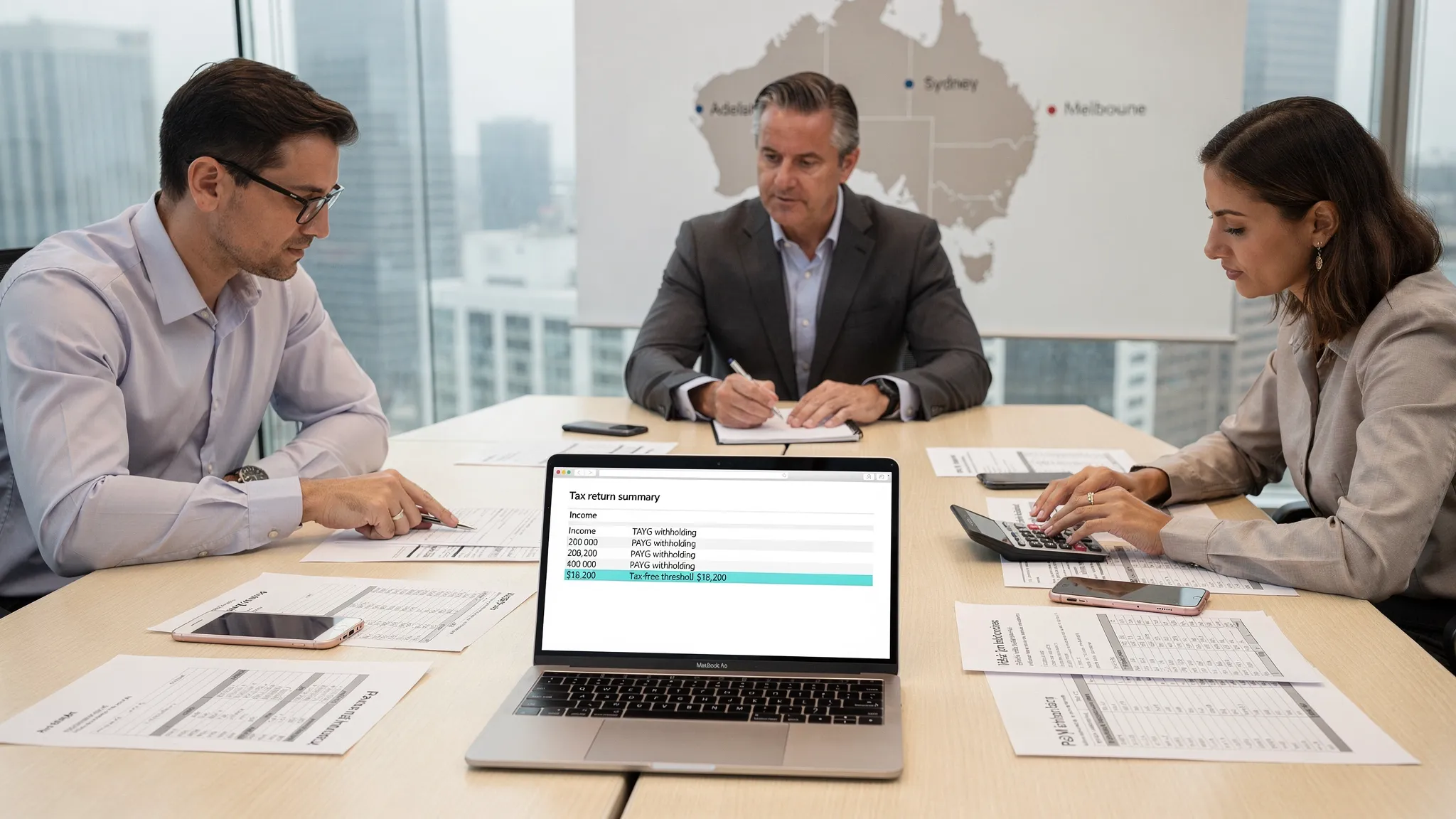
The tax-free threshold in Australia is one of the most misunderstood parts of the personal tax system. It is often described as the amount you can earn before paying tax, but that explanation is incomplete.
For Australian resident individuals, the threshold is a starting point for calculating income tax. It does not make all income tax-free, it does not apply to companies, and it does not remove obligations such as GST, BAS, PAYG withholding, superannuation, Medicare levy considerations or record-keeping.
For business owners, company directors and high-net-worth individuals, the tax-free threshold is less about a simple number and more about cash flow, entity structure, payroll accuracy and strategic planning. We look at it as one component of a wider tax architecture.
What the tax-free threshold actually means
For the 2025-26 income year, the tax-free threshold for Australian resident individuals is $18,200. In practical terms, the first $18,200 of taxable income is taxed at a nil income tax rate for eligible resident individuals.
The key phrase is taxable income. This is not always the same as salary, business revenue, rental receipts or bank deposits. Taxable income is generally calculated as assessable income less allowable deductions.
For example, a sole trader with $75,000 in business receipts and $28,000 in allowable business deductions does not compare $75,000 to the tax-free threshold. The starting point is the net taxable profit, before considering any other income, deductions, offsets and tax adjustments.
The ATO publishes the applicable individual income tax rates for residents, including the nil rate up to the tax-free threshold. These rates should always be checked for the relevant income year, particularly when preparing forecasts or board-level cash-flow models.
Tax-free does not mean tax-free from everything
A common misconception is that earning below $18,200 means there are no tax-related obligations. That may be true for a simple individual with no tax withheld and no other lodgement triggers, but it is not a safe assumption for professionals, investors or business owners.
The threshold relates to income tax. It does not automatically remove other obligations or charges.
| Issue | How it interacts with the tax-free threshold |
|---|---|
| Income tax | Eligible Australian resident individuals pay no income tax on the first $18,200 of taxable income. |
| Medicare levy | The Medicare levy is separate from income tax and depends on income, family circumstances and exemptions. |
| HELP or study debts | Repayment obligations are based on repayment income thresholds, not the tax-free threshold. |
| GST | GST registration and BAS obligations are based on business turnover rules, not personal taxable income. |
| PAYG withholding | Claiming the threshold changes how much tax is withheld during the year, not the final tax calculation. |
| Company tax | Companies do not receive the individual tax-free threshold. |
This distinction matters when we are advising directors, sole traders and investors. The question is not simply whether income is under $18,200. The better question is whether the structure, withholding, instalments and compliance settings reflect the client’s actual commercial position.
Who can claim the tax-free threshold?
The full tax-free threshold generally applies to Australian resident individuals for tax purposes. If you are a full-year Australian resident, you can usually claim it through your employer by completing a TFN declaration.
However, eligibility can change when residency, multiple jobs, working holiday visas or part-year circumstances are involved.
| Taxpayer situation | Practical treatment |
|---|---|
| Australian resident employee with one job | Usually claims the tax-free threshold from that employer. |
| Australian resident with two jobs | Usually claims the threshold from only one payer to reduce under-withholding risk. |
| Sole trader | The threshold applies to the individual’s total taxable income, not to business revenue alone. |
| Company | No individual tax-free threshold applies to company profits. |
| Foreign resident for tax purposes | The Australian resident tax-free threshold generally does not apply. |
| Part-year resident | A pro-rated threshold may apply depending on residency dates. |
| Working holiday maker | Separate working holiday maker tax rates may apply. |
Residency is especially important for expatriates, foreign investors and globally mobile founders. Australian tax residency is not determined by citizenship alone. It depends on legal tests and factual circumstances, including where you live, work, maintain assets and hold personal ties.
Where residency is uncertain, we recommend obtaining advice before lodging. Incorrectly claiming the threshold can create ATO debt, interest and amendment risk.
Claiming the threshold through payroll
Employees claim the tax-free threshold by completing a TFN declaration for their employer. Once claimed, payroll software withholds less PAYG tax during the year because it assumes the employee is entitled to the threshold from that payer.
This is a cash-flow mechanism. It is not the final tax assessment.
At year-end, the ATO calculates tax based on total taxable income from all sources. This includes salary, director fees, business income, rental income, dividends, capital gains, trust distributions, foreign income and other assessable amounts.
If the threshold was claimed from multiple employers or payers, the taxpayer may have underpaid PAYG withholding during the year. That can result in a tax payable position on lodgement.
For directors and senior employees, the issue can be more complex. Director fees, bonuses, employee share scheme amounts, dividends and trust distributions may all affect the final tax outcome. Payroll withholding should be reviewed against forecast annual income, not treated as an isolated compliance task.
The tax-free threshold for sole traders and business owners
Sole traders often ask whether their first $18,200 of business income is tax-free. The answer requires precision.
The threshold applies to the individual’s total taxable income, not a separate bucket of business income. If a sole trader also earns wages, rental income or investment income, all relevant income is brought together in the individual tax return.
Consider a consultant who earns $45,000 from employment and $20,000 net profit from a side business. The tax-free threshold is not applied separately to the business profit. The individual’s taxable income is assessed as a combined amount, subject to deductions, offsets and other rules.
This is why we encourage sole traders to implement proper accounting workflows from day one. Business owners should track:
- Gross receipts and taxable sales.
- Allowable business deductions.
- GST registration status and BAS obligations.
- PAYG instalment exposure.
- Superannuation planning.
- Private versus business use of assets.
A sole trader may have no tax payable in the first year because profit is low. That does not mean the business is outside the tax system. It may still need to lodge, maintain records and plan for future PAYG instalments once profitability increases.
Companies, trusts and the threshold
Companies do not receive the individual tax-free threshold. A company is a separate taxpayer and is generally taxed at the applicable company tax rate. For many base rate entities, the rate is 25%, while other companies may be taxed at 30%, depending on eligibility and income composition.
This distinction is critical for founders and directors. Incorporating a company does not create a new $18,200 tax-free amount. Instead, incorporation changes how income is earned, retained, distributed and taxed.
Trusts require separate analysis. A trust may distribute income to beneficiaries, and those beneficiaries are assessed according to their own circumstances. The tax-free threshold may be relevant for an individual beneficiary, but distributions must be commercially sound, properly documented and consistent with trust law and the trust deed.
For family groups, property investors and high-net-worth clients, threshold planning should never be done in isolation. It must be considered alongside Division 7A, trust distribution resolutions, CGT, asset protection, succession planning and the ATO’s anti-avoidance expectations.
Why the threshold can create false confidence
The tax-free threshold is useful, but it can encourage poor planning when misunderstood. We regularly see taxpayers assume that low income or early-stage business losses mean they can defer systems, ignore reconciliations or delay lodgement.
That approach creates risk. Early financial data becomes the foundation for future finance applications, investor reporting, tax planning and ATO compliance. If the first year is messy, the second year is usually more expensive to clean up.
The most common misconceptions include:
- Assuming no tax payable means no need to lodge.
- Claiming the threshold from more than one employer without modelling the impact.
- Treating business revenue under $18,200 as automatically tax-free.
- Believing a company receives the same threshold as an individual.
- Ignoring GST because personal income tax is low.
- Forgetting that rental income, dividends and capital gains can affect total taxable income.
For professionals and business owners, tax planning should be proactive. The threshold may reduce tax at low income levels, but it does not replace accurate records, cash-flow forecasting or entity-level advice.
The role of tax offsets
Another point often missed is the difference between the tax-free threshold and tax offsets.
The tax-free threshold applies through the tax rates. Tax offsets reduce tax payable after the tax calculation. For example, the low income tax offset can reduce tax for eligible resident individuals above the $18,200 threshold. This means some taxpayers may have taxable income above $18,200 and still pay little or no income tax, depending on their circumstances.
However, offsets are not deductions. They do not reduce taxable income. They reduce the tax payable amount, and many offsets are subject to eligibility rules, income limits or phase-out rates.
For directors and investors, offsets should be modelled carefully. Franking credits, foreign income tax offsets and other tax offsets can materially affect the final position, but they must be supported by correct documentation.
Payroll and cash-flow implications for directors
For company directors, the tax-free threshold is most relevant when salary, director fees or wages are processed through payroll. A director who receives PAYG income can claim the threshold through the company payroll system if appropriate.
The risk is that director remuneration is often decided late, irregularly or without enough forecasting. This can create mismatches between PAYG withholding, superannuation guarantee, company profits and personal tax obligations.
We prefer to align director remuneration with a broader annual plan. This includes reviewing:
- Expected company taxable profit.
- Director salary, bonuses and superannuation.
- Dividends and retained earnings.
- Division 7A loan exposure.
- PAYG withholding and Single Touch Payroll reporting.
- Personal tax, investment income and family group distributions.
This turns payroll from a processing function into a strategic advisory tool. With automated accounting systems, we can identify under-withholding risk earlier, forecast year-end tax outcomes and reduce the likelihood of unexpected tax payable positions.
Property investors and high-net-worth individuals
For property investors, the tax-free threshold is rarely the main driver of strategy. Rental income, interest deductions, depreciation, repairs, capital works and CGT events are usually more important.
A first-time investor with modest income may benefit from the threshold and offsets. A high-net-worth investor with multiple properties, trust distributions and capital gains will require a much broader tax plan.
The same applies to refinancing, equity access and portfolio expansion. Tax must be integrated with borrowing capacity, after-tax cash flow and asset protection. Across the global finance sector, technology-led providers such as smart mortgage solutions show how digital tools and expert guidance can simplify major funding decisions. In our Australian tax context, we apply the same principle: better data, stronger advice and clearer decision-making.
Before acquiring or selling property, investors should model the after-tax impact rather than focusing only on gross yield or headline deductions.
Digital workflows make the threshold easier to manage
The threshold itself is simple. The data around it is not.
Modern tax planning depends on accurate, current and reconciled financial information. Our AI-driven accounting workflows help identify payroll inconsistencies, duplicate deductions, unusual GST coding, late superannuation payments and income classification issues before they become lodgement problems.
For business owners, this means greater visibility throughout the year. Instead of waiting until tax time, we can review live dashboards, forecast tax positions and make decisions before 30 June.
This is particularly valuable for businesses operating across Adelaide, Sydney, Melbourne and other Australian locations. Multi-city operations often have more complex payroll, contractor, GST and reporting issues. Integrated systems reduce fragmentation and support stronger governance.
Practical steps to take before lodging
Before lodging an individual, sole trader or director tax return, we recommend a structured review. This is especially important if you have multiple income sources, business activity or investment assets.
Key steps include:
- Confirm whether you were an Australian resident for tax purposes for the full year.
- Check whether the tax-free threshold was claimed from the correct payer.
- Review all income sources, including wages, business income, dividends, rent, trust distributions and foreign income.
- Reconcile business revenue to bank deposits, invoices and accounting software.
- Confirm GST and BAS obligations separately from income tax.
- Review deductions for evidence, business connection and private use adjustments.
- Forecast PAYG instalments and tax payable for the next year.
- Consider whether your current structure still supports growth, asset protection and exit planning.
For higher-risk taxpayers, we also recommend reviewing ATO pre-fill data, Single Touch Payroll reports, loan accounts, trust distribution minutes and investment statements before lodgement.
Frequently Asked Questions
Is the tax-free threshold still $18,200 in Australia? For the 2025-26 income year, the resident individual tax-free threshold is $18,200. Always confirm the applicable rates for the specific income year before lodging or forecasting.
Can I claim the tax-free threshold from two employers? You generally should claim it from only one payer. Claiming it from multiple employers can reduce PAYG withholding too much and may result in tax payable at lodgement.
Do sole traders get a separate tax-free threshold for business income? No. Sole traders are taxed as individuals, so business profit is combined with other income. The threshold applies to total taxable income, not separately to each income source.
Do companies get the tax-free threshold? No. Companies are separate taxpayers and do not receive the individual $18,200 tax-free threshold. Company profits are taxed under company tax rules.
If I earn under $18,200, do I still need to lodge a tax return? It depends. You may still need to lodge if tax was withheld, you carried on a business, had certain investment income, had reportable obligations or were required by the ATO. If you are not required to lodge, you may need to submit a non-lodgment advice.
Does the tax-free threshold affect GST registration? No. GST registration is based on GST turnover rules, not the personal income tax-free threshold. A business can have GST obligations even if the owner’s personal taxable income is low.
Next steps: make the threshold part of a broader tax strategy
The tax-free threshold is not a loophole or a complete tax plan. It is one component of Australia’s individual income tax system. Used correctly, it improves PAYG withholding and helps low-income taxpayers. Misunderstood, it can create under-withholding, lodgement errors and poor cash-flow decisions.
Our team at Perfect Accounting & Tax Services helps individuals, directors, SMEs and high-net-worth clients across Australia understand how personal tax settings connect with business structure, payroll, BAS, GST, superannuation and long-term growth strategy.
With 25 years of professional experience and AI-driven automation, we provide accurate compliance, real-time financial visibility and strategic advisory support across Adelaide, Sydney and Melbourne.
If you are unsure whether the tax-free threshold has been applied correctly, or you want to modernise your accounting workflows before the next lodgement cycle, contact our team for a consultation. We can review your current position, identify tax risks and help convert compliance into a stronger foundation for corporate growth.