
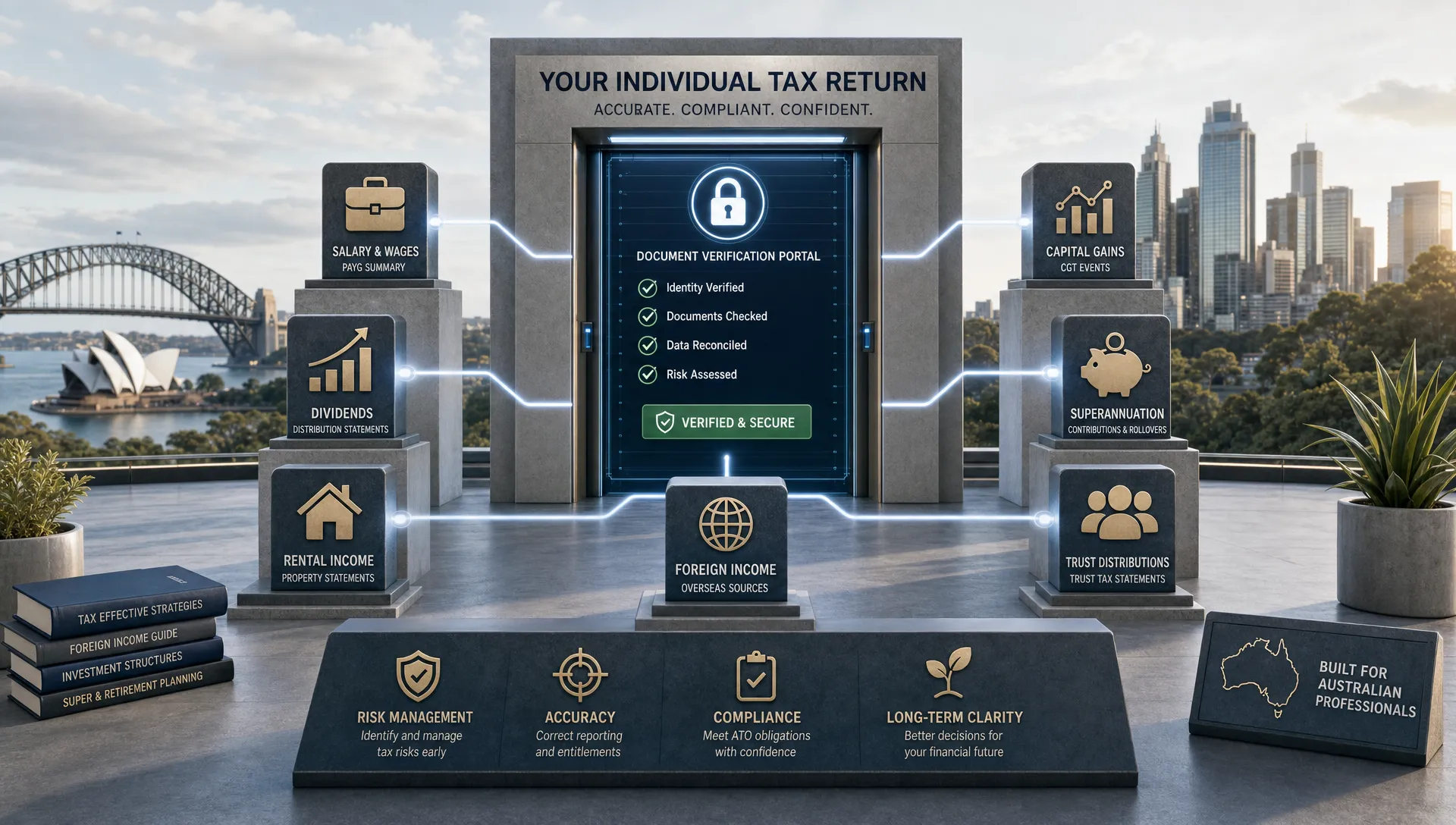
Choosing individual tax return support is not simply about finding someone to lodge before the ATO deadline. For directors, consultants, investors, high-income employees and business owners, the individual return often sits at the intersection of salary, dividends, rental income, capital gains, trust distributions, superannuation strategy and sometimes foreign income.
That is why individual tax return services should be assessed as a risk management and financial optimisation decision, not as an annual administration task. A low-fee lodgement may be suitable for a straightforward employee return, but it can be inadequate where your personal tax position is connected to a company, trust, SMSF, investment portfolio or property strategy.
We take the view that good tax support should do three things: lodge accurately, reduce ATO risk and improve financial decision-making for the year ahead. The right adviser will not just ask, “What can we claim?” They will ask, “What does this return reveal about your cash flow, structure, compliance exposure and long-term financial position?”
Start by defining the complexity of your tax position
Before comparing providers, define what kind of return you actually have. Many taxpayers assume they have an “individual” return because the form is lodged under their personal TFN. In practice, the return may be influenced by business income, company payments, director loans, rental properties, employee share schemes, crypto disposals, capital gains tax events or family trust distributions.
A simple return may suit myTax or a basic registered tax agent service. A complex personal return needs broader tax and accounting judgement. If you are unsure where you sit, our guide on when to use myTax and when to get professional help explains the dividing line clearly.
| Taxpayer profile | Why support quality matters | Key capability to look for |
|---|---|---|
| Company director or shareholder | Personal tax may connect to dividends, loans, wages and company compliance | Integrated company and individual tax advice |
| Sole trader or consultant | Income, deductions, GST registration and super planning may overlap | BAS, GST and business record review |
| Property investor | Rental schedules, interest, repairs, depreciation and CGT must be handled carefully | Property tax and substantiation knowledge |
| High-income employee | Deductions, FBT, reportable fringe benefits and Division 293 tax may be relevant | Salary packaging and superannuation awareness |
| Investor with shares, ETFs or crypto | Capital gains, losses and income classifications must be reconciled | Investment data and CGT expertise |
| Expatriate or foreign income recipient | Residency, double tax agreements and foreign tax offsets can be complex | Australian residency and cross-border tax experience |
The more categories that apply to you, the less useful it is to choose support based only on price or turnaround time.
Confirm the adviser is properly registered
In Australia, anyone providing tax agent services for a fee must generally be registered with the Tax Practitioners Board. This matters because a registered tax agent is subject to professional standards, continuing education obligations and regulatory oversight.
You can check a provider through the TPB public register. We recommend doing this before sharing your TFN, income records or identity documents.
Registration alone is not enough, but it is the minimum threshold. From there, assess whether the adviser has experience with your specific tax profile. A tax agent who mainly lodges simple salary and wage returns may not be the right fit if your personal return includes a company, rental property, trust, SMSF or complex investment activity.
Look for strategic judgement, not just form completion
A tax return is a legal declaration to the ATO. It is also a financial diagnostic tool. When prepared properly, it can highlight patterns that affect cash flow, asset protection, debt structuring, superannuation contributions and future tax planning.
For example, a director’s personal return may reveal whether salary, dividends and superannuation arrangements are aligned with the broader company strategy. A property investor’s return may show whether record-keeping is strong enough to support future CGT calculations. A consultant’s return may indicate whether the business has outgrown sole trader status and should consider a more robust structure.
This is where experienced individual tax return services become more valuable. The adviser should understand how personal tax compliance connects to business growth, family wealth and long-term governance.
If your return is part of a broader commercial picture, it is worth reviewing our article on how to choose a tax accountant in Australia for a deeper framework on expertise, communication and advisory fit.
Assess how deductions are reviewed and substantiated
ATO scrutiny often focuses on whether deductions are real, correctly calculated and properly supported. A good adviser will not maximise deductions by guesswork. They will apply the law, ask for evidence and explain where apportionment is required.
The ATO’s guidance on income, deductions, offsets and records makes the core principles clear. Broadly, an expense must be incurred, connected to assessable income, not private in nature, not reimbursed and supported by appropriate records.
In practice, we look closely at areas such as home office expenses, motor vehicle claims, professional subscriptions, self-education, travel, tools, protective clothing, rental property expenses and investment-related costs. Each category has specific rules. The right adviser should know when a claim is strong, when it needs apportionment and when it should not be made.
Be cautious if a provider promises a larger refund before reviewing your records. A refund is not a measure of professional skill. A defensible and accurate position is far more valuable than an inflated claim that creates ATO exposure later.
Make sure business interests are not treated in isolation
Many professionals now earn income through multiple channels. A consultant may have employment income, ABN income, director fees and investment income. A medical specialist may receive income through a service entity. A property developer may have personal investments alongside company and trust interests.
When the individual return is prepared without considering the broader structure, important issues can be missed. These may include GST registration thresholds, BAS reconciliation, PAYG instalments, superannuation obligations, FBT reporting, Division 7A loan implications and trust distribution documentation.
This is why we treat bookkeeping and compliance as the foundation for strategic advisory. Accurate records do not only support lodgement. They give directors and high-net-worth individuals better visibility over cash flow, tax provisioning and future capital decisions.
For business owners in particular, tax support should connect the personal return to the company accounts, BAS history, payroll records and superannuation data. If these are reviewed separately by different providers with no coordination, the risk of inconsistency increases.
Evaluate the provider’s digital workflow
Modern tax support should be efficient, secure and data-driven. We are not suggesting that automation replaces professional judgement. It should strengthen it.
AI-driven document capture, automated reconciliations and structured digital checklists can reduce manual errors and improve review speed. They can also help identify missing income, duplicated deductions, inconsistent rental records or gaps between business and personal data. For clients managing multiple entities or interstate operations, digital workflows improve consistency across Adelaide, Sydney, Melbourne and the broader Australian market.
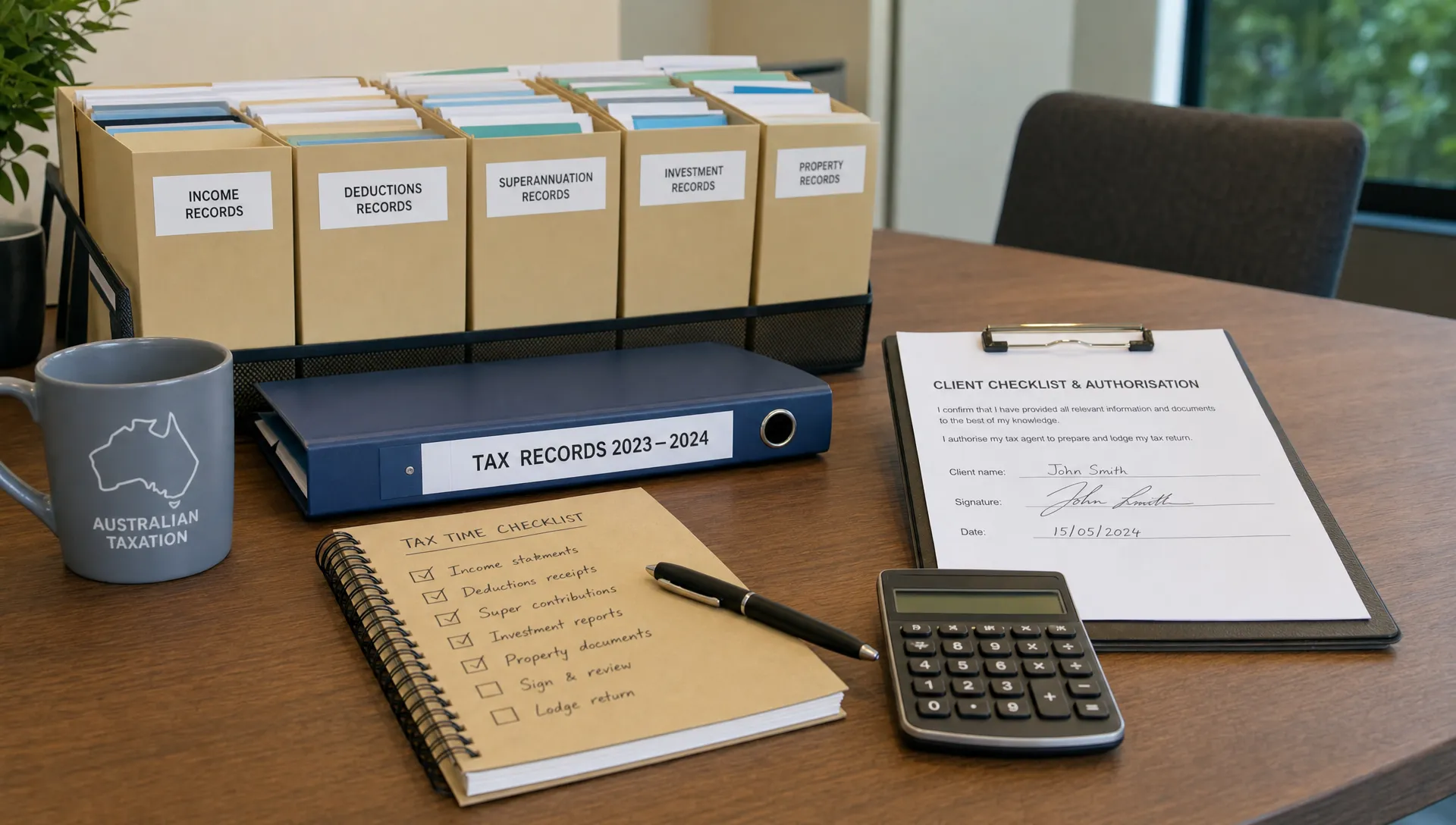
When assessing a provider, ask how they collect documents, verify identity, protect sensitive information and maintain an audit trail. Your TFN, bank statements, payroll summaries, investment reports and property records should not be handled casually.
A mature workflow should provide:
- Secure document collection rather than unprotected email chains
- Clear checklists tailored to your income sources and assets
- Reconciliation against ATO pre-fill data and source documents
- Review points for unusual claims, missing records or tax planning opportunities
- Accessible records that support future amendments, audits or finance applications
Digital transformation is not about making tax feel impersonal. Used properly, it gives the adviser more time to interpret the numbers and provide higher-value advice.
Check how ATO communication is handled
Choosing tax support wisely also means understanding what happens after lodgement. ATO queries, data-matching letters, amended assessments and payment arrangements can arise months after a return is submitted.
A quality adviser should be clear about whether post-lodgement support is included, charged separately or outside their scope. They should also explain how they would respond to an ATO review. The correct approach is rarely to reply quickly without reconciling the underlying records first.
If you have already received ATO correspondence, do not ignore it and do not respond with incomplete information. We have outlined a practical approach in our guide on dealing with the ATO without costly mistakes.
The key point is simple. Your adviser should be capable of defending the position taken in the return. If they are only available at lodgement time, you may be left exposed when the ATO asks questions later.
Understand the fee structure before engaging
A professional fee should reflect the work required, the complexity of the return and the level of advice provided. A basic salary and wage return is different from a return involving rental property schedules, capital gains calculations, foreign income, trust distributions or business reconciliations.
Before engaging, clarify what is included. Ask whether the fee covers pre-lodgement advice, deduction review, rental schedules, investment reconciliations, amendment support, ATO correspondence, tax planning and meetings.
A transparent adviser will not need to be the cheapest. They should be able to explain the value of the work and the risks they are managing. For higher-income individuals, a well-prepared return can support better tax planning, cleaner finance applications, stronger asset reporting and fewer compliance surprises.
Watch for red flags
Some warning signs are obvious. Others are subtle. We recommend caution if a provider displays any of the following behaviours:
- They are not listed on the TPB register
- They guarantee a refund before reviewing your facts
- They encourage deductions without asking for evidence
- They treat company directors, sole traders and investors as simple wage earners
- They cannot explain how they protect your TFN and financial documents
- They rush lodgement without asking about life events, asset sales or business changes
- They are unavailable once the return has been lodged
The biggest red flag is a lack of questions. A strong adviser will ask about your income sources, business interests, properties, investments, residency, superannuation, dependants, private health cover and significant financial changes during the year.
Prepare before the first consultation
You will get better advice if you approach the engagement with organised information. Before speaking with a tax adviser, gather your income records, ATO pre-fill details, private health insurance statement, investment reports, rental property documents, loan statements, business income summaries, work-related expense evidence and prior-year return.
For company directors, we also recommend having access to company financial statements, payroll reports, director loan balances, BAS lodgements and superannuation payment records. For property investors, ensure repairs, interest, depreciation, agent statements and settlement documents are available.
The objective is not to overwhelm the adviser with documents. It is to create a complete view of your tax position so they can identify risk and opportunity efficiently.
Frequently Asked Questions
When should we use professional individual tax return services instead of myTax? Professional support is usually advisable when your return includes business income, rental properties, capital gains, crypto, foreign income, trust distributions, employee share schemes or director-related issues. myTax can suit simpler returns, but complex positions require more review and judgement.
Is the cheapest tax return service a risk? It can be if the fee does not allow time for proper review, substantiation and advice. Price should be considered alongside registration, expertise, data security, communication quality and ability to support you if the ATO raises a query.
Can an adviser help reduce tax legally? Yes, but the focus should be lawful planning, accurate deductions and appropriate structuring. An adviser should not invent claims or push aggressive positions. The best outcomes usually come from year-round planning rather than last-minute lodgement.
Should my business accountant also prepare my individual return? Often, yes. If your personal tax position is connected to a company, trust, sole trader business or SMSF, integrated advice can reduce inconsistencies and improve planning. The key is ensuring the adviser has both individual and business tax capability.
How does automation improve tax return support? Automation can improve document capture, reconciliation, completeness checks and workflow speed. Professional judgement remains essential, but AI-driven processes help identify gaps earlier and give advisers more time to focus on strategy.
Next steps: choose support with strategy in mind
The right tax adviser should help you lodge accurately, reduce ATO risk and strengthen your broader financial position. For professionals, directors, investors and high-net-worth individuals, individual tax return support should not be separated from business records, BAS history, GST obligations, superannuation planning and long-term growth strategy.
Our team at Perfect Accounting & Tax Services brings 25 years of Australian accounting and tax experience, supported by AI-driven workflows that improve accuracy, speed and visibility. We support clients across Australia with integrated capability in Adelaide, Sydney and Melbourne.
If you want individual tax return services that connect compliance with strategic advisory, contact our team for a consultation. We can review your current tax position, identify risk areas and show how automated accounting workflows can support better decisions before the next lodgement deadline.