
Choosing a tax accountant in Australia should not start with the question, “Who can lodge my return for the lowest fee?” For business owners, directors and high-net-worth individuals, the better question is: who can protect my compliance position, improve financial visibility and support better commercial decisions?
A tax accountant is often one of the few advisers who sees the full financial picture: trading performance, cash flow, payroll, GST, asset purchases, loans, trusts, superannuation, property investments and family wealth structures. When that role is handled strategically, tax compliance becomes the foundation for stronger governance and growth.
Below, we outline how we assess the right fit when choosing a tax accountant in Australia, from registration and technical capability to automation, advisory quality and national support.
Start with TPB registration and professional accountability
In Australia, anyone charging a fee to provide tax agent services must generally be registered with the Tax Practitioners Board. This is a non-negotiable starting point.
Before appointing an adviser, check whether they are a registered tax agent or BAS agent on the TPB public register. Registration matters because it indicates the adviser is subject to professional standards, continuing education obligations and the Code of Professional Conduct.
For businesses, this is particularly important. Tax advice is not only about completing forms. It can influence director decisions, financing, payroll, GST treatment, trust distributions, Division 7A exposure, FBT obligations and ATO audit risk.
At a minimum, ask:
- Is the accountant or firm registered with the TPB?
- Who will review and sign off your lodgements?
- Does the firm hold professional indemnity insurance?
- What experience does the team have with your business structure and industry?
- How does the firm manage technical quality control before lodgement?
A strong tax accountant should welcome these questions. If they avoid them, that is a warning sign.
Match their expertise to your level of complexity
The right accountant for a simple salary and wage return may not be the right adviser for a company group, property portfolio, SMSF, cross-border arrangement or fast-growing business.
This distinction matters because Australian tax obligations become more interconnected as your affairs grow. A company director may need advice across company tax, PAYG withholding, GST, superannuation guarantee, director loans, asset protection, trust distributions and retained profits. A high-net-worth investor may need careful planning around CGT, negative gearing, land tax interactions, SMSF rules, estate planning considerations and investment structures.
The table below shows how your circumstances should shape the type of tax accountant you choose.
| Your situation | Capability to look for | Key questions to ask |
|---|---|---|
| Sole trader or freelancer | Income deductions, GST registration, BAS, super contributions, record keeping | “Can you help me track tax, GST and cash flow throughout the year?” |
| Company director | Company tax, payroll, Division 7A, director remuneration, BAS and governance | “How do you review director loans and tax planning before year-end?” |
| Property investor or developer | CGT, GST on property, interest deductibility, depreciation, entity structuring | “What property tax issues do you review before purchase, sale or refinance?” |
| SMSF trustee | SMSF compliance, contribution rules, pension phase, investment restrictions | “Do you understand SMSF tax and regulatory reporting requirements?” |
| Cross-state business | Payroll tax, GST, multi-location reporting, consistent management reporting | “Can you support operations across Adelaide, Sydney, Melbourne and other locations?” |
| Scaling business | Virtual CFO advice, forecasting, KPI reporting, tax structuring, automation | “How do you turn compliance data into strategic advisory insights?” |
If your affairs involve multiple entities, related-party loans, trusts, property or international elements, choose an adviser who can diagnose the entire structure rather than treat each return in isolation. We have written more on this point in our guide to what sets expert tax accountants apart in complex matters.
Look beyond annual lodgement
A capable tax accountant should not appear only when the ATO deadline is approaching. For serious business owners, the value is created throughout the year.
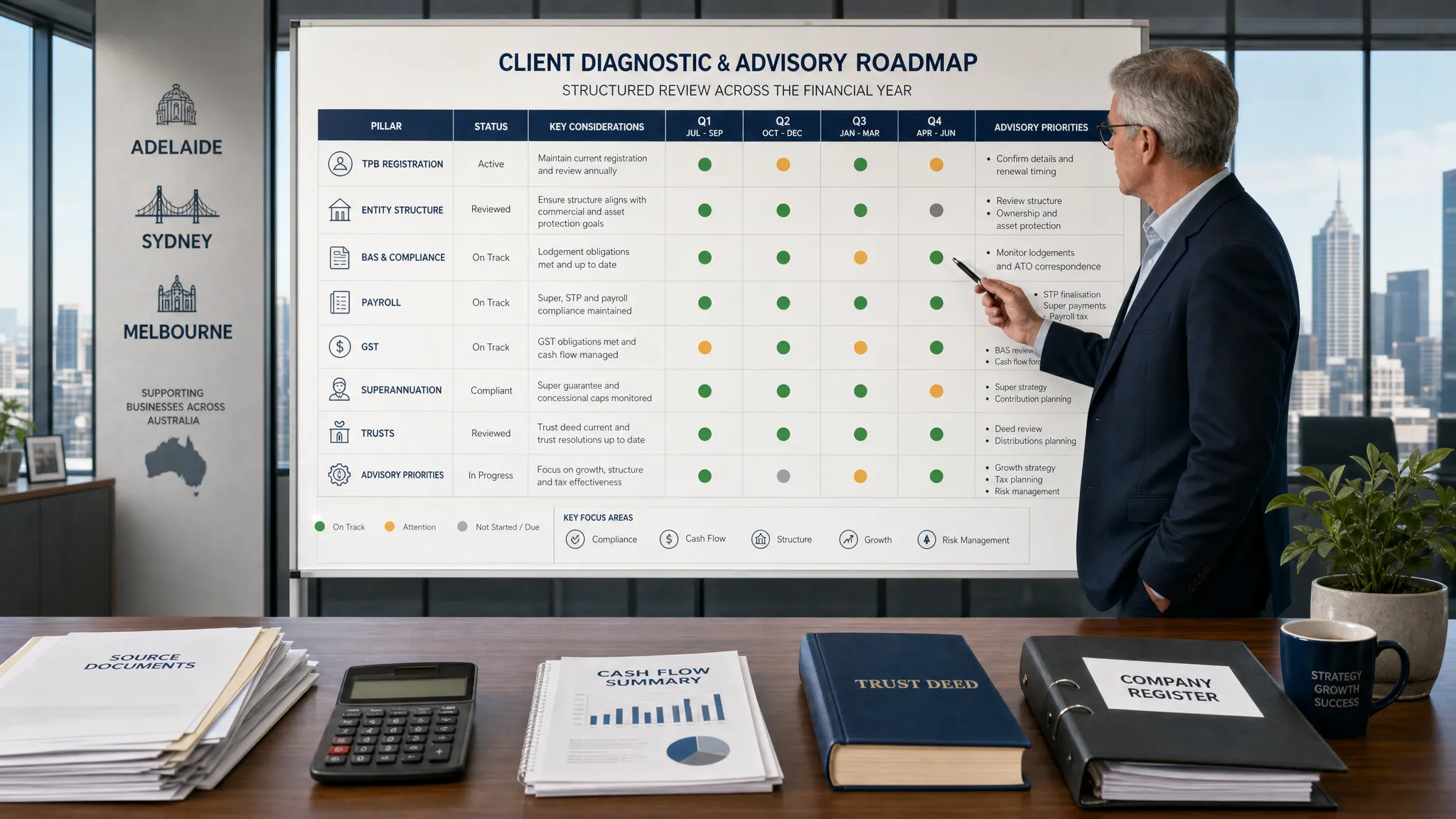
Annual tax returns are historical. By the time a return is prepared, many planning opportunities have already passed. The stronger model is year-round review, where your accountant monitors trends, reconciliations, GST, payroll, superannuation, profitability and cash flow before issues become expensive.
This is especially important for companies and family groups. Decisions made in March, April and May can materially affect tax outcomes at 30 June. These may include timing of asset purchases, bad debt reviews, stock adjustments, superannuation contributions, trust distribution planning, director remuneration and franking credit strategy.
A strategic tax accountant should help you answer questions such as:
- Are we setting aside enough cash for GST, PAYG instalments and income tax?
- Are our BAS lodgements consistent with the general ledger?
- Are payroll, superannuation and Single Touch Payroll records accurate?
- Are director loans being managed before Division 7A issues arise?
- Are we using the right business structure for risk, tax and growth?
- Are we building financial reports that directors can rely on for decisions?
For a deeper view of ongoing review points, our article on what a business tax accountant should be reviewing year-round sets out the practical areas that should not be left until tax time.
Assess their technology and automation capability
Modern accounting is no longer just data entry, bank reconciliations and year-end journals. The best firms use technology to increase accuracy, reduce manual processing and provide faster insight.
This does not mean replacing professional judgement. It means using automation to give the adviser better information earlier.
Our team uses AI-driven workflows to streamline document capture, transaction review, exception identification and compliance processes. The objective is simple: fewer manual bottlenecks, better data quality and more timely financial visibility for clients.
When assessing a tax accountant in Australia, ask how they use technology in practice. Vague references to “cloud accounting” are not enough. You want to understand whether the firm has a disciplined workflow for collecting records, checking data quality, reviewing reconciliations and turning financial information into advice.
Good technology capability may include:
- Secure digital document collection and storage
- Bank feed review and reconciliation controls
- Automated reminders for BAS, payroll, superannuation and tax deadlines
- Exception reporting to identify unusual transactions or missing records
- Digital workpapers that support audit trails and review quality
- Management reporting that helps directors see performance before year-end
The ATO’s record keeping guidance makes it clear that businesses must keep accurate records to support their tax position. Automation can make that obligation easier, but only if the system is implemented properly.

Evaluate advisory depth, not just compliance output
There is a major difference between an accountant who prepares tax returns and an accountant who improves your financial position.
Compliance output is the lodgement. Advisory depth is the thinking behind it.
A strong tax accountant should be able to explain the commercial impact of tax decisions. They should understand cash flow, debt, margins, working capital, investment timing, entity structures and director obligations. They should also be able to identify when tax minimisation becomes tax risk.
For example, claiming deductions without adequate substantiation may reduce tax in the short term, but it can create audit exposure later. Similarly, distributing trust income without considering the family group, beneficiary circumstances or unpaid present entitlements can create downstream issues.
We look for advice that is technically sound, commercially practical and defensible if reviewed by the ATO. That balance is critical.
Your accountant should help you optimise financial health in areas such as:
- Cash flow forecasting and tax provisioning
- Profit improvement and cost control
- Business structure and asset protection alignment
- GST and BAS accuracy
- Payroll tax, superannuation and FBT review
- Director remuneration planning
- Exit, succession and sale readiness
- Investment and property tax planning
For growth-focused businesses, tax services should support strategy, not merely compliance. We explored this in more detail in our guide to choosing tax services that support business growth.
Check communication style and responsiveness
Technical skill is essential, but it is not enough. You need an adviser who communicates clearly and consistently.
This is particularly important when dealing with ATO correspondence, tax debt, BAS errors, late lodgements, audits, payroll issues or significant transactions. Delays can increase penalties, interest and stress. Poor communication can also leave directors making decisions without accurate information.
During your first discussion, assess how the accountant explains complex issues. Do they translate tax law into practical business consequences? Do they ask intelligent questions? Do they identify risks you had not considered? Do they provide a clear process for next steps?
A good adviser should be professional but direct. They should tell you what is possible, what is risky and what must be corrected. We believe clients are best served when advice is clear, evidence-based and action-oriented.
Understand the fee model and scope
Fees should be transparent, but choosing purely on price is rarely wise. A low fee can be expensive if it results in missed deductions, poor structuring, BAS errors, weak records or inadequate ATO support.
Instead, compare scope. Two accountants may both quote for “tax services”, but the inclusions can be very different.
Ask whether the engagement includes:
- Annual financial statements and tax return preparation
- BAS lodgement and GST review
- Payroll and superannuation support
- Tax planning before 30 June
- Management reporting or virtual CFO services
- ATO correspondence support
- Audit or review assistance
- Business structure review
- Meetings during the year
Also clarify what is not included. For example, complex CGT calculations, SMSF matters, payroll tax, FBT, Division 7A review, amended returns or ATO disputes may require separate scope.
The best fee conversations focus on risk, value and outcomes. If your accountant saves you time, improves reporting accuracy, reduces compliance risk and supports better financial decisions, the engagement should be viewed as a strategic investment rather than a basic administration cost.
Confirm they understand your industry
Industry knowledge is not always essential for simple matters, but it becomes valuable when your operations have specific tax and accounting patterns.
A medical specialist, builder, hospitality group, e-commerce operator, property developer, SaaS founder, logistics business and SMSF trustee all face different risk areas. The accountant does not need to know every operational detail on day one, but they should know which questions to ask.
For example, a construction business may need close attention to contractor arrangements, GST, progress claims, retention amounts, asset financing and payroll obligations. A professional services firm may need partner drawings, work-in-progress, payroll, trust accounting and professional indemnity considerations. A digital business may need advice around software subscriptions, contractor payments, overseas suppliers, GST on digital products and research or innovation incentives where relevant.
A strong accountant will map your business model before giving advice. They will look at revenue streams, expense categories, employment arrangements, asset ownership, debt structure, related-party transactions and expansion plans.
Consider national capability and local execution
Many Australian businesses now operate across locations, remote teams, online channels and multiple states. A tax accountant should be able to provide consistent advice across this environment.
Our integrated service capability supports clients across Australia, with practical support for businesses and investors in Adelaide, Sydney and Melbourne. This matters for groups that need a single advisory framework while still understanding local commercial conditions.
A national approach is particularly useful where a business has:
- Directors or shareholders in different states
- Staff working remotely across Australia
- Multi-location operations
- Property holdings across several jurisdictions
- Expansion plans into new cities
- Centralised finance functions with local compliance needs
The goal is consistency. Your tax position, bookkeeping, BAS, payroll and reporting should not become fragmented simply because your business operates in more than one city.
Look for a balanced approach to tax planning
Tax planning should be proactive, but it should not be reckless.
The right accountant will identify legitimate opportunities to improve after-tax outcomes while maintaining a defensible position. They will also explain the difference between ordinary tax planning and arrangements that may attract ATO scrutiny.
This is important because the ATO has sophisticated data matching and risk review systems. In our experience, aggressive advice that ignores documentation, commercial purpose or anti-avoidance principles can create more cost than it saves.
Good tax planning is usually built on fundamentals:
- Accurate and complete records
- Correct GST and BAS treatment
- Proper substantiation for deductions
- Clear documentation of director and related-party transactions
- Timely superannuation payments
- Sensible remuneration and profit distribution strategies
- Entity structures aligned with commercial objectives
- Early planning before 30 June, not after year-end
If an adviser promises unusually large refunds or guaranteed tax savings without reviewing your records, structure and risk profile, proceed carefully.
Review their process for onboarding and data quality
The onboarding process tells you a great deal about how the firm operates.
A professional tax accountant should not simply ask for your prior-year return and begin lodging. They should review your structure, registrations, outstanding lodgements, ATO accounts, bookkeeping system, loan accounts, payroll records, GST treatment and key risk areas.
For companies and trusts, this review may include constitutions, trust deeds, prior financial statements, tax returns, loan agreements, asset registers, payroll reports and BAS history. For high-net-worth individuals, it may include property schedules, investment statements, CGT records, foreign income information, private health insurance details and superannuation contributions.
Data quality is where compliance and strategy meet. If the underlying records are incomplete, the tax return may be technically weak and the advisory output may be unreliable. A modern accountant should therefore have a structured process to clean, reconcile and validate information before offering strategic recommendations.
Red flags and green flags when choosing a tax accountant
The decision is easier when you know what to look for.
| Red flags | Green flags |
|---|---|
| No clear TPB registration or unwillingness to confirm credentials | TPB registration is easy to verify and openly discussed |
| Focuses only on refunds or lowest fees | Discusses compliance, cash flow, risk and long-term structure |
| Gives advice before reviewing your records | Starts with a structured diagnostic review |
| Little interest in your business model | Asks about operations, growth plans, assets, payroll and funding |
| Manual, paper-heavy process with weak follow-up | Uses secure digital workflows and automation to improve accuracy |
| Reactive communication close to deadlines only | Provides year-round planning and timely reminders |
| Promises aggressive tax outcomes without context | Explains tax opportunities and ATO risk clearly |
| Treats bookkeeping as administration only | Uses bookkeeping as a foundation for strategic advisory |
Practical questions to ask before appointing a tax accountant
Before signing an engagement letter, we recommend asking direct questions. The answers will quickly reveal whether the accountant is compliance-only or strategically capable.
- What types of clients do you primarily work with?
- How do you manage BAS, GST, payroll and superannuation compliance throughout the year?
- What is your process for reviewing data quality before lodgement?
- How do you use automation or AI-driven workflows to improve accuracy and turnaround time?
- Will you provide tax planning before 30 June?
- How do you support directors with cash flow, profit planning and tax provisioning?
- What happens if the ATO reviews or audits my affairs?
- How do you communicate deadlines and required actions?
- What is included in the fee, and what is outside scope?
- Can you support my business if we operate across Adelaide, Sydney, Melbourne or nationally?
The strongest advisers will answer these questions with specificity. They will not rely on generic assurances.
When should you change tax accountants?
Changing accountants can feel inconvenient, but staying with the wrong adviser can be more costly.
It may be time to review your position if you regularly receive advice too late, struggle to get responses, do not understand your tax liabilities until the last minute, experience repeated BAS or payroll errors, or feel your accountant does not understand your business direction.
You should also consider a change when your circumstances become more complex. Growth often changes the advisory requirement. A sole trader who incorporates, hires staff, buys property, expands interstate or brings in investors may need a different level of tax and accounting support.
A well-managed transition should be orderly. Your new accountant can request prior records, review ATO accounts, identify outstanding issues and establish a forward plan. The objective is not only to catch up. It is to build a better financial operating system.
Frequently Asked Questions
How do I check if a tax accountant is registered in Australia? You can search the Tax Practitioners Board register to confirm whether the adviser is registered as a tax agent or BAS agent. This should be done before engaging anyone to provide paid tax services.
Is a tax accountant the same as a BAS agent? No. A BAS agent can provide services relating to BAS provisions, such as GST, PAYG withholding and related matters, within their registration scope. A registered tax agent has broader authority to provide tax agent services, including income tax return preparation and tax advice.
Should a business use a tax accountant all year or only at tax time? For most businesses, year-round support is more effective. BAS, GST, payroll, superannuation, cash flow and tax planning decisions occur throughout the year, not only when the annual return is due.
What documents should I prepare before meeting a tax accountant? Useful documents include prior-year tax returns, financial statements, BAS records, payroll reports, superannuation records, bank loan details, asset registers, trust deeds, company documents, investment records and ATO correspondence.
Can a tax accountant help with ATO audits or late lodgements? Yes, many registered tax agents assist with ATO correspondence, reviews, audits and overdue lodgements. The right approach depends on the facts, records, amounts involved and the ATO’s specific concerns.
How important is accounting automation when choosing an adviser? It is increasingly important. Automation can reduce manual errors, improve record collection, speed up reconciliations and provide more timely financial visibility. However, it should support professional judgement, not replace it.
Next steps: choose an adviser who can support your next stage
The right tax accountant in Australia should do more than lodge returns. They should help you build a reliable compliance framework, improve financial visibility and make better strategic decisions.
Our team at Perfect Accounting & Tax Services combines 25 years of professional experience with AI-driven accounting workflows to support businesses, directors and high-net-worth individuals across Australia. We provide tax, accounting, bookkeeping, BAS, payroll, strategic advisory and virtual CFO support, with integrated capability across Adelaide, Sydney and Melbourne.
If you are reviewing your current accountant, preparing for growth, managing complex tax issues or seeking more automated financial workflows, we can help you assess the right path forward.
Contact our team for a consultation and learn how our automated accounting processes can turn tax compliance into a stronger platform for corporate growth and financial control.