
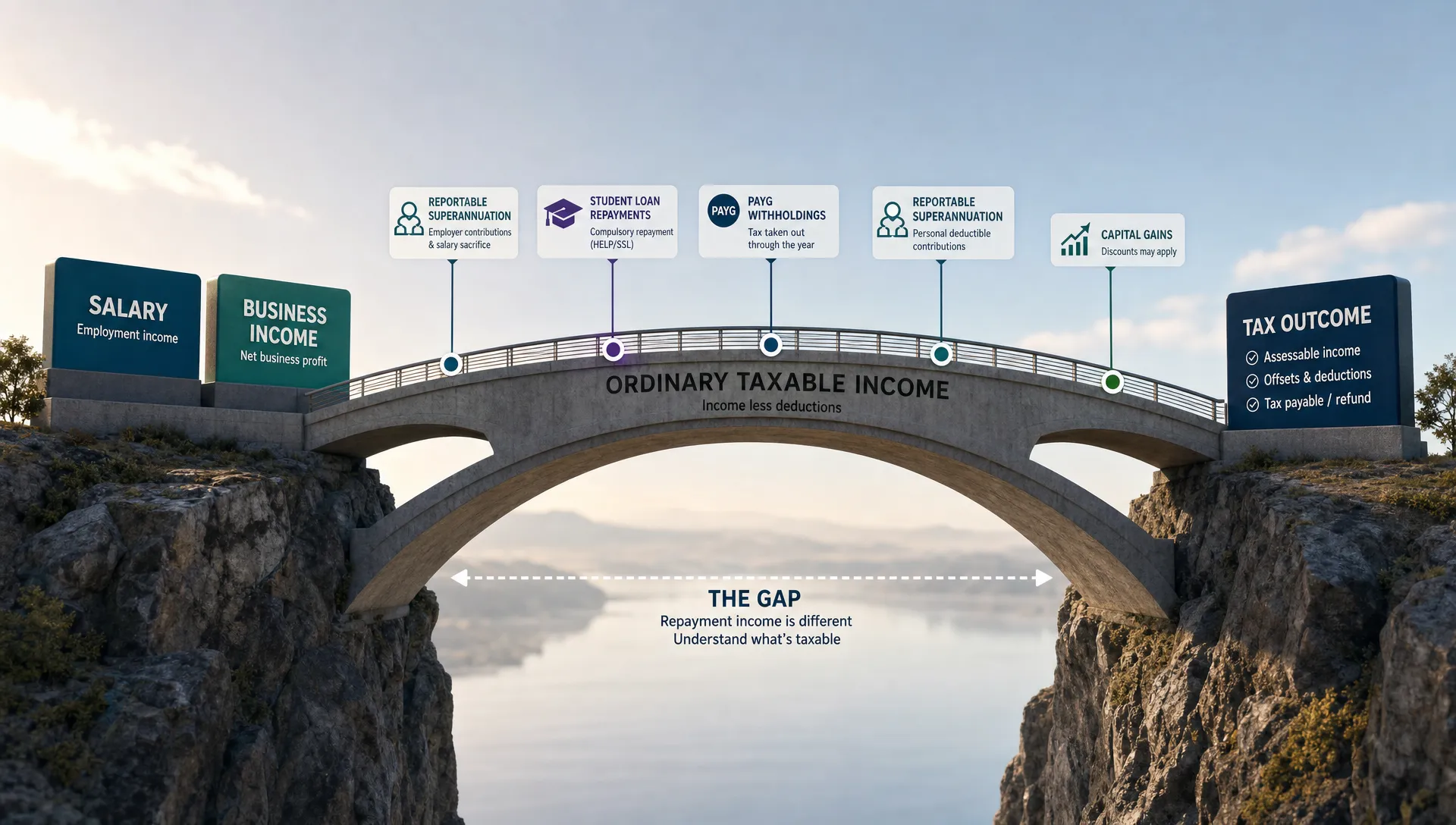
A student loan can change the final result of an Australian tax return even when the salary, business profit, or investment income looks straightforward. For many professionals, founders, directors, and high-income employees, the issue is not the loan balance itself. The issue is how the ATO calculates compulsory repayments using a broader measure of income than ordinary taxable income.
In Australia, the relevant debts are generally grouped as study and training support loans, often referred to as STSL. This can include HELP, HECS-HELP, FEE-HELP, VET Student Loans, Student Financial Supplement Scheme debts, ABSTUDY Student Start-up Loans, and Trade Support Loans. These debts are administered through the tax system, so your annual tax return is often where the true repayment position becomes clear.
For business owners and high-net-worth individuals, this matters because remuneration, trust distributions, investment losses, reportable Superannuation contributions, FBT, and capital gains can all affect repayment income. Our view is simple: a tax return with student loans should not be treated as a routine compliance task. It should be modelled as part of broader cash flow, remuneration, and wealth planning.
How student loans appear in an Australian tax return
Student loans do not usually appear as a normal deduction or business expense. Instead, the ATO calculates whether you must make a compulsory repayment after your tax return is lodged.
Your Notice of Assessment may include:
- Income tax payable or refundable
- Medicare levy and any Medicare levy surcharge
- Compulsory STSL repayment, if your repayment income is above the relevant threshold
- Credits for PAYG withholding already taken from wages or director salaries
- Any remaining tax debt or refund
The practical point is that STSL repayments are assessed in addition to ordinary tax. A taxpayer can believe they have been taxed correctly during the year, then still receive a tax bill if their employer, payroll setup, investment income, or business profit was not aligned with the final repayment calculation.
For employees, the process starts when you complete a TFN declaration and notify your employer that you have a study or training loan. Payroll then withholds extra PAYG amounts. That extra withholding is only a prepayment. The ATO still calculates the final compulsory repayment when your return is assessed.
For sole traders, consultants, directors, and investors, there may be little or no automatic withholding during the year. That creates a cash flow risk, particularly where profit is growing or capital gains are realised late in the financial year.
The key concept: repayment income is not the same as taxable income
The biggest misunderstanding we see is the assumption that student loan repayments are based only on taxable income. They are not.
The ATO uses repayment income. This figure starts with taxable income, then adds back certain items that can reflect broader financial capacity. According to the ATO, repayment income for study and training loans can include taxable income, reportable fringe benefits, reportable Superannuation contributions, total net investment losses, and exempt foreign employment income.
That distinction is critical for sophisticated taxpayers because several legitimate tax planning strategies may reduce taxable income without reducing repayment income by the same amount.
| Item | Effect on ordinary tax planning | Effect on student loan repayment income |
|---|---|---|
| Salary and wages | Taxable income | Generally included |
| Director fees | Taxable income | Generally included |
| Business profit | Taxable income | Generally included |
| Trust distributions | Taxable income to beneficiary | Generally included |
| Net capital gains | Taxable income | Generally included |
| Reportable fringe benefits | May not be paid as cash salary | Added back for repayment income |
| Salary-sacrificed Superannuation | May reduce taxable income | Reportable contributions are generally added back |
| Rental property loss | May reduce taxable income | Total net investment loss is generally added back |
| Exempt foreign employment income | May be exempt from Australian income tax | Can still be included for repayment income |
This is where strategic advice becomes valuable. A professional with a student loan who salary sacrifices into Superannuation, receives a novated lease, holds negatively geared property, and receives trust distributions may have a much higher repayment income than their taxable income suggests.
Why your refund may be smaller than expected
Many taxpayers expect a refund because PAYG withholding seems high. A student loan can reduce or eliminate that refund.
This commonly happens where:
- You did not tell your employer about your STSL debt on your TFN declaration
- You changed jobs and withholding did not reflect your total annual income
- You had multiple employers or contract income
- You received bonuses, commissions, director fees, or employee share scheme income
- You earned business income without setting aside funds for the student loan component
- You received investment income, trust distributions, or a taxable capital gain
A smaller refund is not necessarily an error. It may simply mean the ATO has calculated a compulsory repayment based on your final repayment income.
However, it is worth reviewing the assessment. In our work, we often identify issues in payroll setup, duplicated income reporting, incorrect fringe benefit treatment, or omitted deductions that distort the final outcome. Digital review tools help us compare payroll, bank feeds, BAS data, income statements, and ATO pre-fill information more efficiently, which improves accuracy and reduces surprises.
Student loans and PAYG withholding for directors and employees
If you are an employee or company director receiving salary or wages, your payroll configuration is the first line of defence.
A correct setup should reflect whether you have an STSL debt. If it does not, the employer may withhold too little. The result is often a tax bill after lodgement.
For directors, this is more nuanced. Directors may take a combination of wages, director fees, dividends, trust distributions, and expense reimbursements. Each has different tax and cash flow implications. Student loan planning should therefore be considered alongside PAYG withholding, Superannuation, FBT, Div 7A risk, and company tax planning.
For readers reviewing broader individual tax settings, our guide to tax rates in Australia for 2026 provides useful context on how rates, thresholds, GST, FBT, and Superannuation interact.
Sole traders and business owners face a different cash flow problem
A sole trader, consultant, tradie, creative business owner, or e-commerce operator may not have an employer withholding extra amounts for student loan repayments. The ATO may collect tax through PAYG instalments, but those instalments may lag behind actual growth.
This can be a material issue for fast-growing businesses. A founder may increase profit by $80,000, sell an asset, or receive a large online sales uplift, then discover that the final tax bill includes both income tax and a student loan repayment.
Consider a fashion e-commerce founder who has legitimate costs for inventory, packaging, freight, advertising, and branding items such as custom woven labels. Those expenses may reduce taxable profit where properly substantiated and connected to business income. But once the final profit is known, the founder’s student loan repayment position still needs to be forecast and funded.
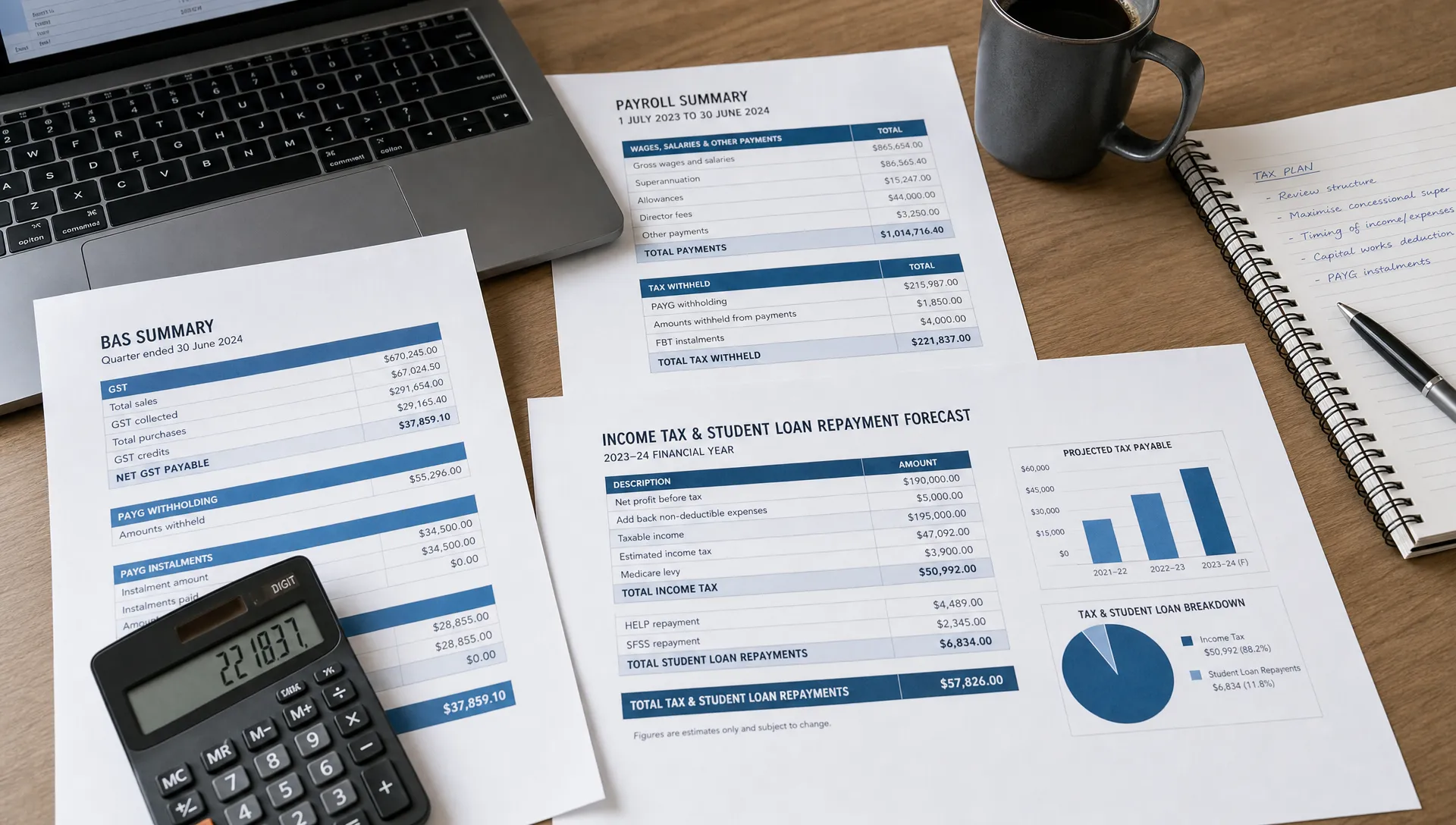
This is why bookkeeping is not merely administrative. Clean records support GST reporting, BAS lodgement, deduction substantiation, and tax planning. More importantly, they allow us to forecast repayment income before 30 June, not after the tax bill arrives. Our article on what Australian small business owners must track explains the records that make this level of planning possible.
Investment income, negative gearing, and capital gains
Student loans can also change the tax outcome for investors.
A negatively geared property may reduce taxable income, but total net investment losses are generally added back when calculating repayment income. That means the property loss may reduce income tax while having less impact on the compulsory student loan repayment than expected.
Capital gains can also trigger an unexpected repayment. If you sell shares, crypto assets, an investment property, or business assets, the taxable capital gain can lift repayment income above the threshold. This is particularly relevant for:
- First-time property investors selling after a strong market cycle
- Professionals with employee share scheme interests
- Crypto investors crystallising gains
- Business owners selling equipment, goodwill, or equity interests
- Family groups distributing capital gains through trusts
The timing of gains matters. So does the ownership structure. Where there are trusts, companies, SMSFs, or related-party arrangements, we recommend modelling the tax outcome before year end. The student loan component may not be the largest liability, but it can affect cash flow and distribution decisions.
Salary packaging, FBT, and reportable fringe benefits
Salary packaging can be valuable, but it does not automatically reduce student loan exposure.
Reportable fringe benefits are generally added back to repayment income. This is relevant for employees and executives with arrangements such as salary-packaged vehicles, certain living-away-from-home benefits, expense payment benefits, or other non-cash benefits that appear as reportable fringe benefit amounts.
From a planning perspective, the question is not whether salary packaging is good or bad. The question is whether the net benefit remains attractive after income tax, FBT, Medicare, cash flow, and student loan repayment consequences are considered.
Our team often models alternative remuneration packages for directors, medical specialists, consultants, and senior employees. The most tax-efficient package on paper may not be the most effective package after student loan obligations and cash flow timing are included.
Overseas income and Australian student loans
Australian student loan obligations can continue even when you move overseas. If you have a HELP or other STSL debt and live abroad, you may need to report worldwide income to the ATO and make repayments where income exceeds the relevant threshold.
This is especially relevant for digital nomads, expatriates, globally mobile executives, and founders expanding into overseas markets. Foreign salary, consulting income, business distributions, and investment returns can create Australian reporting obligations even when no Australian employer is withholding PAYG.
The interaction between residency, foreign income, tax treaties, and student loan reporting can be complex. For globally mobile taxpayers, student loan planning should sit beside residency analysis and foreign income reporting, not behind it.
Does making voluntary repayments help at tax time?
Voluntary repayments can reduce your loan balance, but they do not usually replace your compulsory repayment for the year if your repayment income exceeds the threshold.
This point is important. A taxpayer may make a voluntary repayment in May expecting no further amount at lodgement, then still have a compulsory repayment assessed after the return is lodged. The voluntary payment reduces the debt balance, but the compulsory repayment is calculated through the tax return process.
There can still be strategic reasons to make voluntary repayments, particularly before indexation is applied or where a taxpayer wants to clear a small balance. However, we recommend reviewing the ATO loan balance, expected repayment income, cash reserves, mortgage offset benefits, business working capital needs, and investment strategy before paying extra.
Student loans are generally indexed rather than charged conventional interest. That makes the decision different from paying down credit cards, unsecured business debt, or high-interest personal loans.
How AI-driven accounting changes the planning process
Traditional tax preparation often identifies the student loan outcome after the financial year has ended. That is too late for many business owners and directors.
Our approach is to use automated workflows and AI-assisted review processes to identify repayment exposure earlier. We can reconcile payroll data, BAS reporting, bank transactions, investment records, Superannuation entries, and ATO pre-fill information to build a more complete repayment income forecast.
This creates practical advantages:
- Earlier visibility over likely tax and student loan liabilities
- Better PAYG instalment planning for sole traders and business owners
- Cleaner payroll setup for employees and directors
- More accurate modelling of fringe benefits and salary packaging
- Better timing decisions for bonuses, dividends, trust distributions, and capital gains
- Reduced risk of ATO mismatches and post-lodgement surprises
This is the strategic pivot we encourage clients to make. Compliance is the foundation, but real value comes from using clean financial data to make better decisions.
If your affairs are straightforward, myTax may be sufficient. If you have business income, investments, overseas income, employee share schemes, property, or entity structures, our article on when to DIY and when to get help with myTax in Australia may help you assess the right level of support.
Practical scenarios where student loans change the result
The following scenarios show why student loan planning is rarely isolated from broader tax strategy.
| Scenario | Why the tax return changes | Planning response |
|---|---|---|
| Director receives a larger year-end bonus | Bonus increases taxable income and repayment income | Forecast withholding before bonus is paid |
| Sole trader profit rises quickly | No employer may be withholding for STSL | Set aside tax and repayment amounts monthly |
| Investor has a negatively geared rental | Net investment loss may be added back | Model tax saving and repayment income separately |
| Executive uses salary packaging | Reportable fringe benefits may be added back | Compare net package value after STSL impact |
| Trust distributes income to an adult beneficiary with a student loan | Distribution may trigger repayment | Review family group distribution strategy before 30 June |
| Expat earns overseas income | Worldwide income reporting may apply | Coordinate residency, foreign tax, and ATO reporting |
| Founder sells shares or crypto | Capital gain may lift income above the threshold | Plan disposal timing and cash reserves |
Each scenario requires judgement. The right answer depends on cash flow, commercial goals, asset protection, Superannuation strategy, and family group considerations.
Common errors we see in tax returns with student loans
Student loan errors are often not dramatic. They are usually small data issues that compound into an unexpected assessment.
Common errors include failing to tick the STSL box on a TFN declaration, relying on last year’s repayment thresholds, ignoring reportable fringe benefits, assuming salary sacrifice eliminates repayment exposure, overlooking trust distributions, not setting aside cash for sole trader profit, and misunderstanding overseas reporting obligations.
Another frequent issue is treating the tax return as a once-a-year event. By the time the return is lodged, the income has been earned, the distributions have been made, the asset sale has settled, and the cash may already have been spent. That is not strategic tax management.
We prefer a rolling forecast. For business owners and high-income professionals, a quarterly review can identify whether PAYG instalments, payroll withholding, and cash reserves are aligned with the likely final tax result.
Frequently Asked Questions
Does a student loan reduce my tax refund in Australia? Yes, it can. If your repayment income is above the relevant ATO threshold, a compulsory repayment may be added to your assessment. PAYG withholding may cover some or all of it, but if not, your refund can be reduced or you may receive a tax bill.
Is my HECS-HELP or HELP repayment tax deductible? The repayment itself is not a tax deduction. Separate self-education deductions may be available only where the expense and course satisfy ATO rules, and some subsidised course amounts are specifically excluded.
Why did I get a tax bill when my employer withheld tax? Your employer may not have withheld extra STSL amounts, or your total income may have changed because of bonuses, second jobs, director fees, business income, investments, fringe benefits, or trust distributions. The ATO calculates the final amount after lodgement.
Do voluntary repayments stop compulsory repayments? Not necessarily. Voluntary repayments reduce your loan balance, but if your repayment income exceeds the threshold, the ATO can still assess a compulsory repayment through your tax return.
Can negative gearing reduce my student loan repayment? Not always in the way taxpayers expect. Rental losses may reduce taxable income, but total net investment losses are generally added back when calculating repayment income for study and training loan purposes.
Do I need to report overseas income if I have an Australian student loan? In many cases, yes. Australians with study loans who live overseas may need to report worldwide income to the ATO and make repayments where income exceeds the threshold. Residency and foreign income advice is important.
Next steps for business owners, directors, and investors
If you are preparing a tax return with student loans, we recommend taking a structured approach before lodging.
Start by checking your current ATO loan balance through myGov or your tax agent portal. Then confirm whether your employer or company payroll has correctly recorded your STSL status. Next, forecast repayment income, not just taxable income. Include salary, business profit, reportable fringe benefits, reportable Superannuation contributions, net investment losses, trust distributions, capital gains, and relevant foreign income.
For business owners, we also recommend aligning BAS data, GST coding, payroll, Superannuation, and PAYG instalments with your annual tax forecast. This is where automated accounting workflows provide a measurable advantage. They allow us to identify risk earlier and give you real-time visibility over cash flow before lodgement deadlines create pressure.
How we can help
Our team at Perfect Accounting & Tax Services supports clients across Australia, with integrated service capability in Adelaide, Sydney, and Melbourne. We assist business owners, directors, investors, professionals, and high-net-worth individuals who need more than basic lodgement.
We can help you assess how student loans affect your Australian tax return, model repayment income, review payroll withholding, plan director remuneration, manage trust distributions, and integrate tax forecasting into automated accounting workflows.
If you want clarity before lodging, contact our team for a consultation. We will help you move beyond compliance and use your tax data as a strategic asset for cash flow control, financial health, and long-term growth.