
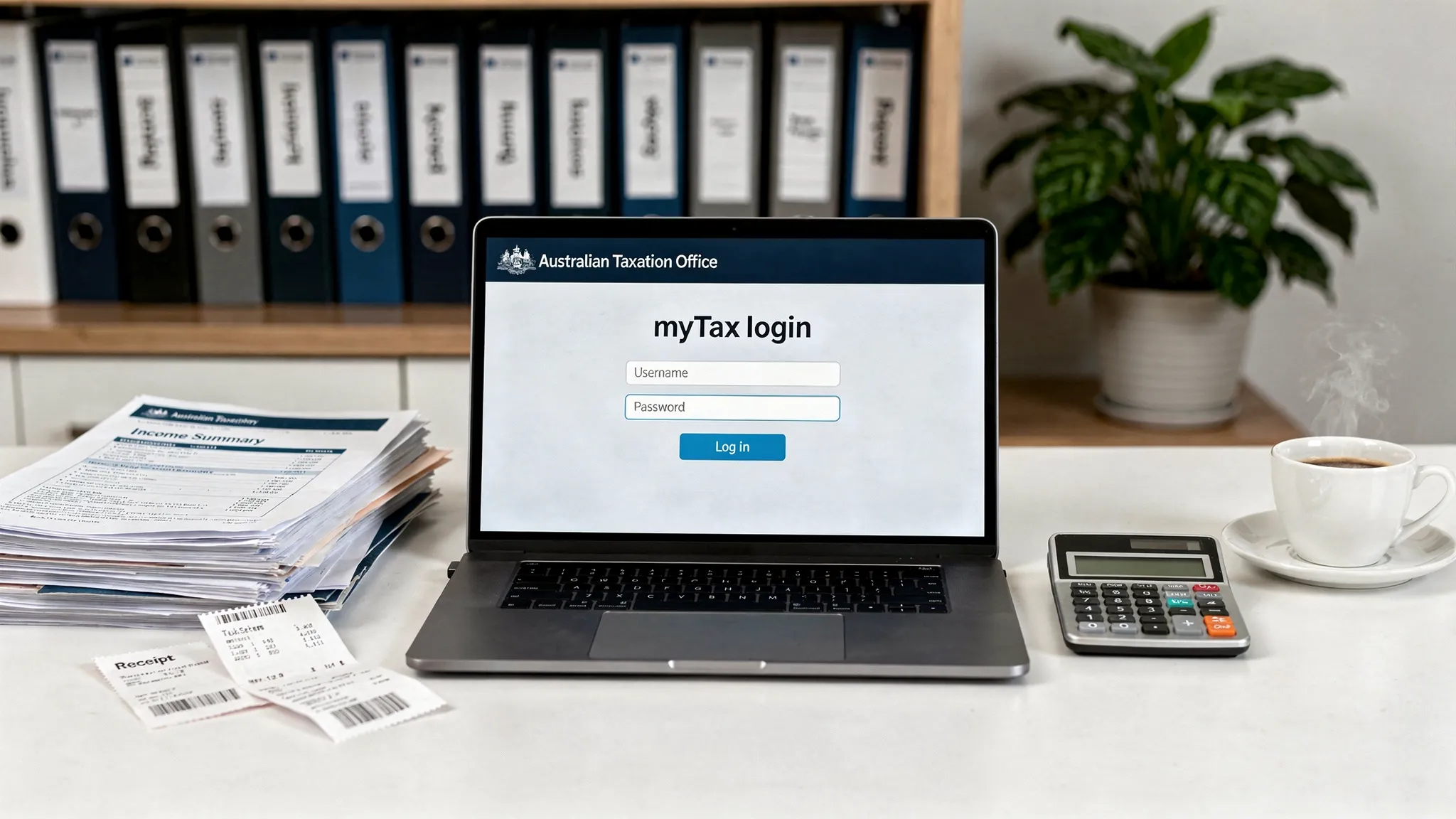
ATO myTax is a useful digital lodgement tool. For the right taxpayer, it can be fast, secure and cost-effective. For the wrong taxpayer, it can turn complex tax decisions into a series of tick boxes that do not fully address risk, cash flow, asset protection or long-term wealth strategy.
We see myTax as a lodgement channel, not a tax strategy. That distinction matters for business owners, company directors, property investors and high-net-worth individuals across Australia.
If you are searching for my tax AU guidance before lodging, the key question is not simply whether you can use myTax. The better question is whether your financial position is simple enough that DIY lodgement will not cost you more than it saves.
What myTax actually does
myTax is the ATO’s online individual tax return system, accessed through myGov when your account is linked to the ATO. It pre-fills certain information from employers, banks, private health insurers, government agencies and investment institutions.
That pre-fill capability is valuable. It reduces manual entry and helps many employees lodge straightforward returns. However, pre-fill is not the same as verification. Some information may be incomplete, delayed or require interpretation. The ATO also makes it clear that you remain responsible for checking the accuracy of your return before lodging.
In practical terms, myTax can help with:
- Salary and wages reported through Single Touch Payroll
- Bank interest and some dividends
- Private health insurance details
- Basic work-related deductions
- Simple donations and tax offsets
- Some rental, capital gains and business income labels for individuals
It does not replace an accounting system, BAS process, payroll review, tax planning session, entity structure assessment or Virtual CFO function. For sole traders, directors and investors, those gaps can be material.
When DIY myTax can be appropriate
DIY lodgement through myTax can make sense where your tax affairs are genuinely simple and well documented. We generally consider DIY reasonable when there are few judgement calls and limited opportunity for strategic tax planning.
| Situation | DIY may be suitable when | Why it can work |
|---|---|---|
| Employee income | You have one employer and accurate income statements | Most income is pre-filled through Single Touch Payroll |
| Basic deductions | You have receipts and simple work-related expenses | Substantiation is straightforward |
| Bank interest | You hold ordinary Australian bank accounts | Interest is usually pre-filled |
| Private health insurance | Your insurer data is accurate | The policy details usually flow through to myTax |
| Simple donations | You donated to deductible gift recipients and kept receipts | Claims are usually easy to verify |
| No business or investment complexity | You have no ABN income, rental property, crypto, foreign income or CGT events | There are fewer technical tax issues to interpret |
A typical example is an employee with one job, no investment property, no side business, no employee share scheme, no foreign income and modest work-related deductions supported by receipts. In that case, myTax may be efficient.
Even then, we recommend waiting until pre-fill data is complete, commonly later in July, rather than lodging too early. Lodging with incomplete data can lead to amendments, ATO queries or unexpected tax debts.
When to get professional tax help
The moment your return involves judgement, apportionment, structuring or future planning, professional advice becomes less of a cost and more of a risk management tool. This is particularly true for professionals managing businesses, assets or multiple income streams.
You operate as a sole trader or contractor
myTax can include sole trader income, but that does not mean DIY is always wise. Business income raises issues beyond data entry.
For example, you may need to consider Personal Services Income rules, GST registration, PAYG instalments, motor vehicle claims, home office deductions, equipment depreciation, software subscriptions, bad debts and the split between private and business use.
A common mistake is claiming deductions based on bank transactions without properly testing whether each expense is deductible, capital in nature, private in nature or only partly business-related. Another is ignoring GST until revenue has already exceeded the registration threshold.
If your business turnover is approaching or exceeds the GST registration threshold of $75,000, or $150,000 for not-for-profits, myTax alone is not enough. You need BAS discipline, accurate GST coding and cash flow planning.
You are a company director or trust beneficiary
Company directors and trust beneficiaries should be particularly careful. Your individual tax return may be only one part of a broader tax structure.
Director fees, dividends, trust distributions, Division 7A loans, shareholder loans, retained earnings, franking credits and unpaid present entitlements can all affect the correct tax position. Lodging your personal return before the company or trust accounts are finalised can create inconsistencies.
In our experience, this is where compliance becomes strategic. Good accounting does not merely report what happened. It helps directors understand profitability, tax provisioning, cash reserves and whether the current structure still supports growth.
You own investment property
Rental property returns often look simple on the surface, but they involve frequent technical issues. Repairs and maintenance may be immediately deductible, while improvements are usually capital in nature. Borrowing costs, depreciation, capital works, interest apportionment and private use all require careful treatment.
Property investors should also think beyond the annual tax refund. Negative gearing, CGT exposure, land tax, refinancing, ownership structure and future sale strategy can materially affect after-tax wealth.
For commercial landlords and developers, the risk level increases again. GST, margin scheme considerations, income recognition and entity structuring should be reviewed before transactions occur, not after settlement.
You sold shares, crypto or other assets
Capital gains tax is one of the most common areas where DIY taxpayers make errors. The ATO receives increasing amounts of third-party data from share registries, managed funds and crypto exchanges, but the tax treatment still depends on correct cost base records and transaction classification.
Issues often arise with:
- Partial disposals and parcel selection
- Reinvested distributions
- Brokerage and incidental costs
- Crypto swaps, staking rewards and DeFi activity
- Foreign currency movements
- Main residence exemption calculations
- The 50% CGT discount and eligibility periods
A pre-filled amount does not always mean the gain has been calculated correctly. It may simply indicate that the ATO is aware a transaction occurred.
You receive employee share scheme benefits or foreign income
High-income professionals, executives and technology employees often have employee share scheme interests, restricted stock units, options or offshore income. These can be difficult to report correctly without understanding taxing points, discounts, deferred schemes and foreign tax credits.
Foreign income also requires careful treatment. Australian tax residents are generally taxed on worldwide income. That can include overseas salary, pensions, dividends, rental income, capital gains and foreign bank interest. Double tax agreements may reduce double taxation, but they do not remove the need to disclose correctly.
For globally mobile executives and businesses hiring across borders, tax advice should align with talent, payroll and expansion strategy. If your growth plans involve overseas leadership or specialist roles, working with partners such as an international executive search and recruitment agency can support hiring execution, while our role is to ensure the Australian tax, payroll, superannuation and compliance implications are managed properly.
You have SMSF, estate or family wealth considerations
SMSF trustees, retirees, beneficiaries of estates and high-net-worth families should avoid treating myTax as a standalone solution. Individual tax outcomes are often connected to superannuation strategies, pension phase rules, contribution caps, estate distributions, trust structures and investment decisions.
For these clients, the return is the final output. The real value comes from the review before lodgement, when we can identify tax planning opportunities, documentation gaps and timing issues.
You are late, under ATO review or facing an audit
If you have overdue returns, ATO debt, amended assessments or review activity, DIY lodgement can create further risk. The priority should be accuracy, disclosure and a controlled communication strategy.
Late lodgement may also affect access to tax agent lodgement concessions. If you usually lodge yourself, the standard deadline is generally 31 October. Registered tax agents may have extended lodgement dates under the ATO lodgement program, but you typically need to be on their client list by the required time and have prior-year obligations under control.
The hidden risks of DIY myTax
The risk with DIY tax is not always obvious. Many taxpayers assume that if myTax accepts the return, the position is correct. That is not how the system works.
myTax is designed to collect information. It does not guarantee that deductions are allowable, that records are adequate, that income is complete or that your structure is optimal. The ATO can review a return after lodgement and request evidence.
Common DIY risks include:
- Claiming expenses without receipts or adequate records
- Overclaiming home office deductions without a reasonable method
- Treating capital purchases as immediate deductions incorrectly
- Ignoring private use adjustments for vehicles, phones and internet
- Forgetting foreign income or foreign tax credits
- Misreporting rental repairs, depreciation or capital works
- Lodging before income statements and investment data are tax ready
- Missing PAYG instalment and tax debt planning
For business owners, the biggest risk is often not one incorrect label. It is the absence of a reliable monthly financial process. If bookkeeping is only cleaned up at tax time, you lose the opportunity to make decisions while there is still time to improve the outcome.
A strategic decision matrix for myTax
We use a simple principle: DIY is suitable when tax is mainly administrative. Professional advice is warranted when tax affects business decisions, wealth outcomes or compliance risk.
| Your position | myTax DIY risk level | Better approach |
|---|---|---|
| Single salary, simple deductions | Low | DIY may be appropriate if records are complete |
| Salary plus modest investments | Low to moderate | DIY may work, but check dividends, managed funds and CGT |
| Sole trader or freelancer | Moderate | Review GST, deductions, PSI and tax instalments |
| Company director | High | Coordinate individual, company and director tax positions |
| Rental property investor | Moderate to high | Review interest, repairs, depreciation and CGT strategy |
| Crypto or active share trading | High | Reconcile transactions and assess capital versus revenue treatment |
| Foreign income or expat issues | High | Assess residency, double tax agreements and disclosure obligations |
| SMSF trustee or high-net-worth family | High | Integrate tax with wealth, superannuation and estate planning |
| ATO review, audit or late returns | High | Seek advice before lodging or amending |
How AI-driven accounting changes the conversation
Digital transformation has changed what clients should expect from tax and accounting services. In the past, many firms focused on year-end compliance. Today, modern accounting should give directors and business owners near real-time visibility over profitability, cash flow, GST exposure, payroll obligations and tax provisioning.
Our AI-driven workflows help streamline classification, reconciliation and exception detection. That does not remove professional judgement. It enhances it. Automation can process high volumes of data quickly, while our team focuses on the strategic questions that matter.
Those questions include:
- Are margins improving or deteriorating?
- Is GST being set aside as cash is collected?
- Are payroll and superannuation obligations being met on time?
- Is the business structure still appropriate for growth?
- Are tax liabilities being forecast before they become cash flow shocks?
- Is the business generating reliable data for finance applications, investors or acquisition discussions?
This is where compliance becomes a foundation for corporate growth. Accurate bookkeeping, BAS and payroll are not just administrative tasks. They are the data layer for strategic advisory, funding decisions, expansion planning and risk control.
Practical checklist before using myTax yourself
Before lodging through myTax, we recommend completing a disciplined review. If any item below raises uncertainty, it is usually worth getting advice before you lodge.
- Confirm all income statements are marked tax ready.
- Reconcile bank interest, dividends and managed fund distributions against your own records.
- Check that all deductions are supported by receipts, invoices or acceptable records.
- Review whether any expense has private use that must be apportioned.
- Confirm whether you had any CGT events, including crypto disposals and asset sales.
- Check whether you earned any foreign income or paid foreign tax.
- Confirm whether you have ABN income, PSI issues, GST obligations or PAYG instalments.
- Review whether you made reportable superannuation contributions or salary sacrifice arrangements.
- Consider whether your spouse, dependants, private health insurance or Medicare levy surcharge position has changed.
- Do not lodge early if key pre-fill data is incomplete.
The goal is not to make DIY difficult. The goal is to avoid preventable amendments, ATO scrutiny and missed planning opportunities.
Timing matters: tax planning happens before lodgement
A tax return reports the past. Tax planning shapes the future.
By the time you are lodging in myTax, many opportunities for the financial year may already be closed. Superannuation contributions, asset purchases, trust distribution decisions, director remuneration, bad debt write-offs and some restructuring actions need to be considered before 30 June.
For this reason, we encourage business owners and investors to separate tax planning from tax lodgement. Lodgement is the compliance step. Planning is the advisory step. Both matter, but they do different jobs.
For growing businesses in Adelaide, Sydney, Melbourne and across Australia, this distinction is critical. A national business needs consistency across entities, payroll locations, state-based obligations, remote teams and reporting systems. Our integrated approach is designed to bring those moving parts into one strategic financial framework.
Next steps before you decide
If your tax affairs are simple, wait until your pre-fill information is complete, check every figure, keep your records and lodge by the relevant deadline.
If you operate a business, own investment property, trade crypto, receive foreign income, manage a trust or company, or have overdue lodgements, pause before using myTax. The time spent on advice can protect cash flow, reduce compliance risk and identify opportunities that a lodgement screen will not highlight.
If you are a director or high-net-worth individual, we recommend a pre-lodgement review that looks at your personal tax return in the context of your wider structure. That may include company accounts, trust distributions, superannuation, investment entities, debt, family wealth objectives and future transactions.
Frequently Asked Questions
Is myTax the same as using a tax agent? No. myTax is an ATO online lodgement tool. A tax agent or adviser provides interpretation, review, planning and representation support where required.
Can sole traders use myTax? Some sole traders can lodge through myTax, but that does not mean it is the best option. GST, BAS, PSI, deductions, depreciation and tax instalments often justify professional review.
When is the deadline if we lodge ourselves? Individual taxpayers who self-lodge generally have a 31 October deadline. Tax agent lodgement dates may be later, subject to ATO lodgement program rules and your compliance history.
Will myTax automatically include all income? Not always. Pre-fill data may be incomplete or delayed. You remain responsible for checking all income, including investment, business, crypto and foreign income.
Can a tax adviser get us a bigger refund? The objective should not be a bigger refund at any cost. The objective is a correct, defensible and strategically sound tax position that supports cash flow and long-term financial health.
Should company directors lodge their personal return before company accounts are finalised? Usually, we prefer to coordinate both positions first. Dividends, director fees, loans, trust distributions and franking credits can affect the personal return.
How we can help
Our team at Perfect Accounting & Tax Services supports individuals, business owners, company directors and high-net-worth families with tax compliance, accounting and strategic advisory across Australia.
We combine 25 years of professional experience with AI-driven automation to improve accuracy, speed and financial visibility. Our services include corporate and SME accounting, BAS, payroll, advanced tax planning, audit support, SMSF compliance, Virtual CFO advisory and digital workflow transformation.
Whether you are based in Adelaide, Sydney, Melbourne or operating across multiple states, we can help you decide whether myTax is suitable or whether a structured advisory approach will deliver a stronger outcome.
Contact our team for a consultation and learn how our automated accounting workflows can turn tax compliance into a clearer, more strategic financial system.