
EOFY readiness is not achieved by chasing receipts in the final week of June. For Australian business owners, company directors and high-net-worth individuals, it comes from having clean financial data, clear tax positions and enough time to make decisions before 30 June.
This is where business tax preparation services create measurable value. The right process does more than prepare an income tax return. It strengthens BAS accuracy, validates payroll and Superannuation obligations, reviews deductions, identifies ATO risk areas and gives management a clearer view of cash flow before key decisions are locked in.
Our view is simple: EOFY should be a strategic control point, not a compliance scramble. With 25 years of professional experience and AI-driven workflows, we help clients across Australia, including Adelaide, Sydney and Melbourne, use tax preparation as a foundation for stronger financial health and corporate growth.
EOFY readiness is a financial control issue
EOFY readiness starts with confidence in the numbers. If the general ledger is unreconciled, GST coding is inconsistent or payroll records have gaps, a business cannot accurately assess its tax position, dividend capacity, financing requirements or growth options.
For directors, this matters because EOFY often coincides with decisions about profit distributions, asset purchases, debt reduction, trust resolutions, employee incentives and reinvestment. For investors and family groups, EOFY can also affect capital gains tax planning, entity structuring and record substantiation.
A strong tax preparation process answers practical questions before they become expensive problems. Are BAS lodgements aligned with the annual accounts? Have PAYG withholding and Superannuation records been reconciled? Are director loans, private expenses and FBT exposures properly identified? Are deductions supported by evidence that would stand up to an ATO review?
When those questions are addressed early, EOFY becomes a planning window rather than a deadline.
What business tax preparation services should review before EOFY
Effective EOFY preparation should bring compliance, reporting and advisory into one coordinated review. The focus is not only on what has already happened, but on what can still be improved before year end.
| Review area | What should be checked | Why it improves EOFY readiness |
|---|---|---|
| GST and BAS | GST coding, BAS reconciliations, PAYG withholding and timing differences | Reduces mismatches between quarterly BAS and annual tax reporting |
| Payroll and Superannuation | STP records, PAYG withholding, Superannuation, leave accruals and TFN records | Helps identify underpayments, reporting errors and payroll compliance gaps |
| FBT | Motor vehicles, entertainment, employee benefits and reportable fringe benefits | Prevents FBT issues from being missed because the FBT year ends on 31 March |
| Assets and depreciation | Asset purchases, disposals, finance arrangements and depreciation treatment | Supports accurate deductions and better capital expenditure decisions |
| Stock and work in progress | Inventory counts, obsolete stock, WIP and job costing | Improves profit accuracy, especially for construction, retail and manufacturing businesses |
| Debtors and bad debts | Aged receivables, recoverability and write-off evidence | Helps ensure profit is not overstated and cash flow risks are visible |
| Director loans and private use | Division 7A risks, drawings, shareholder loans and private expenses | Reduces the chance of unexpected deemed dividends or non-deductible adjustments |
| Trust and company distributions | Trust resolutions, retained profits, dividend strategy and tax rates | Gives owners time to make structured decisions before 30 June |
This level of review is particularly important for growing SMEs and corporate groups. As transaction volume increases, small data errors can compound across BAS, payroll, management reporting and income tax.
Cleaner records reduce ATO risk and adviser rework
The ATO expects businesses to keep records that explain transactions and generally retain those records for five years. Its record keeping guidance for business reinforces a key point we see every year: poor documentation increases the time, cost and risk of tax preparation.
Business tax preparation services improve EOFY readiness by identifying weak records before lodgement. That includes missing supplier invoices, inconsistent GST treatment, incomplete loan statements, unallocated bank transactions and payroll records that do not reconcile to STP finalisation.
Our team uses AI-assisted automation to reduce manual chasing and improve exception detection. Bank feeds, rule-based coding, document capture and transaction review workflows help us identify anomalies earlier. Human judgement remains essential, especially when interpreting tax law, entity structures and commercial context. Automation improves speed and visibility, but experienced advisers still determine the tax treatment.
This is why EOFY preparation should not sit in isolation. We have explored this broader discipline in our guide on what a business tax accountant should be reviewing year-round. The strongest EOFY outcomes usually come from monthly or quarterly review, not an annual clean-up.
Better preparation protects cash flow
Tax liabilities are not just accounting entries. They affect working capital, borrowing capacity, owner distributions and reinvestment decisions.
A business that estimates its income tax, GST, PAYG instalments, payroll obligations and Superannuation commitments early can make more disciplined decisions before 30 June. It can also avoid the stress of unexpected liabilities arriving after cash has already been used for stock, wages, equipment or dividends.
For companies and larger SMEs, EOFY preparation should connect directly with cash flow forecasting. This includes reviewing debtor collection, supplier timing, loan repayments, inventory purchases and upcoming BAS payment cycles. If the business is expanding into another state, state-based obligations such as payroll tax and land tax may also need attention.
We see bookkeeping and tax preparation as linked functions. Accurate books provide the evidence base, while tax analysis converts that evidence into planning. For a deeper view of this connection, our article on how business bookkeeping services improve cash flow control explains why clean records are central to stronger working capital management.
The EOFY readiness calendar: what should happen and when
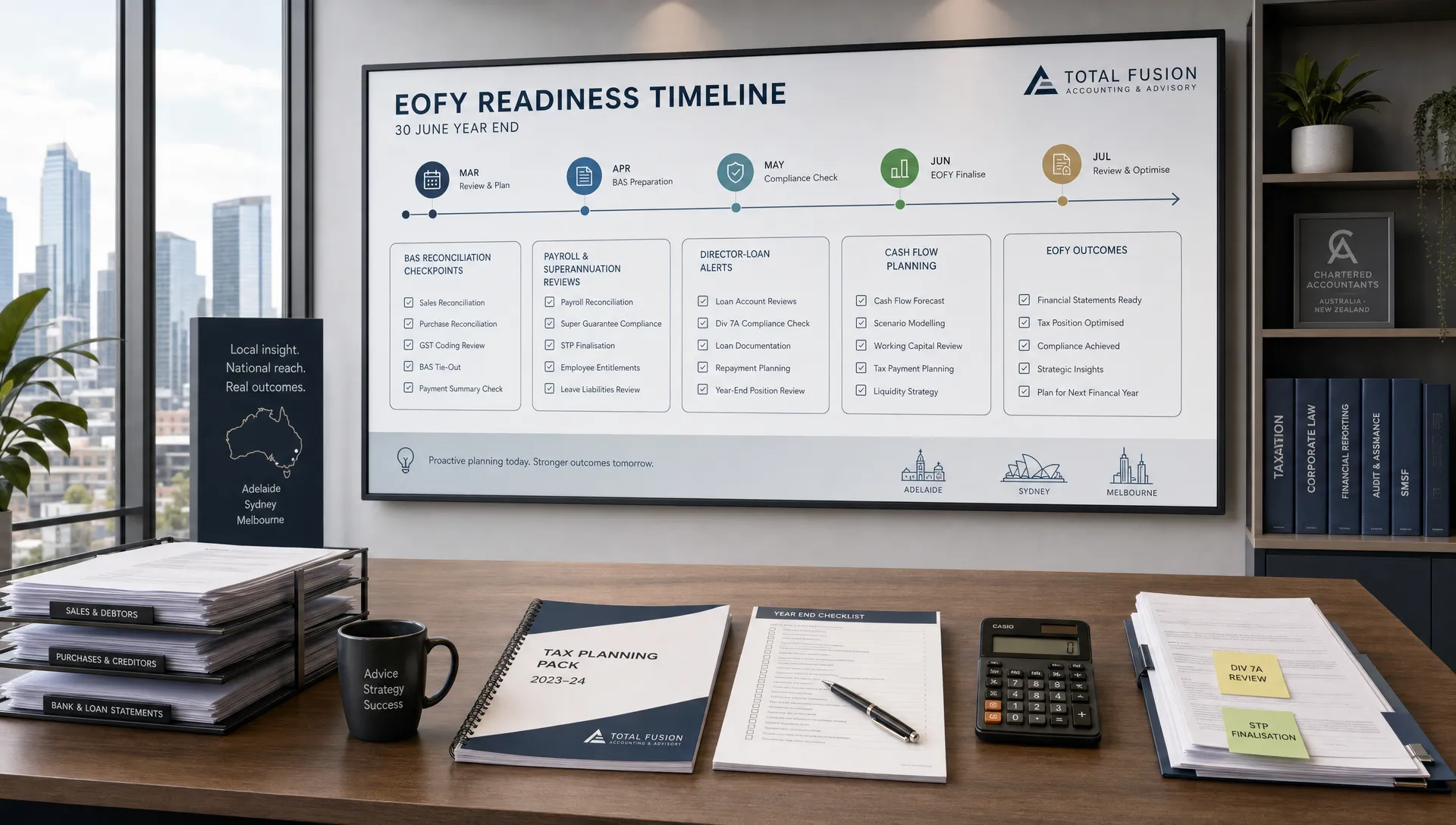
EOFY preparation is most effective when it follows a structured calendar. The exact timing depends on the business size, industry and reporting cycle, but the following framework is a practical starting point.
| Timing | Key focus | Strategic benefit |
|---|---|---|
| March to April | FBT review, payroll checks, asset planning and preliminary profit forecast | Gives directors early visibility before the final quarter |
| May | BAS reconciliation, debtors review, stock planning and deduction analysis | Identifies issues that can still be corrected before 30 June |
| June | Final tax estimate, trust resolutions, dividend planning and year-end adjustments | Supports decisions that must be made before EOFY |
| July to August | STP finalisation, ledger clean-up, income tax workpapers and management reporting | Creates an efficient lodgement process and cleaner advisory base |
| September onward | Forecasting, instalment planning and process improvement | Converts EOFY lessons into better year-round financial control |
This calendar becomes even more important in the current environment. With stronger ATO data matching, changing Superannuation expectations and newer rules affecting areas such as ATO interest deductibility, businesses need to plan earlier. If you are reviewing your current-year obligations, our guide to business tax changes in Australia for 2026 highlights several issues worth factoring into your next EOFY cycle.

Where automation changes the EOFY process
Traditional EOFY preparation often relied on spreadsheets, manual ledger clean-ups and repeated email requests. That model is slow, reactive and prone to missing issues until lodgement is already under pressure.
Modern business tax preparation services should use automation to create a more controlled workflow. AI-assisted systems can help classify transactions, flag unusual movements, compare current-year results to prior periods and identify missing documentation. Cloud accounting integrations also give advisers and business owners faster access to real-time financial information.
The commercial value is not only speed. Better data visibility allows directors to test scenarios before EOFY. A business can assess whether to defer or accelerate expenditure, improve debtor collection, review salary packaging, update instalment planning or reconsider finance timing.
We use digital workflows to reduce low-value administration, then direct professional attention to judgement-based areas such as tax structuring, governance, audit risk and strategic advisory. That is where meaningful value is created.
Common EOFY blind spots we see in Australian businesses
Even well-managed businesses can miss issues when EOFY preparation starts too late. The most common blind spots tend to appear where operational activity moves faster than the accounting process.
- Director drawings and shareholder loans are not reviewed until after 30 June.
- GST codes are applied inconsistently across software subscriptions, imports, deposits and mixed-use expenses.
- Superannuation records do not reconcile cleanly with payroll reports and payment records.
- Work in progress, stock and unbilled revenue are not reviewed before profit is estimated.
- Asset finance transactions are coded as simple purchases or expenses without considering the loan structure.
- Trust distribution decisions are delayed until there is limited time to prepare accurate resolutions.
These issues are rarely solved by simply lodging later. They require better systems, earlier review and clearer accountability between the business, bookkeeper, payroll team and tax adviser.
Different businesses need different EOFY preparation
EOFY readiness should reflect the commercial realities of the business. A construction company does not have the same risk profile as a medical specialist, e-commerce retailer or SaaS founder.
| Business profile | EOFY preparation priority |
|---|---|
| Tradies and construction firms | Job costing, WIP, contractor payments, asset finance, GST and payroll compliance |
| Professional service firms | Work in progress, partner or director drawings, payroll, FBT and profit distribution planning |
| E-commerce and retail businesses | Stock counts, platform fees, GST treatment, refunds, merchant deposits and international transactions |
| Property investors and developers | Interest records, project costs, GST margin scheme considerations, land tax and entity structuring |
| Tech startups and SaaS companies | R&D records, software development costs, employee incentives, investor reporting and cash runway |
| Family groups and high-net-worth clients | Trust resolutions, investment income, capital gains, Division 7A and inter-entity loans |
A strong adviser adapts the EOFY process to these differences. Our role is to ensure compliance is accurate, then use the same data to support strategic planning.
When tax preparation becomes strategic advisory
The best EOFY outcome is not simply a lodged tax return. It is a clearer understanding of business performance, risk and opportunity.
Once the accounts are reliable, business tax preparation services can support broader advisory work. That may include forecasting, margin review, tax instalment planning, entity structure analysis, succession planning, debt management or preparation for investment and sale.
This is where our Virtual CFO and strategic advisory work connects with compliance. We help business owners move from historical reporting to forward-looking decision-making. For clients operating across Adelaide, Sydney, Melbourne or multiple states, our integrated national service model also helps maintain consistency across bookkeeping, BAS, payroll, tax planning and management reporting.
The compliance file becomes a strategic asset when it gives directors the confidence to act.
Frequently Asked Questions
When should Australian businesses start EOFY tax preparation? We recommend starting the EOFY review during the March quarter, with a more detailed tax estimate by May. FBT needs attention even earlier because the FBT year ends on 31 March. Waiting until July usually limits planning options.
Are business tax preparation services different from tax return filing services? Yes. Tax return filing focuses on preparing and lodging the final return. Business tax preparation services are broader because they review data quality, BAS, GST, payroll, Superannuation, deductions, structure and cash flow before lodgement.
Can AI automation replace a tax adviser at EOFY? No. Automation can improve accuracy, speed and visibility, but tax treatment still requires professional judgement. We use AI-driven workflows to identify issues faster, then apply experienced advisory analysis to compliance, structuring and planning decisions.
What records should a business have ready for EOFY? Key records include bank statements, loan statements, supplier invoices, asset purchase documents, payroll reports, Superannuation payment records, BAS workpapers, debtor and creditor listings, stock records, trust deeds, company minutes and evidence for deductions.
Do businesses in Adelaide, Sydney and Melbourne face different EOFY issues? Core federal tax obligations are consistent across Australia, but state-based issues can differ. Payroll tax, land tax, duties and industry regulation may vary by location, which is why cross-state businesses benefit from coordinated national advice.
Next steps for stronger EOFY readiness
The first step is to assess whether your accounting data is decision-ready. If reconciliations, BAS balances, payroll records and debtor reports cannot be trusted, EOFY tax estimates will be unreliable.
The second step is to bring tax planning forward. Directors should have a clear estimate of taxable income, GST exposure, PAYG instalments, Superannuation obligations and likely cash requirements before 30 June.
The third step is to automate the workflow. Digital document capture, structured transaction review and real-time reporting reduce manual delays and allow our advisers to focus on higher-value analysis.
At Perfect Accounting & Tax Services, we work with businesses, directors and high-net-worth clients across Australia to make EOFY preparation more accurate, efficient and strategic. Our team combines deep Australian tax expertise with AI-driven automation to improve compliance, strengthen cash flow visibility and support corporate growth.
If you want EOFY to become a planning advantage rather than a last-minute pressure point, contact Perfect Accounting & Tax Services for a consultation and learn how our automated accounting workflows can support your next EOFY cycle.