

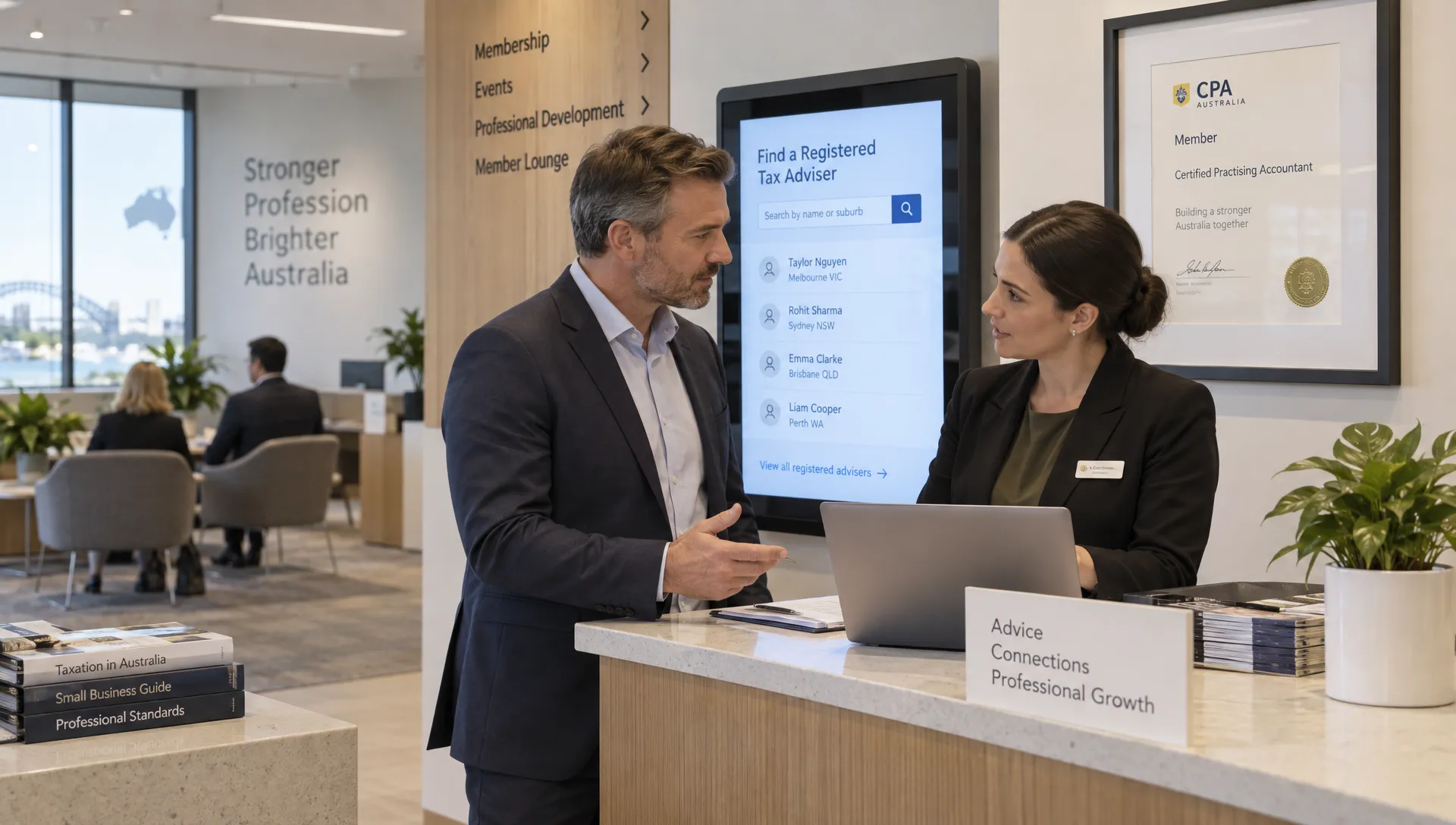
We regard a tax company logo as an introduction, not a credential. A polished identity can help an accounting firm communicate its positioning, but it cannot establish whether the people behind it are registered, technically capable or equipped to manage complex Australian tax obligations.
For business owners, company directors and high-net-worth individuals, that distinction matters. The adviser selected may influence cash flow, entity structuring, reporting quality and decisions involving substantial assets. Visual confidence should not replace evidence of professional competence.
Our approach is to separate three questions: what the branding communicates, whether the business identity is genuine and whether the service can support the financial decisions ahead. That approach gives design its proper place without allowing it to carry more weight than it deserves.
What a tax company logo can tell us
We can reasonably interpret a logo as an expression of how a firm wants to be perceived. Restrained typography might suggest a corporate focus. A contemporary design might signal a preference for digital delivery. A recognisable symbol can help distinguish one practice from another.
These are positioning signals, not verified capabilities. We would use them to frame questions rather than draw conclusions.
| Visual signal | Reasonable interpretation | Evidence still needed |
|---|---|---|
| Consistent branding across documents | The firm presents a coherent identity | Matching legal entity and engagement details |
| Corporate-style design | The firm may be targeting businesses and directors | Relevant experience with company and group tax matters |
| Digital or technology-themed imagery | The firm wants to communicate innovation | A clear explanation of its automated workflows and review controls |
| A professional membership mark | A credential is being represented | Verification with the relevant professional body |
| References to Australian cities | The firm is communicating geographic coverage | Confirmation of how service delivery works in those locations |
We also value consistency for practical reasons. Recognisable branding can make correspondence easier to identify and reduce confusion between related businesses. However, copied branding can create exactly the same impression, so familiarity alone is insufficient.
What branding cannot establish
We cannot use a tax company logo to determine registration status, the quality of advice or the controls protecting confidential financial information. Each requires a separate check.
Registration and professional credentials
We recommend checking the Tax Practitioners Board public register when assessing a provider of tax agent services. The relevant individual or entity should hold the registration appropriate to the services being offered. BAS agent registration and tax agent registration are not interchangeable.
A firm trading name may differ from the name of its registered service provider. We would ask for that relationship to be explained rather than assume a mismatch proves misconduct.
Professional membership and statutory registration also serve different purposes. A Chartered Accountant designation, for example, does not replace the need to verify the relevant tax agent registration. We treat displayed credentials as claims to check, not proof supplied by the artwork itself.
Technical judgement and commercial understanding
For complex matters, we look beyond the visual identity to how the adviser diagnoses a problem. A director loan, a family trust distribution or a property development arrangement requires more than an attractive presentation.
A tax company logo cannot demonstrate whether an adviser will identify a Division 7A exposure, assess GST treatment correctly or explain how a proposed structure affects cash flow. We would ask how the firm documents assumptions, reviews advice and manages matters outside its expertise.
Our discussion of what sets expert tax accountants apart in complex matters explores that distinction further. The useful evidence is the quality of the reasoning and review process, not the confidence of the branding.
Verify the business behind the brand
Before sharing records or signing an engagement, we recommend connecting the trading name to the legal entity providing the service. An engagement letter should make the contracting party clear, alongside the scope, responsibilities and fee arrangements.
We can use ABN Lookup to check publicly available Australian Business Register information. That helps establish business identity, but an active ABN does not prove tax agent registration or technical competence.
Where an invoice, website and engagement letter show different names, we would request clarification. Differences can be legitimate, particularly where a practice uses a trading name, but the relationship should be understandable.
We also recommend confirming who will provide advice, who will review the work and who will communicate about ATO matters. A recognisable brand may represent several entities or service teams. The engagement should identify the relevant provider rather than leave those responsibilities implied.
A familiar logo does not authenticate an email
We treat a tax company logo in an email, invoice or payment request as something that can be copied. It does not authenticate the sender or confirm that attached banking instructions are genuine.
A request to change payment details deserves independent verification using a previously confirmed telephone number. We would not rely solely on contact details contained in the message requesting the change.
The same caution applies to requests for a TFN, identity documents or access to accounting software. Before information is released, we recommend confirming the recipient and the transmission method through an established channel. Passwords and authentication codes should not be disclosed in response to an unexpected message.
For directors and family groups, this is a financial governance issue rather than a branding issue. Clear verification procedures help protect sensitive information and reduce the risk of misdirected payments, even when a message looks entirely familiar.

Test technology claims against the actual workflow
We would never infer digital capability from a futuristic icon or the word “AI” beside a business name. Useful automation should be explainable in operational terms: which tasks it assists, which records it uses and where professional review occurs.
At Perfect Accounting & Tax Services, our AI-driven processes support faster processing, greater accuracy and more timely financial visibility. We approach automation as support for professional judgement, not a substitute for it. The quality of the source records and the treatment of exceptions remain essential.
A tax company logo cannot reveal whether an automated system distinguishes a duplicate receipt from a valid expense or flags an unusual GST classification. We recommend asking how exceptions are identified, checked and resolved before information feeds into reporting or lodgement.
We would also distinguish real-time visibility from completed financial review. A frequently updated dashboard can still contain unreconciled transactions or estimates. Decisions about distributions, borrowing or investment should reflect the status of the underlying records, not simply the freshness of the display.
Compliance should support better decisions
We frame bookkeeping, BAS preparation, payroll, superannuation and FBT compliance as foundations for strategic advisory and corporate growth. Reliable records help us assess working capital, forecast tax payments and identify financial pressure before it constrains a business.
For a company director, the valuable output is not merely a lodged return. We seek a clear view of obligations, available cash and decisions requiring attention. For high-net-worth families, we also consider how information across entities supports coordinated planning.
Our guide to choosing tax services that support business growth explains how to assess that broader service relationship. Branding may introduce the proposition, but the workflow must substantiate it.
Turn the first impression into an evidence request
Rather than judging a tax company logo in isolation, we recommend using the initial enquiry to request a small set of verifiable details. The aim is not to create an excessive procurement exercise, but to establish who is accountable and how the engagement will operate.
Our suggested evidence request covers:
- Identity and registration: The contracting entity, ABN and relevant tax agent or BAS agent registration details.
- Scope and accountability: The work included, exclusions and responsibility for preparation, review and advice.
- Relevant capability: How the team would approach the principal tax or commercial issues involved.
- Digital controls: How records are received, access is managed and automated exceptions are reviewed.
- Service delivery: The communication arrangements, fee basis and coordination across entities or locations.
We regard clear, specific answers as more useful than broad claims about excellence. Confidentiality may prevent a firm from sharing client work, but it should still be able to explain its process without disclosing another client's information.
Frequently asked questions
Does a professional-looking logo prove an accounting firm is legitimate? No. We recommend separately verifying business identity, relevant registration and engagement details. Professional design can be purchased or copied without establishing competence.
Does an ABN confirm that a business can provide tax agent services? No. We use ABN information to help verify business identity, while checking the relevant registration through the Tax Practitioners Board.
Can a professional membership symbol replace a registration check? No. We assess professional membership and statutory registration separately. A displayed symbol should be verified with its issuing organisation where relevant.
Should an older-looking logo rule out a capable adviser? No. We would assess technical judgement, responsiveness, digital processes and review controls directly. Design age is a poor measure of current professional capability.
Next steps: assess the service behind the identity
We recommend treating a tax company logo as the start of due diligence, not its conclusion. Before engagement, confirm the provider, clarify the scope and understand how professional oversight supports the proposed digital workflow.
Our team at Perfect Accounting & Tax Services combines 25 years of professional experience with accounting, tax and strategic advisory services. We support clients across Australia through integrated service capabilities in Adelaide, Sydney and Melbourne.
To discuss business obligations, complex tax planning or AI-driven accounting processes, contact our team for a consultation. We can explore how reliable compliance and more timely financial information can support the next stage of financial planning and corporate growth.