
For a growing Australian business, the quality of tax advice affects far more than the annual return. It influences cash flow, pricing decisions, director remuneration, funding readiness, asset investment, risk management and ultimately, enterprise value.
We see this often with SMEs, professional firms, property investors and national operators. The businesses that scale well rarely treat tax services as an end-of-year obligation. They use tax compliance as the financial discipline that supports strategic advisory, clearer forecasting and better board-level decisions.
Choosing the right adviser is therefore not simply a question of who can lodge a return. It is a question of who can help you convert financial data into commercial intelligence.
Growth-focused tax services start with strategy
Traditional tax support is usually reactive. A return is prepared after year-end, BAS is lodged quarterly, and issues are addressed when the ATO, a lender or a business partner asks questions.
Growth-focused tax services work differently. They begin with the structure, revenue model, margin profile, cash cycle and investment objectives of the business. The adviser should understand how tax, GST, payroll, Superannuation, FBT, Division 7A, asset purchases and financing decisions interact before recommending a course of action.
For company directors, this matters because the tax position is only one part of the decision. A technically valid deduction may still create poor cash flow. A structure may reduce tax in the short term but become inefficient for succession, capital raising or a future sale. A BAS process may be compliant but too slow to support real-time management reporting.
A high-quality adviser should be able to explain both the tax outcome and the business consequence.
Confirm registration, governance and professional standards
In Australia, any adviser who provides tax agent services for a fee must be appropriately registered with the Tax Practitioners Board. Before appointing a firm, directors should check the Tax Practitioners Board public register and confirm who is responsible for the work.
This is not a box-ticking exercise. Registration, professional standards and quality control matter because tax advice often affects director obligations, shareholder returns, employee entitlements and ATO risk.
We recommend assessing governance in practical terms. Does the adviser have a clear review process? Are complex matters escalated to senior professionals? Are assumptions documented? Are recommendations provided in writing when the issue is material?
For businesses with multiple entities, trusts, SMSFs, property holdings or cross-border interests, written advice and documented reasoning become especially important. If the ATO reviews a position later, your records need to show not only what was claimed, but why the treatment was reasonable.
Look for capability across the full business tax cycle
A tax return is only the final output. The real value is created during the year, when transactions are coded, GST is reported, payroll is processed, super is paid, assets are purchased and directors make decisions about profit extraction.
Strong tax services should cover the full operating cycle, including bookkeeping, BAS, payroll, management reporting, tax planning and strategic advisory. If these functions are disconnected, errors accumulate and opportunities are missed.
| Assessment area | What to look for | Why it supports growth |
|---|---|---|
| Tax compliance | Accurate income tax returns, company tax, trust tax and individual tax support | Reduces penalties and creates a reliable compliance baseline |
| BAS and GST | Regular reconciliations and GST classification review | Improves cash-flow forecasting and reduces ATO adjustment risk |
| Payroll and Superannuation | PAYG withholding, Single Touch Payroll and super processes | Protects employees, directors and cash-flow planning |
| Structuring advice | Company, trust, partnership, SMSF and group structure review | Supports asset protection, succession and funding flexibility |
| Management reporting | Monthly or quarterly reporting with meaningful commentary | Gives directors earlier visibility of margin, tax and cash trends |
| Digital automation | AI-assisted workflows, receipt capture and system integration | Reduces manual errors and improves decision speed |
| ATO readiness | Evidence management, audit support and late lodgement assistance | Lowers disruption if the ATO reviews the business |
| National coverage | Consistent support across Adelaide, Sydney, Melbourne and beyond | Helps multi-location businesses operate with one financial framework |
The key point is integration. A firm may be technically competent at lodgement, but if it cannot connect tax compliance with business performance, it may not be the right partner for a growth-stage enterprise.
Prioritise cash-flow led tax planning
Tax planning should not be limited to estimating a year-end liability. It should help directors understand when cash will be required, how profits are being generated, whether margins are sustainable and which decisions may trigger tax consequences.
This is particularly important in the 2026 environment. Australian businesses are managing higher compliance expectations, ATO data-matching, Superannuation obligations and changes that affect tax timing. For example, the non-deductibility of ATO interest charges from 1 July 2025 makes late payment and poor cash-flow planning more expensive from a commercial perspective.
A growth-oriented adviser should help you forecast tax liabilities before they become urgent. That includes income tax, PAYG instalments, GST, payroll tax where relevant, FBT and Superannuation.
We have explored several of these issues in more detail in our article on business tax changes in Australia for 2026. The broader lesson is consistent: tax planning is strongest when it is connected to live financial data, not historical guesswork.
Assess whether the adviser understands your business model
Different industries create different tax risks. A medical specialist, SaaS founder, logistics operator, property developer and high-net-worth investor may all require tax support, but the technical issues are not the same.
For example, a property developer may need advice on GST, margin scheme considerations, financing costs, related-party transactions and project profit recognition. A technology company may need support with R&D tax incentive eligibility, employee share schemes, contractor arrangements and capital raising. A professional services firm may need careful planning around Personal Services Income, director remuneration, trust distributions and working capital.
Your adviser should ask detailed questions about revenue, costs, contracts, assets, people and future plans. If the conversation begins and ends with last year’s tax return, the service is unlikely to support business growth.
We believe the adviser should understand both the numbers and the commercial mechanics behind them.
Choose digital workflows, not manual bottlenecks
Modern tax services should be built around clean data. Manual spreadsheets, delayed reconciliations and disconnected systems make it difficult to provide timely advice. They also increase the chance of GST errors, missed deductions, duplicated transactions and weak substantiation.
AI-driven accounting workflows can improve the process by automating data capture, identifying anomalies, accelerating reconciliations and giving directors earlier visibility of performance. Automation does not replace professional judgement. It improves the quality and speed of the information used to make that judgement.
For example, a director reviewing monthly accounts should not have to wait weeks for basic reconciliations. A finance team should be able to identify unusual expense trends, GST coding inconsistencies or unpaid Superannuation obligations before they become compliance issues. A growing business should be able to compare actual performance against forecast and adjust tax planning accordingly.
The ATO also expects businesses to maintain proper records. Its record-keeping guidance makes it clear that records must explain transactions and support tax positions. Digital systems make this easier, but only if they are configured correctly.
Operational discipline matters at every level. For teams travelling between Adelaide, Sydney and Melbourne, centralised expense capture, GST tax invoices and clear approval workflows can reduce leakage. Even simple procurement decisions, such as comparing hotel booking deals for interstate business travel, should feed into a controlled accounting process so that cost management and substantiation work together.
Demand proactive advisory, not annual surprises
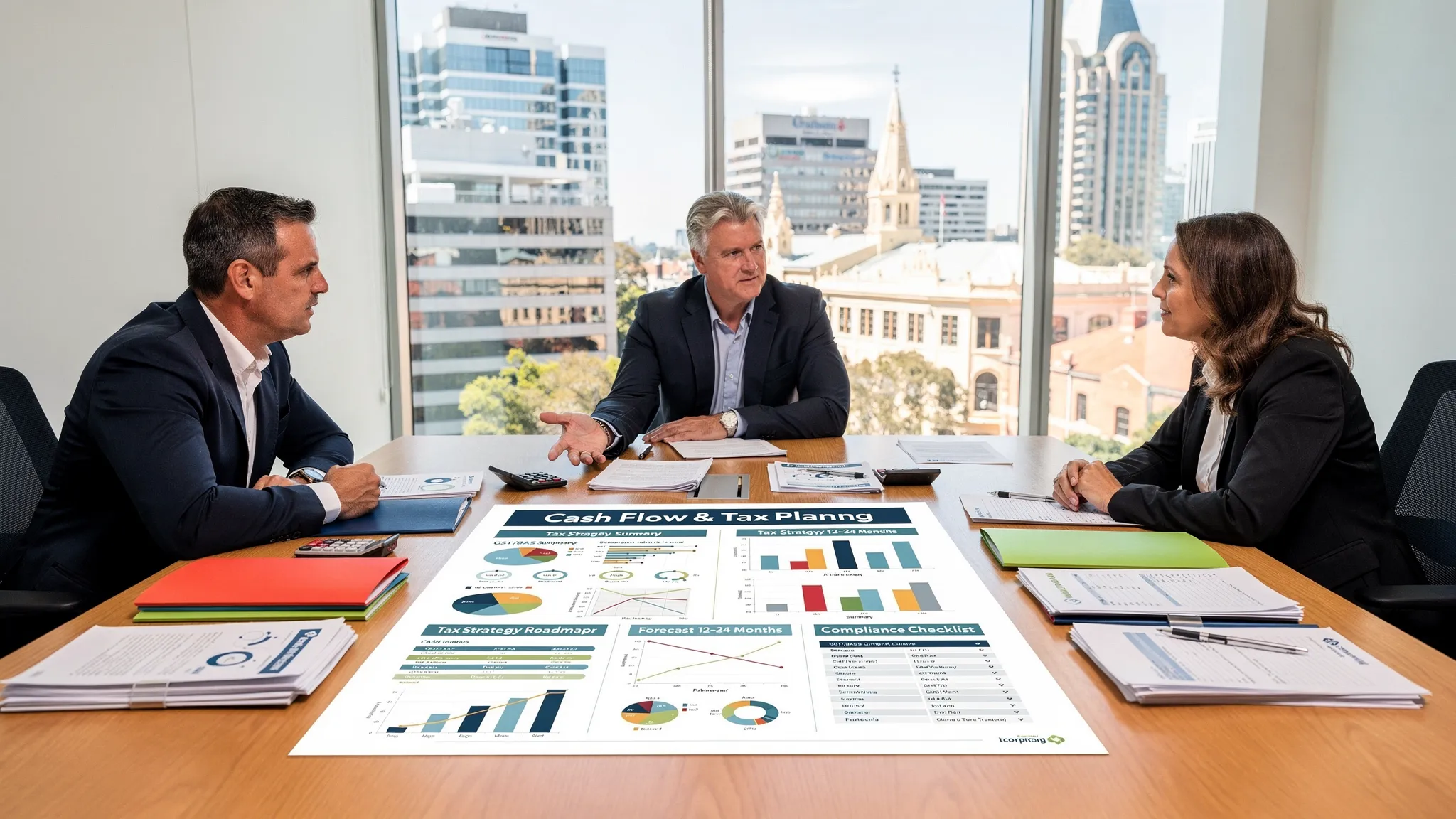
A strong adviser should set a rhythm for review. For some businesses, quarterly tax planning may be sufficient. For others, especially companies scaling quickly or managing multiple entities, monthly reporting and advisory meetings may be more appropriate.
The right cadence depends on complexity, growth rate and risk. A business preparing for funding, acquisition, expansion or sale needs more frequent insight than a stable, low-complexity operation.
Proactive advisory should cover practical questions such as:
- Are gross margins moving in the right direction?
- Is GST being reported correctly across revenue streams?
- Are PAYG withholding and Superannuation obligations up to date?
- Is the business setting aside enough cash for tax?
- Are director loans, dividends and wages being managed appropriately?
- Does the current structure still suit the next three to five years?
- Are asset purchases being timed and documented correctly?
- Would a virtual CFO model improve financial governance?
These questions turn tax from a compliance function into a decision framework.
Test their ability to manage complexity
Many businesses outgrow basic tax support before they realise it. Warning signs include multiple entities, rapid hiring, interstate expansion, foreign income, investor reporting, director loans, complex property transactions, SMSF interests, crypto assets, employee share schemes or an upcoming business sale.
Complexity does not automatically mean something is wrong. It means the adviser must be able to identify interactions across tax law, accounting standards, cash flow and commercial objectives.
For company directors, one useful test is to ask how the adviser would approach a material transaction before it occurs. The answer should include fact-finding, modelling, risk assessment, documentation and implementation. If the adviser only explains what will happen after the transaction, that is a warning sign.
We have also addressed this distinction in our article on what sets expert tax accountants apart in complex matters. In our experience, the strongest advice is diagnostic before it is technical.
Ask better questions before appointing a tax firm
The selection process should be structured. Business owners often ask about price first, but fees only make sense when compared with risk, responsiveness, expertise and strategic value.
Ask prospective advisers the following questions:
- How do you review our structure before preparing tax work? The answer should cover entities, asset ownership, profit extraction, succession and risk.
- How do you use automation and AI in your accounting workflows? Look for speed, accuracy and visibility, not vague claims about technology.
- How often will we review tax and cash-flow forecasts? The cadence should match the size and complexity of the business.
- Who handles complex matters and ATO correspondence? Senior oversight is important when the stakes are high.
- How do you document advice and assumptions? Written reasoning is essential for governance and ATO readiness.
- Can you support us across multiple locations? National businesses need consistent processes across states and teams.
- How do you link compliance work to business growth? A strong adviser should be able to discuss funding, margins, profitability and strategic planning.
The best advisers welcome these questions because they reflect the way serious businesses should manage tax risk.
Watch for red flags
Not every tax service is designed for growth. Some models are built for high-volume lodgement, not strategic advice.
Be cautious if an adviser promises aggressive tax savings without reviewing source documents, gives generic answers to industry-specific issues, avoids written advice on material matters, relies heavily on manual spreadsheets, or only contacts you near lodgement deadlines.
Another red flag is a narrow focus on minimising tax without considering cash flow, banking covenants, investor expectations, employee obligations or future exit plans. Tax efficiency is important, but it should never be pursued in isolation from the broader financial health of the business.
How we help businesses choose and implement the right tax framework
Our team supports Australian businesses, company directors and high-net-worth individuals with integrated tax, accounting and strategic advisory services. We work across Adelaide, Sydney, Melbourne and nationally, with a focus on accurate compliance, stronger systems and commercial decision-making.
We assist with corporate and SME accounting, BAS, payroll, advanced tax planning, audit representation, late return assistance, SMSF compliance, virtual CFO services and AI-driven automation. Our objective is to make financial workflows cleaner, faster and more useful for management decisions.
When we review a business, we look beyond the return. We assess the structure, reporting cycle, tax risk, cash-flow visibility, automation opportunities and strategic priorities. That gives directors a clearer basis for action, whether the next step is stabilisation, expansion, acquisition, succession or exit planning.
Frequently Asked Questions
What should Australian businesses look for in tax services? Businesses should look for registered tax expertise, strong GST and BAS capability, payroll and Superannuation knowledge, proactive tax planning, digital workflows, documented advice and strategic reporting that supports growth decisions.
Are low-cost tax services suitable for a growing company? They may suit simple lodgement needs, but growing companies usually need more than form preparation. Directors should consider the value of cash-flow forecasting, structure review, ATO readiness and management reporting before choosing on price alone.
How often should a business review tax planning? At minimum, tax planning should be reviewed before 30 June. Growth businesses, multi-entity groups and companies with tight cash flow should usually review tax and forecasts quarterly or monthly.
Can automation improve tax compliance? Yes. AI-assisted and automated workflows can reduce manual data entry, improve reconciliation speed, identify anomalies and provide more timely financial visibility. Professional judgement is still required to interpret the results and advise correctly.
Do businesses operating in multiple Australian cities need a different tax approach? They often need stronger systems. Multi-city operations across Adelaide, Sydney, Melbourne or other locations require consistent payroll, expense, GST, reporting and governance processes.
Next steps: choose tax services that scale with your business
Before appointing or changing advisers, review your current tax function against three questions. Is it accurate? Is it timely? Does it help you make better commercial decisions?
If the answer is uncertain, it may be time to move from basic compliance to a strategic tax and accounting framework.
We invite business owners, directors and high-net-worth individuals to contact Perfect Accounting & Tax Services for a consultation. Our team can review your current tax position, identify automation opportunities and help design accounting workflows that support compliance, cash flow and corporate growth across Australia.