
Tax planning for high-performing professionals should not be a June-only exercise. In Australia, many of the most valuable personal tax decisions depend on timing, documentation, cash flow and evidence collected throughout the year.
For directors, medical specialists, consultants, lawyers, engineers, property investors, executives with equity incentives and high-net-worth families, the individual return is rarely simple. Personal tax outcomes can be influenced by salary packaging, investment structures, trust distributions, superannuation strategy, capital gains, rental property records, business reimbursements and private-use apportionment.
Our view is straightforward: effective personal tax planning is a live management process. Compliance is the baseline. The strategic opportunity is to use accurate financial data to improve after-tax cash flow, reduce risk and make better decisions before 30 June arrives.
Why year-round personal tax planning matters
The ATO increasingly relies on data matching across banks, employers, health funds, share registries, cryptocurrency platforms, rental property systems and government agencies. That does not mean professionals should become defensive. It means personal tax planning should be evidence-led.
A rushed end-of-year tax review often identifies issues too late. A concessional super contribution may need time to clear. A capital gain may have already crystallised. A deductible expense may lack proof of payment. A director loan issue may have compounded. A rental repair may have been incorrectly treated as an immediate deduction when it is capital in nature.
For individual tax Australia-wide, the best results usually come from a disciplined annual rhythm. Professionals who manage tax progressively tend to achieve cleaner lodgements, fewer ATO queries and stronger visibility over their total financial position.
If you need a refresher on the thresholds and settings that affect planning, our guide to tax rates in Australia for 2026 outlines key rates across individual tax, company tax, GST, superannuation and other areas.
The year-round tax planning calendar for Australian professionals
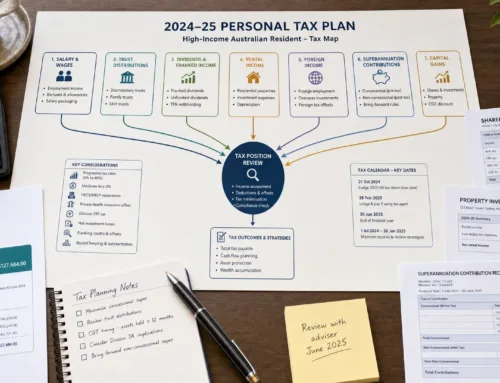
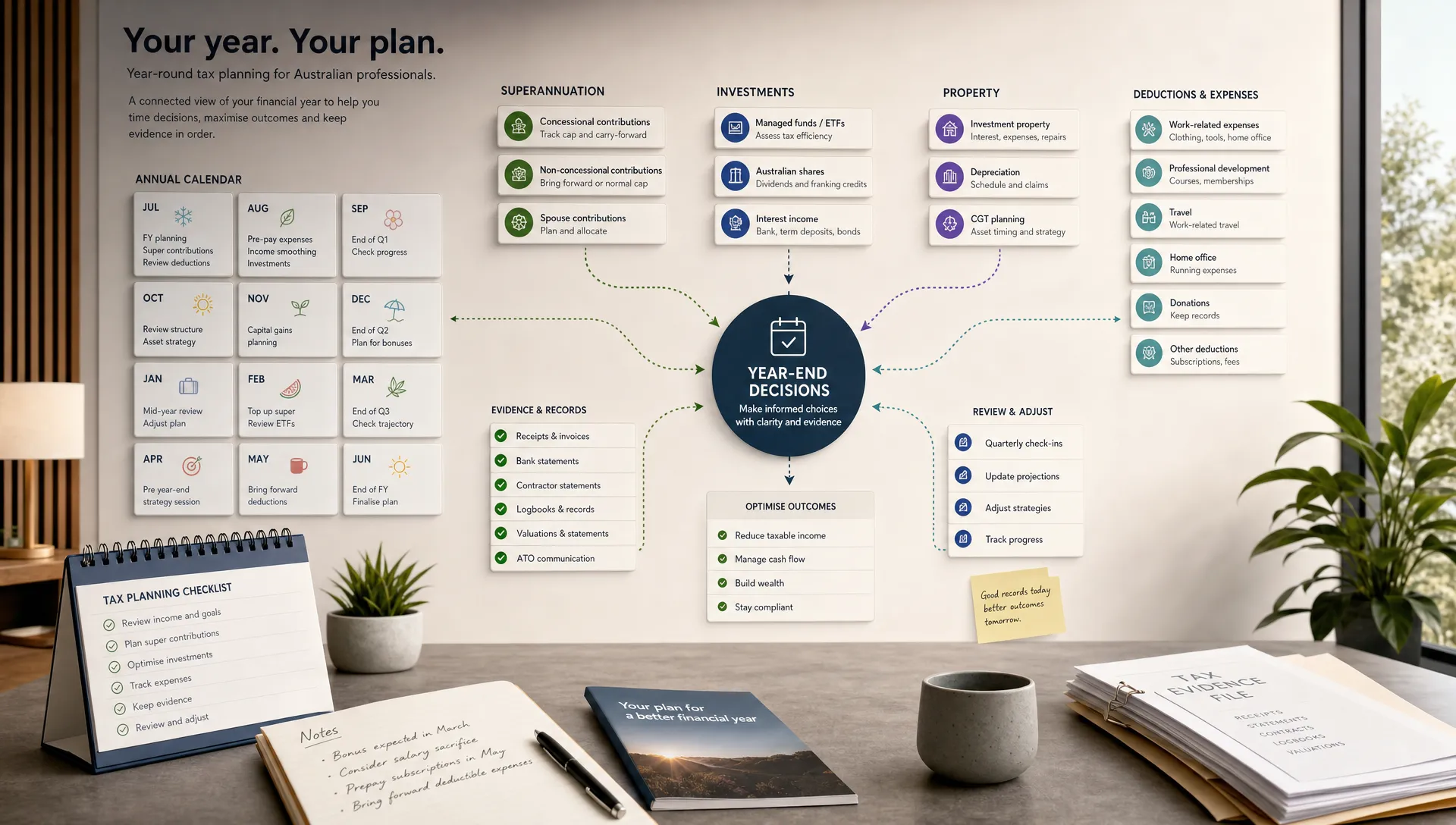
Personal tax planning should follow the financial year, but it should not wait until the final quarter. We generally encourage clients to use the following cadence.
| Period | Planning focus | Practical actions |
|---|---|---|
| July to September | Review the prior year and reset systems | Review the Notice of Assessment, check PAYG instalments, update deductions tracking, reconcile investment income and confirm record-keeping workflows. |
| October to December | Correct the course early | Review salary packaging, home office records, motor vehicle logs, rental property costs, charitable giving and investment portfolio movements. |
| January to March | Model outcomes before decisions are locked in | Forecast taxable income, review capital gains and losses, assess superannuation contribution capacity and plan trust or company-related distributions. |
| April to June | Execute before 30 June | Finalise deductible payments, ensure super contributions are received by the fund, document work-related claims, review CGT positions and prepare lodgement evidence. |
This rhythm is particularly important for professionals with multiple income streams. Salary, consulting income, directors’ fees, dividends, rental income, managed fund distributions and foreign income can interact in ways that are not obvious until the data is consolidated.
Start with data quality, not deduction hunting
We do not begin tax planning by asking, “What can we claim?” We begin by asking, “What does the data prove?”
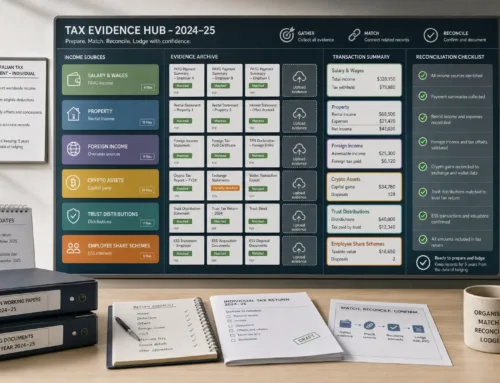
Accurate tax planning depends on reliable source records. That includes payroll summaries, bank feeds, invoices, receipts, investment statements, loan statements, dividend statements, trust distribution minutes, superannuation records and asset purchase contracts.
The ATO’s core position on work-related deductions is simple: you must have spent the money yourself and not been reimbursed, the expense must directly relate to earning assessable income, and you must have a record to prove it. The same evidence mindset applies across investment and property claims.
Digital workflows make this far easier. Our team uses AI-driven processes to identify missing records, flag unusual transactions, improve categorisation and accelerate review cycles. The strategic benefit is not just a faster tax return. It is real-time financial visibility, allowing professionals to make informed decisions before the year closes.
For record retention, the general rule is that individuals should usually keep tax records for five years, although some records need to be retained longer, particularly where assets, property, companies, trusts or SMSFs are involved. We explain this in more detail in our article on how long to keep tax records in Australia.
Key personal tax levers to review during the year
Work-related expenses and professional deductions
Professionals often incur legitimate work-related costs, including registrations, subscriptions, continuing professional development, professional indemnity insurance, technical resources, protective equipment, travel between work sites and home office expenses.
The risk is not usually whether deductions exist. The risk is whether they are sufficiently documented and correctly apportioned between work and private use.
Home office claims require particular care. The ATO provides methods for claiming working-from-home expenses, but the rates and substantiation requirements can change. We recommend keeping contemporaneous records of hours worked from home, as well as invoices or evidence for relevant costs.
Motor vehicle deductions also require discipline. A logbook must be valid and representative if the logbook method is used. For consultants, real estate professionals, tradies, allied health practitioners and directors travelling between sites, the tax treatment can be materially different depending on whether the travel is ordinary commuting or genuinely work-related.
Superannuation contributions
Superannuation remains one of the most important year-round planning areas for high-income professionals. Concessional contributions can reduce taxable income, but they must be managed against annual caps and cash flow needs.
For many clients, the most overlooked opportunity is not simply making a contribution before 30 June. It is checking contribution history early enough to consider carry-forward unused concessional cap amounts, where eligible. Broadly, carry-forward rules may allow unused concessional cap amounts from up to five previous financial years to be used if the individual’s total super balance at the prior 30 June is below the relevant threshold.
Timing matters. A contribution is generally counted when received by the super fund, not when the transfer is initiated. Waiting until the final days of June can create unnecessary risk.
For business owners and directors, superannuation also intersects with payroll governance. Super Guarantee and payday super obligations affect business cash flow and compliance discipline, while personal contribution planning affects the individual’s tax and retirement strategy.

Investment income, capital gains and losses
Investment portfolios can create income that arrives after year-end through annual tax statements, particularly for managed funds and exchange traded funds. This can surprise professionals who only monitor cash distributions rather than taxable components.
Capital gains tax planning should be reviewed before transactions occur. The timing of disposal, eligibility for the CGT discount, availability of capital losses and the interaction with other income can materially change the after-tax result.
Key issues we monitor include:
- Whether an asset has been held for at least 12 months before disposal, where the CGT discount may be relevant.
- Whether capital losses exist and how they can be applied against capital gains.
- Whether cryptocurrency, foreign shares or employee share scheme interests require additional reporting.
- Whether investment debt, margin lending or redraw activity affects interest deductibility.
For crypto investors and internationally mobile professionals, documentation is critical. The ATO receives increasing third-party data, and reconstruction after the fact can be expensive and imprecise.
Rental property and property investment records
Property investors should review tax records throughout the year, not just after receiving an annual loan statement. Common issues include interest apportionment, repairs versus capital improvements, borrowing costs, depreciation schedules, travel limitations and private-use periods.
A repair may be deductible where it restores something to its previous condition. An improvement is generally capital in nature and may need to be depreciated or included in the CGT cost base. The distinction can materially affect timing and risk.
We also encourage property investors to maintain clean documentation for refinancing, offset accounts and redraw facilities. Mixed-purpose borrowings can create deduction complexity, particularly where funds are used partly for private purposes and partly for income-producing assets.
Salary packaging, FBT and employer-provided benefits
Professionals receiving employer-provided benefits should understand how salary packaging affects taxable income, reportable fringe benefits, Medicare levy surcharge exposure, private health insurance rebate calculations, HELP repayments and family assistance thresholds.
Not all salary packaging is tax-effective once the full position is modelled. A benefit that appears attractive in isolation may produce a different result when adjusted taxable income is considered.
For directors and business owners, FBT is both a business compliance issue and a personal planning issue. Motor vehicles, entertainment, reimbursements and related-party benefits should be reviewed before 31 March, the end of the FBT year, rather than after year-end.
Company, trust and director remuneration planning
Many Australian professionals hold wealth through companies, trusts or investment entities. The personal tax return then becomes the endpoint of broader structuring decisions.
Director remuneration, dividends, trust distributions, Division 7A loans and personal services income rules can all influence individual tax outcomes. The key is to align commercial reality, cash flow, governance and tax evidence.
For company directors, personal planning should be coordinated with company obligations. Our article on company taxes in Australia and planning tips for directors explains how governance, remuneration and compliance interact before 30 June.
Common mistakes we see in personal tax planning
The most costly mistakes are rarely dramatic. They are often small process failures repeated over time.
Professionals should avoid assuming that a bank transaction alone proves deductibility. A payment record shows that money moved, but it may not prove the nature of the expense or its connection to income.
Another common issue is failing to distinguish between cash flow and taxable income. Managed fund distributions, trust income, employee share schemes and capital gains can create tax liabilities that do not match the cash received in the bank account.
Late planning is also a recurring problem. By June, some options are still available, but others are constrained by timing, documentation or legal form. We prefer to model tax progressively so decisions are made with evidence rather than pressure.
Finally, professionals sometimes rely on myTax when their affairs have outgrown a basic lodgement pathway. The ATO system is useful for straightforward returns, but complex deductions, investments, property, business income, foreign income or entity structures often require professional judgement. We discuss this distinction in our guide to when to DIY myTax and when to get help.
A practical year-round checklist
A strong personal tax planning system should be simple enough to maintain and detailed enough to withstand review. We recommend building a monthly or quarterly workflow around the following areas.
| Area | What to review | Why it matters |
|---|---|---|
| Income | Salary, bonuses, dividends, trust distributions, rental income, foreign income and capital gains | Prevents year-end surprises and supports PAYG instalment planning. |
| Deductions | Work expenses, home office costs, professional fees, income protection insurance and investment expenses | Improves substantiation and reduces missed claims. |
| Superannuation | Employer contributions, salary sacrifice, personal deductible contributions and cap history | Helps optimise contributions while avoiding excess contribution issues. |
| Investments | Realised gains, losses, dividend statements, managed fund tax statements and crypto records | Supports CGT planning and accurate reporting. |
| Property | Loan interest, repairs, depreciation, agent statements, insurance and mixed-use periods | Reduces errors in rental schedules and CGT cost base records. |
| Structures | Company loans, trust minutes, director fees, dividends and related-party payments | Aligns personal tax outcomes with governance and compliance. |
This checklist is not a substitute for advice. It is a management framework. The value comes from combining disciplined data capture with strategic interpretation.
How AI-driven tax workflows improve planning
AI does not replace professional judgement. In our practice, it improves the quality and speed of the information we use to advise clients.
Automated workflows can help identify missing receipts, classify transactions, detect duplicate entries, compare current-year patterns against prior years and highlight anomalies for review. This reduces manual friction and gives our accountants more time to focus on higher-value analysis.
For professionals and business owners, the result is better visibility. Instead of waiting until lodgement season, we can review tax positions progressively and connect personal tax planning with business performance, investment decisions and cash flow strategy.
This is where compliance becomes a foundation for strategic advisory. A clean tax file is useful. A clean tax file connected to timely decision-making is far more valuable.
Frequently Asked Questions
When should Australian professionals start personal tax planning? Ideally, planning should start in July when the new financial year begins. A quarterly review is usually sufficient for straightforward professionals, while directors, investors and high-income earners may benefit from more frequent monitoring.
Is personal tax planning only relevant before 30 June? No. Some actions must occur before 30 June, but the evidence and modelling should be managed throughout the year. Superannuation, CGT, record keeping, PAYG instalments and property documentation all benefit from early review.
Can I claim home office expenses if I work partly from home? You may be able to claim eligible working-from-home expenses if the costs are connected to earning assessable income and you keep the required records. The correct method and evidence depend on your circumstances and current ATO rules.
Do company directors need separate personal tax planning? Yes. A director’s personal tax position can be affected by salary, dividends, director fees, trust distributions, Division 7A loans, superannuation and reportable benefits. Personal and company planning should be coordinated.
How does automation help with individual tax in Australia? Automation improves data capture, categorisation and exception reporting. This helps reduce missed deductions, improves substantiation and gives advisers earlier visibility over tax risks and opportunities.
Next steps: turn personal tax compliance into strategic financial control
Year-round personal tax planning is not about aggressive deductions. It is about control, evidence and timing. For Australian professionals managing complex income, assets or business interests, the right process can improve cash flow, reduce risk and support better long-term financial decisions.
Our team supports clients across Australia with integrated capabilities in Adelaide, Sydney and Melbourne. We combine senior tax expertise with AI-driven accounting workflows to help professionals, directors and high-net-worth individuals manage personal tax with greater accuracy and visibility.
If your personal tax position involves business income, investments, property, trusts, company interests, foreign income or significant deductions, we can help you build a structured year-round planning process.
Contact Perfect Accounting & Tax Services to arrange a consultation and learn how our automated accounting workflows can turn your tax data into a strategic asset for the year ahead.