
Keeping tax records is not just an ATO compliance task. For business owners, directors and investors, it is part of risk management, finance readiness and strategic decision-making.
The practical answer is that many Australian tax records must be kept for five years, but that is not the full story. Companies often need to retain financial records for seven years. SMSFs may need to keep some records for 10 years. Property, CGT assets, tax losses and disputes can require records to be kept much longer.
In our advisory work across Adelaide, Sydney, Melbourne and nationally, we treat record retention as a financial control system. When records are structured properly, they support faster BAS preparation, cleaner tax planning, stronger audit defence and better real-time visibility for corporate growth.
The short answer: how long should you keep tax records in Australia?
For most Australian taxpayers, the baseline rule is five years. However, the correct retention period depends on the taxpayer type, the record type and whether the record relates to an asset, employee, company, SMSF or unresolved tax matter.
As a practical rule, we recommend:
- Individuals should keep tax records for at least five years from the date they lodge their tax return.
- Sole traders and businesses should keep most income, expense, GST and BAS records for at least five years.
- Companies should keep financial records for at least seven years under Australian company law.
- Employers should keep payroll and employee records for seven years to align with Fair Work requirements, even where some ATO records have a five-year rule.
- Property investors and CGT asset owners should keep acquisition, improvement and sale records for the life of the asset, plus at least five years after the relevant CGT event.
- SMSF trustees should keep some records for five years and important trustee records for 10 years.
The ATO’s record-keeping guidance for businesses confirms that records generally need to explain all transactions and be in English, or readily convertible into English. Digital records are acceptable if they are clear, accurate and accessible.
Why record retention matters more in 2026
The ATO’s compliance environment is increasingly data-driven. Bank data, Single Touch Payroll, superannuation information, property data, cryptocurrency platform data and third-party reporting are now part of a much broader risk detection ecosystem.
That does not mean every taxpayer is under audit. It means poor records are easier to identify and harder to defend. If a business claims expenses, GST credits, depreciation, vehicle costs, contractor payments or Division 7A repayments, the supporting evidence needs to be available when requested.
For business owners and high-net-worth individuals, the risk is not limited to tax penalties. Weak records can reduce finance approval confidence, delay due diligence during a sale, complicate succession planning and weaken commercial decision-making.
We see record-keeping as the foundation for strategic advisory. When transactions are captured correctly and retained in a structured digital environment, management reporting becomes faster and more reliable. That gives directors and owners better information for pricing, cash flow, debt management, expansion and tax planning.
Tax record retention periods in Australia
The following table summarises common Australian record retention periods. These are general rules, and some industries, contracts or legal matters may require longer retention.
| Record type | Recommended minimum retention | Key point |
|---|---|---|
| Individual tax deduction records | 5 years from tax return lodgement | Includes receipts, logbooks, work-related expenses and income evidence |
| Business income and expense records | 5 years | Includes sales, supplier invoices, bank records and accounting files |
| GST and BAS records | 5 years | Tax invoices must support GST credits and taxable supplies |
| Company financial records | 7 years | Required under company law for records explaining transactions and financial position |
| Payroll and employee records | 7 years | Aligns with Fair Work record-keeping requirements |
| Superannuation guarantee records | 5 years | We generally retain payroll and super records together for 7 years |
| FBT records | Generally 5 years | Includes employee declarations, logbooks and valuation records |
| CGT asset records | Life of asset plus at least 5 years after disposal | Essential for property, shares, crypto, business assets and collectables |
| Tax loss records | Until the loss is fully used and review periods have passed | Often longer than 5 years for companies, trusts and investors |
| SMSF financial records | 5 years | Includes annual returns, accounting records and financial statements |
| SMSF trustee records | 10 years | Includes trustee minutes, trustee declarations and key decisions |
| Trust deeds, company constitutions and major legal documents | Permanent | These are governance records, not just tax records |
For company directors, the seven-year rule is particularly important. ASIC explains that companies must keep financial records that correctly record and explain transactions and financial position, and these records must generally be retained for seven years. This sits alongside tax law and should not be ignored.
Individuals, professionals and high-net-worth taxpayers
For individuals, the ATO generally expects tax records to be kept for five years from the date the return is lodged. This includes records for salary and wages, deductions, donations, investment income, rental income, interest, dividends and foreign income.
The record set becomes more complex for professionals, executives and high-net-worth taxpayers. A simple annual tax folder is often not enough where there are employee share schemes, foreign investments, multiple rental properties, trust distributions, private company dividends, capital gains, crypto assets or substantial deductible expenses.
Key records usually include:
- Payment summaries or income statements through myGov and payroll records.
- Receipts and invoices for deductions.
- Work-related expense evidence, including home office records and travel diaries where relevant.
- Dividend statements, managed fund annual tax statements and foreign income summaries.
- Property purchase, loan, depreciation, repair and sale documentation.
- CGT calculations and asset cost base evidence.
A frequent mistake is retaining only the final tax return and assessment. The tax return is not the evidence. It is the result. If the ATO asks for substantiation, the taxpayer must produce the underlying records that support the claim.
Sole traders and small business owners
Sole traders, freelance consultants, tradies, content creators, digital agencies, e-commerce operators and professional service providers need to retain records that explain their business income and deductions.
That includes invoices issued, supplier bills, bank statements, merchant platform reports, loan records, asset purchase documents, motor vehicle records, GST reports, BAS lodgements and payroll records if staff are employed.
For new operators, the system should be designed from day one. We often see fast-growing businesses try to reconstruct records after the fact, especially when GST registration, contractor payments or inventory become material. That is inefficient and creates risk. Our guidance on what sole traders should set up from day one explains the baseline structure that supports cleaner tax compliance and better management information.
If your business is already established, retention should be built into the accounting workflow rather than handled manually at year-end. For example, invoices should attach to transactions, payroll reports should reconcile to STP and superannuation payments, and BAS workpapers should be stored with the lodgement evidence.
For broader compliance discipline, we also recommend reviewing what small business owners must track so the business is not merely storing documents, but capturing the right financial data throughout the year.
Companies, directors and multi-entity groups
Company directors need to think beyond the ATO’s five-year record rules. Under the Corporations Act framework, company financial records generally need to be kept for seven years. For directors, this is a governance obligation as much as a tax obligation.
Company records should show how revenue was earned, expenses were incurred, liabilities were created and assets were managed. They should also support director remuneration, shareholder loans, Division 7A loan agreements, trust distributions, management fees, inter-entity transactions and asset financing.
In multi-entity groups, the retention challenge is not usually storage. It is structure. Records need to be searchable by entity, income year, transaction type, tax issue and decision-maker. A folder full of PDFs is better than paper, but it is not a complete control environment.
This is where AI-driven accounting workflows create material value. Automated data capture, transaction coding, exception alerts and document matching reduce the risk of missing evidence. More importantly, they create real-time financial visibility that supports strategic advisory, not just tax lodgement.
For directors considering profit extraction, growth capital, restructuring or year-end tax planning, strong records are essential. Our article on company tax planning tips for directors covers several areas where record quality directly affects tax outcomes.
Property investors and CGT records
Property investors should be especially conservative with tax records. Rental property ownership may run for 10, 20 or 30 years, and CGT calculations depend on records created at acquisition, during ownership and at disposal.
Important property records include purchase contracts, settlement statements, stamp duty records, legal fees, loan documents, refinancing documents, agent statements, rental income reports, repairs and maintenance invoices, capital improvement costs, depreciation schedules, insurance claims and sale contracts.
The distinction between repairs and capital improvements is a common audit focus. A $2,000 repair and a $20,000 improvement may both involve a contractor invoice, but the tax treatment can be very different. Without supporting evidence, the taxpayer’s position is weaker.
The ATO has also increased scrutiny of rental property deductions, including interest claims, apportionment, holiday homes and repairs. We have covered these issues in more detail in our analysis of the ATO rental property crackdown.
For CGT assets generally, the most reliable approach is to keep records for the entire ownership period, then at least five years after the CGT event is reported. This applies to property, shares, business goodwill, cryptocurrency, collectables and other capital assets.
Digital tax records: what the ATO expects
Digital records are acceptable in Australia, provided they are accurate, complete and accessible. The issue is not whether a receipt is paper or digital. The issue is whether the record can be produced, read and connected to the relevant transaction.
A robust digital record system should include clear file naming, secure cloud storage, backup protocols, restricted access for sensitive payroll or TFN information, and links between source documents and accounting transactions. For higher-risk taxpayers, we also recommend maintaining audit trails that show who approved, coded or adjusted key transactions.

AI and automation can significantly improve this process. Automated invoice capture can reduce manual data entry. Bank feeds can support transaction matching. Exception reports can highlight missing receipts, GST anomalies, duplicate payments or unusual expense categories before lodgement.
However, automation does not remove governance responsibility. Directors, trustees and business owners still need policies, review procedures and professional oversight. In our experience, the best systems combine automation with advisory judgement.
What happens if you cannot produce tax records?
If records are missing, the ATO may disallow deductions, deny GST credits, amend assessments or impose penalties and general interest charge. In an audit, the issue is often not whether the expense was genuinely incurred. The issue is whether it can be substantiated under Australian tax law.
For businesses, poor records can also affect payroll compliance, superannuation guarantee obligations, FBT exposure and state-based payroll tax reviews. For companies, inadequate records can raise director governance concerns. For SMSF trustees, missing records can create audit qualification risk and regulatory consequences.
There is also a commercial cost. If a lender, buyer, investor or legal adviser requests financial evidence, weak records slow the transaction and reduce confidence. Clean records can improve the speed of due diligence and support stronger valuations.
A strategic retention framework for business owners
We recommend a structured retention framework rather than an informal habit of keeping everything in email folders. The framework should reflect taxpayer type, entity structure, asset profile and audit risk.
A practical framework includes:
- A digital document management system connected to accounting software.
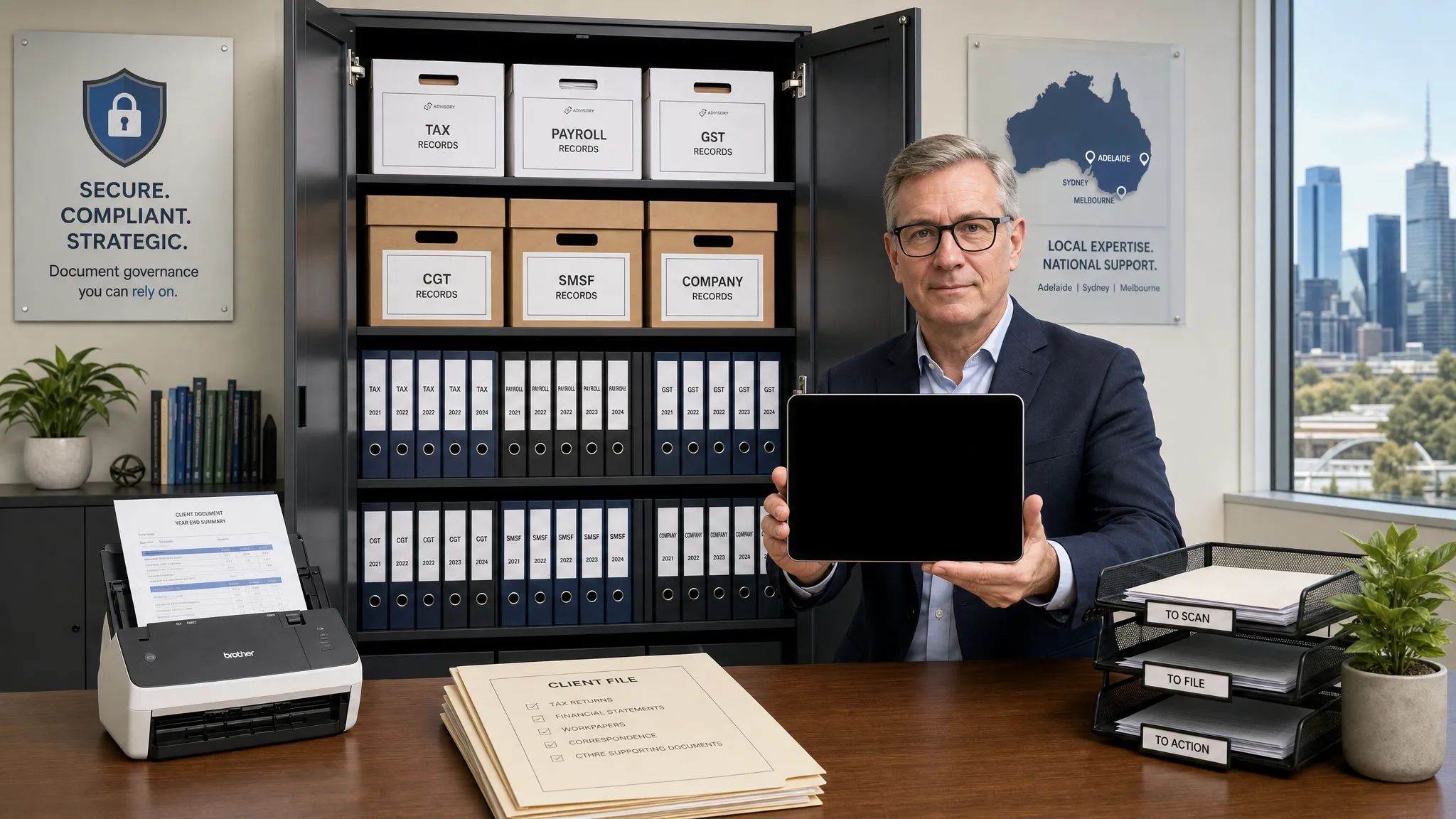
- A retention schedule by record category, including tax, payroll, company, SMSF and property records.
- Monthly reconciliation of bank feeds, invoices, payroll, GST and superannuation.
- Automated exception reporting for missing documents, duplicate transactions and unusual claims.
- Secure access controls for TFNs, payroll data, legal documents and private client information.
- Annual review of carried-forward losses, CGT assets, Division 7A loans and trust distributions.
For larger businesses and multi-city groups, the system should also support board reporting, virtual CFO oversight and management dashboards. This is where compliance becomes an asset. The same records that defend a tax position can also reveal margin pressure, working capital issues and growth opportunities.
When should you keep records longer than the minimum period?
Minimum retention periods are not always enough. We generally recommend keeping records longer where the matter is material, unresolved or connected to a long-term asset.
Keep records beyond the standard period if they relate to:
- Property, shares, crypto or other CGT assets still owned.
- Carried-forward tax losses or capital losses.
- Business restructures, trust distributions or Division 7A loans.
- ATO reviews, objections, audits or amended assessments.
- Employee disputes, contractor classification issues or unpaid superannuation questions.
- SMSF trustee decisions or investment strategy documentation.
- Major financing, sale, merger or investor due diligence.
In strategic advisory, our bias is simple: if a document could affect tax, ownership, valuation or legal rights in the future, retain it securely.
Frequently Asked Questions
Can the ATO ask for tax records older than five years? Yes, in some circumstances. While many records have a five-year rule, longer periods can apply for assets, tax losses, fraud or evasion concerns, unresolved disputes and records needed to support later-year tax positions.
Are bank statements enough to support deductions? Usually no. Bank statements show that money moved, but they may not prove what was purchased, the business purpose, GST treatment or deductibility. Invoices, receipts, contracts and workpapers are often required.
Do digital copies of receipts count as tax records? Yes, digital copies are generally acceptable if they are clear, accurate and accessible. The system should preserve the relevant details and allow the document to be produced if requested.
How long should a company keep tax and financial records? A company should generally keep tax records for at least five years and financial records for at least seven years. In practice, many companies retain key governance, asset and loan records for longer.
How long should payroll records be kept in Australia? We recommend keeping payroll and employee records for seven years. This aligns with Fair Work requirements and gives the business stronger support for PAYG withholding, STP, superannuation and employment-related reviews.
How long should tax records be kept after closing a business? Closing a business does not remove record-keeping obligations. Records should generally be kept for at least five years after the relevant transactions, lodgements or closure events, and longer for company, payroll, CGT, tax loss or legal records.
Next steps: turn record-keeping into financial control
Tax record retention should not be an annual clean-up exercise. It should be embedded into your accounting workflow, from invoice capture and BAS preparation through to payroll, superannuation, CGT tracking and strategic advisory.
Our team at Perfect Accounting & Tax Services supports businesses, directors, investors and high-net-worth individuals across Australia, with integrated service capability in Adelaide, Sydney and Melbourne. We combine 25 years of professional experience with AI-driven automation to improve accuracy, speed and real-time financial visibility.
If you are unsure whether your tax records are complete, defensible or structured for growth, we can review your current process and help design a more resilient system.
Contact our team for a consultation and learn how our automated accounting workflows can strengthen compliance, reduce manual administration and support better strategic decisions.