
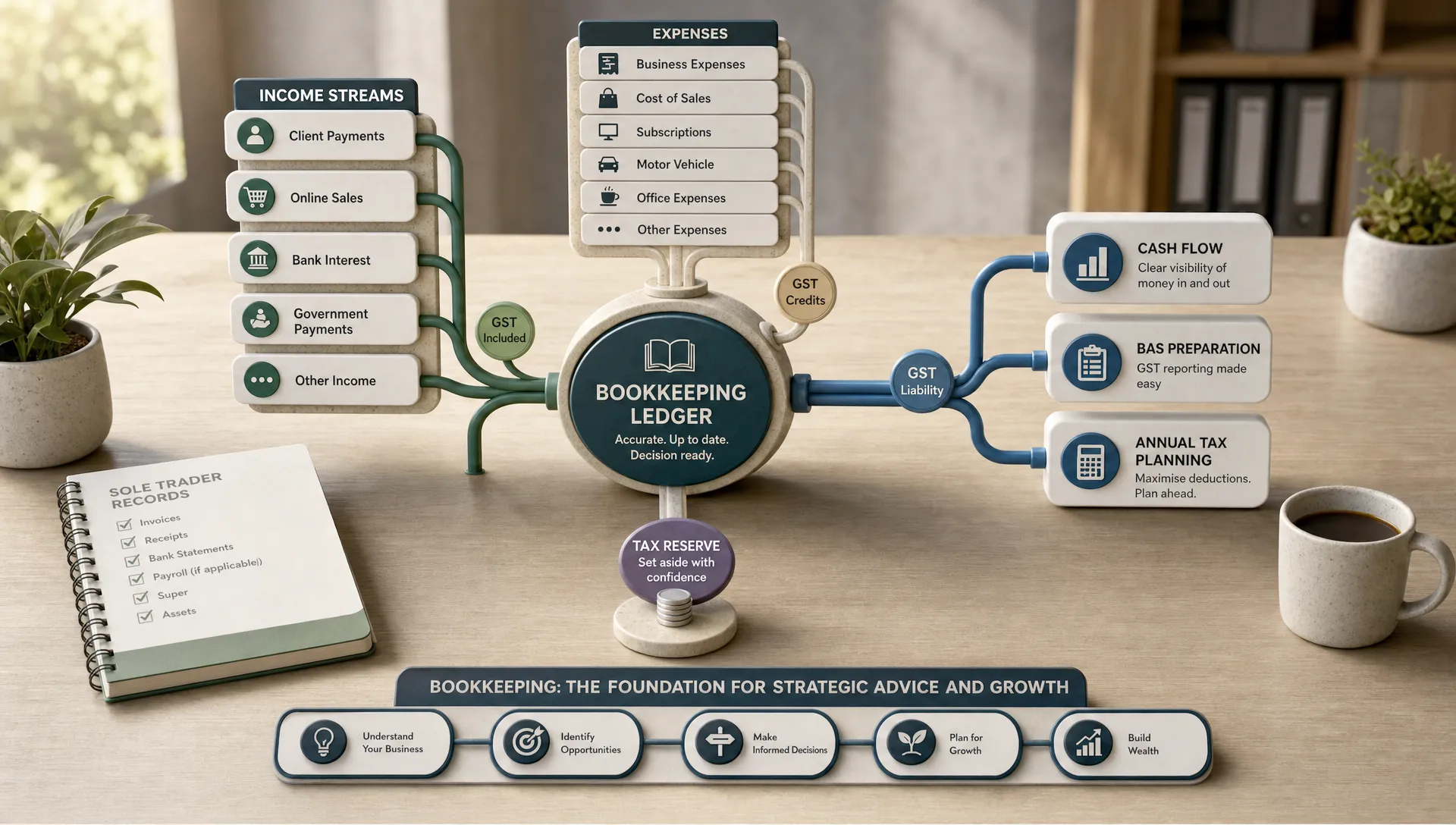
Sole trader bookkeeping is often treated as basic administration. We see it differently. For an Australian sole trader, clean books are the operating system behind tax compliance, cash flow control and growth decisions.
Because a sole trader is taxed as an individual, business performance flows directly into the personal tax return. That means every missed invoice, mixed personal transaction or poorly described expense can distort taxable income, GST reporting and the quality of decisions made during the year.
Strong bookkeeping does more than prepare you for tax time. It helps you understand whether your pricing is sustainable, whether you can afford to hire support, whether GST is being reserved properly and whether your business model is creating real financial value.
Why sole trader bookkeeping matters beyond compliance
A sole trader structure is simple to establish, but it still requires disciplined financial control. The ATO expects accurate records of income, expenses, assets and tax obligations. Most business records must generally be kept for five years, and those records need to be complete enough to substantiate what has been reported.
For growing consultants, tradies, e-commerce operators, creative professionals and allied health practitioners, the real risk is not only non-compliance. The bigger commercial risk is operating without current financial information.
When bookkeeping is delayed until the end of the quarter or the end of the financial year, tax becomes reactive. Cash flow becomes guesswork. Business decisions rely on bank balance rather than profitability.
We encourage sole traders to see bookkeeping as the foundation for strategic advisory. If the data is clean, we can use it to forecast tax, identify margin leakage, analyse service lines and advise on growth options. If the data is incomplete, advisory becomes much less precise.
What effective sole trader bookkeeping should capture
Sole trader bookkeeping should provide a reliable financial record and a practical view of how the business is performing. It should not be a shoebox exercise or a spreadsheet that only one person understands.
A well-structured bookkeeping system should capture the following areas.
| Bookkeeping area | Tax purpose | Growth purpose |
|---|---|---|
| Sales and invoices | Confirms assessable income and GST treatment | Shows revenue trends, debtor delays and client concentration |
| Business expenses | Supports deductions and substantiation | Identifies cost creep and operating efficiency |
| GST collected and paid | Supports accurate BAS lodgement if GST registered | Helps reserve cash for ATO liabilities |
| Bank reconciliations | Confirms transactions are complete and correctly coded | Gives confidence in real-time cash position |
| Business assets | Supports depreciation and instant asset write-off assessment where applicable | Helps plan equipment purchases and funding needs |
| Motor vehicle and home office records | Supports claims under eligible ATO methods | Clarifies the real cost of mobile or home-based operations |
| Drawings and personal spending | Separates owner withdrawals from business expenses | Shows whether the business can support the owner’s income needs |
| Contractor, employee and superannuation records | Supports payroll, superannuation and contractor compliance | Helps assess labour cost, capacity and hiring strategy |
If you are still setting up your operating framework, our guide on what sole traders should establish from day one explains the tax and cash flow foundations that should sit behind your bookkeeping system.
How bookkeeping improves tax outcomes
Good bookkeeping does not make tax disappear. It makes tax predictable, defensible and easier to manage.
It separates business and personal activity
Many sole traders use one bank account in the early stages. That may feel convenient, but it creates avoidable tax risk. Mixed transactions increase the chance that private expenses are incorrectly claimed or legitimate business costs are missed.
We generally prefer a dedicated business bank account, even where the structure is still legally a sole trader. It simplifies reconciliations, improves evidence and gives a cleaner view of business cash flow.
It supports accurate deductions
Deductions depend on evidence, purpose and apportionment. Software subscriptions, tools, professional memberships, travel, training, advertising and home office costs can all be relevant, but each needs to be coded correctly and supported by records.
For mixed-use costs, such as phone, internet, vehicle and home office expenses, bookkeeping should capture the business-use basis. Without that discipline, claims become harder to justify if the ATO reviews them.
It reduces BAS and GST stress
If your GST turnover is $75,000 or more, you generally need to register for GST. Some activities, such as ride-sourcing, can require GST registration regardless of turnover. Once registered, you need to track GST on sales and purchases correctly and lodge BAS by the relevant due dates.
This is where poor bookkeeping becomes expensive. GST collected from customers is not profit. It is cash that must be reserved. A clean bookkeeping process helps prevent the common problem of spending money that will later be owed to the ATO.
It helps plan PAYG instalments and income tax
As income grows, the ATO may place a sole trader into PAYG instalments. Even before that occurs, we recommend estimating tax throughout the year so the owner is not surprised after lodging the individual tax return.
Bookkeeping allows us to calculate expected taxable income, estimate upcoming obligations and recommend sensible tax reserves. That creates a more disciplined approach to cash management.
It improves audit readiness
ATO reviews are easier to manage when records are complete, reconciled and logically organised. Good bookkeeping produces an audit trail: invoices, receipts, bank transactions, GST treatment and supporting notes. That audit trail matters whether the issue is a simple deduction query or a more complex review of income, contractors or GST.
How bookkeeping supports growth decisions
Tax compliance is the baseline. The larger opportunity is using bookkeeping data to make stronger commercial decisions.
For sole traders who intend to scale, bookkeeping should answer questions such as:
- Which products, services or clients generate the strongest margins?
- Are payment terms creating cash pressure?
- Is revenue seasonal, recurring or dependent on a small number of clients?
- Can the business afford a contractor, employee, vehicle or equipment upgrade?
- Is the current structure still suitable, or should a company or trust be considered?
These questions cannot be answered properly from a bank balance. A bank balance shows available cash on one date. It does not show GST liabilities, unpaid invoices, future tax, asset commitments or the owner’s required drawings.
We use bookkeeping data to help clients move from historical reporting to forward-looking financial management. That is the shift from compliance to strategic advisory.
The role of AI and automation in modern bookkeeping
Manual bookkeeping is slow, inconsistent and vulnerable to timing delays. Modern sole trader bookkeeping should use automation to reduce friction and improve visibility.
AI-driven processes can assist with bank feed matching, receipt capture, transaction categorisation, anomaly detection and recurring expense recognition. Automation does not replace professional judgement, but it reduces the time spent on low-value processing and helps us focus on interpretation.
For a sole trader, the practical benefits are significant. Reconciliations can be kept closer to real time. Missing receipts can be identified earlier. GST coding errors can be reviewed before BAS lodgement. Profit and cash flow reports can be produced while decisions are still current.
This matters for high-performing sole traders because growth decisions often need to be made quickly. If you are assessing a new contract, expanding into another state, buying equipment or engaging staff, outdated numbers are a strategic disadvantage.
Sector-specific bookkeeping considerations
Different sole traders need different bookkeeping controls. A freelance consultant does not have the same risk profile as a builder, online retailer or allied health practitioner.
| Sole trader type | Bookkeeping focus | Strategic insight created |
|---|---|---|
| Consultants and IT specialists | Time billing, subscriptions, travel and contractor costs | Project profitability and capacity planning |
| Tradies and construction operators | Materials, tools, vehicles, subcontractors and progress claims | Job margins and cash flow timing |
| E-commerce sellers | Merchant fees, stock, freight, GST and platform reporting | Product profitability and inventory discipline |
| Creative and content professionals | Royalties, licensing, equipment, travel and mixed-use costs | Revenue diversification and tax planning |
| Allied health and professional services | Appointment income, room hire, consumables, insurance and CPD | Service line margins and sustainable pricing |
For allied health and professional service operators, the client experience is part of the commercial model. International health-centred practices such as Origin Dental Wellness illustrate how prevention, service mix and reputation interact with operational planning. In an Australian sole trader context, bookkeeping should support that same commercial discipline by showing which services are profitable and where cash is being tied up.
The lesson is not that every sole trader needs the same chart of accounts. The lesson is that bookkeeping should reflect how the business actually earns money, carries risk and plans growth.
Warning signs your bookkeeping is holding you back
We often meet sole traders who have outgrown their original bookkeeping habits. A spreadsheet or once-a-year reconciliation may be acceptable in the earliest stage, but it becomes risky once income, GST, contractors or assets increase.
Common warning signs include:
- BAS preparation takes longer than it should because records are incomplete.
- You are unsure how much of your bank balance belongs to the ATO.
- You cannot quickly identify your most profitable services or clients.
- Personal expenses and business expenses are still mixed together.
- Receipts are stored across email, phone photos and paper files.
- You only know your profit after your tax return is prepared.
- You are considering hiring staff or contractors without reliable cash flow forecasts.
If several of these apply, it may be time to review whether DIY bookkeeping is still appropriate. We have expanded on this decision point in our article on when to stop DIY sole trader accounting.
A practical bookkeeping rhythm for sole traders
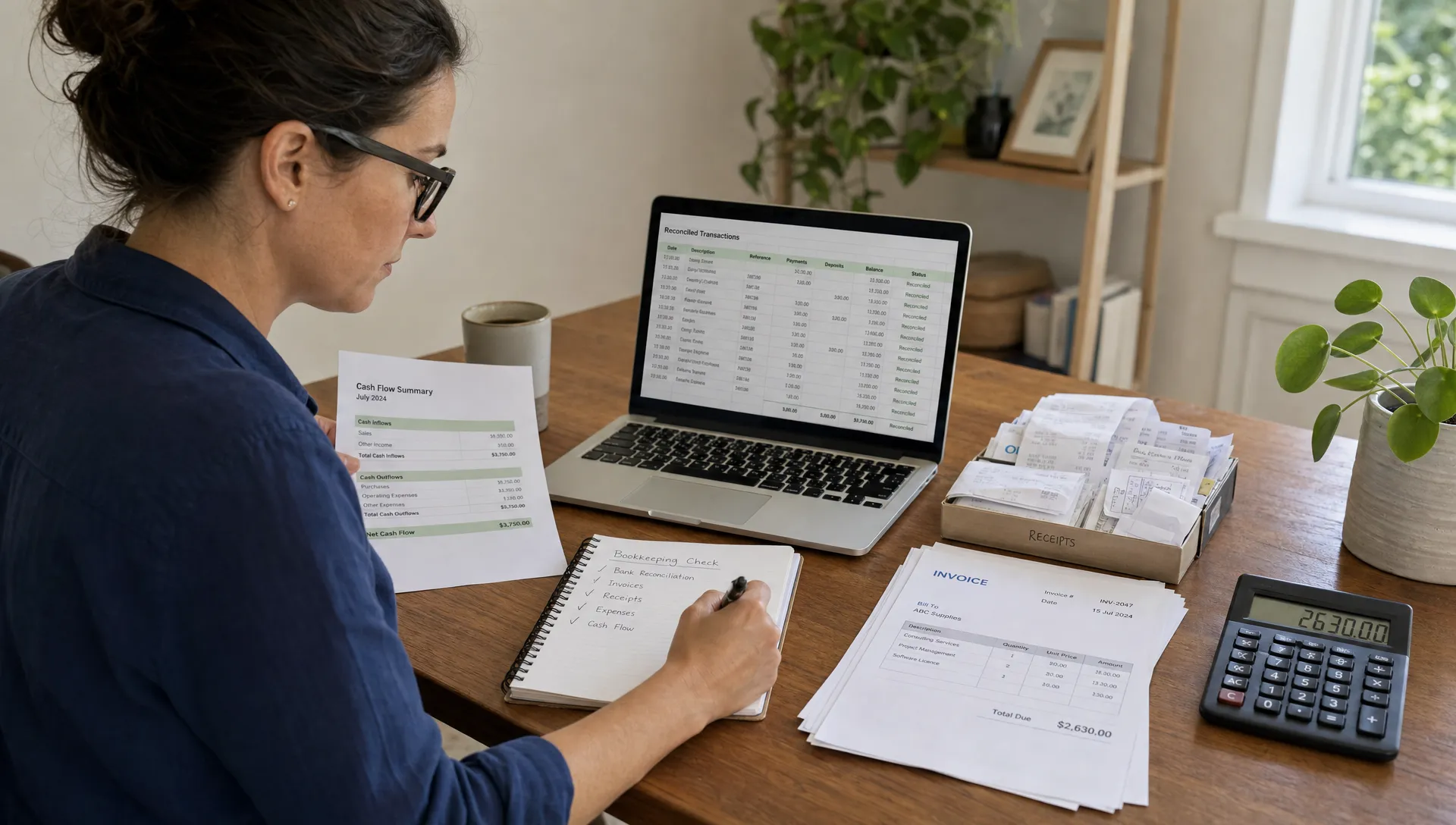
Bookkeeping works best when it is continuous. Waiting until BAS time or year-end usually leads to rushed coding, missing deductions and unreliable financial reports.
We recommend a rhythm that matches the scale and risk of the business.
| Frequency | Action | Why it matters |
|---|---|---|
| Weekly | Upload receipts, issue invoices and follow up overdue payments | Keeps revenue and evidence current |
| Monthly | Reconcile bank accounts and review profit, GST and cash reserves | Prevents hidden tax and cash flow issues |
| Quarterly | Prepare BAS, review PAYG instalments and analyse margins | Links compliance with business performance |
| Annually | Finalise tax planning, asset records and structure review | Supports accurate returns and strategic decisions |
For growing sole traders, monthly reporting is often the turning point. It allows us to see trends early enough to act, rather than explain them after the year has ended. Our discussion of how bookkeeping improves cash flow visibility explores this in more detail.
When bookkeeping becomes strategic advisory
Bookkeeping becomes advisory when the numbers are used to guide decisions, not merely record them.
For example, if a consultant’s revenue has increased but net profit has not, bookkeeping data may reveal excess subcontractor cost, underpriced retainers or high non-billable time. If an e-commerce seller has strong sales but weak cash flow, the issue may be stock timing, merchant fees, freight leakage or GST reserves. If a tradie appears profitable but cannot pay suppliers on time, debtor management and job costing may need urgent attention.
This is where our role extends beyond compliance. With clean data, we can advise on pricing, tax reserves, GST timing, superannuation planning, financing, contractor arrangements and possible restructuring. For some sole traders, remaining a sole trader is appropriate. For others, growth, risk or income level may justify considering a company, trust or broader asset protection strategy in collaboration with legal advisers.
The decision should be based on evidence. Bookkeeping provides that evidence.
Frequently Asked Questions
What records should a sole trader keep for tax in Australia? A sole trader should keep records of all income, expenses, invoices, receipts, bank statements, asset purchases, motor vehicle claims, home office evidence and any GST or BAS records. Most records must generally be kept for five years.
Do sole traders need a separate business bank account? It is not always legally required for a sole trader, but we strongly recommend it. A separate account improves record keeping, reduces coding errors and makes tax, GST and cash flow planning much clearer.
When does a sole trader need to register for GST? A sole trader generally needs to register for GST when GST turnover reaches $75,000 or more. Some activities, including ride-sourcing, can require GST registration regardless of turnover. Advice should be sought before assuming GST does not apply.
Can bookkeeping reduce the tax a sole trader pays? Bookkeeping does not reduce tax by itself, but it helps identify legitimate deductions, improve substantiation, manage timing and support proactive tax planning. Poor records often mean missed deductions or higher compliance risk.
Does a sole trader need to pay superannuation? A sole trader does not pay compulsory superannuation guarantee on personal drawings, but may have super obligations for employees and some contractors. Sole traders may also consider personal concessional super contributions, subject to eligibility, contribution caps and notice requirements.
Next steps: how we can help
Sole trader bookkeeping should give you more than tidy records. It should give you control over tax, confidence in cash flow and the financial visibility needed to grow deliberately.
Our team at Perfect Accounting & Tax Services supports sole traders, SMEs and growing businesses across Australia, with integrated service capability in Adelaide, Sydney and Melbourne. We combine 25 years of professional accounting experience with AI-driven automation to streamline bookkeeping, BAS preparation, tax planning and strategic advisory.
If your bookkeeping is still reactive, we can help you move to a more disciplined and automated workflow. We will assess your current records, identify compliance gaps, improve reporting accuracy and help convert bookkeeping data into practical growth decisions.
Contact our team to book a consultation and learn how our automated accounting workflows can support stronger tax outcomes, better cash flow visibility and long-term business growth.