
DIY accounting often starts as a practical decision. In the early stage, a sole trader may have a handful of clients, low expenses, no GST registration, and enough time to reconcile transactions manually. At that point, sole trader accounting can be managed internally if records are clean and the tax position is simple.
The risk is that business complexity rarely announces itself clearly. It builds through higher turnover, new software subscriptions, contractors, equipment purchases, mixed personal and business use, late BAS pressure, and ATO correspondence. By the time the problem is visible, the cost is often more than an accounting fee. It may include lost deductions, incorrect GST, weak cash flow decisions, and avoidable compliance exposure.
We advise sole traders to stop asking, ‘Can I still do this myself?’ and start asking, ‘Is DIY accounting still giving us accurate, timely information for decisions?’ That shift matters because accounting is not just a lodgement task. It is the data layer for tax planning, pricing, capacity, financing, and business growth.
When DIY sole trader accounting is still reasonable
DIY accounting can work where the business is genuinely simple. A freelance designer with one income stream, a separate business bank account, no employees, no GST registration, and disciplined record-keeping may be able to manage the basics with cloud software and periodic professional review.
The key phrase is ‘genuinely simple’. Many sole traders underestimate the complexity of their affairs because they are still operating under an individual TFN and ABN. A sole trader structure may be simple legally, but the tax, GST, record-keeping, contractor, and cash flow issues can become sophisticated very quickly.
If you are still at the setup stage, we recommend reviewing what sole traders should put in place from day one in our guide to sole trader tax setup in Australia. Strong foundations make DIY safer at the start and make the transition to professional support much cleaner later.
The point where DIY stops being economical
DIY becomes uneconomical when the time you spend on accounting no longer produces reliable financial control. That point is not defined only by income. A sole trader earning $80,000 with clean records may be easier to manage than a sole trader earning $45,000 through five platforms, multiple currencies, home office costs, motor vehicle claims, and contractor payments.
The real calculation includes three costs:
- The visible cost of your time spent coding transactions, checking receipts, and preparing tax records.
- The hidden cost of errors, missed deductions, GST misclassification, and late lodgements.
- The opportunity cost of not using accurate numbers to price better, manage cash flow, or decide when to scale.
As Chartered Accountants, we see the turning point most often when the business owner is still ‘getting it done’ but no longer trusts the numbers. If you cannot quickly answer what your taxable profit is, how much GST is payable, what cash is reserved for tax, and whether your pricing covers your true costs, DIY has likely reached its limit.
Clear signs you should stop doing it yourself
The following signs do not automatically mean you have done anything wrong. They mean the risk profile has changed and your accounting process needs more structure.
| Trigger | Why it matters | Recommended response |
|---|---|---|
| Turnover is approaching or exceeding $75,000 | GST registration may be required, and BAS lodgement becomes a regular obligation | Review GST status, invoicing, software setup, and BAS process before the threshold is crossed |
| You are behind on reconciliations | Late coding creates unreliable profit figures and missed deductions | Move to a monthly close process with automated bank feeds and review controls |
| You use contractors or subcontractors | Labour arrangements can raise PAYG withholding, superannuation, reporting, and documentation issues | Review contractor agreements, invoices, ABNs, and super obligations |
| You cannot separate personal and business spending | Mixed-use expenses increase ATO review risk and make deductions harder to support | Establish clear accounts, receipt capture, and private-use adjustment methods |
| You have received ATO contact or amended assessments | Responses must be accurate, timely, and evidence-based | Reconcile records before responding and seek professional review |
| You are buying vehicles, tools, equipment, or technology | Asset treatment, depreciation, GST credits, and private use can materially affect tax | Plan purchases before year-end and maintain asset records |
| You are considering staff, a company, or expansion | Compliance now connects with strategy, risk, and structure | Move from tax preparation to advisory-led accounting |
The most important warning sign is not stress. It is uncertainty. If your accounts are only prepared after year-end, you are managing the business through memory rather than financial evidence.
GST and BAS often mark the first serious transition
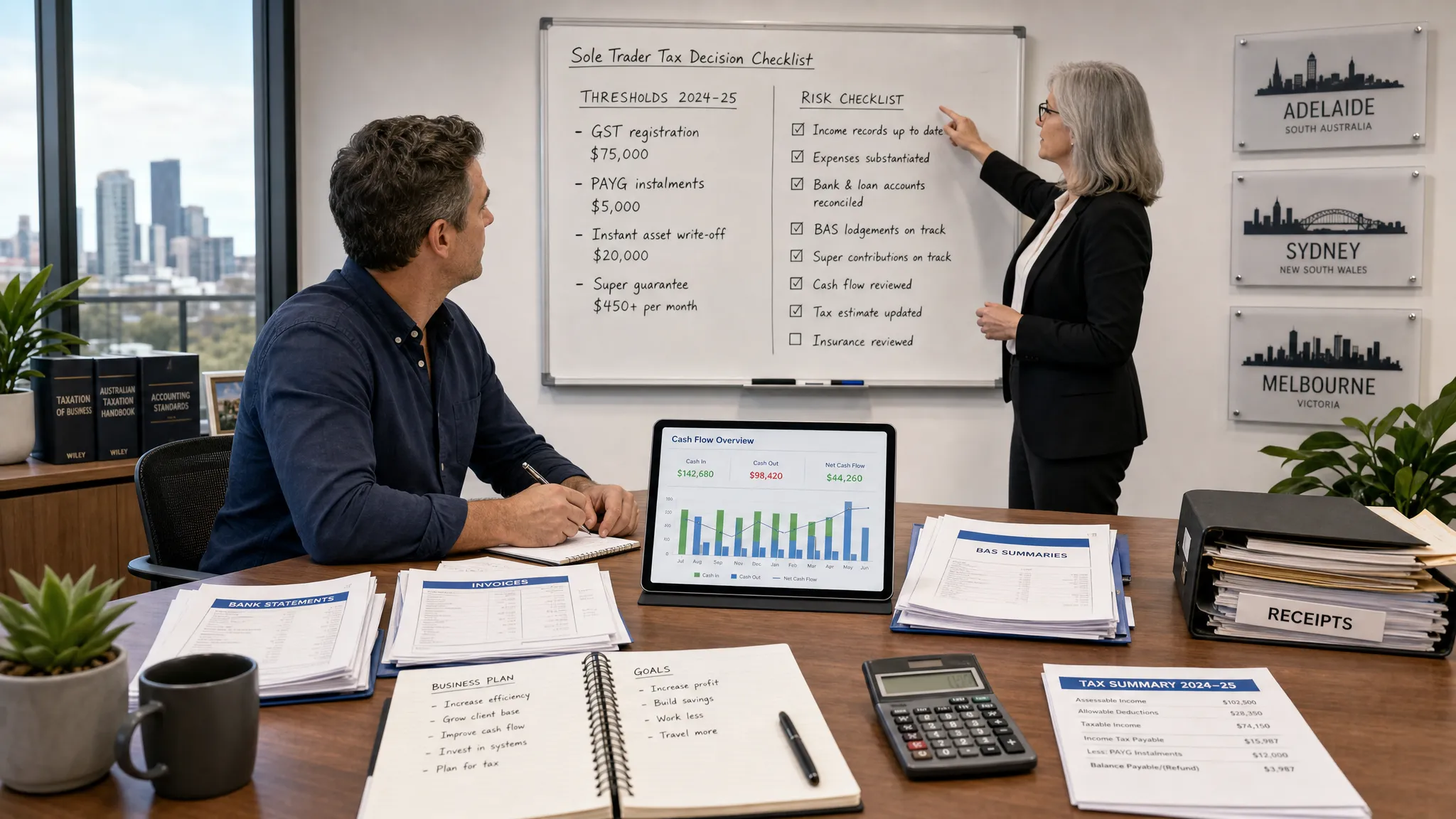
For many Australian sole traders, GST is the first point where DIY accounting becomes risky. In most cases, you must register for GST if your GST turnover is $75,000 or more. Taxi, limousine, and ride-sourcing drivers have specific GST obligations regardless of turnover. The ATO provides guidance on when to register for GST, and the decision should be made before the business is already overdue.
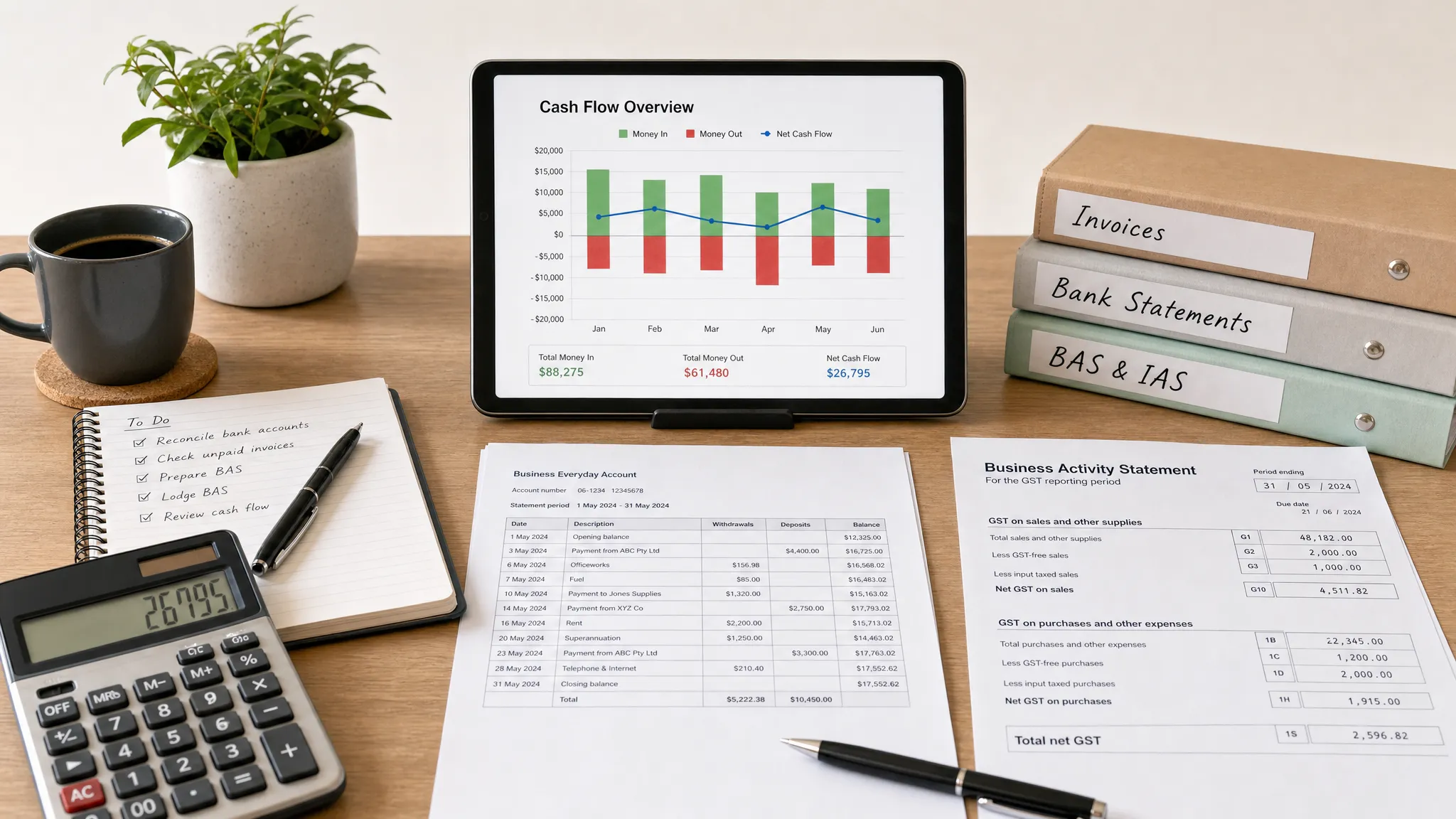
GST changes the discipline required in your accounts. It is no longer enough to know whether money came in or went out. You need to know whether each sale is taxable, GST-free, input taxed, or outside the GST system. You also need to know whether each expense includes claimable GST and whether the tax invoice is valid.
Common DIY GST problems include claiming GST on expenses without valid tax invoices, treating all software subscriptions the same, miscoding bank fees and insurance, forgetting GST on asset sales, and using cash flow as if GST collected belongs to the business. These errors may appear small in a single BAS period, but they compound across a year.
Our view is straightforward. Once BAS lodgement becomes part of your cycle, accounting should move from annual clean-up to regular review. That does not mean you lose visibility. With the right automation, you gain it.
Employees, contractors, and superannuation add another layer
A sole trader can hire staff, engage contractors, and run a sizeable operation. The accounting risk rises when labour enters the model.
Employees introduce payroll, PAYG withholding, Single Touch Payroll reporting, superannuation guarantee obligations, leave records, and potentially FBT if benefits are provided. Contractors require a different assessment. The label on an invoice is not always decisive. In some circumstances, superannuation may apply to contractors who are paid mainly for their labour.
This is where DIY accounting often fails because the issue is not just bookkeeping. It is classification, evidence, and process. The system must capture the right data from the start, including ABN checks, contracts, invoices, payment terms, and super assessments.
We recommend professional involvement before your first hire or major contractor relationship, not after the first payroll error. The cost of retroactive correction is usually higher than building the workflow properly at the beginning.
PSI, home office costs, vehicles, and mixed-use deductions
Many consultants, creatives, IT professionals, allied health providers, and specialists operate through a sole trader ABN while earning income mainly from their personal skills or effort. That can raise personal services income, commonly called PSI, considerations.
PSI does not automatically mean tax has been handled incorrectly. It does mean deductions and income treatment need more care. The rules can affect what expenses are claimable and whether income can be split or retained in certain ways. Where a sole trader has one dominant client, works under close direction, or provides labour rather than a business outcome, PSI should be reviewed.
Mixed-use expenses also require discipline. Home internet, mobile phone, motor vehicle costs, home office expenses, software, travel, and equipment often have both private and business components. The ATO expects reasonable, evidence-based apportionment. Guesswork is not a method.
For higher-income sole traders, the issue is not merely whether a deduction is available. It is whether the deduction can withstand review and whether the overall tax position aligns with the business model.
International, e-commerce, and project-based income complicate the ledger
Modern sole traders often operate nationally or globally from day one. A marketing consultant in Melbourne may bill clients in Singapore. An event planner in Sydney may coordinate offshore suppliers. A digital product creator in Adelaide may receive platform income in multiple currencies.
International transactions raise questions about foreign exchange, GST treatment, withholding documentation, platform fees, and whether income has been recorded gross or net. If you coordinate events or offshore activations, even supplier categories such as premium event furniture rental providers can introduce cross-border payments, documentation requirements, and GST classification issues that should not be handled casually.
E-commerce and platform income create a similar challenge. Payment gateways often deduct fees before deposits reach the bank account. If the bookkeeping records only the net bank deposit, revenue may be understated and fees may be missed or duplicated. This can distort GST, income tax, and performance reporting.
The hidden cost of holding on too long
The most expensive accounting problems are not always the dramatic ones. They are the quiet distortions that affect decisions for months.
If expenses are misclassified, you may think a service line is profitable when it is not. If GST is not reserved, you may overestimate available cash. If your tax estimate is prepared only once a year, you may make spending decisions that create pressure when instalments or assessments arrive. If records are incomplete, you may miss deductions you were legally entitled to claim.
DIY accounting can also delay strategic decisions. We often meet sole traders who should have reviewed pricing, contractor margins, business structure, or cash reserves 12 months earlier. Their accounting was technically present, but not decision-ready.
That is the difference between compliance and strategic advisory. Compliance asks, ‘Can we lodge?’ Strategic advisory asks, ‘What do these numbers tell us about risk, capacity, and growth?’
What professional sole trader accounting should improve
Professional accounting should not simply replace your spreadsheet with a fee. It should improve the quality, speed, and usefulness of your financial information.
Modern accounting services should create an operating rhythm. Bank feeds, receipt capture, rules-based coding, GST review, monthly reconciliations, and cloud reporting should reduce manual work while increasing accuracy. AI-driven workflows can help detect duplicate transactions, unusual coding, missing receipts, GST inconsistencies, and late reconciliations. Professional judgement remains essential, but automation improves the speed and reliability of the review.
| DIY focus | Professional accounting focus |
|---|---|
| Recording transactions after the fact | Building a timely monthly review cycle |
| Estimating tax near lodgement | Forecasting tax and cash flow during the year |
| Coding expenses manually | Using automation with professional oversight |
| Lodging BAS as a compliance task | Using BAS data to understand margins and cash reserves |
| Reacting to ATO issues | Maintaining evidence and controls before questions arise |
| Looking only at tax deductions | Reviewing pricing, structure, risk, and growth strategy |
This is why we frame bookkeeping as infrastructure. Clean books support BAS accuracy, tax planning, financing discussions, contractor decisions, and expansion planning. For a broader view of this shift, we have outlined what owners should expect from modern accounting services for small businesses.
When to consider moving beyond a sole trader structure
Stopping DIY accounting does not always mean changing your business structure. However, it is often the moment when structure should be reviewed.
A sole trader structure can be efficient and simple, but it also means the individual is the business. Personal liability, tax planning limitations, asset protection concerns, staff growth, intellectual property, financing, and succession can all justify a deeper review.
We do not recommend restructuring purely because a business has become profitable. The better question is whether the current structure still matches the commercial risk, income profile, growth plan, and administrative capacity of the business.
A structure review may be appropriate where you have rising profit, meaningful business assets, long-term contracts, employees, significant equipment, investor discussions, or exposure to professional liability. The right answer may still be to remain a sole trader, but the decision should be deliberate rather than assumed.
A practical handover checklist
If you are ready to stop DIY accounting, the transition does not need to be disruptive. A structured handover protects continuity and reduces clean-up costs.
Prepare the following before engaging professional support:
- Current accounting software access, if used.
- Business bank statements and credit card statements.
- Prior-year tax returns, notices of assessment, and BAS lodgements.
- Invoices issued, unpaid debtor lists, and platform income reports.
- Receipts for major purchases, vehicles, tools, software, and equipment.
- Loan documents, lease agreements, and finance contracts.
- Contractor agreements, employee payroll records, and superannuation records.
- Details of any ATO payment plans, overdue lodgements, or correspondence.
If the records are messy, do not delay the conversation. Accountants are used to reconstructing incomplete information, but timing matters. The earlier we can review the file, the more options are usually available.
Where the ATO has already made contact, avoid responding before the records have been reconciled. Our guide on dealing with the ATO without costly mistakes explains why evidence, scope, and timing are critical.
Frequently Asked Questions
At what income level should a sole trader stop DIY accounting? There is no single income level, but GST turnover of $75,000 is a major trigger. You should also seek help earlier if you have contractors, employees, PSI issues, mixed-use deductions, foreign income, or poor visibility over profit and tax reserves.
Can I still do my own bookkeeping and use an accountant for tax? Yes, but the bookkeeping must be accurate and reviewed regularly. A hybrid model can work well where the sole trader maintains daily records and the accountant reviews GST, BAS, tax planning, and year-end adjustments.
Is accounting software enough for a sole trader? Software is useful, but it is not a substitute for tax judgement. Bank feeds and automation can speed up processing, but GST treatment, PSI, deductibility, apportionment, and structure decisions still require professional review.
Should I register for GST before reaching $75,000 turnover? Sometimes, but it depends on your clients, pricing, cash flow, expenses, and industry. Voluntary registration may help where you have significant GST-bearing expenses or business clients who can claim GST credits, but it also adds BAS obligations.
Does stopping DIY mean I need a company? Not necessarily. Many sole traders simply need better systems, BAS support, and tax planning. A company or other structure should be considered only after reviewing risk, profit, asset protection, administration, and commercial objectives.
Next steps: move from compliance stress to financial control
If your accounting is taking time, creating uncertainty, or failing to give you decision-ready numbers, it is time to stop treating it as a DIY task. The goal is not just cleaner lodgements. The goal is better control over tax, GST, cash flow, pricing, and business direction.
Our team supports sole traders and growing businesses across Australia, with integrated service capability in Adelaide, Sydney, and Melbourne. We combine Chartered Accounting expertise with AI-driven automation to streamline records, improve accuracy, and give business owners clearer financial visibility throughout the year.
Contact Perfect Accounting & Tax Services for a consultation if you are ready to review your sole trader accounting, clean up your records, or learn how our automated accounting workflows can support your next stage of growth.