
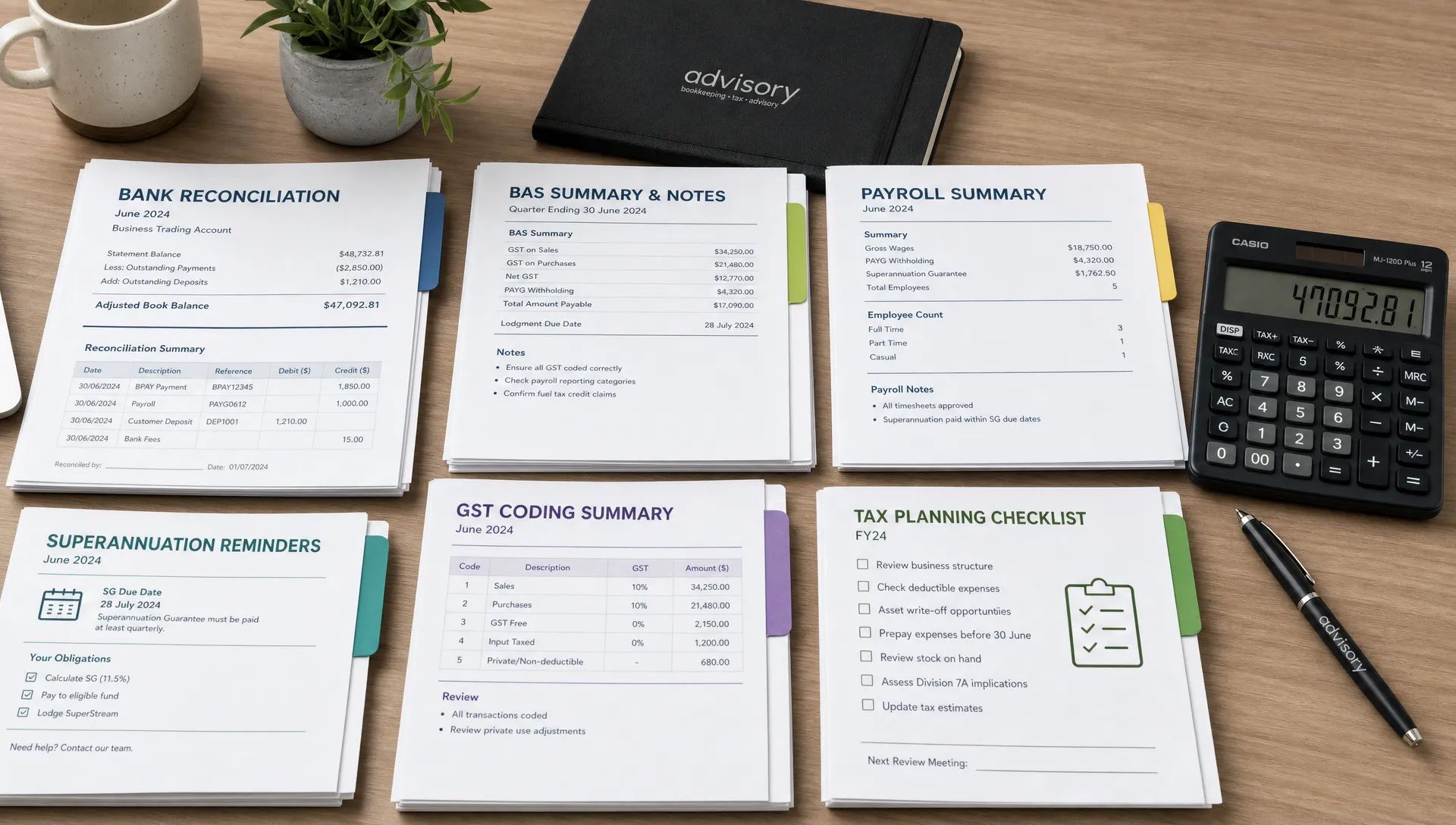
For Australian small business owners, bookkeeping and tax should not sit in separate silos. Bookkeeping gives us the evidence, timing and commercial context. Tax work applies the rules, confirms the position and turns compliance into a planning opportunity.
When we scope bookkeeping and taxes for small business, we are not just asking, “Can this business lodge on time?” We are asking whether the owner, director or family group can see margin, cash flow, GST exposure, payroll risk, debt capacity and tax obligations before decisions are made.
A strong system should cover four layers: accurate records, tax compliance, management visibility and strategic advisory. If one layer is weak, the others become unreliable.
Start With the Business Structure and Tax Profile
Every bookkeeping and tax system should start with the entity and registration profile. A sole trader with an ABN and TFN has different obligations from a company with employees, a trust distributing income to family members or a group with property and trading entities.
Before coding transactions or preparing BAS, we review the following foundations:
- Entity structure, including sole trader, company, partnership, trust or SMSF-related arrangements
- ABN, TFN, GST, PAYG withholding and other ATO registrations
- Business locations, including cross-state activity in South Australia, Victoria and New South Wales
- Director, shareholder, beneficiary and related-party relationships
- Industry-specific reporting obligations, such as taxable payments annual reporting for building, cleaning, courier, road freight, IT and security services
- Whether the business has employees, contractors or a mixed workforce
This matters because bookkeeping categories should reflect the way tax law applies to the business. For example, a director loan, shareholder payment, subcontractor invoice or asset purchase should not be treated as a generic expense without review. The coding decision affects income tax, GST, BAS, payroll, Superannuation and sometimes FBT.
What Core Bookkeeping Should Cover
Good bookkeeping is not simply bank-feed coding. It is the control system for business performance. In our view, the bookkeeping function should be designed so that the accounts are reliable enough for tax lodgments, finance applications, investor reporting and management decisions.
Transaction Capture and Evidence
Every transaction should be captured with enough evidence to satisfy the ATO and enough detail to support decision-making. This includes sales invoices, supplier bills, receipts, finance documents, payroll records, loan agreements and asset contracts.
The ATO generally requires business records to be kept for five years. We recommend digital record capture because it reduces missing documentation, improves audit readiness and gives owners faster access to financial evidence when banks, investors or advisers request it.
Bank, Credit Card and Loan Reconciliations
Reconciliations should be current, not rushed at year-end. Bank accounts, credit cards, merchant facilities, loan accounts and clearing accounts should be reconciled to supporting statements.
Unreconciled accounts create practical problems. GST can be overstated or understated. Owner drawings may be confused with deductible expenses. Loan repayments may be incorrectly split between interest and principal. Merchant fees can be missed. These errors affect both compliance and cash flow visibility.
Chart of Accounts and Cost Coding
The chart of accounts should be built around how the business earns revenue and incurs cost. A generic chart may be adequate for very simple businesses, but growing companies need more precision.
For example, an e-commerce business may need separate tracking for merchant fees, inventory, freight, returns and platform costs. A construction business may need job-level tracking for materials, labour, subcontractors and retention amounts. A professional services firm may need reporting by consultant, client segment or recurring revenue stream.
| Bookkeeping area | What should be covered | Strategic value |
|---|---|---|
| Sales and income | Invoices, deposits, merchant sales, refunds and revenue categories | Shows revenue quality and customer concentration |
| Purchases and expenses | Supplier bills, recurring subscriptions, job costs and overheads | Identifies margin leakage and unnecessary spend |
| Bank reconciliations | Business accounts, credit cards, loans and clearing accounts | Confirms completeness and reduces tax errors |
| Payroll | Wages, PAYG withholding, super, leave and STP reporting | Reduces employee compliance risk and labour cost surprises |
| Assets and finance | Equipment, vehicles, leases, loans and depreciation schedules | Supports tax planning and capital investment decisions |
| Owner and related-party accounts | Drawings, director loans, trust distributions and reimbursements | Prevents private costs becoming tax and governance issues |
Receivables, Payables and Cash Flow Control
Bookkeeping should show who owes the business money, who the business owes and what cash will be required for tax, wages, super and supplier payments. For many businesses, profit exists on paper while cash is trapped in debtors, stock or work in progress.
This is where bookkeeping becomes advisory. Accurate debtor ageing, creditor ageing and GST liability tracking give business owners the evidence to tighten payment terms, negotiate supplier timing and plan working capital. We have covered this cash flow discipline in more detail in our article on how business bookkeeping services improve cash flow control.
Payroll, Superannuation and Contractor Management
Payroll bookkeeping must cover more than wage payments. It should include employee setup, TFN declarations, award or contract information, leave accruals, PAYG withholding, Single Touch Payroll reporting and Superannuation Guarantee obligations.
Contractors also require attention. The distinction between employee and contractor is not determined by an invoice alone. Control, delegation, commercial risk, tools, integration into the business and payment arrangements all matter. Misclassification can lead to payroll tax, super, PAYG withholding and workers compensation exposure.
What Taxes for Small Business Should Cover in Australia
Tax coverage should be mapped to the business structure, size and activities. For most Australian small businesses, the core tax areas include income tax, GST, BAS, PAYG withholding, PAYG instalments, super, payroll tax where thresholds are met, FBT where benefits are provided and industry-specific reporting.
We do not view tax as an annual event. Tax planning should be part of the operating rhythm of the business, especially where there are directors, trusts, investors, assets or growth plans.
| Tax area | What should be reviewed | Why it matters |
|---|---|---|
| Income tax | Profit, deductions, depreciation, trading stock and structure | Determines taxable income and planning opportunities |
| GST and BAS | GST on sales, GST credits, adjustments and lodgment timing | Protects cash flow and reduces ATO correction risk |
| PAYG withholding | Employee tax withheld and reported through payroll | Prevents payroll compliance gaps |
| PAYG instalments | ATO instalments toward income tax liabilities | Helps avoid tax-time cash shocks |
| Superannuation | Contribution calculations, due dates and employee eligibility | Avoids non-deductible super guarantee charge exposure |
| FBT | Motor vehicles, entertainment, parking, loans and employee benefits | Identifies benefits that may not appear in ordinary expense reports |
| Payroll tax | State-based wage thresholds and grouping issues | Critical for multi-entity and cross-state employers |
| TPAR | Payments to contractors in specified industries | Supports ATO reporting obligations |
For business owners wanting a deeper record-keeping checklist, we recommend reviewing what small business owners must track for tax in Australia and then aligning those records with the bookkeeping workflow.
The Year-Round Workflow: Monthly, Quarterly and Annual Coverage
The strongest small business accounting systems operate on a calendar. Monthly work keeps the accounts reliable. Quarterly reviews support BAS, GST and cash flow decisions. Annual tax work finalises the position and identifies planning issues for the next year.
| Timing | Bookkeeping focus | Tax and advisory focus |
|---|---|---|
| Monthly | Reconcile accounts, code transactions, review debtors, review payables and update payroll records | Track GST exposure, cash flow, wage costs and management reporting |
| Quarterly | Prepare BAS workpapers, confirm GST coding, review payroll and super, check director or owner transactions | Lodge BAS, plan upcoming tax payments and assess profit trends |
| Pre year-end | Review profit, deductions, assets, stock, bad debts and trust or company distributions | Identify tax planning opportunities before 30 June |
| Year-end | Finalise accounts, reconcile balance sheet, prepare depreciation and confirm supporting evidence | Prepare financial statements, income tax returns and advisory recommendations |
This rhythm also improves bank and investor readiness. Lenders and investors rarely want accounts that were reconstructed months after the transaction. They want timely, reconciled numbers with clear assumptions.
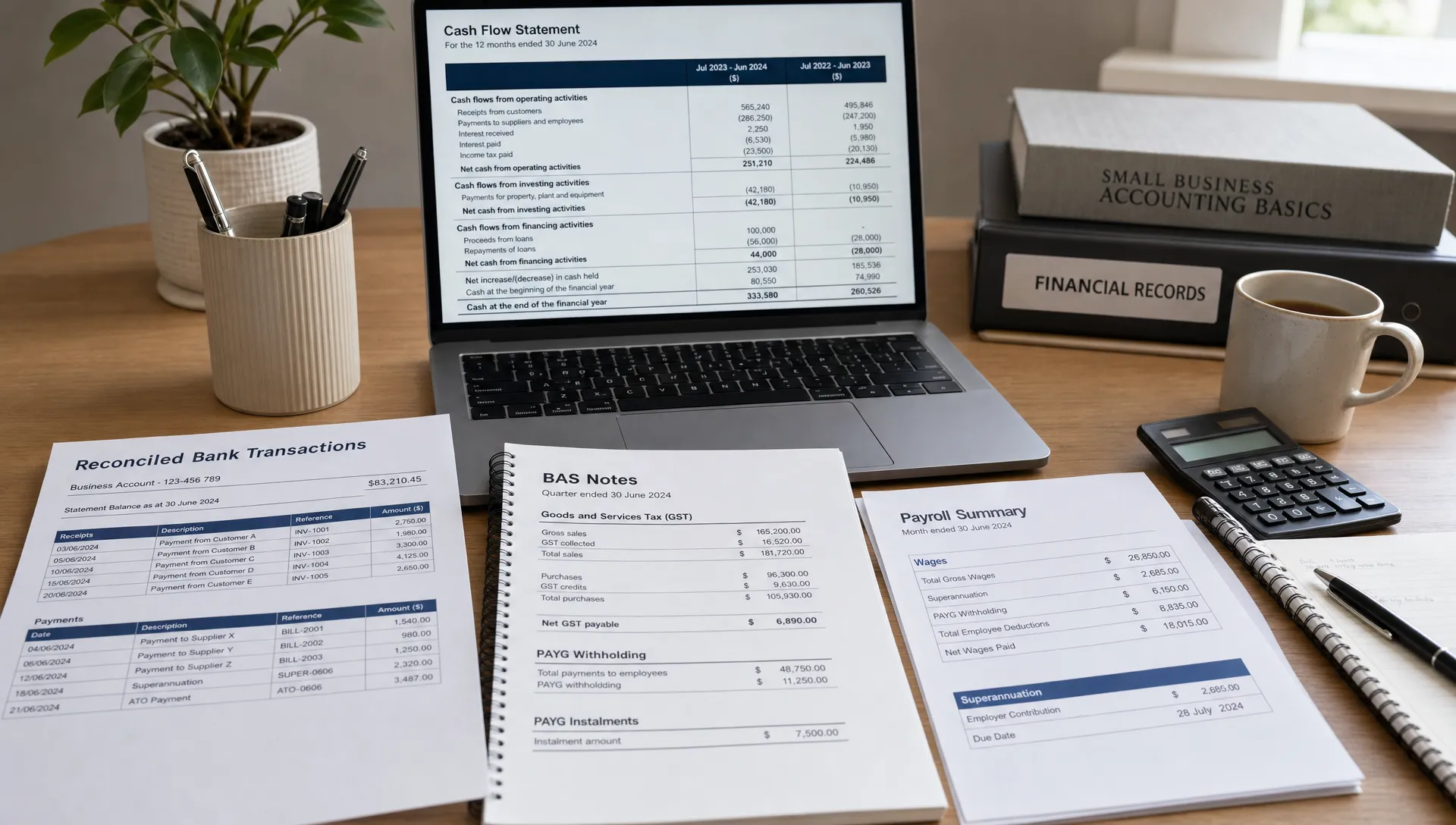
Industry-Specific Coverage Should Not Be Ignored
The scope of bookkeeping and tax changes by industry. A high-margin consulting firm, a building contractor, a medical practice, a SaaS company and a property investment structure all need different reporting priorities.
A trade-based business, for example, often needs job costing, materials tracking, subcontractor management, vehicle cost allocation and equipment finance records. The same commercial logic applies across markets, whether we are reviewing an Australian building contractor or looking at how specialist trade operators such as roofing firms working across Odense and Fyn present project-based services that require disciplined costing, scheduling and documentation.
For Australian businesses, the practical tax implications depend on local rules. Building and construction operators may need taxable payments annual reporting. Hospitality businesses must carefully manage payroll, tips, weekend rates and stock. Property investors need loan interest, repairs, capital works and depreciation separated correctly. Tech startups may require R&D tax incentive documentation, employee share scheme considerations and capital raising records.
The main point is simple: industry context should shape the bookkeeping system. If the accounts do not mirror the business model, the reports will not support strategic decisions.
Where Automation and AI Improve Bookkeeping and Tax Outcomes
Modern bookkeeping should reduce manual handling and increase review quality. Our team uses AI-driven automation to streamline data capture, transaction categorisation, document matching and exception detection. The purpose is not to remove professional judgment. It is to give our accountants and advisers cleaner data sooner, so we can focus on analysis, risk and strategy.
Automation can improve small business accounting in several ways:
- Faster capture of invoices, receipts and bank transactions
- Fewer missing documents at BAS or year-end
- Earlier identification of unusual transactions or coding inconsistencies
- Real-time visibility over GST, cash flow and profitability
- More consistent workflows across Adelaide, Sydney, Melbourne and other Australian locations
The governance layer remains essential. Automation rules must be reviewed. Access permissions should be controlled. Bank feeds need reconciliation. AI can highlight anomalies, but a Chartered Accountant or registered tax agent should assess tax treatment, structure, risk and planning implications.
This is why we encourage business owners to expect more from their advisers than basic processing. We have explained this broader standard in our guide to modern accounting services for small businesses.
Common Gaps We Find in Small Business Bookkeeping and Tax Files
When we review business accounts, recurring issues tend to appear. They are usually not caused by one major failure. They are caused by small errors that accumulate over time.
Common gaps include private expenses coded as business costs, GST claimed without valid tax invoices, unreconciled loan accounts, missing payroll records, inconsistent treatment of contractors, old debtor balances that are not reviewed, assets expensed incorrectly and BAS figures that do not reconcile to annual accounts.
For companies and trusts, related-party transactions require particular care. Director loans, beneficiary entitlements, reimbursements and inter-entity transfers should be clearly documented. Where Division 7A, trust distribution resolutions or unpaid present entitlements are relevant, year-end planning should not be left until after 30 June.
These issues are not just compliance problems. They affect valuation, finance approval, succession planning and the owner’s ability to make confident decisions.
What a Complete Small Business Accounting Scope Should Deliver
A complete scope for bookkeeping and taxes for small business should deliver more than lodgments. It should create a reliable financial operating system.
At a minimum, business owners should expect:
- Accurate bookkeeping with reconciled accounts and supporting documentation
- BAS and GST processes that can be checked back to source transactions
- Payroll, PAYG withholding and super records that are current and compliant
- Balance sheet reviews, including loans, assets, liabilities and related-party accounts
- Management reporting that explains profit, margin, cash flow and tax obligations
- Tax planning before year-end, not only after the year has closed
- Strategic advisory that connects compliance data to growth, funding and risk management
For growing businesses, this scope should evolve. A sole trader may begin with quarterly BAS and annual tax planning. A company with staff, vehicles, finance and interstate activity may need monthly reporting, payroll governance, FBT review, tax forecasting and virtual CFO support.
Frequently Asked Questions
What should bookkeeping and taxes for small business include? They should include transaction capture, reconciliations, payroll, super, GST, BAS, income tax, asset records, loan accounts, cash flow reporting and year-round tax planning. The exact scope depends on the structure, industry and growth stage of the business.
How often should a small business review its books? We recommend monthly bookkeeping reviews for most businesses, with quarterly BAS and GST checks. Higher-growth businesses or companies with payroll, inventory, finance or multiple locations should consider more frequent reporting.
Is bookkeeping enough if my BAS is lodged on time? No. BAS lodgment confirms part of the compliance cycle, but it does not replace balance sheet review, tax planning, payroll governance, cash flow forecasting or strategic advice. Timely lodgment is only one measure of a healthy accounting system.
Can automation replace an accountant for small business taxes? Automation can improve speed, accuracy and visibility, but it cannot replace professional judgment. Tax treatment, structure, audit risk, related-party transactions and strategic planning still require experienced review.
When should a small business move from basic bookkeeping to advisory support? The transition should happen when the business has employees, GST complexity, finance, multiple entities, property, investors, interstate operations or growth plans. Advisory support helps owners use financial data to make better decisions before risks become expensive.
Next Steps: Build a Bookkeeping and Tax System That Supports Growth
If your bookkeeping only tells you what happened months ago, it is not doing enough. A modern small business accounting system should give you current numbers, clean compliance records and strategic insight into tax, cash flow and growth.
Our team at Perfect Accounting & Tax Services supports businesses and high-net-worth individuals across Australia, with integrated capability in Adelaide, Sydney and Melbourne. We combine 25 years of professional accounting experience with AI-driven workflows to improve accuracy, reduce manual administration and give clients clearer financial visibility.
Contact our firm for a consultation if you want to review your bookkeeping and tax scope, strengthen BAS and GST processes or explore automated accounting workflows that support better decisions year-round.