
The benchmark for accounting has changed. Small businesses should no longer expect a once-a-year conversation, a spreadsheet of historical transactions, and a tax return prepared after all the important decisions have already been made.
In 2026, modern accounting services for small business should provide compliance, real-time visibility, stronger financial controls, and strategic advice. The ATO is increasingly data-driven. Directors are expected to understand their numbers. Margins are under pressure. Cash flow must be managed before problems appear, not after.
We see accounting as a strategic operating system for business owners, not an administrative task. When the right systems, automation, and advisory cadence are in place, bookkeeping and compliance become the foundation for better decisions, cleaner governance, and corporate growth.
The modern accounting standard: compliance, visibility and advice
A modern accounting service should perform three functions at the same time.
First, it must keep the business compliant with Australian tax and reporting obligations, including GST, BAS, income tax, payroll, Superannuation, FBT, and relevant ASIC or state-based requirements.
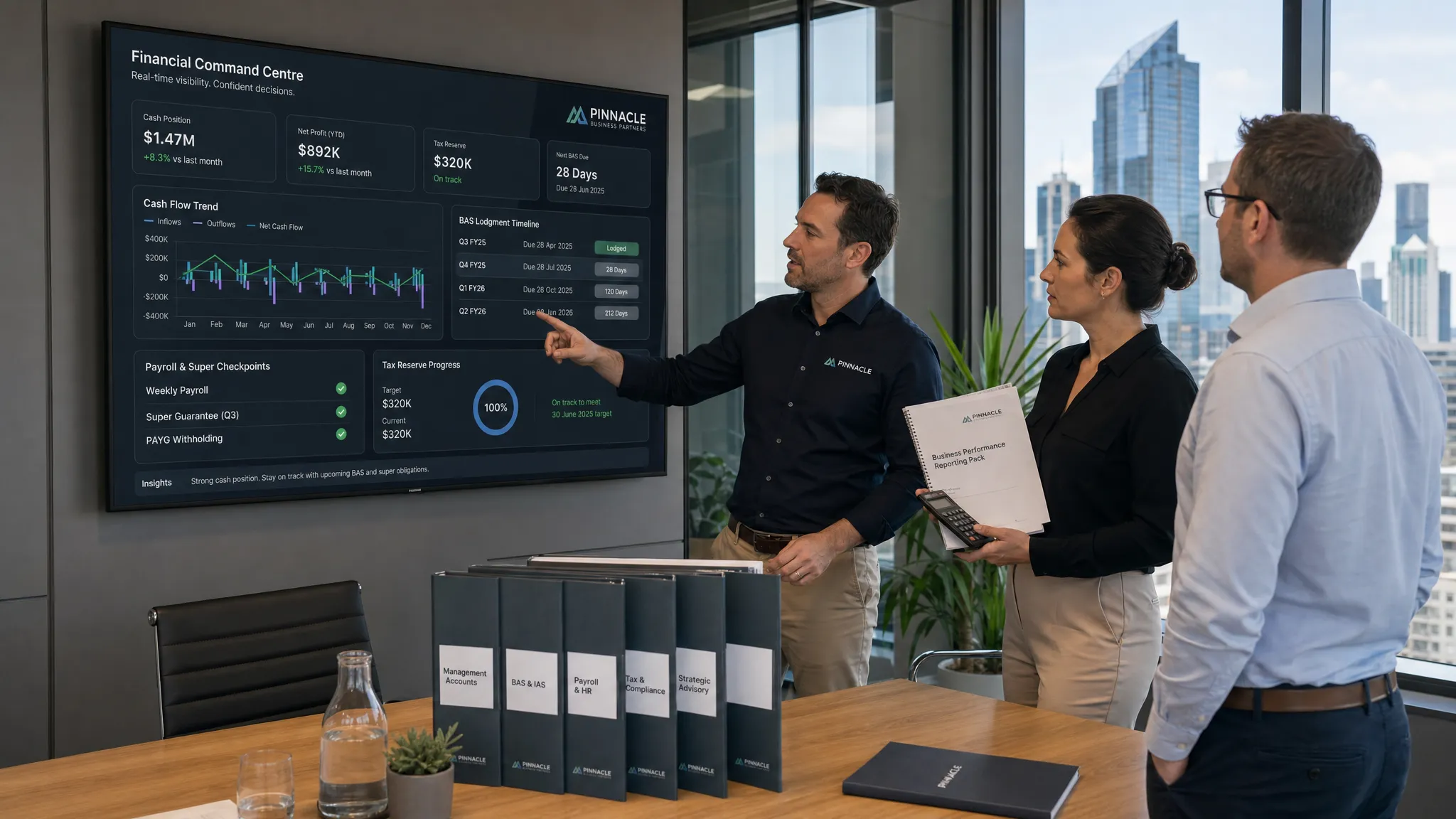
Second, it should give owners and directors timely visibility over cash flow, profitability, tax exposure, and working capital. A business cannot scale confidently if financial reports are months out of date.
Third, it should help management make better decisions. This may include entity structuring, tax planning, funding preparation, pricing analysis, cost control, virtual CFO support, and growth strategy.
Traditional accounting often stops at lodgement. Modern accounting should connect compliance to commercial outcomes.
1. A year-round compliance framework
Small businesses should expect their accountant to maintain a structured compliance calendar, not simply react when a deadline approaches.
For Australian businesses, this typically includes BAS or IAS lodgements, income tax returns, PAYG withholding, payroll reporting through Single Touch Payroll, Superannuation obligations, and tax planning before 30 June. Depending on the business, it may also include FBT, payroll tax, ASIC company statements, trust resolutions, SMSF compliance, or industry-specific reporting.
The ATO expects businesses to maintain accurate records, and ATO guidance on business record keeping generally requires records to be kept for five years. Modern accountants should not treat that as a filing exercise. They should design a record-keeping process that supports deductions, audit defence, financing, and management reporting.
A well-managed compliance framework should include:
- Accurate GST coding and BAS reconciliations before lodgement.
- Payroll records that align with STP, Superannuation, and employment obligations.
- Clear separation between business, personal, loan, and director transactions.
- Tax planning completed before year-end, not after the financial year has closed.
- Evidence retained for deductions, asset purchases, travel, motor vehicle use, and home office claims.
When compliance is handled properly throughout the year, business owners gain confidence. They also reduce the risk of penalties, amended returns, cash-flow shocks, and avoidable ATO scrutiny.
2. Automation that improves accuracy, not just convenience
Technology is now central to professional accounting. However, automation should not be used merely to reduce administration. It should improve accuracy, consistency, and decision speed.
AI-driven workflows can help classify transactions, identify unusual GST treatment, detect duplicate supplier invoices, flag missing documentation, and accelerate reconciliations. Cloud accounting platforms can connect bank feeds, payroll, invoicing, payment systems, and management reporting.
The critical point is that automation does not replace professional judgement. It strengthens it. Our team uses automation to process data faster, then applies human analysis to tax treatment, risk, structure, and strategic interpretation.
| Accounting area | Outdated approach | Modern expectation |
|---|---|---|
| Bookkeeping | Transactions coded weeks or months later | Regular processing with automated checks and human review |
| BAS preparation | GST reviewed only near the deadline | GST monitored continuously with reconciled source data |
| Payroll | Pay runs processed separately from accounting records | Payroll, STP, Superannuation, and ledger balances reconciled |
| Reporting | Profit and loss produced after year-end | Monthly or quarterly management reporting with KPI commentary |
| Tax planning | Advice provided after 30 June | Forecasting and planning completed before decisions are locked in |
| Advisory | Reactive answers to isolated questions | Proactive discussion of cash flow, structure, risk, and growth |
The best accounting systems create a reliable financial data layer. That data layer then supports tax planning, funding applications, performance reviews, and strategic advisory.

3. Management reporting that explains what is really happening
Small business owners should expect more than a profit and loss statement. A modern accountant should help interpret the numbers.
For example, a business may show accounting profit while experiencing cash pressure because debtors are slow, inventory is building, loan repayments are increasing, or GST and PAYG liabilities are under-reserved. A basic report may not explain this. A strategic accountant should.
Useful management reporting often covers:
- Revenue trends by service line, product, location, or project.
- Gross margin movement and direct cost pressure.
- Debtor days, creditor days, and working capital stress.
- Cash-flow forecasts and tax payment reserves.
- Payroll costs as a percentage of revenue.
- Director drawings, shareholder loans, and Division 7A exposure.
- Budget versus actual performance.
This is where accounting becomes commercial. The question is not only, “What tax do we owe?” It is, “What is this business generating, where is cash being absorbed, and what decisions should management make next?”
For owners who want deeper financial control, we have also written about what a small business tax accountant should help you improve, including bookkeeping quality, BAS processes, cash flow, and governance.
4. Tax planning before the financial year closes
Tax planning is most valuable when there is still time to act.
Modern accounting services should include regular reviews of taxable profit, PAYG instalments, deductible expenditure, asset purchases, director remuneration, trust distributions, and company tax obligations. For companies and trusts, this should also consider Division 7A, retained earnings, shareholder loans, unpaid present entitlements, and distribution minutes.
For high-growth businesses, tax planning should be connected to cash-flow forecasting. A tax outcome that looks efficient on paper may create pressure if cash is tied up in debtors, stock, expansion costs, or loan repayments.
Business owners should expect their accountant to raise issues such as:
- Whether the current structure still suits the business risk profile and growth plans.
- Whether GST registration, PAYG withholding, or FBT obligations are being managed correctly.
- Whether asset purchases are commercially justified, not merely tax-driven.
- Whether director loans and private use expenses are being tracked properly.
- Whether profits should be retained, distributed, reinvested, or used to reduce debt.
Tax planning should never be a last-minute attempt to reduce taxable income. It should be part of an integrated financial strategy.
5. Payroll and Superannuation treated as governance issues
Payroll is one of the highest-risk areas for small businesses. It affects employees, cash flow, tax compliance, Superannuation, and director accountability.
A modern accounting service should ensure payroll data is not isolated from the broader accounting system. Wages, PAYG withholding, STP reporting, superannuation accruals, and payment records should reconcile to the ledger.
For the 2025-26 year, the Superannuation Guarantee rate is 12%. Businesses also need to prepare for Payday Super reforms scheduled to apply from 1 July 2026, subject to the final rules and the way they apply to each employer. This makes payroll system readiness, clearing house timing, employee onboarding, TFN details, and cash-flow planning more important than ever.
We view payroll as more than a pay run. It is a governance function. If payroll is inaccurate, management reports are unreliable, BAS figures may be wrong, and Superannuation exposure can accumulate quickly.
6. Strategic advisory aligned to the business stage
The needs of a sole trader are different from those of a multi-entity company group. Modern accounting should adjust as the business matures.
| Business stage | What the accounting service should focus on |
|---|---|
| Sole trader or consultant | ABN, GST registration, tax reserves, PSI considerations, deductible expenses, and transition planning |
| Established SME | BAS systems, payroll controls, cash-flow forecasting, margin analysis, and management reporting |
| Growing company | Virtual CFO support, funding readiness, director governance, Division 7A management, and profit planning |
| Multi-location business | Consolidated reporting, GST consistency, payroll tax review, location profitability, and stronger internal controls |
| Property or investment group | CGT planning, loan interest tracking, trust distributions, GST on property issues, and SMSF interaction where relevant |
| Exit or succession stage | Due diligence readiness, normalised earnings, asset protection, sale structure, and tax consequences |
This is why accounting support should not remain static. As turnover, staffing, locations, funding, and ownership structures change, the accounting function should evolve.
Businesses operating across Adelaide, Sydney, Melbourne, and other Australian markets also need consistent national processes. Multi-city operations can create different payroll, state tax, lease, staffing, and reporting considerations. An integrated accounting team helps standardise the financial data while still recognising local operating conditions.
7. Clear communication, secure systems and professional accountability
Small business owners should expect clarity around scope, timing, responsibility, and communication.
A professional accounting service should explain what is handled monthly, quarterly, and annually. It should confirm who is responsible for providing source documents, approving lodgements, maintaining payroll records, and responding to ATO correspondence.
Modern systems should also be secure. Financial data includes TFNs, payroll details, bank information, customer records, supplier data, and commercially sensitive reports. Secure client portals, controlled access, multi-factor authentication, and clear document retention processes should be standard practice.
If tax agent services are being provided, businesses should ensure the practitioner is appropriately registered. The Tax Practitioners Board public register can be used to verify registration details.
Good accounting is not only about technical skill. It is also about governance, communication, and trust.
Red flags that your accounting service is outdated
A small business should review its accounting arrangements if the service is consistently reactive or disconnected from management decisions.
Common warning signs include:
- BAS lodgements are prepared without clear reconciliations.
- Financial reports are only discussed after the year has ended.
- Payroll, Superannuation, and STP are not reconciled to the ledger.
- The accountant does not discuss cash-flow impact before tax deadlines.
- GST errors are repeated across multiple BAS periods.
- Director drawings or shareholder loans are not reviewed during the year.
- There is no structured process for management reporting or tax planning.
- Technology is used only for data entry, not insight or controls.
If these issues exist, the business may still be receiving compliance support, but it is not receiving modern accounting support.
How our team supports modern small business accounting
At Perfect Accounting & Tax Services, we combine 25 years of professional experience with AI-driven automation and strategic advisory. Our objective is to help business owners convert accounting from a compliance burden into a reliable decision-making asset.
Our team supports small businesses, company directors, investors, and growing corporate groups across Australia. We provide integrated service capabilities in Adelaide, Sydney, and Melbourne, with digital workflows that allow us to work efficiently with businesses operating locally, interstate, or nationally.
Our work commonly includes bookkeeping system improvement, BAS and GST compliance, payroll management, tax planning, audit support, virtual CFO services, SMSF-related compliance, and advisory for business growth. We do not see these as disconnected tasks. We see them as parts of one financial operating framework.
For business owners reviewing their broader support model, our guide on how to choose tax services that support business growth explains the key questions to ask before engaging an adviser.
Next steps for small business owners
Before upgrading your accounting support, we recommend completing a structured review of your current financial processes.
Start with the quality of your data. Are bank accounts, loans, credit cards, payroll, GST, and Superannuation reconciled regularly? If not, management reports may be unreliable.
Next, review your compliance calendar. Confirm BAS, income tax, ASIC, payroll, Superannuation, and FBT deadlines are documented and assigned to the right person.
Then review your reporting cadence. If you are making pricing, hiring, borrowing, or expansion decisions without current financial reports, the accounting function is not supporting strategy.
Finally, assess whether your accountant is helping you plan ahead. A modern accounting relationship should include forward-looking conversations about cash flow, tax, structure, automation, and growth.
Frequently Asked Questions
What should small businesses expect from modern accounting services? Small businesses should expect accurate compliance, automated bookkeeping workflows, BAS and GST management, payroll and Superannuation support, tax planning, management reporting, and strategic advisory. The service should help owners understand the business, not just lodge returns.
How often should a small business speak with its accountant? The right cadence depends on complexity, but most established businesses should have at least quarterly discussions around BAS, GST, cash flow, payroll, and tax planning. Growing businesses often benefit from monthly reporting and advisory meetings.
Can automation replace an accountant? No. Automation can improve speed, consistency, and data accuracy, but professional judgement is still required for tax treatment, structure, risk assessment, ATO correspondence, and strategic planning. The strongest model combines AI-driven workflows with experienced human review.
When should a sole trader move to more advanced accounting support? A sole trader should consider stronger accounting support when registering for GST, hiring staff, dealing with PSI issues, buying assets, working with multiple clients, earning higher profits, or considering a company or trust structure.
Why is management reporting important for small businesses? Management reporting helps owners see profitability, cash flow, margins, debtor risk, tax liabilities, and growth pressure before problems escalate. It turns accounting data into practical business intelligence.
Speak with our team about modern accounting workflows
If your accounting process is still reactive, we can help you build a more accurate, automated, and strategic financial framework.
Contact Perfect Accounting & Tax Services to arrange a consultation with our team. We can review your current systems, identify compliance risks, assess automation opportunities, and show how modern accounting workflows can provide better visibility across tax, BAS, payroll, cash flow, and growth planning.