
Modern tax filing services should no longer feel like a once-a-year scramble to gather receipts, reconcile accounts and hope nothing has been missed. For Australian business owners, company directors and high-net-worth individuals, tax lodgement is now part of a broader financial control system.
We see the strongest outcomes when tax compliance, bookkeeping, BAS, payroll, GST, superannuation and advisory are connected throughout the year. The tax return then becomes the final output of a disciplined process, not the first time anyone has properly reviewed the numbers.
That shift matters. The ATO has more data-matching capability than ever, business structures are more complex, and directors are expected to maintain strong governance. Modern tax filing services should therefore provide more than form preparation. They should help you improve accuracy, manage risk, protect cash flow and make sharper commercial decisions.
Why expectations around tax filing services have changed
In Australia, the phrase “tax filing services” usually refers to tax return preparation and lodgement with the ATO. For sophisticated clients, however, lodgement is only one part of the engagement.
The modern tax environment is more data-rich and more transparent. The ATO receives information from employers, banks, share registries, property records, government agencies and digital platforms. For businesses, Single Touch Payroll, BAS reporting, GST reconciliations and superannuation compliance create a continuous trail of financial information.
This means errors are easier to detect, but also easier to prevent if your accounting systems are well designed. We prefer to treat tax filing as the end point of a controlled workflow that captures transactions correctly, classifies them accurately and tests them before lodgement.
Technology has also raised the standard. Cloud accounting platforms, secure document collection, bank feeds, automated reconciliations and AI-assisted checks can reduce manual handling. Used properly, automation does not replace professional judgement. It gives accountants better visibility, faster exception reporting and more time to focus on advisory.
If you are already thinking about whether professional lodgement is worth it, our separate guide on when tax return filing services make strategic sense explores that decision in more depth.
What modern tax filing services should include
A modern engagement should begin well before the return is lodged. We expect a professional tax process to cover compliance, data quality, risk review and strategic interpretation.
A structured pre-lodgement review
Before any return is prepared, your adviser should understand your entity structure, revenue streams, asset base, financing arrangements and major transactions during the year. For a company director, this may include director loans, Division 7A exposure, trust distributions, retained earnings and inter-entity balances. For an investor, it may include capital gains tax, negative gearing, depreciation, interest deductibility and ownership structure.
A pre-lodgement review should also identify whether your records support the claims being made. The ATO generally requires taxpayers to keep records for five years, and business records must be complete enough to explain income and deductions. The ATO’s record keeping guidance is a useful reference point, but a strong accountant should translate that requirement into a practical system for your business.
We recommend using the pre-lodgement conversation to surface issues before they become amendments, ATO queries or cash flow surprises. Our article on what to cover in a tax consultation before you lodge sets out the key discussion areas for business owners, investors and directors.
Digital document capture and clean audit trails
Modern tax filing services should not rely on scattered email attachments and incomplete spreadsheets. A technology-led process should capture invoices, receipts, loan statements, payroll records and investment reports in an organised way.
AI-driven automation can help classify documents, identify missing information, match transactions to bank feeds and flag unusual items for review. This improves speed, but the real benefit is audit readiness. If the ATO questions a deduction, GST credit or income treatment, the supporting evidence should be accessible and logically connected to the return.
Clean audit trails are especially important for businesses with multiple locations, high transaction volumes, contractor payments, asset purchases or complex revenue models. They are also critical for high-net-worth individuals with investment portfolios, trusts, property assets or SMSF interests.
Integration with BAS, GST, payroll and superannuation
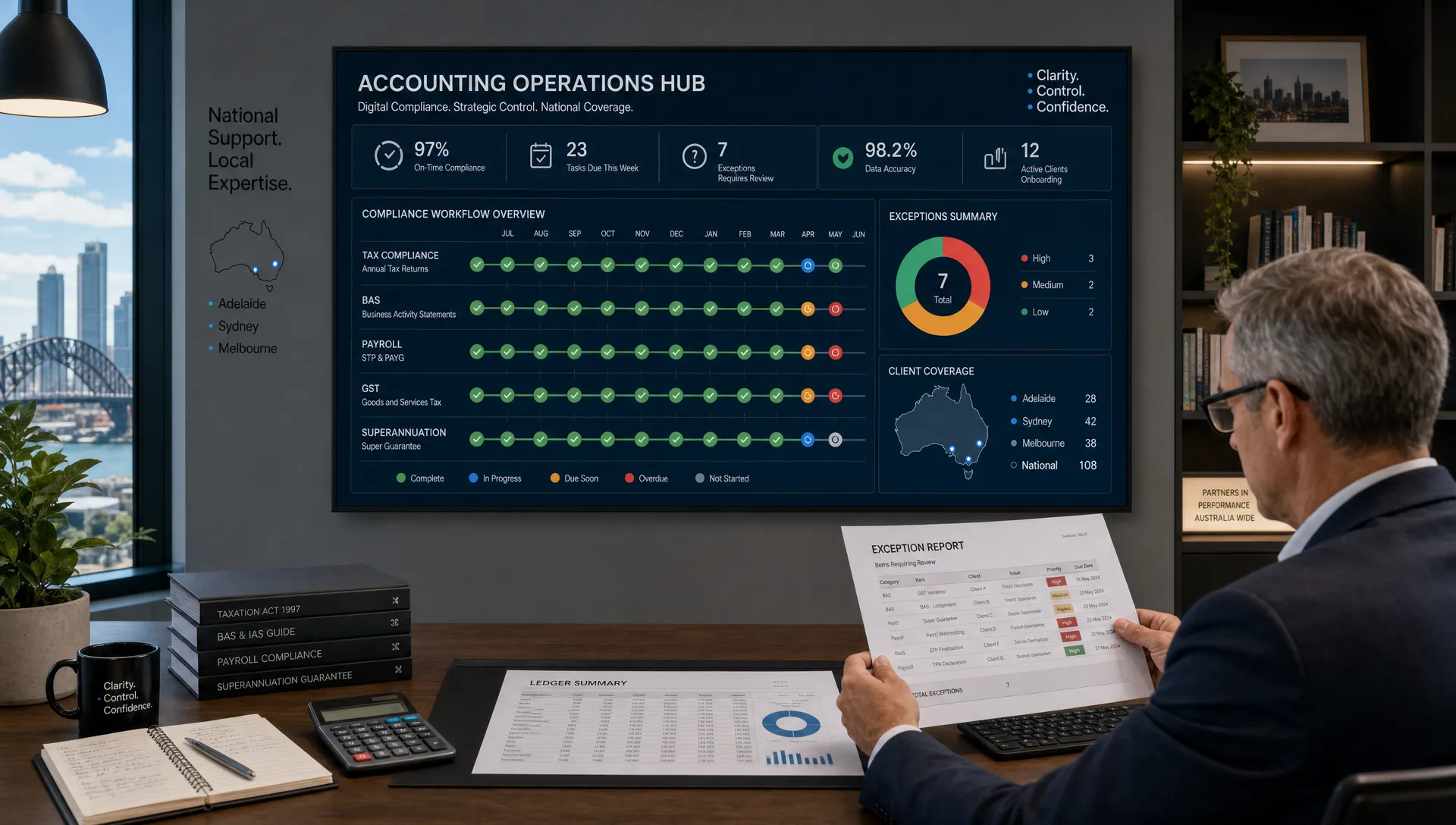
Tax lodgement should not sit separately from your monthly or quarterly compliance cycle. If your BAS lodgements are inaccurate, your year-end income tax return will often require significant correction. If payroll has not been reconciled to Single Touch Payroll reports, PAYG withholding and superannuation obligations may not align with the accounts.
A modern adviser should reconcile GST control accounts, wages, PAYG withholding, superannuation payable, FBT-related amounts and director payments before finalising the tax return. This reduces the risk of double-counting income, missing deductions or lodging inconsistent information across ATO systems.
For growing businesses, this is where compliance becomes strategic. Accurate BAS and payroll data helps you monitor gross margins, labour costs, GST cash flow and working capital pressure throughout the year. That visibility supports better decisions, not just better lodgements.
| Area reviewed | Why it matters | Modern service expectation |
|---|---|---|
| Income and revenue recognition | Reduces under-reporting and timing errors | Reconcile accounting records to bank feeds, invoices and platform data |
| GST and BAS | Prevents inconsistent ATO reporting | Review GST coding, BAS lodgements and control accounts before tax finalisation |
| Payroll and superannuation | Protects directors from compliance exposure | Match payroll records, STP data, PAYG withholding and superannuation obligations |
| Deductions and substantiation | Supports claims if reviewed by the ATO | Maintain organised records, receipts and business-purpose evidence |
| Structure and distributions | Impacts tax outcomes and asset protection | Review companies, trusts, beneficiaries, loans and retained profits |
The difference between traditional and modern tax filing
Traditional tax preparation is often reactive. The accountant receives information after year-end, prepares the return, asks for missing documents and lodges once the client approves. That model may be adequate for a simple salary and wage return, but it is rarely enough for a business owner, investor or director managing complex affairs.
Modern tax filing services are proactive. The adviser works with live data, reviews issues earlier and uses automation to identify inconsistencies. The return is still lodged accurately and in accordance with Australian tax law, but the process also produces insights about profitability, cash flow, compliance weaknesses and future planning opportunities.
The practical difference is that modern tax work should answer more than “what do I owe?” It should also answer “why did the result occur?”, “what risks are emerging?” and “what should we change before next year?”
How AI and automation improve the tax lodgement process
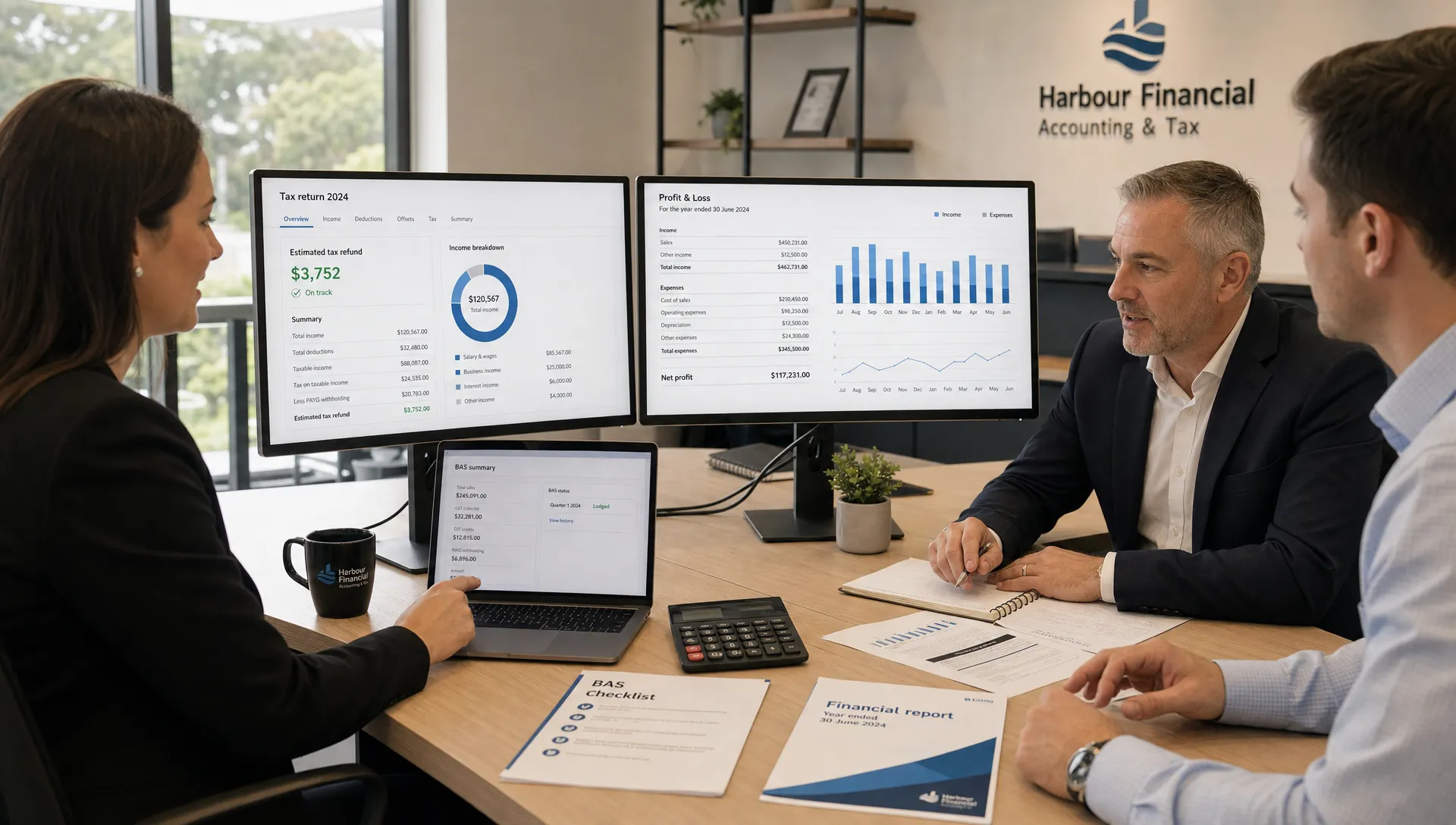
We use automation as a control mechanism, not a shortcut. In our view, the best results come from combining AI-assisted workflows with senior accounting review.
Automation can scan for duplicate transactions, unusual expense categories, missing GST codes, unreconciled balances and large movements from prior periods. It can also reduce time spent on repetitive data entry, allowing our team to focus on tax interpretation, commercial context and strategic advisory.
For example, a marketing agency may have software subscriptions, contractor payments, cross-border receipts and GST considerations. A property investor may have interest apportionment, repairs versus capital improvements and depreciation schedules. A technology company may have R&D-related records, capitalised development costs and employee share scheme considerations. Automation helps organise the data, while professional judgement determines the correct tax treatment.
This is the standard modern clients should expect. Technology should make the process faster and more accurate, but it should also improve financial visibility. If your accountant is only using software to lodge the same old return, the opportunity is being underused.
What business owners and directors should expect from the advisory layer
For business clients, tax filing should connect directly to corporate growth. The tax return is a historical document, but the analysis behind it should inform the future.
A strong adviser should explain margin trends, deductible expenditure, cash flow pressures, tax instalment impacts and the relationship between profit and available cash. They should also identify where the entity structure may no longer match the business model.
This is particularly relevant for companies expanding across Australia. A business operating in Adelaide, Sydney and Melbourne may face different payroll tax considerations, state-based obligations, lease commitments, staffing models and reporting needs. National growth requires unified accounting systems and consistent compliance workflows.
Our team supports clients across Australia with integrated service capability in Adelaide, Sydney and Melbourne. That national perspective matters when businesses operate across multiple jurisdictions or when directors need consistent reporting across entities.
If you are comparing providers, it is worth reviewing how to choose tax services that support business growth, because the right adviser should strengthen decision-making as well as compliance.
What high-net-worth individuals and investors should expect
For high-net-worth individuals, tax filing services should include a careful review of investment income, capital gains, trust distributions, foreign income, property records and deductible expenses. The work should also consider how tax outcomes interact with asset protection, estate planning and cash flow.
Residential property investors, commercial landlords and property developers should expect detailed attention to loan purpose, interest deductibility, depreciation, repairs, capital works and GST where relevant. ATO scrutiny of rental property claims remains significant, so substantiation and correct classification are essential.
SMSF trustees should expect their accountant to distinguish between individual tax matters and fund compliance matters. While SMSF tax and audit requirements are separate from personal tax lodgement, the records often overlap, particularly where members have related entities, property arrangements or contribution strategies.
For expatriates and foreign investors, Australian tax residency, foreign income, withholding tax, CGT and double tax agreement considerations may be relevant. These matters require careful analysis. They should not be treated as routine data entry.
Warning signs your tax filing process is outdated
Many clients come to us after realising their existing process is too slow, too manual or too disconnected from the business. The warning signs are usually clear.
- You only hear from your accountant close to lodgement deadlines.
- Your BAS, payroll and year-end tax numbers do not reconcile cleanly.
- You send the same documents repeatedly because there is no structured workflow.
- You receive a tax result but no explanation of the commercial drivers.
- You discover tax liabilities too late to manage cash flow properly.
- Your accountant cannot provide timely management reporting from your accounting system.
- You feel uncertain about ATO risk, substantiation or director obligations.
An outdated process creates friction. More importantly, it prevents you from using financial data as a strategic asset.
What you should prepare before engaging a modern tax adviser
A good adviser will guide the process, but preparation still matters. Before the engagement begins, we generally want to understand your structure, key transactions, accounting systems and compliance history.
For a company or trust, that may include prior year tax returns, financial statements, trust deeds, company registers, loan agreements and details of distributions or dividends. For a business, we also review accounting software access, BAS lodgements, payroll reports, superannuation records, bank reconciliations and asset registers.
For individuals and investors, key records may include PAYG summaries or income statements, dividend statements, managed fund tax statements, rental property records, loan statements, purchase and sale contracts, cryptocurrency reports and evidence for work-related deductions.
The objective is not to overwhelm the client. It is to build a complete picture. Once we can see the full financial position, we can lodge accurately and advise strategically.
Frequently Asked Questions
Are modern tax filing services only for companies? No. Individuals, sole traders, trusts, SMSFs, partnerships and companies can all benefit from a modern process. The value increases when there are multiple income streams, investments, employees, GST obligations or complex structures.
Can automation replace a tax accountant? No. Automation improves data capture, reconciliation and exception detection, but Australian tax treatment still requires professional judgement. We use AI-driven workflows to support accuracy and speed, while our team applies technical interpretation and strategic advice.
Do tax filing services include BAS and GST? They should be connected, even if they are billed or managed separately. BAS, GST, payroll and income tax reporting need to reconcile. Treating them as isolated tasks increases the risk of errors and inconsistent ATO reporting.
When should we start preparing for tax lodgement? Ideally, preparation should occur throughout the year. At minimum, business owners and investors should review their position before 30 June, then complete a structured pre-lodgement review once year-end records are available.
What if we have late tax returns or ATO issues? A modern tax adviser should help reconstruct records, prioritise outstanding lodgements, communicate with the ATO where appropriate and create a forward compliance plan. The goal is to resolve the backlog and prevent the same issue recurring.
Next steps: move from lodgement to financial control
Modern tax filing services should give you confidence in three areas: your lodgement is accurate, your ATO risk is managed, and your financial information is useful for decision-making.
At Perfect Accounting & Tax Services, we combine 25 years of professional experience with AI-driven automation to help Australian businesses, directors and high-net-worth individuals streamline compliance and improve strategic visibility. Our team supports clients nationally, with integrated capability across Adelaide, Sydney and Melbourne.
If your current tax process feels reactive, manual or disconnected from growth planning, we can help you modernise it. Contact Perfect Accounting & Tax Services to arrange a consultation and learn how our automated accounting workflows can support accurate lodgement, stronger compliance and better financial decisions.
This article is general information only and does not constitute personal tax advice. We recommend seeking advice tailored to your structure, circumstances and objectives before making tax decisions.