

A pre-lodgement tax consultation should do more than confirm whether your return is ready to submit. For business owners, company directors, investors, and high-net-worth individuals, it is a final control point before your numbers become a formal position with the ATO.
In our experience, the strongest outcomes come from treating the consultation as a structured review of risk, evidence, cash flow, and future strategy. The tax return is important, but the discussion around it often reveals larger opportunities: better systems, cleaner governance, stronger forecasting, and fewer surprises next year.
Why a tax consultation before lodgement matters
Once a tax return, company return, trust return, SMSF annual return, or BAS has been lodged, your options narrow. You may still be able to amend an error, but amendments can create extra administration, ATO attention, interest exposure, and unnecessary professional costs.
A well-run tax consultation before you lodge helps answer four core questions:
- Are the numbers accurate and complete?
- Are the claims defensible if the ATO asks for evidence?
- Does the tax position align with your business, investment, and cash-flow strategy?
- What should be improved before the next income year?
This matters because the ATO now receives extensive third-party data from employers, banks, share registries, health insurers, property platforms, crypto exchanges, government agencies, and digital marketplaces. For businesses, the ATO can also compare GST, BAS, STP payroll, superannuation, and income tax data. A mismatch is not automatically a problem, but it should be explained before lodgement.
The ATO’s record-keeping guidance also makes clear that records generally need to be kept for five years. In practical terms, your consultation should test whether your tax position is supported by records, not just estimates.
What to prepare before your consultation
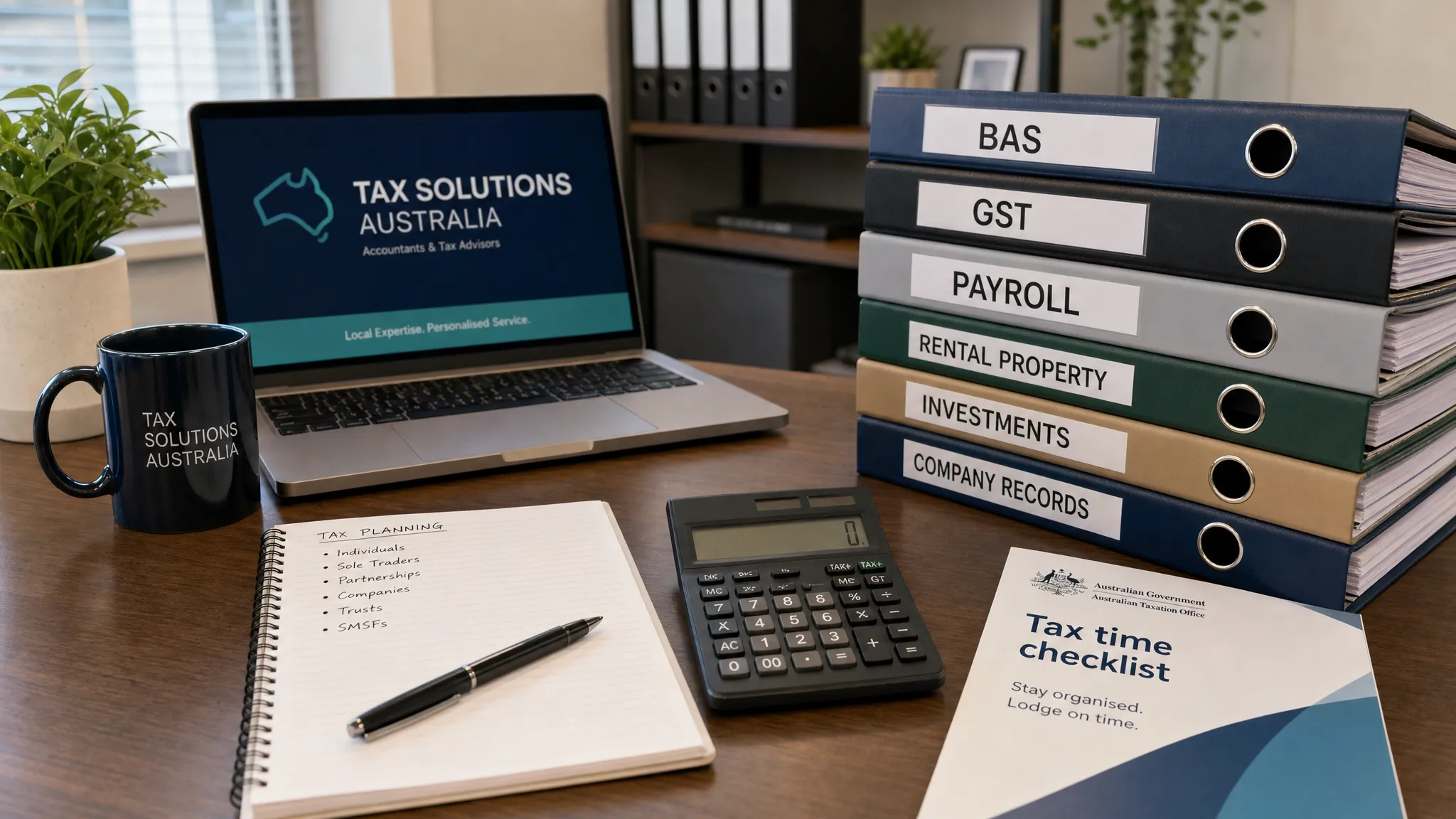
The quality of the advice depends on the quality of the information. We do not need clients to arrive with perfect files, but we do need enough detail to identify gaps, reconcile key balances, and understand the commercial context behind the numbers.
| Area to prepare | What to bring or confirm | Why it matters before lodgement |
|---|---|---|
| Identity and registrations | TFN, ABN, GST status, company or trust details, SMSF details if relevant | Confirms the correct taxpayer, obligations, and lodgement pathway |
| Accounting records | Profit and loss, balance sheet, general ledger, bank reconciliations, loan accounts | Helps verify that financial statements agree with tax positions |
| BAS and GST | BAS lodged, GST reports, GST coding exceptions, adjustments | Reduces the risk of income tax and BAS mismatches |
| Payroll and superannuation | STP finalisation, payroll reports, super clearing house records, contractor details | Confirms wage deductions, PAYG withholding, and super compliance |
| Business assets | Asset purchases, disposals, finance documents, depreciation schedule | Supports depreciation, write-off eligibility, and capital gains treatment |
| Investments and property | Rental statements, loan interest summaries, managed fund reports, dividend statements, crypto records | Ensures all assessable income and deductions are captured correctly |
| Company and trust matters | Director loan accounts, trust distribution minutes, shareholder transactions, inter-entity balances | Identifies Division 7A, trust, and family group issues before lodgement |
| Private use and apportionment | Motor vehicle logs, home office records, mixed-use asset calculations | Supports deductions where expenses have both business and private elements |
| ATO correspondence | Notices, payment arrangements, review letters, prior-year queries | Ensures the current lodgement aligns with ATO expectations and history |
1. Confirm the entity and lodgement position
The first item in any serious tax consultation is not deductions. It is structure.
A sole trader, company, trust, partnership, and SMSF are not just different labels. They have different tax rates, reporting obligations, profit extraction rules, asset protection considerations, and governance requirements. If the structure no longer reflects the way you operate, the tax return may be compliant but strategically weak.
For example, a fast-growing consultant may still be operating as a sole trader even though revenue, risk, contractors, and profit retention now justify reviewing a company or trust structure. A family business may be using a trust but failing to maintain distribution documentation properly. A company director may be drawing funds without clearly distinguishing salary, dividends, expense reimbursements, and loans.
Before lodging, we would typically discuss whether the current structure remains appropriate, whether registrations are correct, whether inter-entity transactions are documented, and whether any changes should be considered for the next income year.
If you operate through a company, it is also worth reviewing broader director issues alongside tax. We have covered this in more detail in our guide to company taxes in Australia.
2. Reconcile income before the ATO does
Income is the first area the ATO is likely to compare against external data. For that reason, your tax consultation should confirm that all income sources have been identified and reconciled.
For individuals and investors, this may include salary and wages, allowances, interest, dividends, managed fund distributions, rental income, foreign income, employee share schemes, capital gains, crypto disposals, and income from side businesses.
For businesses, it may include cash sales, bank deposits, invoices issued, debtor balances, e-commerce sales, platform income, Stripe or PayPal receipts, government grants, insurance proceeds, asset sales, and related-party transactions.
A common error is relying only on bank deposits. That can miss accrued income, year-end debtors, platform fees, foreign receipts, contra transactions, or non-cash benefits. It can also create timing differences between accounting income, GST reporting, and income tax.
Your consultation should ask: does reported income agree to source systems, bank feeds, BAS, payment gateways, and debtor records? Where it does not, there should be a clear explanation.
3. Review deductions for evidence, timing, and commercial logic
A strong deduction strategy is not about claiming the largest possible number. It is about claiming the correct amount, in the correct year, with the correct evidence.
We generally review deductions through three lenses. First, there must be a connection to earning assessable income. Second, the amount must be substantiated. Third, the treatment must be technically correct, especially where the expense may be capital, private, prepaid, or only partly deductible.
Areas that often require deeper review include motor vehicle expenses, home office costs, travel, training, repairs, interest, professional fees, subscriptions, software, bad debts, stock, depreciation, and contractor payments.
For property investors, the distinction between repairs and capital improvements is particularly important. For business owners, the difference between an immediate deduction and a depreciating asset can materially change taxable income. For companies and trusts, related-party payments need to be commercially justifiable and properly documented.
If a claim would be difficult to defend in an ATO review, the better approach is to identify that risk before lodgement. We would rather adjust a position early than have a client face a costly dispute later.
4. Check GST, BAS, PAYG, payroll, and superannuation alignment
For business clients, income tax should not be reviewed in isolation. The annual return should agree with the compliance activity that happened throughout the year.
A pre-lodgement consultation should compare annual revenue against BAS-reported sales, review GST coding, identify private-use adjustments, and check whether GST-free or input-taxed items have been treated correctly. Businesses with cross-border services, imports, exports, property transactions, or mixed supplies should take particular care.
Payroll is another key area. Wages in the accounts should reconcile to STP finalisation, PAYG withholding, superannuation guarantee records, and any contractor reporting obligations. With payday super scheduled to start from 1 July 2026, payroll governance is becoming even more important for Australian employers.
FBT should also be discussed where there are motor vehicles, entertainment, car parking, employee reimbursements, salary packaging, or benefits provided to directors and staff. FBT operates on its own year ending 31 March, but errors often surface during the income tax review.
In our view, bookkeeping and compliance are not back-office tasks. They are the data foundation for strategic advisory, cash-flow control, and corporate growth.
5. Raise director loans, Division 7A, and trust distributions early
Company directors and family groups should use the consultation to address private use of business funds, shareholder loans, and trust distributions before lodging.
Division 7A can apply when private companies provide payments, loans, or forgiven debts to shareholders or their associates. These issues can become expensive if they are not identified early. A director may think they have simply taken drawings, but a company is not a sole trader. The treatment needs to be clear.
Trusts require similar discipline. Distribution resolutions, beneficiary entitlements, unpaid present entitlements, and family group arrangements should be reviewed carefully. A trust can be a powerful structure, but only when the governance is properly maintained.
For high-net-worth individuals and family-owned businesses, these discussions are often more valuable than the tax return itself. They reveal whether the group has clean records, appropriate documentation, and a coherent approach to profit distribution, asset protection, and succession.
6. Cover property, investments, capital gains, and foreign income
If you hold property, shares, crypto assets, managed funds, foreign investments, or business assets, your consultation should include a capital and investment review.
For rental property, we would examine income completeness, loan interest, refinancing, repairs, depreciation reports, capital works, private use, ownership percentages, and disposal events. The ATO continues to scrutinise rental property claims, particularly where interest, repairs, and apportionment are involved.
For share portfolios and managed funds, annual tax statements can include capital gains, foreign income, franking credits, and tax-deferred amounts. These items are not always obvious from cash received. Crypto investors also need transaction-level records, because swapping one asset for another can still trigger a CGT event.
Foreign income should be raised even if tax has already been paid overseas. Australian tax residents are generally taxed on worldwide income, with foreign income tax offset rules potentially applying. If your affairs involve overseas employment, US income, foreign property, or international entities, your pre-lodgement review should be more detailed.
We have discussed cross-border reporting separately in our article on US income and Australian tax.
7. Turn the tax estimate into a cash-flow plan
A tax consultation should not end with a number. It should convert that number into a plan.
Before lodging, business owners and directors should know the expected tax payable or refund, when payment is likely to be due, whether PAYG instalments need review, and how the result affects working capital. If the business has debt, expansion plans, asset purchases, or hiring decisions ahead, the tax outcome should be built into cash-flow forecasting.
This is where tax compliance becomes strategic advisory. The goal is not merely to meet a deadline. The goal is to understand how tax interacts with liquidity, profitability, financing, director remuneration, dividends, and growth.
If a client is facing a large liability, we may discuss ATO payment options, but we prefer to go further. We want to understand why the liability was unexpected. Often the root cause is delayed bookkeeping, poor instalment planning, weak margin reporting, or no rolling forecast.
8. Discuss ATO risk before there is an ATO review
Every tax position carries some level of risk. The issue is whether that risk is understood, documented, and proportionate.
In a pre-lodgement consultation, we look for unusual movements, large deductions, inconsistent margins, unexplained loan balances, GST differences, related-party transactions, late superannuation payments, and claims that are high compared with business activity. These are not automatically wrong, but they should be supported by evidence.
A useful test is simple: if the ATO asked for substantiation tomorrow, could we respond quickly and confidently?
This is also where digital systems matter. Clean accounting data, attached source documents, automated reconciliations, and exception reporting reduce the time required to respond to questions. They also improve the quality of advice because we can focus on interpretation, not data rescue.
For more on avoidable issues, see our article on tax return mistakes that cost Australian business owners.
Questions to ask during your tax consultation
A productive consultation is a two-way discussion. We encourage clients to ask direct questions, especially where they are managing a business, investment portfolio, or multi-entity group.
- Are my accounting records fully reconciled and ready for lodgement?
- Do my BAS, GST, payroll, and income tax records align?
- Which deductions are well supported, and which need more evidence?
- Are there any ATO review risks in my return?
- Are director loans, trust distributions, and related-party balances correctly documented?
- Should my structure be reviewed before the next income year?
- What tax payment, PAYG instalment, or cash-flow issues should I plan for?
- Which parts of my accounting workflow should be automated before next year?
These questions shift the meeting from a compliance appointment to a strategic financial review.
How AI-driven accounting improves the consultation
Traditional tax consultations often rely on historical records that are incomplete, delayed, or manually assembled. That creates friction. It also limits the quality of advice because the accountant spends too much time finding errors and not enough time interpreting the position.
Our approach is different. We use AI-driven automation and digital workflows to help streamline data capture, reconciliation, exception review, and reporting. This allows our team to identify anomalies earlier, improve accuracy, and give clients clearer financial visibility before lodgement.
For directors and business owners, the benefit is practical. You can see tax liabilities developing throughout the year, not after year-end. You can monitor margins, GST, payroll, and cash flow in near real time. You can also build a stronger audit trail because key documents and transactions are captured closer to the point of activity.
Automation does not replace professional judgement. It strengthens it. The technology improves the data; our role is to interpret the data, assess risk, and advise on the commercial decisions behind the numbers.
Next steps before you lodge
If your lodgement date is approaching, we recommend taking five practical steps before your consultation.
- Finalise bookkeeping, bank reconciliations, and loan account reconciliations.
- Gather source documents for major deductions, asset purchases, property expenses, and investment income.
- Review BAS, GST, payroll, superannuation, and STP records for consistency.
- Prepare a list of major business or personal changes, including new entities, asset sales, refinancing, overseas income, or director drawings.
- Ask your adviser for a tax estimate, risk summary, and action plan before approving lodgement.
If your affairs are complex, do not wait until the final week. The earlier we review the position, the more time there is to correct data, locate evidence, resolve entity issues, and plan cash flow.
Frequently Asked Questions
How early should I book a tax consultation before lodging? For straightforward individual returns, a short pre-lodgement review may be enough. For companies, trusts, SMSFs, property investors, or business owners with GST and payroll, we recommend booking as soon as the year-end accounts are substantially complete. Earlier is better if there are director loans, capital gains, foreign income, or ATO correspondence.
Do I need a tax consultation if my bookkeeping is already up to date? Yes. Good bookkeeping improves the process, but it does not replace tax analysis. A consultation reviews the treatment of transactions, substantiation, timing, GST alignment, structure, risk, and cash-flow implications.
Can a tax consultation reduce my ATO review risk? It can reduce avoidable risk by identifying mismatches, unsupported claims, incorrect GST treatment, payroll issues, and unusual balances before lodgement. It cannot guarantee the ATO will not ask questions, but it helps ensure your position is more defensible.
What should company directors discuss before lodging? Directors should discuss salary, dividends, director loans, Division 7A, shareholder transactions, FBT, superannuation, PAYG instalments, retained profits, and cash-flow planning. The company tax return should reflect both compliance and governance.
Can I still do tax planning after 30 June? Some strategies must be completed before 30 June, such as certain superannuation contributions or timing decisions. However, post-year-end planning still matters. You can review evidence, correct accounting treatment, manage lodgement risk, forecast payments, and improve systems for the next income year.
How we can help
Perfect Accounting & Tax Services provides pre-lodgement tax consultation, accounting, BAS, payroll, tax planning, virtual CFO, and strategic advisory support for businesses and individuals across Australia.
Our team combines 25 years of professional experience with AI-driven automation to help clients move beyond reactive tax lodgement. We support clients nationally, with integrated service capabilities across Adelaide, Sydney, and Melbourne.
If you want your next lodgement to be accurate, defensible, and strategically useful, speak with our team before you lodge. Contact Perfect Accounting & Tax Services to book a consultation or learn how our automated accounting workflows can improve compliance, visibility, and corporate growth.