
An expert tax adviser should deliver more than a correct lodgement. Accuracy matters, but it is only the baseline. For business owners, company directors and high-net-worth individuals, the real value lies in how tax advice improves cash flow, strengthens governance and supports better commercial decisions.
In our experience, the strongest tax outcomes are rarely created in the final week before lodgement. They are built through clean records, proactive planning, digital visibility and a disciplined understanding of the ATO risk environment. A tax return, BAS or FBT return should be the end product of a well-managed financial system, not a rushed annual event.
Below, we outline what an expert tax adviser should really deliver, and how we assess whether tax support is genuinely strategic or merely administrative.
Expert tax advice starts with diagnosis, not deduction chasing
A capable adviser does not begin by asking what deductions you want to claim. We begin by understanding your structure, income streams, cash cycle, financing arrangements, asset base and future plans.
For an Australian business, that may include company, trust or partnership structures, GST registration, PAYG withholding, payroll, superannuation, contractor arrangements, Division 7A risks, fringe benefits, cross-border activity and state-based obligations such as payroll tax. For individuals and investors, it may include rental property positions, CGT exposure, SMSF compliance, residency, employee share schemes, private health insurance implications and family group planning.
The aim is to identify what is driving the tax outcome. If we do not understand the commercial model, we cannot provide meaningful tax advice.
This is also where technology changes the quality of the conversation. AI-assisted transaction review, automated reconciliations and digital document capture allow our team to move faster from data collection to analysis. Instead of spending the meeting trying to reconstruct the past, we can focus on what the numbers are telling us.
The adviser should define your tax position clearly
A tax position is not simply the amount payable or refundable. It is the reasoning behind how income, deductions, GST, superannuation, FBT and capital events are treated.
An expert adviser should be able to explain:
- What has been included or excluded, and why.
- Which positions are conservative, commercial or higher risk.
- What records are required to support the treatment.
- Whether the position is consistent with ATO guidance.
- What should change before the next reporting period.
This is particularly important for businesses operating in complex sectors such as construction, property development, e-commerce, professional services, medical practices, logistics, manufacturing and technology. The tax consequences often depend on contract terms, timing, substantiation and whether the accounting system reflects reality.
For a deeper view of how advanced advisers approach complex matters, we have also explained what sets expert tax accountants apart in complex matters.
Compliance should become the foundation for strategic advisory
We see compliance as a foundation, not the destination. BAS lodgements, tax returns, payroll, superannuation and bookkeeping must be correct, but their greater value is the insight they create.
When financial information is timely and accurate, we can identify margin compression, rising debtor days, seasonal working capital pressure, underpriced services, inefficient entity structures and tax instalment issues before they become urgent.
This is why modern tax support should include an advisory rhythm. The adviser should not disappear after lodgement and reappear when the next deadline approaches. There should be planned conversations around profitability, capital expenditure, debt, hiring, dividends, trust distributions, asset sales and expansion.
If your current arrangement is largely transactional, our article on when a tax professional becomes a strategic advantage outlines how to think beyond basic compliance.
Cash flow forecasting is a core tax deliverable
Many profitable businesses still experience tax stress because obligations are not forecast early enough. A tax adviser should help you see future liabilities before they arrive.
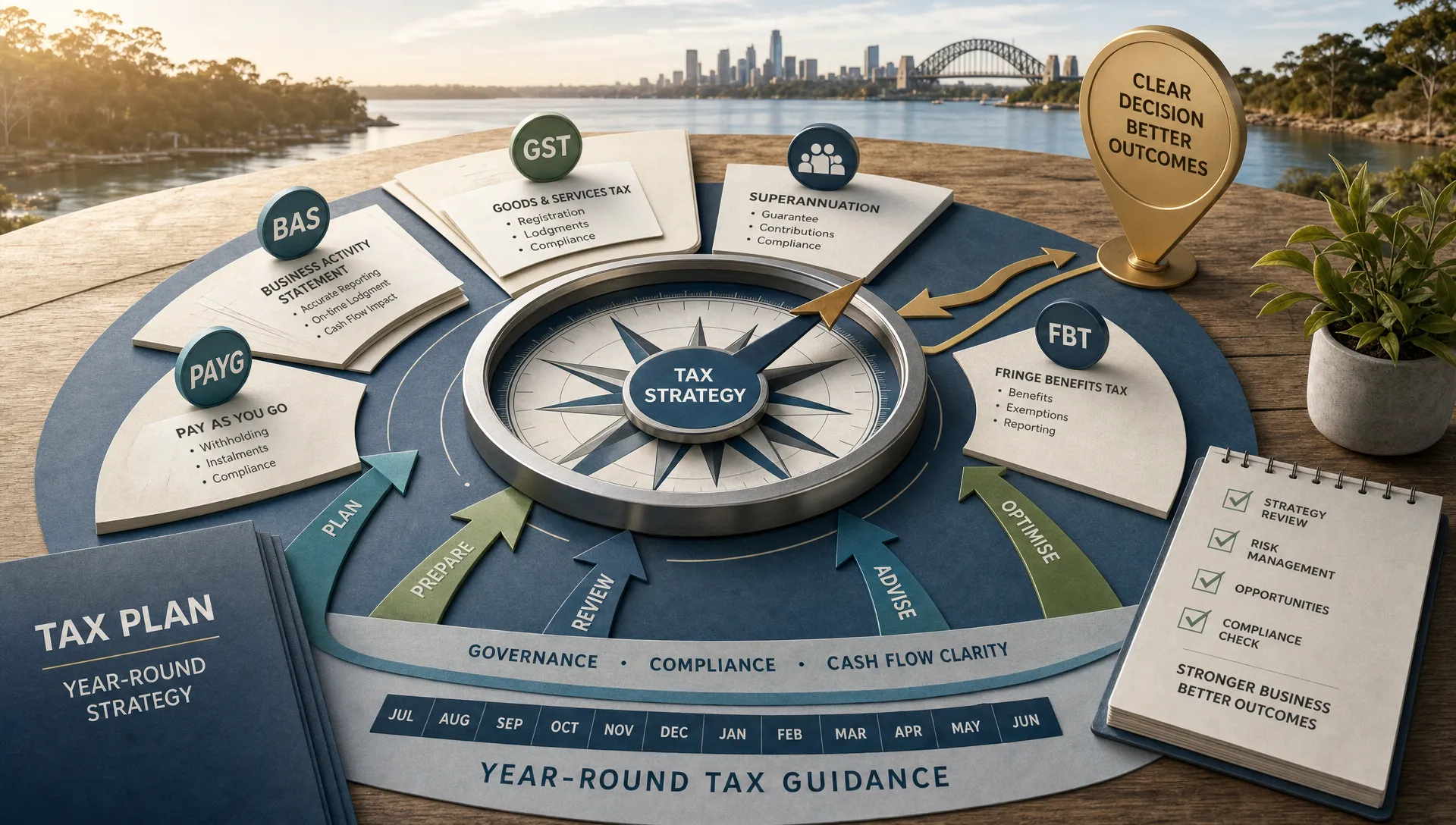
For Australian businesses, this usually means monitoring GST, PAYG instalments, PAYG withholding, superannuation guarantee, income tax, FBT and, where relevant, payroll tax. For directors, it may also include understanding how drawings, loans, dividends and trust distributions affect personal tax and corporate cash reserves.
A strong adviser should connect tax planning to cash flow planning. For example, if a business is scaling quickly, the GST and payroll obligations may rise before cash collections stabilise. If a property investor sells an asset, CGT planning should occur before exchange where possible, not months after settlement. If a company director relies on shareholder loans, Division 7A planning should be addressed before year-end.
The deliverable is not just a calculation. It is a decision framework that helps you retain enough cash, time payments appropriately and avoid unnecessary pressure.
What a genuine expert tax adviser should deliver
The difference between basic tax support and expert tax advisory becomes clear when we look at tangible outputs. A quality engagement should produce more than a lodged form.
| Deliverable | What it should achieve | Why it matters |
|---|---|---|
| Tax position review | Clarify how income, deductions, GST and capital events are treated | Reduces uncertainty and improves ATO defensibility |
| Risk register | Identify exposures such as substantiation gaps, Division 7A, FBT, GST errors or contractor issues | Helps directors act before problems escalate |
| Cash flow forecast | Estimate future tax, BAS, superannuation and payroll obligations | Prevents surprise liabilities and improves funding decisions |
| Entity structure assessment | Review whether the current structure suits growth, asset protection and succession goals | Aligns tax planning with commercial strategy |
| Year-end planning session | Consider timing of income, deductions, distributions, dividends and capital expenditure | Supports lawful and commercially sound tax optimisation |
| Digital workflow review | Improve document capture, reconciliations and reporting cadence | Creates faster, cleaner data for better advisory decisions |
This level of output is especially important for directors and owners who need to make decisions under time pressure. The adviser should convert complex rules into clear options, practical implications and accountable next steps.
Tax planning should be commercial, not artificial
Effective tax planning is not about aggressive schemes or artificial arrangements. It is about lawful structuring, timing, documentation and alignment between tax treatment and commercial purpose.
In practice, this may include reviewing business structure before expansion, planning for asset purchases, assessing the tax effect of borrowing, managing trust distributions, considering CGT events, preparing for business sale, reviewing FBT exposure or ensuring directors understand the tax consequences of extracting profits.
For growing businesses, tax planning should also connect to customer acquisition, pricing and investment decisions. If a professional services firm, e-commerce brand or agency is investing heavily in growth, the adviser should understand how marketing spend affects cash flow, GST credits, profit forecasts and tax instalments. For example, businesses using managed digital growth support such as BrandBuilder's Collective should ensure campaign investment is reflected properly in management reporting and tax planning.
The same principle applies to technology spend, software subscriptions, offshore contractors, inventory, property improvements and research activity. The tax treatment must follow the evidence, the contracts and the commercial facts.
Governance and documentation are part of the service
An expert tax adviser should help directors and trustees build defensible processes. Good governance is not only for large corporates. It matters for SMEs, family groups, SMSF trustees and private investment structures.
That governance may include board minutes, trustee resolutions, director loan documentation, employee versus contractor assessments, asset registers, depreciation schedules, loan agreements, reimbursement policies and consistent record-keeping procedures.
In our work, documentation is often where risk is reduced. A technically correct position can still fail if the records are incomplete or inconsistent. Conversely, strong documentation can make ATO queries easier to resolve because the commercial reasoning is already clear.
This is one reason we support digital workflows. Automated document capture, structured approval processes and exception reporting reduce the likelihood of missing invoices, duplicated expenses or unsupported claims. They also create a stronger audit trail.
The adviser should understand your stage of growth
Tax advice should change as your business or asset base changes. A sole trader moving into a company structure needs different guidance from a national business managing multiple payroll locations. A first-time property investor has different risks from a developer, SMSF trustee or high-net-worth family group.
For early-stage businesses, the priority may be registration, GST, bookkeeping discipline, pricing and cash flow. For scaling companies, the focus often shifts to payroll, reporting, tax instalments, internal controls, funding and governance. For mature or exit-focused businesses, the adviser should consider succession, asset protection, CGT, business sale readiness and wealth transfer.
This is why we believe a tax adviser should act as part of the broader strategic framework. The question is not only what is deductible. The better question is whether the financial structure supports the next three to five years.
If you are assessing providers, our guidance on how to choose a tax accountant in Australia explains the importance of registration, relevant expertise and year-round advisory support.
Red flags that your tax advice is too reactive
A tax adviser does not need to overcomplicate the relationship. However, there are signs the service may not be giving you enough strategic value.
Common warning signs include:
- You only hear from the adviser close to lodgement deadlines.
- BAS, payroll and income tax are treated as separate issues rather than connected cash flow obligations.
- You receive little explanation of the assumptions behind your tax position.
- Your accounting file is not reviewed for data quality before advice is provided.
- No one discusses ATO risk areas relevant to your industry or structure.
- Tax planning happens after 30 June, when many options have already closed.
- You do not receive clear next steps after meetings.
The issue is not whether the adviser is busy. The issue is whether the advice helps you make better decisions before deadlines create pressure.
How AI-driven workflows improve expert tax advice
Digital transformation does not replace professional judgement. It improves the evidence base for that judgement.
Our team uses automation and AI-driven processes to streamline repetitive work, identify anomalies and improve the speed of review. That allows more time for analysis, forecasting and strategic advisory. The benefit for clients is greater visibility, faster turnaround and fewer avoidable errors.
For example, automated bank feeds and rule-based processing can support cleaner reconciliations. Exception reporting can highlight unusual transactions. Digital document capture can improve substantiation. Real-time reporting can help directors understand tax exposure during the year rather than after year-end.
This matters across Australia, particularly for clients operating across multiple locations. Our integrated service capability supports businesses and private clients in Adelaide, Sydney, Melbourne and beyond, with consistent processes and local understanding.
What directors and high-net-worth individuals should expect
For directors and high-net-worth individuals, tax advice often overlaps with governance, investment strategy and risk management. The adviser should understand both the personal and entity-level consequences of decisions.
A director may need advice on salary versus dividends, superannuation contributions, shareholder loans, company vehicles, FBT and succession planning. A property investor may need support with CGT, GST on property transactions, land tax considerations, depreciation and financing structures. An SMSF trustee must manage strict compliance obligations, investment strategy documentation and contribution rules.
The adviser should also coordinate effectively with lawyers, finance brokers, financial advisers and other specialists where appropriate. Tax decisions rarely sit in isolation. Poor coordination can create inconsistent documents, duplicated advice or missed timing opportunities.
Questions to ask an expert tax adviser before engaging them
Before choosing an adviser, we recommend asking questions that test process, judgement and accountability.
| Question | What a strong answer should show |
|---|---|
| How do you identify tax risks before lodgement? | A structured review process, not a last-minute checklist |
| How do you use technology in your workflow? | Automation that improves accuracy, speed and visibility |
| How often will we review tax cash flow? | A proactive cadence aligned to BAS, payroll and year-end planning |
| What industries or structures do you regularly advise? | Relevant experience with comparable complexity |
| How do you document advice and decisions? | Clear records that support governance and ATO defensibility |
| How do you connect tax advice to growth strategy? | Commercial thinking beyond compliance |
The best responses will be specific. If the adviser cannot explain their process, the service may depend too heavily on individual memory rather than a reliable advisory system.
Frequently Asked Questions
What is the difference between a tax accountant and an expert tax adviser? A tax accountant may focus mainly on preparing and lodging returns. An expert tax adviser should also assess structure, risk, cash flow, governance and future planning. In practice, the strongest advisers combine technical tax capability with commercial strategy.
Should tax advice happen before or after 30 June? Important planning should usually happen before 30 June, because many timing, contribution, distribution and expenditure decisions must be made within the relevant financial year. Post-year-end advice is still valuable, but it may be more limited.
How does automation improve tax advice? Automation improves the quality and speed of data capture, reconciliation and review. It allows advisers to spend less time cleaning records and more time interpreting results, identifying risk and advising on strategy.
Do high-net-worth individuals need business-style tax advisory? Often, yes. Complex investment portfolios, trusts, companies, SMSFs, property interests and cross-border issues can require the same level of governance and forecasting as a business group.
Can an expert tax adviser help with ATO reviews or audits? Yes, an experienced adviser should help assess the issue, organise supporting records, explain the tax position and manage communication with the ATO. Strong documentation before an audit is always preferable to reconstructing records later.
Next steps: how we can help
An expert tax adviser should deliver clarity, foresight and disciplined execution. Lodgement is important, but the greater value is a stronger financial system that supports growth, protects cash flow and reduces avoidable risk.
At Perfect Accounting & Tax Services, we combine 25 years of professional experience with AI-driven automation, strategic advisory and Australian tax expertise. Our team supports business owners, company directors, SMSF trustees and high-net-worth individuals across Adelaide, Sydney, Melbourne and nationally.
If you want tax advice that goes beyond annual compliance, we can review your current workflow, identify risk areas and show how automated accounting processes can improve accuracy and real-time financial visibility.
Contact our team for a consultation and learn how our strategic tax and accounting support can help you build a more resilient, growth-ready financial position.