

For a complex Australian tax return, the most important tax documents are not simply the receipts with the largest dollar values. They are the records that prove the commercial story behind the numbers.
For business owners, company directors, investors and high-net-worth individuals, the ATO is not only looking at totals. It may examine how income was derived, whether GST was treated correctly, whether private and business use were separated, whether trust distributions were valid, and whether capital gains have been calculated from a defensible cost base.
After 25 years advising Australian clients, we view document preparation as more than compliance. It is the foundation for strategic advisory, better cash flow decisions, cleaner governance and stronger corporate growth. When the right tax documents are captured, classified and reconciled early, the tax return becomes a financial management tool rather than an annual scramble.
Why document quality matters more in complex returns
A simple salary-and-interest return may rely on pre-filled ATO data and a small number of deductions. A complex return is different. It often involves companies, trusts, SMSFs, investment properties, cross-border income, business assets, payroll, GST, FBT or capital gains tax events.
The ATO increasingly uses data matching, Single Touch Payroll, bank information, property data, share registry data and other third-party reporting to identify inconsistencies. The issue is not whether the ATO can see some of the information. The issue is whether your records explain the full position accurately.
Strong documentation helps answer four questions:
- Was the income completely reported?
- Was the deduction genuinely incurred and connected to assessable income?
- Was the transaction treated correctly for GST, CGT, FBT, payroll and superannuation?
- Does the entity structure support the way profits, losses, assets and liabilities have been reported?
The ATO’s record keeping guidance makes it clear that records must generally explain all transactions and be kept in a form that can be accessed when required. For complex taxpayers, we recommend going further: records should also be organised so they support advisory decisions during the year, not only after 30 June.
The highest-priority tax documents for complex returns
The best way to prioritise tax documents is to focus on risk and materiality. A $200 office supply receipt matters less than a trust distribution resolution, a Division 7A loan agreement, a property settlement statement or a BAS reconciliation that affects GST reporting across the year.
The following document categories usually carry the most weight.
| Document category | Why it matters | Common risk if missing or incomplete |
|---|---|---|
| Entity structure and governance records | Proves who owns what, who controls decisions and how profits are allocated | Incorrect trust distributions, director loan issues or unsupported ownership positions |
| Income and sales records | Confirms all assessable income has been captured | Underreported revenue, unreconciled platform income or GST discrepancies |
| BAS, GST and payroll records | Links tax return figures to activity statements and employee obligations | Mismatched GST, PAYG withholding or superannuation reporting |
| Asset and CGT records | Establishes cost base, proceeds, timing and tax treatment | Overpaid tax, denied losses or unsupported capital gains calculations |
| Loan and finance documents | Separates deductible, private and capital components | Incorrect interest deductions or poor tracing of borrowed funds |
| Trust, SMSF and investment records | Supports distributions, member balances, contributions and investment income | Invalid distributions, contribution cap issues or incomplete income reporting |
Entity structure documents: the starting point for complex advice
Before we review income and deductions, we want to understand the legal and tax structure. Many complex return errors begin with unclear ownership, outdated trust documents or informal arrangements between related parties.
For companies, key records may include ASIC company details, share registers, shareholder agreements, director minutes, loan agreements and records of dividends or franking credits. For family groups, we also look closely at related-party transactions and director loan accounts, especially where Division 7A may apply.
For trusts, the trust deed is essential. So are deed variations, trustee resolutions, distribution minutes, beneficiary details and records of unpaid present entitlements. A trust distribution that is not properly documented before the relevant deadline can create significant tax consequences.
For SMSFs, documentation must support both tax and regulatory compliance. This may include the SMSF trust deed, investment strategy, member statements, contribution records, pension documentation, actuarial certificates where relevant, and evidence supporting related-party transactions.
These documents help us move beyond lodgement and into strategy. If your structure is no longer aligned with growth, succession, asset protection or financing plans, the tax return process can reveal that early.
Income documents: complete, reconciled and source-specific
Complex taxpayers often receive income from multiple channels. A company may have direct invoices, e-commerce sales, marketplace revenue, rental income, interest, dividends and grants. A high-net-worth individual may receive trust distributions, managed fund income, foreign income, employee share scheme income and capital gains.
The most useful income documents include customer invoices, sales summaries, bank statements, merchant facility reports, platform statements, rental statements, dividend statements, trust distribution statements, managed fund tax statements and foreign income summaries.
For digital businesses, we also look for source platform exports. E-commerce, SaaS, content creator and gig economy income should be reconciled back to bank receipts and accounting software. Gross platform revenue, fees, refunds, GST and net deposits are not the same thing.
Where foreign income is involved, we need both the Australian dollar conversion basis and evidence of any foreign tax paid. This is particularly important for Australian tax residents, who may need to report worldwide income.
A pre-lodgement review should identify these income streams before the return is prepared. We have outlined the broader strategic conversation in our guide on what to cover in a tax consultation before you lodge.
BAS, GST, payroll and superannuation records
For businesses registered for GST, the income tax return should not be prepared in isolation from BAS records. We compare annual revenue, GST collected, GST credits, PAYG withholding, wages, superannuation and accounting profit to identify inconsistencies before lodgement.
Important records include lodged BAS, GST reconciliation reports, tax invoices, adjustment notes, payroll reports, Single Touch Payroll finalisation reports, superannuation payment confirmations, contractor payment records and PAYG withholding summaries.
Payroll documentation is particularly important where a business has directors, related-party employees, contractors or workers across multiple states. Misclassifying workers can create superannuation, payroll tax, PAYG withholding and workers compensation issues.
Superannuation records should show not only the accrued expense but also when contributions were paid. Timing matters because employer superannuation contributions are generally deductible only when paid to the employee’s super fund by the required date.
FBT should also be considered where motor vehicles, entertainment, car parking, living-away-from-home arrangements or employee benefits are provided. A vehicle logbook, employee declarations and benefit calculations can materially affect the tax position.
Deduction evidence: substantiation, purpose and apportionment
For complex returns, deduction evidence is not just about keeping receipts. It is about proving the connection between the expense and assessable income, and applying the correct apportionment where private use exists.
Bank statements alone are often not enough. They may show that money was spent, but not what was purchased or why it was deductible. We generally prefer tax invoices, contracts, statements, usage records and business purpose notes.
| Expense area | Documents that matter most | Strategic point to review |
|---|---|---|
| Motor vehicles | Logbook, odometer records, fuel and maintenance invoices, finance documents | Whether the method used reflects actual business use |
| Travel and accommodation | Itineraries, invoices, diary notes, conference agendas, business purpose records | Whether private components have been excluded |
| Home office and remote work | Usage records, floor area calculations, internet and electricity evidence | Whether the claim is consistent and supportable |
| Professional fees | Engagement letters, invoices, payment records | Whether costs are deductible now or capital in nature |
| Repairs and maintenance | Invoices, inspection reports, photos, asset history | Whether the expense is a repair, improvement or capital asset |
| Interest and borrowing costs | Loan agreements, refinance documents, statements, fund tracing | Whether borrowed funds were used for income-producing purposes |
This is where digital workflows create a measurable advantage. When invoices, receipts and bank transactions are captured in real time, we can classify expenses earlier, identify missing evidence and reduce the risk of year-end reconstruction.
Property, asset and CGT documents
Property investors, developers and business owners with substantial assets need robust capital gains tax records. The cost base of an asset may include more than the purchase price. It can include certain incidental costs, capital improvements and ownership costs, depending on the asset and circumstances.
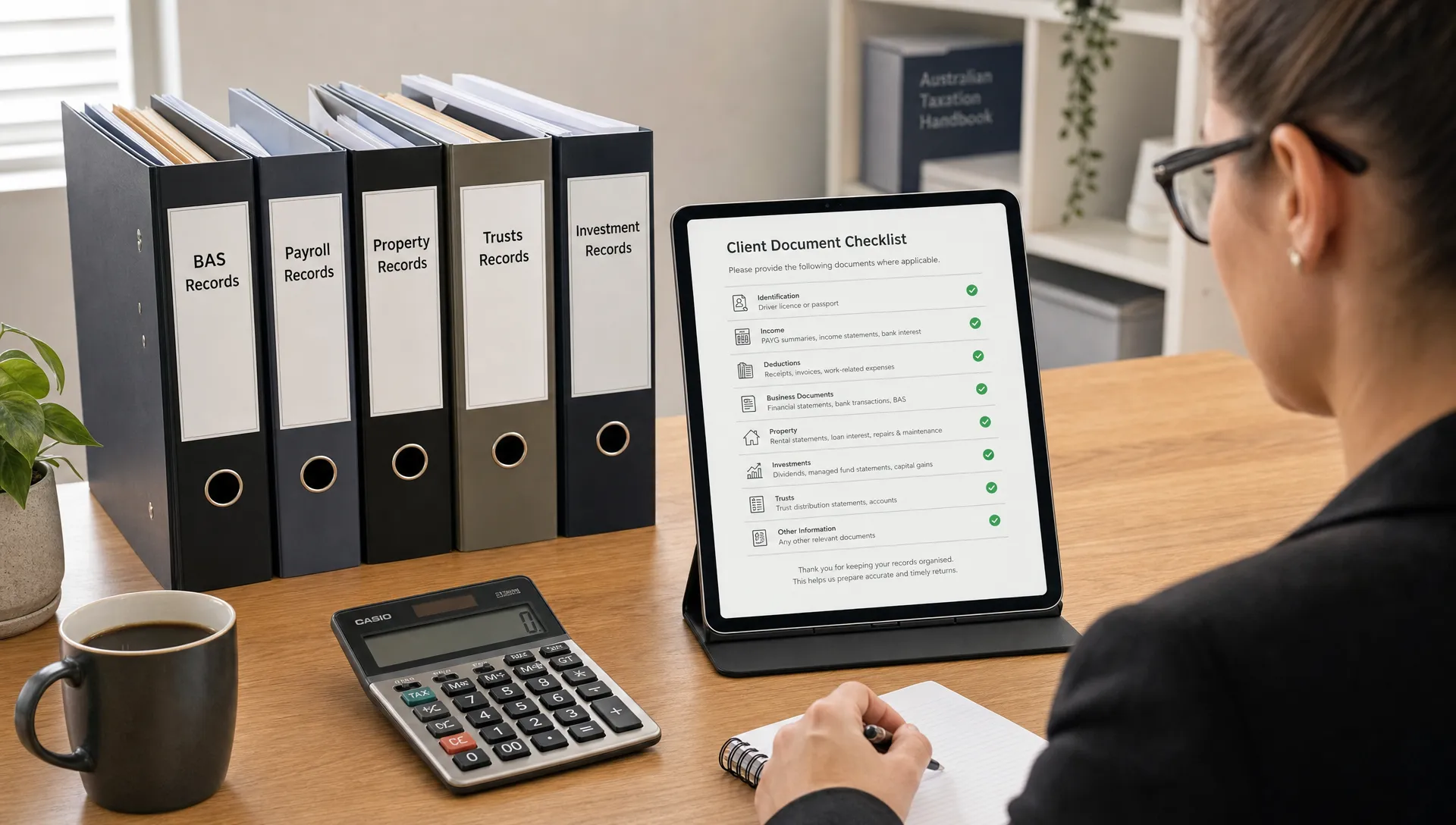
For property, important documents include purchase contracts, settlement statements, stamp duty records, legal invoices, borrowing cost details, depreciation schedules, lease agreements, property manager statements, repair invoices, improvement invoices, council rates, land tax notices and sale contracts.
For property development or substantial renovations, we also need to consider whether the activity is on capital account, revenue account or part of an enterprise for GST purposes. This distinction can materially change the tax outcome.
For shares and managed investments, records should include contract notes, dividend statements, dividend reinvestment plan records, corporate action notices and annual tax statements. Managed fund tax statements are especially important because they may split income into different components, including capital gains, foreign income and franking credits.
For crypto assets, we look for exchange transaction histories, wallet records, transfer records, staking income reports, disposal calculations and Australian dollar values at the time of each transaction. Crypto-to-crypto swaps can still be CGT events, so a simple year-end balance is not sufficient.
Because CGT records may be needed long after the original purchase, document retention is critical. Our guide on how long to keep tax records in Australia explains why some records should be kept beyond the standard period.
Trust distribution, beneficiary and family group documents
Trusts remain common in Australian business and investment structures, but they demand disciplined documentation. The ATO expects trust distributions to be supported by the trust deed and valid trustee resolutions.
The key documents usually include the trust deed, prior variations, annual distribution resolutions, beneficiary statements, trustee minutes, financial statements, tax returns, loan account reconciliations and evidence of payments or unpaid present entitlements.
Where a family trust election or interposed entity election is relevant, those records should also be kept and reviewed. If distributions are made across a family group, we need to assess the tax profile of beneficiaries, cash flow, Division 7A exposure and future succession objectives.
This is a prime example of compliance becoming strategy. A trust return is not merely an allocation exercise. It affects wealth transfer, asset protection, working capital, tax risk and family governance.
Loan, refinance and related-party records
Interest deductions are often high-value and high-risk. The purpose of borrowed funds matters. If a loan is refinanced, split, redrawn or used partly for private purposes, clean documentation becomes essential.
For each loan, we prefer to see the loan agreement, settlement statement, statements for the full year, refinance documents, redraw records and evidence showing how funds were applied. For related-party loans, written agreements, repayment schedules and commercial terms are important.
For companies and trusts, director loan accounts should be reconciled before lodgement. Unreconciled drawings, private expenses paid by the company, or payments made on behalf of shareholders can trigger issues that need to be addressed before returns are finalised.
Documents that support strategic advisory
Some documents do not directly attach to a tax return but are still highly valuable. They help us identify tax planning opportunities, cash flow pressure, financing constraints and growth risks.
These include management accounts, budgets, cash flow forecasts, board papers, acquisition documents, shareholder agreements, business sale discussions, insurance summaries and asset protection reviews.
When we provide strategic advisory or virtual CFO support, these records allow us to connect tax outcomes with commercial decisions. For example, a tax loss may be less important than understanding whether margins are deteriorating, working capital is tightening or the business is undercapitalised for growth.
This is why we encourage clients to treat tax document preparation as part of an integrated finance function. Our national team supports clients across Australia, with coordinated capability in Adelaide, Sydney and Melbourne, so multi-entity and cross-state groups can maintain consistent reporting standards.
How AI-driven workflows improve document accuracy
Manual document collection is one of the biggest causes of late, incomplete or inconsistent returns. It also consumes time that could be used for analysis.
Our AI-driven accounting workflows help streamline document capture, classification and reconciliation. In practical terms, this means documents can be reviewed faster, anomalies can be flagged earlier and financial information can be made more visible throughout the year.
Human judgement remains essential. Automation does not replace strategic tax advice. It improves the quality and speed of the evidence base, so our team can focus on higher-value questions such as structure, risk, cash flow, tax planning and growth.
For complex matters, this distinction matters. The right technology helps identify what is missing. Experienced advisers determine what it means.
A practical priority framework before lodgement
If you are preparing for a complex return, we recommend ranking documents in three levels.
Priority 1: documents that can change the tax outcome
These include trust resolutions, company loan records, CGT cost base documents, BAS reconciliations, payroll and superannuation records, property settlement statements, finance documents and foreign income records. If these are wrong or missing, the return may be materially incorrect.
Priority 2: documents that substantiate high-value claims
These include invoices, contracts, vehicle logbooks, travel records, home office calculations, depreciation schedules, repairs evidence, professional fee invoices and investment statements. They support deductions and reduce audit exposure.
Priority 3: documents that improve advisory quality
These include budgets, forecasts, board minutes, business plans, asset protection documents and succession plans. They may not all be required for lodgement, but they help convert compliance into strategic decision-making.
If your return involves multiple entities, significant assets or ATO risk, engaging the right adviser can make a material difference. We discuss this further in our article on what sets expert tax accountants apart in complex matters.
Common document gaps we see in complex returns
The same issues appear repeatedly across business groups and private wealth clients. Trust minutes are prepared late or do not match the deed. BAS figures do not reconcile to the income tax return. Asset purchases are recorded without settlement adjustments. Director loan accounts are not reviewed until after year-end. Crypto transactions are summarised without disposal-level evidence.
These gaps are avoidable. The solution is not simply asking for more documents. The solution is building a workflow that captures the right documents at the right time and connects them to the financial accounts.
That is where a tech-forward finance function becomes valuable. When bookkeeping, tax compliance and advisory are integrated, documents are no longer a year-end burden. They become live evidence supporting better decisions.
Frequently Asked Questions
What are the most important tax documents for a complex Australian return? The most important documents are those that affect income completeness, deduction substantiation, GST, payroll, superannuation, CGT, trust distributions, company loans and entity structure. Examples include BAS reconciliations, trust resolutions, loan agreements, settlement statements, payroll records and investment tax statements.
Are bank statements enough to claim business deductions? Usually not on their own. A bank statement may prove payment, but it rarely proves the nature of the expense, the supplier, GST treatment or business purpose. Tax invoices, contracts and supporting records are usually stronger evidence.
How early should we prepare tax documents for a complex return? We recommend preparing progressively throughout the financial year, with a formal pre-lodgement review soon after year-end. Trust distributions, payroll finalisation, superannuation payments and year-end tax planning should be addressed before deadlines arise.
Do digital records satisfy ATO requirements? Digital records can satisfy ATO requirements if they are accurate, accessible, securely stored and able to explain the relevant transactions. We recommend structured digital document workflows rather than ad hoc folders or email trails.
When should a business seek professional help with tax documents? Seek professional help when your return involves companies, trusts, SMSFs, property transactions, foreign income, crypto assets, employee benefits, payroll complexity, ATO queries or material capital gains. Complexity increases both opportunity and risk.
Next steps: turn tax documents into strategic financial visibility
If your return is complex, do not wait until lodgement season to discover missing evidence. Start with the documents that influence tax outcomes, then build a digital workflow that keeps those records current throughout the year.
Our team at Perfect Accounting & Tax Services assists business owners, company directors and high-net-worth individuals across Australia with complex tax returns, BAS, payroll, SMSF compliance, virtual CFO support and strategic advisory. We combine experienced Australian tax judgement with AI-driven automation to improve accuracy, speed and real-time financial visibility.
To prepare your next return with greater confidence, contact our team for a consultation. We can review your current tax documents, identify gaps before they become ATO issues, and show how automated accounting workflows can support stronger compliance and corporate growth across Adelaide, Sydney, Melbourne and beyond.