

Choosing a tax expert for a deceased estate requires more than finding someone who can lodge a return. We look for the ability to distinguish the deceased person’s obligations from the estate’s, identify risks before assets are distributed and coordinate with the executor’s solicitor. For business owners, directors and families with substantial assets, those distinctions can materially affect cash flow and beneficiary outcomes.
Australia has no inheritance or estate tax. However, income tax, capital gains tax (CGT) and tax on certain superannuation death benefits can still arise. We recommend assessing an adviser against the actual assets, structures and decisions involved, rather than their job title alone.
Establish what the estate actually needs
We start by separating three areas that families often group together: legal estate administration, tax compliance and decisions about retaining or selling assets.
Probate, the interpretation of a will and disputes between beneficiaries require appropriate legal advice. Tax work concerns matters such as outstanding returns, income earned during administration and the consequences of asset disposals. Investment recommendations may require a suitably licensed financial adviser.
One professional does not necessarily cover every area. We favour an engagement that identifies who owns each responsibility and how advice will be coordinated. That becomes particularly important where an estate includes a private company, investment properties, an SMSF or overseas assets.
Check the credentials behind your tax expert
For paid tax return preparation and tax-agent representation, we verify that the responsible provider holds appropriate registration with the Tax Practitioners Board (TPB). We recommend checking the TPB public register, rather than relying solely on a website badge or professional title.
Chartered Accountant or CPA qualifications can provide useful evidence of professional training. They do not replace registration requirements or establish experience with deceased estates.
We would also establish who will undertake the work, who will review it and whether specialist advice is needed. A senior practitioner appearing at the initial meeting does not necessarily mean they will supervise every technical decision.
Ask for an anonymised explanation of a comparable engagement. A useful answer should describe the issues identified, the reasoning applied and the limits of the adviser’s role, without disclosing another client’s confidential information.
Test their knowledge of estate-specific tax risks
Separate the final individual return from estate obligations
We expect a tax expert to explain the distinction between the deceased person’s final individual return and any returns required for the deceased estate. These involve different taxpayers, reporting periods and administrative requirements.
The review should address outstanding earlier returns, income up to the date of death and income received during administration. Depending on its circumstances, the estate may require its own tax file number (TFN) and trust tax returns.
The ATO’s deceased estate guidance explains these separate responsibilities. Concessional treatment may apply to an eligible estate during its first three income years, but that is not a blanket exemption. The first income year can be only part of a year.
We also expect the adviser to examine the administration stage and beneficiaries’ entitlements before deciding how estate income should be assessed.
Examine property and investment cost bases
Inherited assets do not all receive the same CGT treatment. We assess an adviser’s ability to distinguish pre-CGT assets, post-CGT assets, a deceased person’s main residence and income-producing property.
For an eligible inherited dwelling, a two-year disposal period can be relevant to the main residence exemption. That period generally runs from death, not the grant of probate, and settlement timing matters. Eligibility conditions and any available extension need individual assessment.
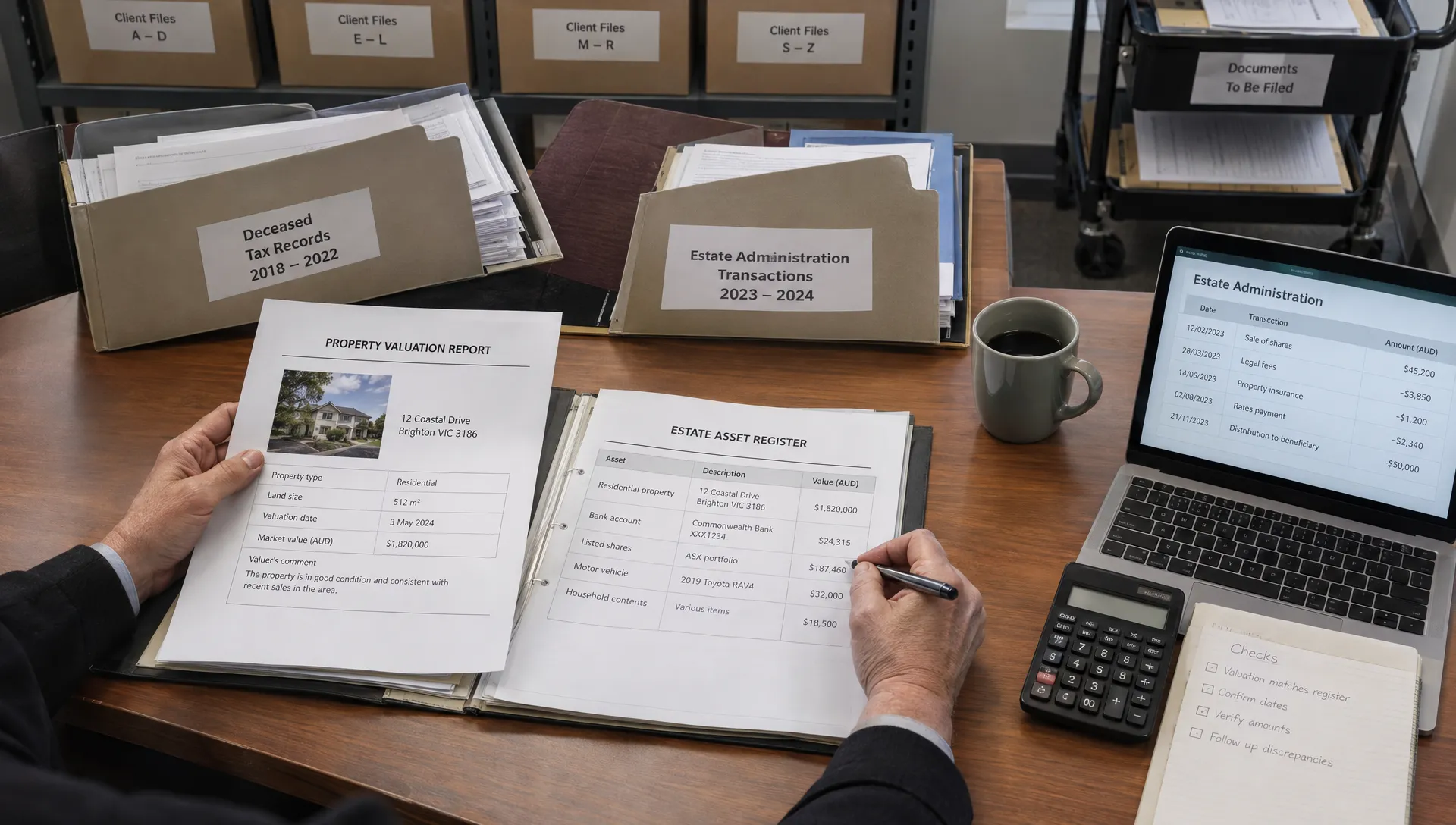
We would ask which acquisition records, improvement costs and valuations are required before a property is sold. A date-of-death valuation can be important in some circumstances, but it is not automatically the correct cost base for every asset.
The practical test is whether the adviser requests evidence early enough to influence the decision, rather than reconstructing the position after settlement.
Understand superannuation and beneficiary differences
A capable tax expert should distinguish a dependant under superannuation law from a death benefits dependant under tax law. The definitions are not identical, and an adult child is not automatically a tax dependant.
We expect the review to consider the recipient, the benefit’s components and whether payment is made directly or through the estate. Superannuation also does not automatically form part of the estate simply because the deceased left a will.
For an SMSF, the tax adviser should coordinate with the relevant legal and superannuation specialists on trustee arrangements, governing documents and death benefit requirements. We would be cautious about appointing anyone who treats superannuation as an ordinary bank account awaiting distribution.
Require coordination for businesses, trusts and overseas assets
Where the deceased controlled a business or family structure, we look beyond the assets listed in the will. A company’s assets belong to the company, while trust assets are not automatically owned personally by the deceased. Share ownership, director roles, trustee arrangements and succession provisions need separate examination.
We would ask a prospective tax expert how they identify continuity risks and work with the solicitor before control changes occur. If operations continue, BAS, GST, payroll, superannuation and FBT obligations may also continue where applicable. A death does not automatically end the entity’s compliance responsibilities.
For overseas assets or non-resident beneficiaries, we expect the adviser to identify when foreign advice is required. Australia’s lack of inheritance tax does not remove another jurisdiction’s estate or inheritance tax rules. Residency, foreign reporting and cross-border transfers should be reviewed before implementation.
Assess digital controls, not just the software
We view reliable bookkeeping as the foundation for strategic advisory and financial health. During estate administration, reconciled records help establish available cash, outstanding liabilities and the evidence supporting proposed distributions.
Our AI-driven approach is designed to improve accuracy, speed and real-time financial visibility through streamlined workflows. Professional judgement remains essential, particularly when records contain transactions spanning the date of death or transfers between related entities.
When assessing a provider, we ask how automated outputs are checked against source documents. Transaction categorisation should not determine a legal entitlement, a tax cost base or whether an expense is deductible without review.
A tax expert should also explain how sensitive documents are collected, who can access them and how authority to act is verified. Our guide to assessing a tax provider’s data protection and ATO safeguards provides a broader framework for these checks.
We distinguish current accounting visibility from asset valuation. An up-to-date ledger does not replace a properly supported valuation where one is required.
Compare written scope and fees before appointing anyone
We recommend comparing proposals by responsibilities and deliverables, not simply by the quoted total. A low-cost return preparation engagement may exclude the asset review, beneficiary analysis or solicitor coordination that the estate actually needs.
Before appointing a tax expert, we would request a written scope covering the following areas:
| Area | What we would seek in the proposal | Why it matters |
|---|---|---|
| Taxpayer coverage | Identification of the individual, estate and any related entities included | Prevents gaps between separate obligations |
| Technical review | Specified property, investment and superannuation issues to be assessed | Clarifies whether advice extends beyond lodgement |
| Deliverables | Written advice, calculations, returns and an obligations timetable | Makes the work reviewable and actionable |
| Coordination | Responsibility for communication with the executor, solicitor and other advisers | Reduces conflicting instructions |
| Fees and variations | Pricing basis, assumptions and approval process for additional work | Makes costs easier to manage |
We also establish who is authorised to instruct the adviser and how fees will be approved. A beneficiary requesting information may not have the same authority as the legal personal representative.
Professional indemnity insurance, conflict checks and the complaints process are worth confirming. Where beneficiaries’ interests differ, the engagement should make clear whom the adviser represents and when separate advice is needed.
Ask questions that reveal how the adviser works
We use scenario-based questions to assess whether a prospective tax expert can turn technical knowledge into a workable administration plan. Useful questions include:
- “Which decisions should wait for advice?” We would expect the adviser to identify relevant property sales, superannuation payments, business changes or distributions, rather than recommending a blanket delay.
- “What evidence do you need before calculating tax?” The response should connect document requests to the estate’s actual assets and transactions.
- “How will we know what funds must be retained?” We look for a process to estimate liabilities, update calculations and distinguish provisional figures from final amounts.
- “When will you involve another specialist?” A credible adviser should recognise the boundaries of their competence and explain the referral process.
We treat guaranteed “tax-free inheritance” outcomes, pressure to distribute before liabilities are assessed and reluctance to provide written reasoning as warning signs.
An executor can face personal exposure if assets are distributed without adequately addressing estate liabilities. We recommend coordinating the tax position with legal advice on distributions, statutory protections and any required reserves.
Frequently asked questions
Is an estate tax professional necessary if Australia has no inheritance tax? We assess the estate’s income, assets and outstanding obligations before answering. The absence of inheritance tax does not eliminate final returns, estate income tax, CGT or tax on certain superannuation death benefits. A straightforward estate may need a narrower engagement than one holding businesses or multiple properties.
Is a tax expert worth the cost for a complex estate? We assess value by the decisions supported and risks addressed, not only the number of returns lodged. Advice before a property sale, business restructure or distribution can be more useful than a review after the transaction. The scope should identify those decisions clearly.
Can the same adviser act for the executor and every beneficiary? We would first assess the engagement terms and potential conflicts. The estate’s obligations and individual beneficiaries’ positions can differ. Separate advice may be appropriate where interests diverge, particularly around distributions or asset allocations.
What should we prepare for the first consultation? We recommend providing available authority documents, the will, the date of death, an asset and liability summary, prior returns and details of proposed transactions. Sensitive documents and TFNs should be shared through an agreed secure channel. We would not delay an initial discussion merely because some historical records are missing.
Next steps: define the engagement before making irreversible decisions
We recommend starting with a written summary of the estate’s assets, outstanding obligations and proposed sales or distributions. Our guide to preparing for a tax consultation can help organise the financial information for that discussion.
At Perfect Accounting & Tax Services, we bring 25 years of professional experience to complex tax planning, accounting and strategic advisory. Our integrated service capabilities support clients across Australia, including Adelaide, Sydney and Melbourne.
We invite executors, business owners and families to contact our team for a consultation. We can discuss the scope of tax support required, specialist coordination and how our automated accounting workflows can strengthen financial visibility before important decisions are made.