
We start every tax consultation about BAS deadlines by confirming the reporting period, lodgement method and applicable concessions. As at 8 November 2026, the next BAS due date depends on the business: eligible quarterly online self-lodgers may have until 11 November, monthly reporters generally have until 23 November and eligible quarterly registered-agent clients may have until 25 November.
For businesses managing several entities, we check each obligation separately. A quarterly GST cycle does not necessarily mean every PAYG withholding obligation follows that same timetable.
Which BAS deadline is next?
We use the following dates to distinguish the main reporting situations in November 2026.
| Reporting situation | Period covered | Relevant lodgement and payment date |
|---|---|---|
| Quarterly reporting without an applicable concession | July to September 2026 | 28 October 2026, already passed |
| Eligible quarterly online self-lodgement | July to September 2026 | 11 November 2026 |
| Monthly reporting | October 2026 | 23 November 2026, because 21 November falls on a Saturday |
| Eligible quarterly electronic lodgement through a registered tax or BAS agent | July to September 2026 | 25 November 2026, subject to lodgement-program eligibility |
| Next quarterly reporting period | October to December 2026 | 1 March 2027, because 28 February falls on a Sunday |
We use the ATO’s BAS lodgement and payment guidance as the starting point, then confirm the deadline against the business’s records and any applicable concession or approved deferral.
We do not assume that lodging electronically or appointing an adviser automatically creates an extension. Eligibility matters, particularly where there are outstanding statements or a recent change of agent.
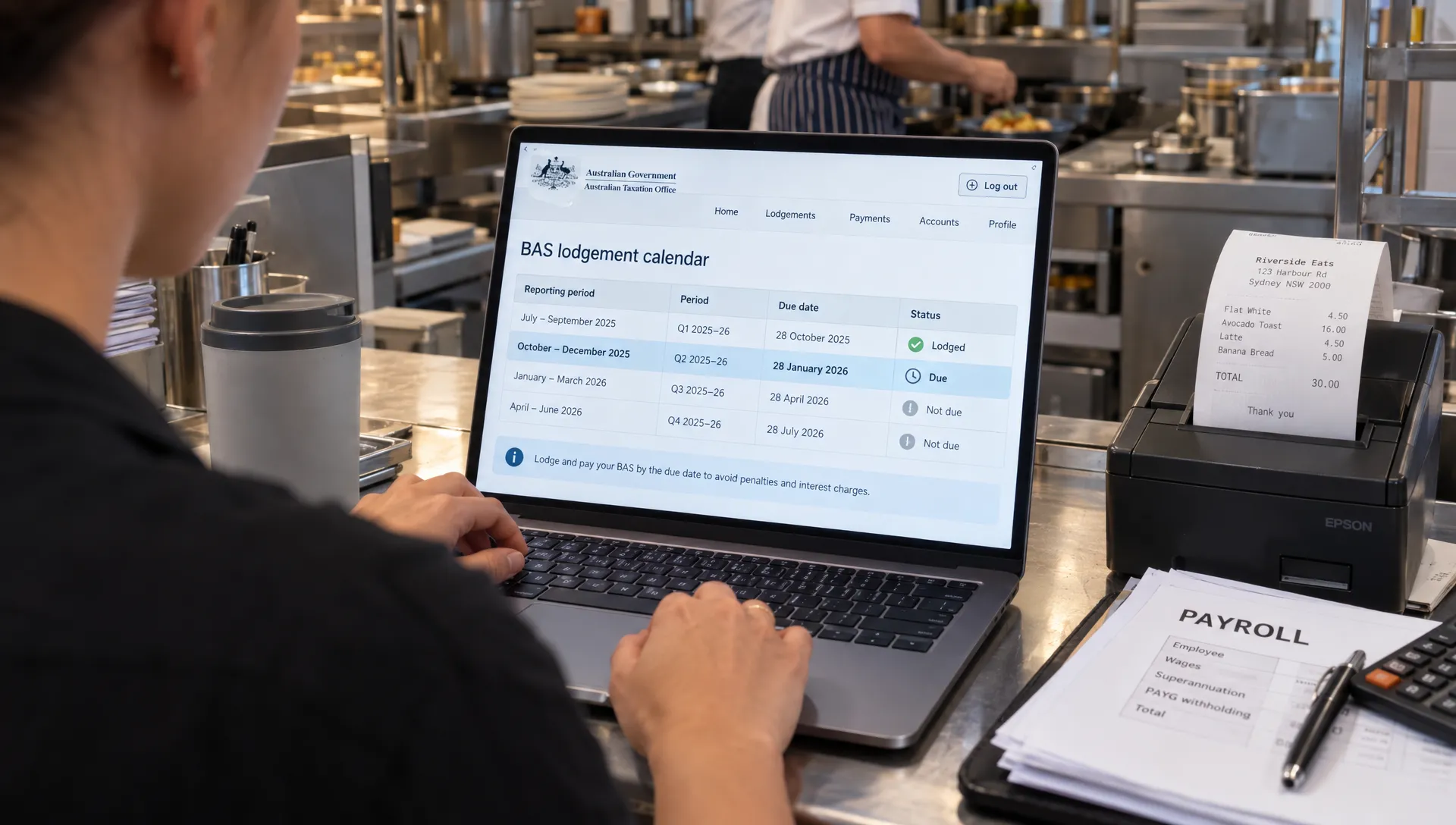
Quarterly BAS due dates for the 2026–27 financial year
During a tax consultation, we distinguish the standard quarterly calendar from any additional time available through online lodgement or an eligible agent arrangement.
| Quarter | Reporting period | Standard due date, adjusted for weekends |
|---|---|---|
| Quarter 1 | 1 July to 30 September 2026 | 28 October 2026 |
| Quarter 2 | 1 October to 31 December 2026 | 1 March 2027 |
| Quarter 3 | 1 January to 31 March 2027 | 28 April 2027 |
| Quarter 4 | 1 April to 30 June 2027 | 28 July 2027 |
Eligible businesses lodging their quarterly BAS online can generally receive an additional two weeks to lodge and pay for quarters 1, 3 and 4. We do not apply that additional online concession to the October-to-December quarter, which already has a later standard deadline.
For the September 2026 quarter, those additional two weeks move the standard 28 October deadline to 11 November. That is a different concession from the eligible registered-agent deadline of 25 November.
We also keep annual GST reporting and special reporting arrangements outside this table. Their deadlines require a separate check rather than an assumption that the quarterly calendar applies.
Monthly BAS: why the next deadline is 23 November 2026
We generally work to the 21st day of the following month for monthly BAS reporting. Where that date falls on a weekend or public holiday, the deadline moves to the next business day.
For October 2026, the usual 21 November date falls on a Saturday. The next business day is Monday 23 November 2026. For November 2026, the ordinary monthly deadline is Monday 21 December 2026, unless a different arrangement applies.
We use a tax consultation to identify mixed reporting cycles before they create a missed obligation. For example, an entity may report GST quarterly but need to report PAYG withholding monthly, potentially through an instalment activity statement for intervening months.
We therefore maintain the calendar by entity, tax obligation and reporting period, rather than relying on a single recurring “BAS due” reminder. This becomes particularly important when a growing business changes reporting arrangements or adds another employing entity.
What should a tax consultation confirm before BAS lodgement?
The actual obligation and reporting period
We first identify which entity must report, which period remains outstanding and whether the document is a BAS or an instalment activity statement. We then review the relevant obligations, including GST, PAYG withholding, PAYG instalments and FBT instalments where applicable.
An income tax return deadline is separate. We do not treat lodging a company or individual tax return as satisfying outstanding activity statements.
Eligibility for additional time
We check the lodgement channel, agent arrangements and any conditions attached to a concession. Appointing an agent after a deadline has passed does not automatically make an overdue BAS current or remove earlier consequences.
Where an ATO-approved deferral exists, we record its scope and revised date. We distinguish that from an internal preparation target, which has no effect on the legal deadline.
Both lodgement and payment
We confirm the applicable payment date alongside the lodgement date. A payment plan addresses an outstanding debt; it does not, by itself, extend the time to lodge a statement.
Our internal approval date sits earlier than the ATO deadline. That leaves time to resolve coding issues, obtain director approval and arrange cleared funds without turning a routine reporting obligation into an urgent cash-flow problem.
Our preparation checklist before the next BAS deadline
We use the reporting cycle to improve the quality of management information, not simply to produce a form. During a tax consultation, we examine whether the underlying records support both the BAS figures and the business decisions that follow.
Reconcile the records that drive the liability
Our preparation checks typically cover:
- Bank accounts, credit cards and payment platforms reconciled through the reporting period.
- Sales, customer deposits, refunds and credit notes reviewed for correct GST treatment.
- Purchase records checked for GST coding and supporting tax invoices where required.
- Payroll and PAYG withholding reconciled, including differences between payroll records and ledger balances.
- Capital purchases, private use and unusual transactions reviewed rather than accepted solely from automated coding.
We also confirm whether GST is accounted for on a cash or non-cash basis. The timing of GST attribution can differ, so an unpaid invoice does not receive identical treatment under both methods.
Translate the result into a cash-flow decision
We compare the expected BAS payment with available cash, upcoming payroll, supplier commitments and other liabilities. Superannuation remains a separate obligation with its own payment requirements, not an amount we simply add to the BAS.
Our approach to tax-efficient accounting that improves cash flow connects these reconciliations with forward planning. Reliable bookkeeping becomes the foundation for strategic advisory and corporate growth, rather than a retrospective compliance exercise.

How we use automation without weakening BAS controls
We combine AI-driven automation with professional review to reduce repetitive processing and direct attention towards exceptions. Faster transaction capture is useful only when the source records, coding and approval process remain reliable.
In a tax consultation, we assess where automation can improve accuracy, speed and real-time financial visibility. Depending on the existing workflow, priorities may include reducing manual data entry, identifying unusual GST coding and bringing reconciliations forward rather than leaving them until the due date.
We retain human review for transactions where context changes the tax outcome. Property transactions, cross-border supplies, mixed private and business expenditure and changes in business structure require more than a software-generated GST code.
Keep cloud access and approvals resilient
We recommend named approvers, secure document access and a backup process for connectivity failures. A completed draft is not evidence that the ATO has received the statement; we retain the lodgement acknowledgement and confirm payment arrangements separately.
For an Australian group with a Dutch office, business fibre connectivity in Tilburg is one local infrastructure option to assess alongside backup access. We treat dependable connectivity as support for timely record sharing, not as a substitute for early preparation or a reason to assume an ATO extension.
Across Adelaide, Sydney and Melbourne, our integrated service approach connects local business context with consistent accounting controls. We support clients throughout Australia while keeping each entity’s reporting obligations distinct.
What we do when the BAS deadline has already passed
We first establish what is missing: the statement, the payment or both. We then reconcile the records, determine the outstanding liability and assess whether any valid concession or deferral applies.
If the September-quarter BAS was due on 28 October 2026 and no later deadline applies, it is already overdue as at 8 November. We do not delay reviewing it simply because the next quarter has not ended.
A tax consultation at this stage should produce a recovery plan covering outstanding periods, available records, payment capacity and communication with the ATO. Failure-to-lodge penalties may apply and unpaid amounts can attract general interest charge, depending on the circumstances.
We generally prioritise accurate lodgement even where full payment is not immediately possible, while addressing payment arrangements separately. Our guide to resolving back taxes and outstanding activity statements explains the broader recovery process where several obligations have accumulated.
Frequently asked questions
Does lodging BAS online always provide two extra weeks? We check eligibility before relying on that concession. It generally applies to eligible quarterly online lodgers for quarters 1, 3 and 4, not automatically to monthly statements or the December quarter.
Does using an accountant automatically extend the deadline? We distinguish an accountant’s involvement from eligibility under the registered tax or BAS agent lodgement program. The appointment alone does not guarantee additional time, particularly for an already-overdue statement.
Do we still need to lodge a nil BAS? We generally lodge a required activity statement even where there is no amount to report or pay. A nil result does not cancel an existing lodgement obligation.
Can a BAS payment plan replace lodgement? We treat these as separate matters. A payment arrangement does not replace the statement and interest may continue on the outstanding balance.
What information helps establish the correct deadline? We review the latest activity statement, reporting cycle, ATO account information and any agent concession or deferral correspondence. For a tax consultation involving several entities, we also map which entity carries each obligation. We use secure channels for sensitive information such as a TFN.
Next steps: confirm the date and prepare the cash
We recommend confirming the applicable November deadline now, then setting an earlier internal date for reconciliation, approval and payment preparation. Where an obligation is overdue, we address it alongside the current reporting cycle rather than allowing another period to accumulate.
At Perfect Accounting & Tax Services, we draw on 25 years of professional experience and AI-driven processes to connect compliance with financial strategy. We support business owners, directors and high-net-worth individuals across Australia, with integrated capabilities in Adelaide, Sydney and Melbourne.
Contact our team to confirm the next BAS obligation, discuss cash-flow planning or learn how our automated accounting workflows can support more timely reporting.