

Payday super has changed how Australian employers manage superannuation, payroll and working capital. From 1 July 2026, compulsory employer contributions are tied to payday rather than the former quarterly payment cycle. As tax specialists, we focus on the operational consequence: calculating super correctly is no longer enough. Employers also need reliable payment processing, accurate employee data and evidence that contributions reached the fund on time.
We explain the requirements below, together with the controls we recommend for businesses managing payroll across Australia.
What is payday super?
Payday super requires employers to pay superannuation guarantee contributions in connection with each payday. Contributions generally need to reach the employee’s super fund within seven business days of payday, subject to specific exceptions.
The reform changes payment timing, not the purpose of superannuation. We still assess employee eligibility, contribution calculations and applicable limits. However, we now connect those assessments directly to each payroll cycle.
| Area | Former quarterly approach | Payday super approach |
|---|---|---|
| Payment cycle | Contributions generally paid by quarterly deadlines | Contributions linked to each payday |
| Cash management | Employers could retain accrued super until the quarterly deadline | Employers need funding aligned with payroll |
| Payment monitoring | Reconciliation often centred on quarter-end | Receipt and exceptions need monitoring throughout the year |
For our tax specialists, the key distinction is between a payroll expense being recorded and a legal payment obligation being satisfied. An accounting entry does not establish that the employee’s fund received the money.
When must the super fund receive payment?
We work backwards from the receipt deadline, not forwards from the day someone approves a payment file.
Under the general rule, contributions must reach the relevant super fund within seven business days of payday. Authorising a bank payment or submitting a clearing house batch is not necessarily the same as the fund receiving the contribution.
We use the ATO’s payday super guidance to check the applicable requirements and exceptions. We also review processing arrangements with the employer’s payroll provider and clearing house.
A practical payment calendar needs to accommodate weekends, public holidays, provider cut-off times and rejected transactions. We do not recommend treating the full statutory window as routine processing time.
Exceptions need their own controls
Specific rules can affect timing for circumstances such as a new employee’s first contribution. We assess the relevant exception before applying an extended period.
Our tax specialists do not assume that missing fund details, a returned payment or an internal approval delay automatically extends the deadline. We document the circumstances, check the applicable rules and arrange corrective action promptly.
We also distinguish the actual payday from the date a payroll officer prepares the pay run. Those dates may differ, especially around holidays or off-cycle payments.
How much super do employers need to pay?
The superannuation guarantee rate is 12% for 2026–27. We apply that rate to the relevant earnings base, subject to the applicable contribution limits and legislative rules.
Payday super uses the concept of qualifying earnings. Ordinary time earnings remain central, with relevant salary-sacrifice amounts also requiring attention. We review payroll earning codes rather than assuming every amount classified as wages has identical super treatment.
Allowances, commissions, bonuses, overtime and termination payments each need appropriate classification. We also check that salary-sacrificed super does not improperly reduce the employer’s compulsory contribution.
Eligibility still needs a separate assessment
Payday super does not remove the need to determine who is entitled to superannuation. We review employee eligibility and arrangements involving contractors paid principally for their labour. An ABN alone does not settle that question.
Special eligibility rules can also apply, including for employees under 18. Our tax specialists assess the working arrangement and relevant conditions before relying on a payroll system’s default setting.
Where awards, employment contracts or other arrangements impose additional requirements, we review those alongside the statutory minimum. Automation should implement a defensible position, not substitute for establishing one.
What does payday super mean for cash flow?
For a compliant employer, the reform principally changes when cash leaves the business. It does not, by itself, increase the statutory contribution rate.
We illustrate the funding effect using a business with $50,000 of eligible weekly earnings, assuming no contribution-cap adjustments:
| Item | Illustrative amount |
|---|---|
| Eligible weekly earnings | $50,000 |
| Employer SG at 12% | $6,000 |
| SG associated with four weekly paydays | $24,000 |
Under payday super, that $6,000 weekly obligation needs funding alongside the payroll cycle. It cannot remain available for general working capital until a quarterly deadline.
We therefore incorporate super payments into rolling cash flow forecasts alongside net wages, PAYG withholding, GST, BAS payments and supplier commitments. A business can be profitable yet still encounter a funding problem when customer receipts arrive after payroll obligations.
Our tax specialists use integrated tax support and cash flow planning to connect those obligations with debtor collections, finance arrangements and growth spending. This turns payroll compliance into an input for strategic advisory rather than an isolated payment task.
Check that transition liabilities were cleared
We also review the changeover from the former quarterly system. The April–June 2026 quarter generally retained its 28 July 2026 payment deadline, while payday obligations began from 1 July 2026.
That created overlapping funding demands for employers moving from quarterly payments. An unpaid historical liability did not disappear when the new system started.
We reconcile the final quarterly obligations separately from subsequent payday contributions. Clear allocation matters because an undifferentiated payment total does not prove that every employee’s obligations were met correctly and on time.
Which payroll controls should employers have in place?
We recommend a documented process covering calculation, authorisation, payment and receipt. Outsourcing payroll or using a clearing house does not, by itself, discharge the employer’s obligations.
Our tax specialists review the following control points before treating a payday super process as reliable:
| Control | Evidence we look for | Business purpose |
|---|---|---|
| Employee and fund validation | Current fund details and relevant onboarding records | Reduce rejected or misdirected contributions |
| Earnings-code review | Documented super treatment for each pay component | Prevent recurring calculation errors |
| Funded payment approval | Authorised payment matched to available cash | Avoid approval and funding delays |
| Receipt reconciliation | Contribution status matched to employees and funds | Distinguish submission from successful receipt |
| Exception management | Named owner, escalation deadline and resolution record | Address failures before they accumulate |
We also reconcile payroll, Single Touch Payroll reporting, the general ledger and contribution records. A successful STP submission does not prove that a super contribution reached the fund.
For former users of the ATO’s Small Business Superannuation Clearing House, which closed from 1 July 2026, we verify that the replacement payment channel is operating correctly.
Where AI and automation add value
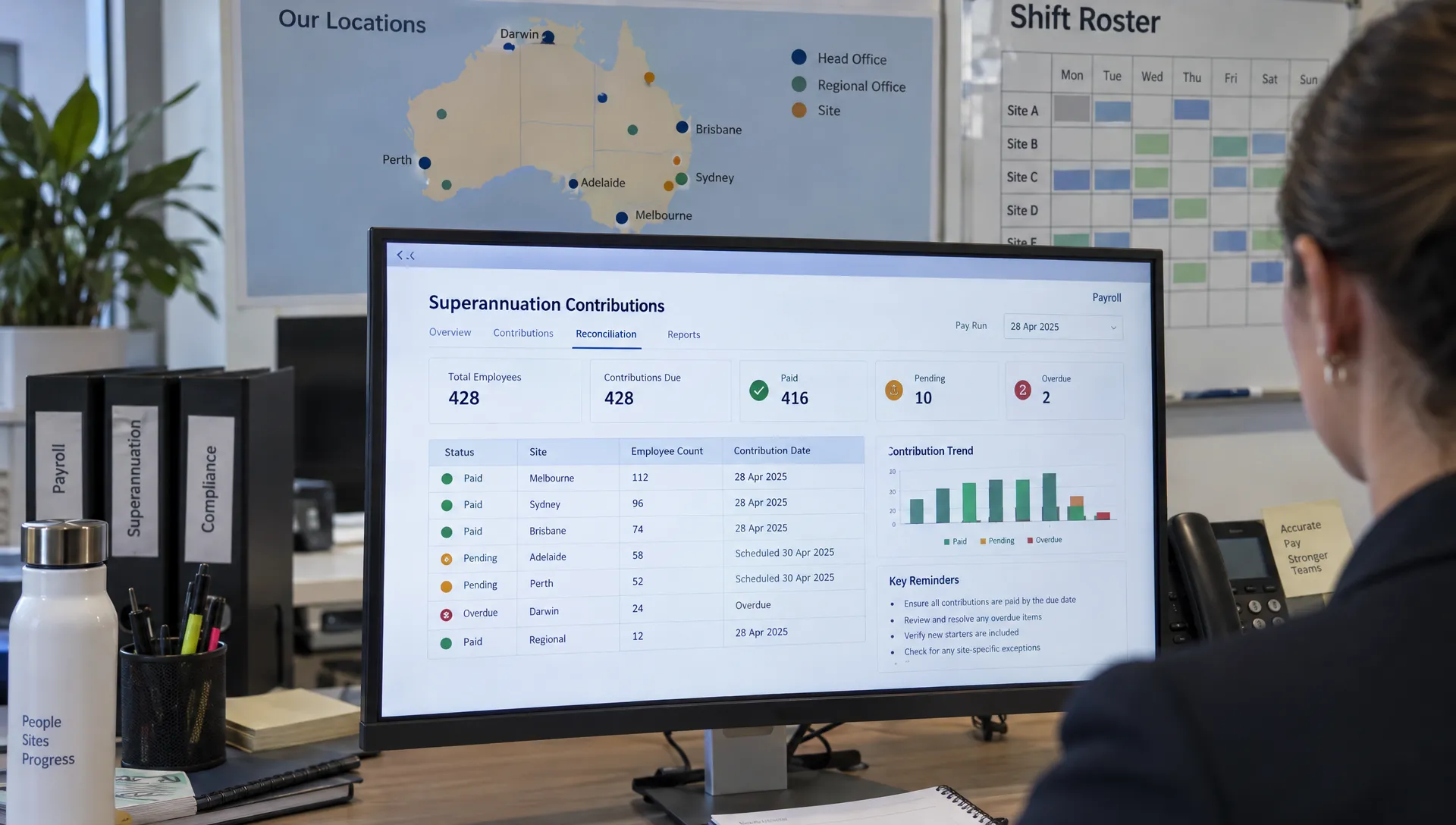
We use AI-driven automation to streamline financial workflows and improve the speed and accuracy of review. For payday super, useful applications include identifying inconsistent earning codes, highlighting unusual contribution amounts and bringing unresolved payment exceptions to attention.
We retain human review for eligibility decisions, legislative interpretation and material exceptions. Automated submission without reconciliation can simply repeat an error more quickly.
When payroll data and contribution records are kept current, we can provide more timely financial visibility. That supports decisions about recruitment, pricing and expansion using labour costs that include the associated super obligation.
What should employers do if a contribution is late or rejected?
We first establish the facts: the payday, qualifying earnings, required contribution, payment history and date of receipt by the fund. We then assess whether an exception applies and what corrective action or disclosure is required.
A rejected contribution needs an identified owner. We investigate whether the problem arose from employee details, fund information, payment processing or an internal control failure.
Our tax specialists assess potential super guarantee charge, interest and penalties under the rules applying to the relevant period. We do not assume that making a later payment automatically removes every consequence of missing the deadline.
Directors also need visibility over outstanding obligations because unpaid super guarantee charge can create personal exposure under the director penalty regime. We address historical problems alongside current payroll controls, rather than allowing one to obscure the other.
Where records reveal broader reporting failures, our guidance on late filing risks for directors explains why overdue lodgments and unpaid liabilities require separate attention.
How do we manage payday super across multiple locations?
We support employers across Australia through integrated accounting, tax and advisory capabilities in Adelaide, Sydney and Melbourne. For multi-location businesses, we recommend consistent standards with clear responsibility at each stage of payroll.
The federal superannuation framework applies nationally, but different pay calendars, public holidays, payroll systems and approval arrangements can create operational gaps. We map each employing entity, its payroll frequency, payment channel and escalation contact.
Our tax specialists also distinguish superannuation from state-based payroll tax and other employment costs. Similar source data may feed these calculations, but their legal treatment is not interchangeable.
For directors and finance leaders, we bring exceptions into a consolidated review: contributions awaiting confirmation, rejected payments, unresolved employee details and upcoming funding requirements. That visibility helps management address specific risks without relying on a general assurance that payroll has been processed.
Frequently asked questions
Does payday super mean employers must run payroll more frequently? We distinguish payroll frequency from contribution timing. Payday super links contributions to the existing payday; it does not generally require a weekly payroll where employees are lawfully paid fortnightly or monthly.
Can employers still pay super quarterly? We would not treat quarterly payment as compliant for ordinary payday super obligations arising from 1 July 2026. The general requirement is linked to each payday, with receipt required within seven business days unless a specific exception applies.
Does a clearing house confirmation prove compliance? We check what the confirmation establishes. Acceptance of a batch is different from receipt by the employee’s fund. Our reconciliation needs sufficient evidence of the contribution’s destination, amount and timing.
Is payday super connected to payday loans? No. We use payday super to describe Australian employer superannuation obligations, not short-term borrowing. For cross-border business owners comparing terminology, guidance on the tax treatment of payday loans in Singapore concerns a separate lending issue and jurisdiction. We do not apply that guidance to Australian superannuation or employee-benefit arrangements.
Next steps with our tax specialists
We recommend reviewing a recent payroll cycle from earnings calculation through to confirmed fund receipt. That review should identify payment delays, coding errors, rejected contributions and any gap between recorded liabilities and actual payments.
At Perfect Accounting & Tax Services, we combine 25 years of professional experience with AI-driven accounting processes to connect payroll compliance with cash flow planning and corporate growth.
We support businesses nationally, including Adelaide, Sydney and Melbourne. Contact our team for a consultation to review payday super controls, resolve historical issues or discuss automated accounting workflows that improve financial visibility.