
Tax is one of the most important cash flow variables in an Australian business, yet it is often treated as a compliance task rather than a management input. That separation creates risk. A profitable month can still lead to a cash squeeze if GST, PAYG withholding, superannuation, PAYG instalments, FBT or income tax have not been forecast correctly.
We see this most clearly when business owners make decisions from bank balances rather than tax-adjusted cash flow. The bank account may look healthy after a strong sales period, but part of that balance may already be committed to the ATO, employees, lenders or shareholders. Integrated tax support solves this by connecting compliance, bookkeeping, forecasting and strategic advisory into one decision framework.
For company directors, family-owned businesses, property investors and growing SMEs, the objective is not simply to lodge on time. The objective is to know how much cash is genuinely available, when tax obligations will crystallise, and which decisions improve financial resilience.
Why tax and cash flow cannot be managed separately
Cash flow decisions fail when tax is reviewed too late. If tax advice only happens at year-end, the business has already made most of its meaningful cash decisions: hiring, pricing, asset purchases, dividends, drawings, debt repayments and expansion commitments.
In Australia, many tax obligations are timing-sensitive. GST collected on sales is not business cash. PAYG withholding deducted from wages must be remitted. Superannuation must be paid by the relevant due dates to preserve deductibility and avoid Superannuation Guarantee Charge exposure. PAYG instalments are prepayments toward expected income tax, and they can materially affect quarterly cash reserves.
The ATO explains that business activity statements may report obligations such as GST, PAYG withholding and PAYG instalments. That means BAS preparation is not just a lodgement exercise. It is a recurring cash flow control point.
When tax is integrated into management reporting, directors can make better decisions earlier. They can distinguish operating cash from tax-held cash, plan for seasonal obligations, and avoid using ATO money to fund growth. This is the practical difference between reactive compliance and strategic financial management.
What integrated tax support means in practice
Integrated tax support brings together the systems, people and advisory processes that influence tax-sensitive cash flow. It is not one isolated annual conversation. It is a year-round framework that links accounting records, tax planning, BAS, payroll, superannuation, management reporting and forward-looking advisory.
At a practical level, it means that tax is considered before key decisions are made. If a business is preparing to buy equipment, hire senior staff, expand interstate or distribute profits, we assess the tax and cash implications together. We look at timing, deductibility, GST impact, working capital, finance structure and director obligations.
This is where modern tax help and accounting support should move beyond basic recordkeeping. We have discussed the broader shift in our article on when a tax professional becomes a strategic advantage, because the real value is created before the transaction occurs, not after the paperwork arrives.
| Tax and finance area | Cash flow risk when managed in isolation | How integrated support improves decisions |
|---|---|---|
| GST and BAS | GST collected is mistaken for available working capital | GST reserves are built into rolling forecasts and pricing reviews |
| PAYG instalments | Quarterly income tax prepayments surprise directors | Instalments are modelled against profit forecasts and business changes |
| Payroll and superannuation | Hiring decisions ignore total employment cash cost | Wages, PAYG withholding and superannuation are forecast together |
| FBT | Benefits are provided without considering post-tax cost | Vehicle, entertainment and employee benefit decisions are assessed upfront |
| Dividends and trust distributions | Profit is distributed before tax cash is preserved | Distribution planning aligns with tax liabilities and liquidity needs |
| Financing and asset purchases | Decisions focus on deductions rather than net cash return | Tax impact is weighed against debt service, timing and commercial value |
How integrated tax support improves cash flow decisions
The value of integration becomes clear when we look at common decisions Australian businesses face.
1. BAS planning becomes a cash flow discipline
For GST-registered businesses, BAS lodgement is one of the most consistent cash flow events in the year. If the business has strong invoicing but slow debtor collections, the GST component can create pressure. This is particularly relevant for construction firms, agencies, professional services firms and wholesalers where revenue recognition, debtor timing and supplier payments can vary significantly.
Integrated support allows us to monitor GST exposure throughout the BAS period. Rather than waiting until lodgement, we can estimate the upcoming BAS obligation, check GST coding accuracy, and encourage directors to reserve the tax component as cash is received.
This supports stronger debtor management. If a client delays payment, the cash flow forecast can show whether the business still has enough liquidity to meet BAS, payroll and superannuation obligations without drawing on overdrafts or delaying suppliers.
2. PAYG instalments are built into profit planning
PAYG instalments are designed to prepay tax on business and investment income during the year. They can be helpful for smoothing tax, but they can also create pressure if profit changes suddenly.
A growing business may face higher instalments after a strong prior year, even if current-year cash is being reinvested into stock, staff or expansion. A business experiencing a downturn may need to assess whether its instalment position still reflects expected income. Any variation needs care, because underestimating tax can lead to interest and penalties.
When tax support is integrated with forecasting, we can assess PAYG instalments alongside expected profit, drawings, dividends, debt commitments and working capital. This gives directors a more realistic view of what the business can afford.
3. Payroll decisions reflect the full cash cost
Hiring is often assessed through salary alone. In reality, the cash impact includes PAYG withholding, superannuation, payroll systems, workers compensation, potential payroll tax, leave accruals and FBT where benefits are offered.
For businesses operating across Adelaide, Sydney, Melbourne and other locations, state-based payroll tax rules can also become relevant as headcount grows. Integrated tax support helps identify these thresholds and obligations early, so expansion decisions are made with a complete cost base.
This does not mean tax should discourage hiring. It means the hiring plan should be financially transparent. A business can then decide whether to hire permanently, use contractors where appropriate, outsource specific functions, or invest in automation to support scale.
4. Asset purchases are judged on commercial value, not just deductions
We often see businesses rush into equipment, vehicle or technology purchases because they expect a tax benefit. A deduction can be useful, but it does not make a poor cash decision good. The business still pays cash or takes on finance, and the after-tax benefit depends on the entity, timing, deductibility rules and taxable profit position.
Integrated tax support reframes the decision. We assess whether the purchase improves productive capacity, margin, compliance, safety, speed or client delivery. We then model the tax outcome, GST credits, finance repayments and working capital impact.
That approach is particularly important for property developers, building contractors, medical practices, logistics businesses, manufacturers and technology firms where capital expenditure can be significant.

From compliance calendar to cash flow forecast
A strong business should not wait for tax deadlines to discover its obligations. We prefer to convert the compliance calendar into a forecasting tool.
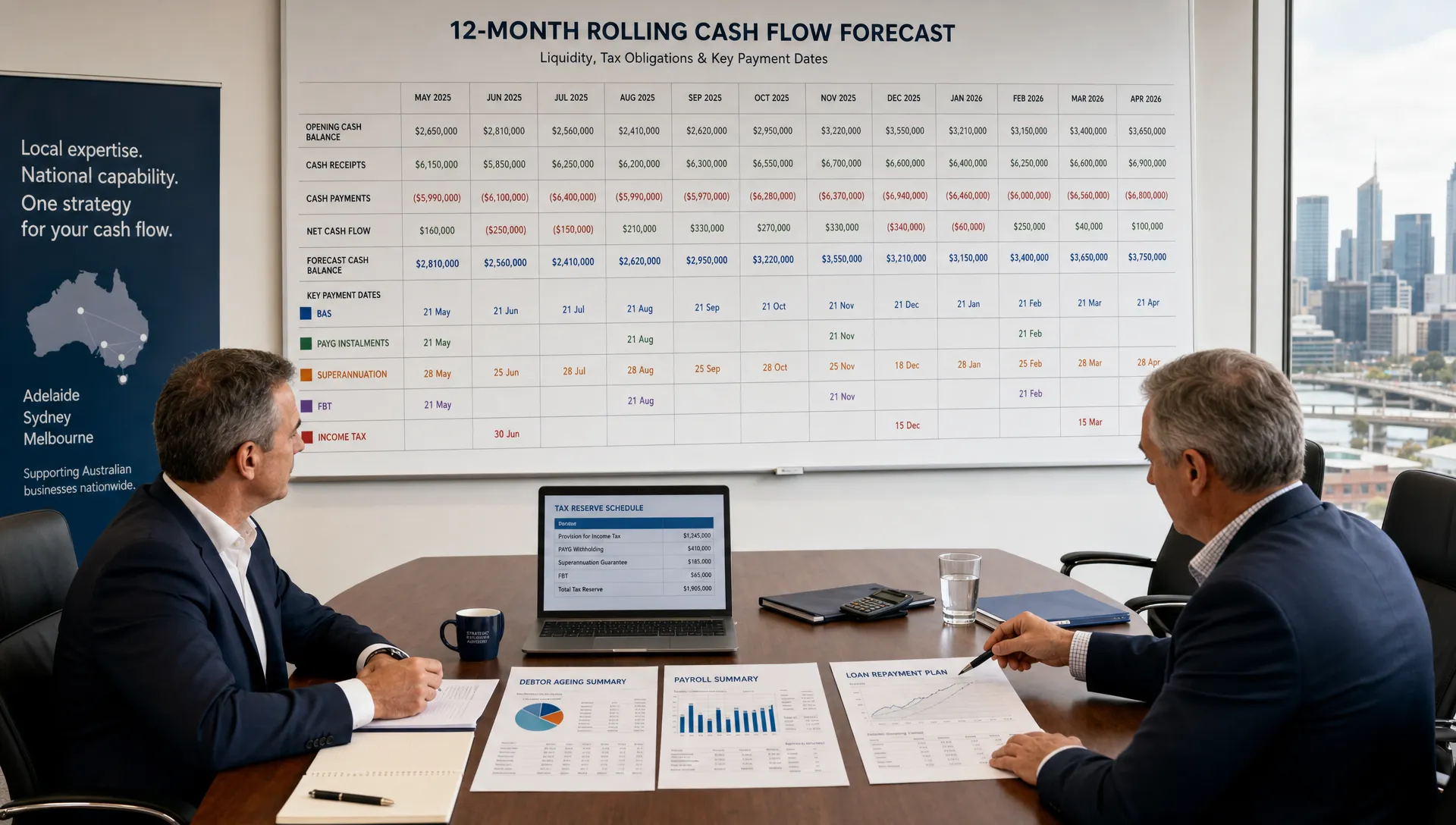
That means BAS dates, PAYG instalments, superannuation payments, income tax due dates, FBT lodgement cycles, loan repayments, insurance renewals and major supplier commitments are mapped into one cash flow view. The business can then see liquidity pressure before it arrives.
For many clients, we recommend combining a short-term cash flow forecast with a longer 12-month tax-aware forecast. The short-term view supports weekly and monthly decisions. The annual view supports strategic decisions such as profit distributions, asset purchases, financing, pricing and growth investment.
This is also where modern accounting services should add value. Bookkeeping and compliance create the data foundation, but management reporting and advisory convert that data into action.
The role of AI-driven automation in tax-informed cash flow
Digital transformation is changing the way tax and accounting support cash flow decisions. AI-driven automation can reduce manual processing, improve transaction classification, identify anomalies and speed up reconciliations. The result is better information earlier.
We do not view automation as a replacement for professional judgement. We view it as a way to remove friction from the accounting workflow so our team can focus on higher-value analysis. When transaction data is cleaner and more current, tax planning becomes more accurate. BAS estimates become more reliable. Payroll and superannuation checks become easier to monitor. Directors gain faster visibility of risks and opportunities.
For growing businesses, this matters because delayed reporting creates delayed decisions. A management report produced six weeks after month-end is often too late to influence cash flow. Automated workflows support a more current financial picture, which allows tax advisers and directors to act before liquidity tightens.
This is one reason our team integrates accounting, tax and advisory support rather than treating them as separate service lines. A business services accountant supports better decisions when the underlying systems are accurate, timely and connected to business strategy.
Strategic decisions that improve when tax support is integrated
Integrated tax support improves the quality of several high-impact decisions.
| Decision | What can go wrong without integrated tax support | Better outcome with integrated advice |
|---|---|---|
| Paying dividends or drawings | Cash is extracted before income tax and working capital needs are covered | Distributions are planned after tax reserves and trading cash are assessed |
| Expanding interstate | Payroll tax, GST, registrations and reporting complexity are missed | Compliance and cash requirements are mapped before expansion |
| Buying property or equipment | The focus is on tax deductions rather than total return | Tax, finance, GST and operational value are assessed together |
| Taking on debt | Repayments are modelled without tax cash requirements | Debt service is tested against tax-adjusted forecasts |
| Responding to ATO debt | Payment pressure escalates without a coordinated plan | Cash flow, lodgements and communication are managed strategically |
| Preparing for sale or succession | Historical tax issues reduce buyer confidence | Records, tax positions and earnings quality are strengthened early |
For high-net-worth individuals and family groups, integration is equally important. Trust distributions, Division 7A considerations, property income, capital gains, SMSF matters and investment structures can all affect cash flow. The right advice should connect personal, business and investment tax positions rather than treating each entity in isolation.
Director governance and risk management
Cash flow decisions are also governance decisions. Directors have obligations to ensure the company can meet its debts as and when they fall due. Tax liabilities are part of that assessment.
Unpaid PAYG withholding, GST and Superannuation Guarantee Charge can create serious director risk, including potential director penalty exposure. ATO debt can also affect finance applications, supplier confidence and business sale negotiations.
Integrated tax support improves governance by giving directors clearer visibility of upcoming obligations. It also supports better board reporting, creditor management and decision documentation. For companies seeking investment, finance or acquisition opportunities, clean tax compliance and disciplined cash flow forecasting can strengthen credibility.
This is not just defensive. Good governance creates options. When tax obligations are known and cash is controlled, the business is better positioned to negotiate with lenders, invest in growth, pursue acquisitions or withstand seasonal volatility.
A national approach for Australian businesses
Australian businesses increasingly operate across multiple markets. A company may have headquarters in Adelaide, contractors in Melbourne, clients in Sydney and remote staff across several states. This creates complexity in payroll, GST, superannuation, contractor classification, state taxes and reporting processes.
Our integrated model is designed for that reality. We support clients across Australia with connected advisory capability in Adelaide, Sydney and Melbourne. That national reach helps businesses maintain consistent financial control while still addressing local compliance considerations.
For expanding SMEs, professional firms, property groups and technology companies, this integrated approach can prevent fragmentation. Instead of separate conversations with bookkeepers, tax advisers, payroll processors and strategic consultants, the business benefits from one coordinated view of financial health.
Practical next steps for better tax-informed cash flow
Business owners and directors can start improving cash flow decisions by tightening the link between tax and management reporting.
- Build a rolling cash flow forecast that includes BAS, PAYG instalments, superannuation, income tax and loan repayments.
- Reconcile accounts regularly so GST, wages, superannuation and debtor balances are visible before lodgement deadlines.
- Review pricing and margins after GST, payroll, financing and tax effects are considered.
- Separate tax reserves from operating cash so GST and PAYG amounts are not unintentionally spent.
- Assess major purchases, dividends, hiring and financing decisions before committing cash.
- Automate bookkeeping workflows where possible to improve speed, accuracy and real-time financial visibility.
The key is rhythm. Tax support should not be an annual event. It should be embedded into monthly reporting, quarterly planning and major strategic decisions.
Frequently Asked Questions
How does integrated tax support improve cash flow decisions? It connects BAS, GST, PAYG, payroll, superannuation, income tax and advisory into one forecast. This helps directors understand which cash is available for operations and which cash is already committed to tax or compliance obligations.
Is integrated tax support only relevant for larger companies? No. SMEs, sole traders with employees, property investors, family groups and high-net-worth individuals can all benefit. The more complex the income, staffing, assets or entity structure, the more valuable integration becomes.
Can tax planning help if cash flow is already tight? Yes, but timing matters. We can review lodgement status, upcoming obligations, forecast cash flow, potential ATO communication options and future tax planning. The earlier the issue is identified, the more options are usually available.
How does automation improve tax and cash flow management? Automation helps keep accounting records current, reduces manual errors and speeds up reconciliations. This gives advisers and directors more reliable information for BAS estimates, tax planning and cash flow forecasting.
Should we vary PAYG instalments if profit has changed? Possibly, but it should be assessed carefully. PAYG instalment variations need to reflect a reasonable estimate of expected tax. Underestimating can lead to interest or penalties, so professional review is important.
Next steps: how we can help
At Perfect Accounting & Tax Services, we help Australian businesses move from reactive tax compliance to proactive financial control. Our team combines 25 years of professional experience with AI-driven automation, integrated accounting workflows and strategic advisory support.
We work with business owners, company directors and high-net-worth individuals across Adelaide, Sydney, Melbourne and wider Australia. Whether you need stronger BAS planning, clearer cash flow forecasting, complex tax structuring, payroll compliance, SMSF support or Virtual CFO guidance, we can help build a more accurate and strategic financial system.
If you want tax support that strengthens cash flow decisions rather than simply lodges returns, contact our team for a consultation. We can review your current accounting workflow, identify cash flow risks and show how automated, integrated tax support can improve financial visibility and long-term growth decisions.