

Good decisions are rarely the product of instinct alone. For Australian business owners, company directors and high-net-worth individuals, the quality of a decision depends on the quality of the financial evidence behind it.
That is where a business services accountant should add real value. The role is not limited to preparing tax returns, lodging BAS or keeping the ATO satisfied. Those obligations are important, but they are the foundation. The strategic opportunity is using accurate accounting data to improve cash flow, profitability, tax efficiency, governance and long-term business value.
We see this most clearly when businesses move from reactive accounting to decision-ready reporting. Instead of asking, “What happened last year?”, directors can ask, “What should we do next quarter, and what will it mean for tax, cash and risk?”
What a Business Services Accountant Really Does
A business services accountant sits between compliance, management reporting and strategic advisory. The work typically includes bookkeeping oversight, BAS and GST management, payroll governance, tax planning, financial statements, business structuring, cash-flow forecasting and board-level advice.
The distinction is important. A tax return explains a period that has already ended. Business services accounting helps management make decisions while there is still time to act.
For example, a growing company may need to decide whether to hire staff, buy equipment, expand interstate, restructure, increase director remuneration or retain profits for working capital. Each decision has accounting, tax and commercial consequences. The right adviser brings these issues together, rather than treating them as separate tasks.
In our view, the modern business services function has three core responsibilities:
- Maintain accurate, compliant financial records for ATO, ASIC, payroll and internal governance purposes.
- Convert financial records into useful management information, including cash-flow forecasts, margins, tax provisions and risk alerts.
- Support strategic decisions with scenario modelling, structure advice and commercial interpretation.
This is why we treat compliance as the starting point for Strategic Advisory, not the end product.
Better Decisions Start With Reliable Financial Data
Many poor business decisions begin with weak numbers. The issue is not always obvious. A profit and loss report may look complete, but if GST coding is inconsistent, payroll liabilities are unreconciled, stock is misstated, private expenses are mixed with business costs or director loans have not been reviewed, the report may give management false confidence.
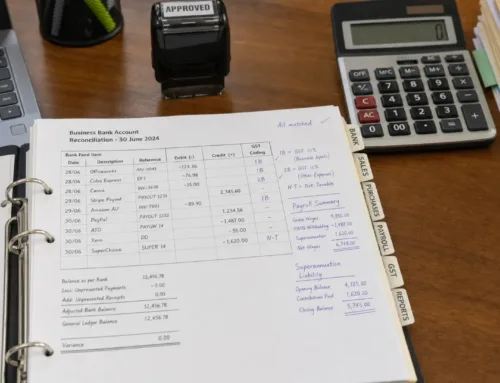
A business services accountant improves decision-making by strengthening the underlying data. This includes reconciling bank accounts, reviewing BAS and GST treatment, checking payroll and superannuation obligations, maintaining fixed asset registers, reviewing debtor and creditor balances, and ensuring the balance sheet is not treated as an afterthought.
The ATO’s record-keeping guidance is clear that businesses must keep records that explain transactions and support tax positions. From a strategic perspective, we go further. Good records should not only satisfy a regulator. They should help owners understand what is driving profit, where cash is leaking and which risks need attention.
A clean accounting file gives directors better visibility across:
- Gross margin by product, service line or project.
- GST payable or refundable before BAS lodgement deadlines.
- PAYG withholding, superannuation and payroll liabilities.
- Cash reserves available for tax, debt, growth and distributions.
- Unusual transactions that may create ATO, FBT or Division 7A issues.
When the numbers are reliable, decisions become more disciplined. When they are not, management may be making high-impact choices on incomplete evidence.
Turning Compliance Work Into Management Intelligence
BAS, payroll, GST, superannuation and annual tax returns are often viewed as administrative obligations. We believe they should also operate as diagnostic tools.
BAS preparation, for example, can reveal whether revenue is trending upward, whether expense claims are properly substantiated, whether GST coding is consistent and whether cash reserves are sufficient for quarterly obligations. Payroll processing can reveal labour cost pressure, superannuation compliance risk and whether employee benefits may trigger FBT considerations.
For companies, annual accounts should support more than tax lodgement. They should clarify retained earnings, director loan accounts, working capital, debt capacity and the ability to fund growth. For trusts, they should support distribution planning and beneficiary-level tax outcomes. For property investors and developers, they should distinguish between capital and revenue treatment, financing costs, GST implications and cash-flow timing.
We have written more broadly about this discipline in our article on how accounting professionals improve financial control. The key point is simple: financial control is not only about preventing errors. It is about creating a management system that supports better decisions.
The Decisions a Business Services Accountant Helps Improve
The practical value of a business services accountant becomes clear when we map common business decisions against the financial insight required.
| Business decision | Financial insight required | How the accountant supports the decision |
|---|---|---|
| Pricing a product or service | Gross margin, labour cost, overhead allocation, GST treatment | Tests whether pricing supports profit after direct and indirect costs |
| Hiring employees or contractors | Payroll cost, superannuation, PAYG withholding, workers compensation, cash-flow impact | Models the true cost of labour and compliance obligations |
| Buying equipment or vehicles | Deductibility, depreciation, finance cost, GST credits, FBT exposure | Compares cash purchase, finance and timing options |
| Expanding into another state | Payroll tax, registrations, local compliance, reporting consistency | Identifies multi-state obligations and governance needs |
| Paying directors or distributing profits | Salary, dividends, trust distributions, Division 7A and tax cash flow | Aligns remuneration with structure, tax and cash requirements |
| Preparing for sale or succession | Normalised earnings, working capital, tax exposures, documentation | Improves business readiness and reduces due diligence issues |
These are not theoretical issues. They affect day-to-day management decisions and long-term enterprise value.
A business with strong sales but weak gross margin may not need more revenue. It may need pricing reform, supplier renegotiation or better job costing. A company showing profit but under cash pressure may need debtor controls, tax provisioning, stock management or revised payment terms. A director taking irregular withdrawals may need a formal remuneration and Division 7A review before the issue becomes costly.
The accountant’s role is to identify these patterns early and translate them into practical options.

Cash Flow Is Often the Decision That Matters Most
Profit is important, but cash flow determines whether a business can execute its strategy. We often see profitable businesses placed under pressure because tax, GST, payroll, superannuation, debt repayments and growth costs have not been forecast together.
A strong business services accountant helps management understand the timing of cash movements. This includes preparing rolling cash-flow forecasts, estimating tax instalments, reviewing BAS cycles, planning for superannuation obligations and identifying seasonal pressure points.
A 13-week cash-flow forecast is especially useful for businesses managing rapid growth, stock purchases, project work, debtor delays or expansion costs. For larger or more complex groups, we may also use monthly and annual scenario models to test hiring, capital expenditure, debt servicing and profit distribution decisions.
Cash-flow advice becomes even more valuable when linked to tax planning. A business may be profitable on paper, but if funds are tied up in debtors, stock or work in progress, directors need to know whether they can safely invest, borrow, distribute profits or defer discretionary spending.
The outcome is not simply a forecast. It is decision clarity.
Tax Planning Becomes Stronger When It Is Built Into Business Strategy
Effective tax planning is not a June discussion. It should be integrated into business decisions throughout the year.
For Australian businesses, tax outcomes can be affected by structure, timing, deductibility, GST registration and reporting, PAYG instalments, payroll tax, superannuation, FBT, Division 7A, trust distributions and capital gains tax. For high-net-worth individuals, SMSFs, property portfolios, foreign income and investment entities can add further complexity.
A business services accountant supports better decisions by identifying tax consequences before transactions occur. This may include reviewing whether a purchase is capital or deductible, whether a vehicle arrangement creates FBT exposure, whether a company has sufficient franking credits, whether a trust distribution is properly documented or whether director drawings are creating private-use or loan account risks.
The ATO’s guidance on super guarantee obligations also highlights why payroll and tax planning cannot be separated. Superannuation is not just a payroll line item. It affects cash flow, employee obligations, director governance and potential penalties.
The best tax advice is proactive, documented and commercially aligned. It helps directors choose the right path, not merely report the path already taken.
AI and Automation: Faster Data, Better Visibility, Stronger Controls
Technology has changed what business owners should expect from accounting support. Cloud accounting, digital document capture, automated bank feeds, workflow approvals and AI-assisted transaction review can reduce manual processing and improve the speed of reporting.
We use AI-driven processes to streamline workflows, detect inconsistencies, accelerate reconciliations and support more timely management reporting. Importantly, automation does not replace professional judgement. It improves the quality and speed of the information we analyse.
For directors, the value is practical. Instead of waiting weeks for reports, management can access more current financial information. Instead of relying on manual spreadsheets, recurring processes can be standardised. Instead of discovering problems at year-end, exceptions can be identified earlier.
Digital transformation also supports governance. Approval workflows, document trails and consistent coding rules help businesses maintain stronger evidence for ATO reviews, finance applications, internal controls and due diligence.
This is particularly important for businesses operating across Adelaide, Sydney, Melbourne and other parts of Australia. Multi-location businesses need consistency. Automated workflows help create one source of financial truth, even when teams, projects and operations are spread across different states.
What Decision-Ready Reporting Should Include
A good reporting pack is not necessarily long. It should be relevant, timely and designed around the decisions management needs to make.
For many SMEs and growing companies, we recommend a monthly reporting rhythm. The exact format depends on the business model, but the aim is to move beyond historical profit and loss statements.
| Reporting element | What it helps answer | Strategic value |
|---|---|---|
| Profit and loss by division, project or location | Which areas are driving or reducing profit? | Supports pricing, staffing and investment decisions |
| Balance sheet review | Are assets, liabilities and loan accounts accurate? | Improves governance and reduces year-end surprises |
| Cash-flow forecast | Can the business fund tax, wages, debt and growth? | Helps directors plan before pressure builds |
| Debtor and creditor ageing | Is cash trapped in unpaid invoices or supplier timing? | Strengthens working capital management |
| BAS and GST reconciliation | Are lodgements consistent with accounting records? | Reduces ATO risk and improves tax visibility |
| Payroll and superannuation review | Are employment obligations current and complete? | Supports compliance and labour cost control |
| Tax provision and planning notes | What tax cash flow should be expected? | Prevents under-provisioning and supports distribution planning |
The important question is not, “Did we produce a report?” The better question is, “Did the report help management make a better decision?”
When Directors Should Seek Business Services Support
Some businesses only contact an accountant near tax time. That may be adequate for simple affairs, but it is rarely enough for companies managing staff, stock, multiple entities, investors, finance, property or growth plans.
Directors should consider more proactive support when financial decisions become more complex. Warning signs include inconsistent cash flow despite strong revenue, late BAS lodgements, uncertainty around GST treatment, increasing payroll obligations, unexplained profit fluctuations, growing director loan balances, expansion into new states, weak management reporting or difficulty preparing finance-ready accounts.
We also recommend seeking advice before major transactions. This includes buying or selling a business, restructuring, purchasing commercial property, admitting new shareholders, changing remuneration arrangements, expanding overseas, raising capital or preparing for succession.
The cost of advice is usually highest when it is sought after the decision has already been made. Early involvement gives directors more options.
How We Approach Business Services Accounting
Our approach combines technical accounting, tax advisory and digital transformation. With 25 years of professional experience, our team supports Australian businesses and individuals across compliance, tax planning, corporate bookkeeping, virtual CFO services, SMSF matters, payroll governance and strategic advisory.
We do not view bookkeeping as a low-value back-office function. When designed properly, bookkeeping becomes the data layer for better decisions. BAS becomes a checkpoint for tax and cash-flow discipline. Payroll becomes a governance function. Management reporting becomes the bridge between daily transactions and corporate growth.
Our integrated service capability allows us to support clients across Australia, including Adelaide, Sydney and Melbourne. That national perspective is valuable for businesses with cross-state operations, remote teams, property interests, multi-entity structures or expansion plans.
Practical Next Steps for Better Financial Decisions
If your current accounting process feels reactive, start by reviewing the decision quality your numbers are supporting. The objective is not simply to produce more reports. It is to produce the right information at the right time.
A practical improvement plan may include:
- Review the chart of accounts so revenue, costs and margins are reported in a commercially useful way.
- Reconcile BAS, GST, payroll, superannuation and balance sheet accounts before management relies on reports.
- Build a rolling cash-flow forecast that includes tax, debt, payroll and planned investment.
- Set a monthly reporting meeting to review profit, cash, risks and upcoming decisions.
- Identify transactions that need tax advice before implementation, not after year-end.
- Automate document capture, approvals and reconciliations where appropriate.
These steps create a stronger platform for advisory conversations. Once the data is reliable, the focus can shift to growth, profitability, structure and risk management.
Frequently Asked Questions
What is a business services accountant? A business services accountant supports businesses with accounting, BAS, GST, payroll, tax planning, financial reporting, cash-flow management and strategic advisory. The role is broader than annual tax lodgement because it helps owners and directors make better commercial decisions throughout the year.
How is business services accounting different from bookkeeping? Bookkeeping records transactions and keeps financial data organised. Business services accounting uses that data to review compliance, interpret performance, identify tax issues and advise on decisions such as hiring, pricing, investment, restructuring and cash-flow planning.
Can a business services accountant help with ATO risk? Yes. A strong accountant helps reduce ATO risk by improving record keeping, GST coding, BAS reconciliation, payroll compliance, superannuation processes, tax substantiation and documentation for key decisions. Where issues already exist, early professional review can help determine the appropriate next steps.
Do growing businesses need monthly reporting? In most cases, yes. Monthly reporting gives directors timely visibility over profitability, working capital, tax liabilities and cash flow. Businesses with staff, stock, multiple projects, debt, property or interstate operations usually benefit from a structured monthly reporting rhythm.
How does automation improve accounting decisions? Automation reduces manual processing, improves consistency and helps identify issues earlier. When combined with professional review, AI-driven workflows can provide faster reporting, stronger controls and clearer visibility for management decisions.
How We Can Help
We help business owners, company directors and high-net-worth individuals turn accounting data into better decisions. Our team provides business services accounting, tax planning, BAS and payroll support, virtual CFO advisory and AI-driven workflow automation for clients across Australia.
If you want more than year-end compliance, we can help you build a decision-ready accounting system that supports cash flow, tax governance and corporate growth.
Contact our team at Perfect Accounting & Tax Services to arrange a consultation and learn how our automated accounting workflows can give your business clearer, faster and more strategic financial visibility.