
Financial control is the difference between knowing your numbers and merely receiving them after the fact. For Australian business owners, company directors and high-net-worth investors, that distinction matters. Weak control can show up as BAS surprises, delayed debtor collections, payroll errors, stock leakage, undocumented director loans, or decisions based on outdated profit figures.
Accounting professionals improve financial control by designing the systems, reporting rhythms and governance checks that keep financial information accurate, current and decision-ready. In our view, bookkeeping and compliance are only the foundation. The real value comes when the finance function becomes a strategic control centre for cash flow, tax planning and corporate growth.
Financial control is a management discipline, not just bookkeeping
Financial control means having reliable oversight of how money enters, moves through and leaves the business. It covers transaction accuracy, approvals, reconciliations, cash-flow visibility, tax compliance, asset protection and management reporting.
In Australia, this is not optional for serious operators. The ATO expects businesses to keep accurate records, generally for five years, and to retain enough evidence to support income, deductions, GST and employer obligations. The ATO record-keeping guidance makes clear that proper records are central to meeting tax obligations.
For companies, directors also need to consider their duties under the Corporations Act. ASIC outlines that company officeholders must ensure proper financial records are kept, and that directors remain responsible for understanding the financial position of the company. The ASIC guidance on company officeholder duties is particularly relevant for growing SMEs, family groups and multi-entity structures.
Accounting professionals bring these requirements together into a practical control framework. We do not see compliance as a separate annual event. We see it as an operating system that helps owners and directors make better decisions every month.
Creating a single source of financial truth
Many businesses lose control because their financial data is fragmented. Sales sit in an e-commerce platform, payroll in separate software, receipts in email inboxes, loans in spreadsheets and bank transactions in the accounting file. When these systems do not connect cleanly, directors end up managing the business from partial information.
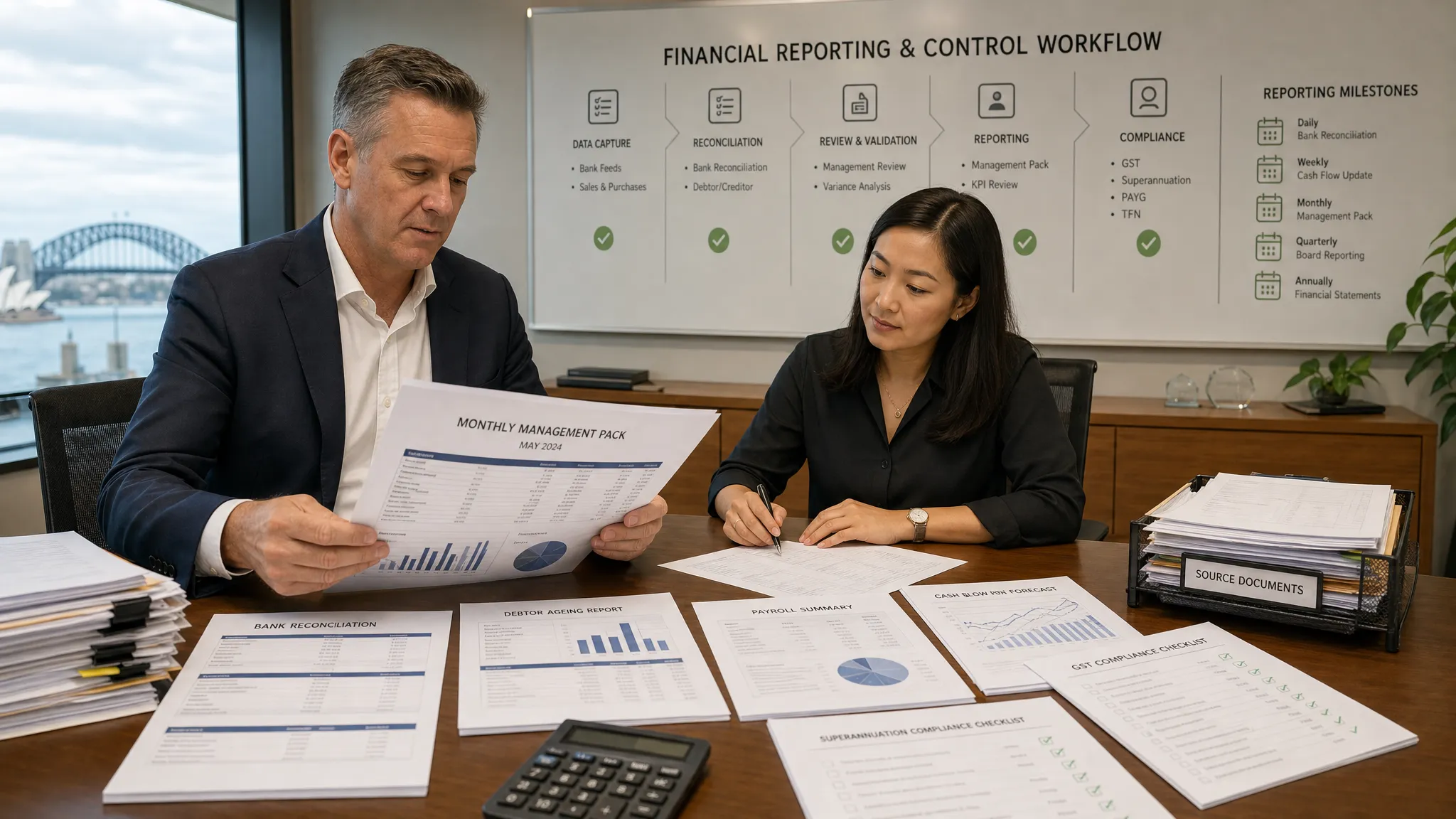
A professionally designed accounting workflow creates a single source of financial truth. This includes a structured chart of accounts, clean bank feeds, consistent coding rules, digital document capture, approval workflows and regular reconciliations. The objective is simple: every transaction should be traceable, explainable and reported in the right period.
AI-driven automation strengthens this process. Modern accounting workflows can extract invoice data, match transactions, flag anomalies and reduce manual entry. However, automation alone is not financial control. Our team applies professional judgement to ensure GST treatment, private use, payroll allocation, loan coding and capital versus revenue treatment are correctly reviewed.
This combination of automation and accounting oversight gives business owners speed without sacrificing accuracy. It also reduces the risk that small data errors compound into incorrect BAS lodgements, misleading profit reports or poor cash-flow decisions.
Turning BAS, GST and payroll compliance into a control framework
BAS, GST, PAYG withholding, superannuation, FBT and payroll obligations are often treated as administrative tasks. We take a different view. These obligations reveal whether the underlying finance system is working properly.
If BAS preparation is difficult each quarter, the issue is rarely the BAS itself. It usually means the business lacks reliable transaction coding, GST reviews, reconciled bank accounts, accurate debtor records or clean payroll data. The compliance deadline exposes the control weakness.
Accounting professionals improve financial control by building recurring checks before lodgement deadlines. This includes reviewing GST on mixed transactions, reconciling PAYG withholding to payroll records, checking superannuation accruals, separating capital assets from repairs, and ensuring private expenses are not incorrectly claimed.
| Control area | Common risk | Professional control response | Strategic outcome |
|---|---|---|---|
| GST and BAS | Incorrect GST coding or unreconciled sales | Monthly GST review, bank reconciliation and BAS workpaper preparation | Fewer ATO issues and clearer cash-flow planning |
| Payroll and superannuation | Underpaid super, incorrect employee classification or PAYG errors | Payroll reconciliations, award-aware review and superannuation tracking | Lower employer risk and better labour cost visibility |
| Director and shareholder transactions | Private payments, undocumented loans or Division 7A exposure | Director loan monitoring and annual tax planning | Stronger governance and reduced tax leakage |
| Accounts receivable | Slow collections and poor debtor follow-up | Debtor ageing review and collection workflow | Improved working capital and stronger cash conversion |
| Management reporting | Decisions based on late or unreliable figures | Monthly close process and KPI reporting | Faster, evidence-based management decisions |
This is where compliance becomes strategic. A clean BAS process does more than satisfy the ATO. It confirms that revenue, expenses, tax liabilities and working capital are being measured correctly.
Improving cash-flow control before pressure builds
Profit does not equal cash. A business can be profitable on paper while struggling to fund wages, GST, PAYG withholding, superannuation, supplier payments or debt repayments. This is common in construction, professional services, hospitality, property development, medical practices, agencies and inventory-heavy businesses.
Accounting professionals improve cash-flow control by separating reported profit from available cash. We look at debtor days, creditor timing, tax reserves, inventory movements, work in progress, loan commitments, capital expenditure and seasonal trading patterns. This creates a forward-looking view rather than a reactive one.
For example, a building contractor may show strong revenue but have cash tied up in progress claims, retentions and subcontractor payments. A medical specialist may generate high income but face quarterly BAS, PAYG instalments and superannuation obligations that require disciplined reserving. A SaaS company may need to track recurring revenue, churn, development costs and runway more closely than a traditional P&L report allows.
A robust cash-flow forecast gives directors time to act. They can negotiate supplier terms, adjust pricing, accelerate debt collection, restructure finance, defer non-essential expenditure or plan tax payments earlier. The objective is not just to avoid cash shortages. It is to make capital allocation more deliberate.
Strengthening management reporting for better decisions
Financial control improves when management receives relevant information at the right time. Annual accounts are not enough for a growing business. By the time year-end reports are finalised, the opportunity to correct margin erosion, cost blowouts or working capital pressure may already be gone.
We prefer monthly or at least quarterly management reporting for businesses with meaningful turnover, employees, debt, stock, multiple locations or significant tax obligations. The report should go beyond a standard profit and loss statement. It should explain what changed, why it changed and what management should do next.
Effective management reporting may include gross margin trends, overhead ratios, debtor ageing, stock turnover, labour productivity, project profitability, tax liabilities, cash runway and variance against budget. For companies with directors or investors, this reporting also supports governance, board discussions and strategic planning.
The key is interpretation. A dashboard may show that revenue increased by 18 percent, but accounting professionals will ask whether gross margin improved, whether debtor days deteriorated, whether payroll increased faster than revenue and whether GST reserves are adequate. This level of analysis turns financial data into management intelligence.
For further context on moving beyond compliance, see our article on when a tax professional becomes a strategic advantage.
Protecting assets through internal controls
Financial control is also about protecting business assets. Smaller businesses often rely heavily on trust, especially in family-owned operations or founder-led companies. Trust is important, but it should not replace controls.
Professional internal controls reduce the risk of fraud, payment errors, duplicate invoices, unauthorised spending and poor record-keeping. In practical terms, this may include approval limits, supplier verification, separate access levels, corporate card policies, expense substantiation, payroll review and regular balance sheet reconciliations.
In a small team, full segregation of duties may not be practical. However, compensating controls can still be built. For example, the person who enters supplier bills should not be the only person approving payment batches. New supplier bank details should be independently verified. Payroll changes should be reviewed before processing. Director expenses should be coded and substantiated regularly, not reconstructed at year-end.
These controls matter for every business type, but they become especially important in high-volume retail, hospitality, construction, logistics, medical practices, property groups and businesses operating across multiple sites.
Using AI and automation without losing professional judgement
AI has changed the way finance functions operate. Automated coding, receipt capture, bank reconciliation, invoice matching and anomaly detection can reduce delays and improve accuracy. For business owners, the benefit is faster access to financial information and less dependence on manual spreadsheet processes.
However, automation must be governed. AI tools can suggest coding, but they do not understand every commercial arrangement, tax nuance or director responsibility. A transaction may look like a deductible expense, but professional review may identify private use, FBT implications, capital treatment, GST adjustments or documentation gaps.
Our approach is to use automation as a control accelerator, not a replacement for professional judgement. We design workflows so that routine processing is faster, while higher-risk areas receive targeted review. This allows accounting professionals to focus on analysis, governance and strategic advisory rather than low-value data entry.
For directors and business owners, this creates real-time financial visibility. Instead of waiting until tax time, management can see emerging issues earlier and take action while there is still time to influence the outcome.
Supporting multi-entity and multi-city operations
Financial control becomes more complex when a business operates through multiple entities, locations or asset structures. This is common for property investors, family groups, franchisors, professional practices, hospitality groups, construction firms and technology businesses scaling nationally.
Multi-entity structures require disciplined intercompany accounting, loan tracking, payroll allocation, GST reporting, asset registers and tax planning. Without proper controls, directors may not know which entity is generating cash, which entity is carrying debt, or whether related-party transactions are properly documented.
Our team supports clients across Australia, with integrated service capability in Adelaide, Sydney and Melbourne. This national perspective is valuable for businesses operating across state borders, particularly where payroll tax, workers compensation, land tax, licensing or local compliance requirements may differ.
Financial control in this environment is not just about keeping each entity compliant. It is about giving the owner, board or family group a consolidated view of performance, cash and risk.
Signs your business needs stronger financial control
Many directors recognise control weaknesses only after a problem has already surfaced. The earlier warning signs are usually visible in the finance process itself.
You may need stronger financial control if:
- BAS preparation feels rushed or relies on manual adjustments each quarter.
- Management reports arrive too late to influence decisions.
- Cash flow is unpredictable despite apparent profitability.
- Director loans, private expenses or related-party transactions are unclear.
- Payroll, superannuation or contractor records require frequent correction.
- Debtor collections are slow and not actively managed.
- Multiple software systems do not reconcile cleanly.
- Business growth has outpaced the current bookkeeping process.
These issues do not always indicate serious non-compliance. Often, they mean the business has matured beyond basic bookkeeping and now needs a more strategic finance function.
How accounting professionals lift financial control in practice
When we assess financial control, we look beyond the accounting file. We examine how financial information flows through the business, who approves transactions, how often accounts are reconciled, which reports management relies on and whether tax obligations are being forecast before they fall due.
A practical financial control review usually considers the chart of accounts, bank reconciliation process, BAS workpapers, payroll setup, superannuation controls, debtor and creditor workflows, inventory or work-in-progress records, asset registers, loan accounts, software integrations and management reporting cadence.
From there, we prioritise changes based on risk and commercial impact. A high-growth technology company may need revenue recognition, runway reporting and investor-ready dashboards. A construction firm may need project costing, subcontractor controls and retention tracking. A property group may need entity-level reporting, loan interest allocation and GST treatment reviewed. A professional practice may need partner drawings, payroll efficiency and debtor recovery monitored more closely.
The objective is not to over-engineer the finance function. It is to build controls that are proportionate to the size, complexity and risk profile of the business.
Frequently Asked Questions
How do accounting professionals improve financial control for small businesses? Accounting professionals improve financial control by setting up accurate bookkeeping systems, reconciling accounts regularly, reviewing BAS and GST data, monitoring cash flow, strengthening approvals and producing management reports that support better decisions.
Is financial control only relevant for larger companies? No. Smaller businesses often need strong controls because they have fewer staff, tighter cash flow and less room for error. The controls should be practical and proportionate, but they still need to protect cash, records and tax compliance.
Can automation replace an accountant? Automation can reduce manual processing and improve speed, but it does not replace professional judgement. Australian tax, GST, payroll, FBT, Division 7A and business structuring issues still require experienced interpretation.
How often should a business review its financial controls? We recommend reviewing controls at least annually, and sooner if the business is growing, changing structure, adding staff, expanding locations, acquiring assets, raising finance or experiencing cash-flow pressure.
Next steps: strengthen control before it becomes a cost
Financial control is not built at year-end. It is built through disciplined systems, accurate data, clear reporting and proactive advisory throughout the year.
At Perfect Accounting & Tax Services, our team works with business owners, directors and high-net-worth individuals across Australia to improve financial control through accounting, tax planning, BAS and payroll management, virtual CFO support and AI-driven automation. We combine 25 years of professional experience with modern digital workflows to give clients stronger accuracy, faster reporting and clearer visibility over financial performance.
If your current accounting process is too reactive, we can help you redesign it into a strategic control framework. Contact our team for a consultation and learn how our automated accounting workflows can support compliance, cash-flow management and corporate growth across Adelaide, Sydney, Melbourne and beyond.