
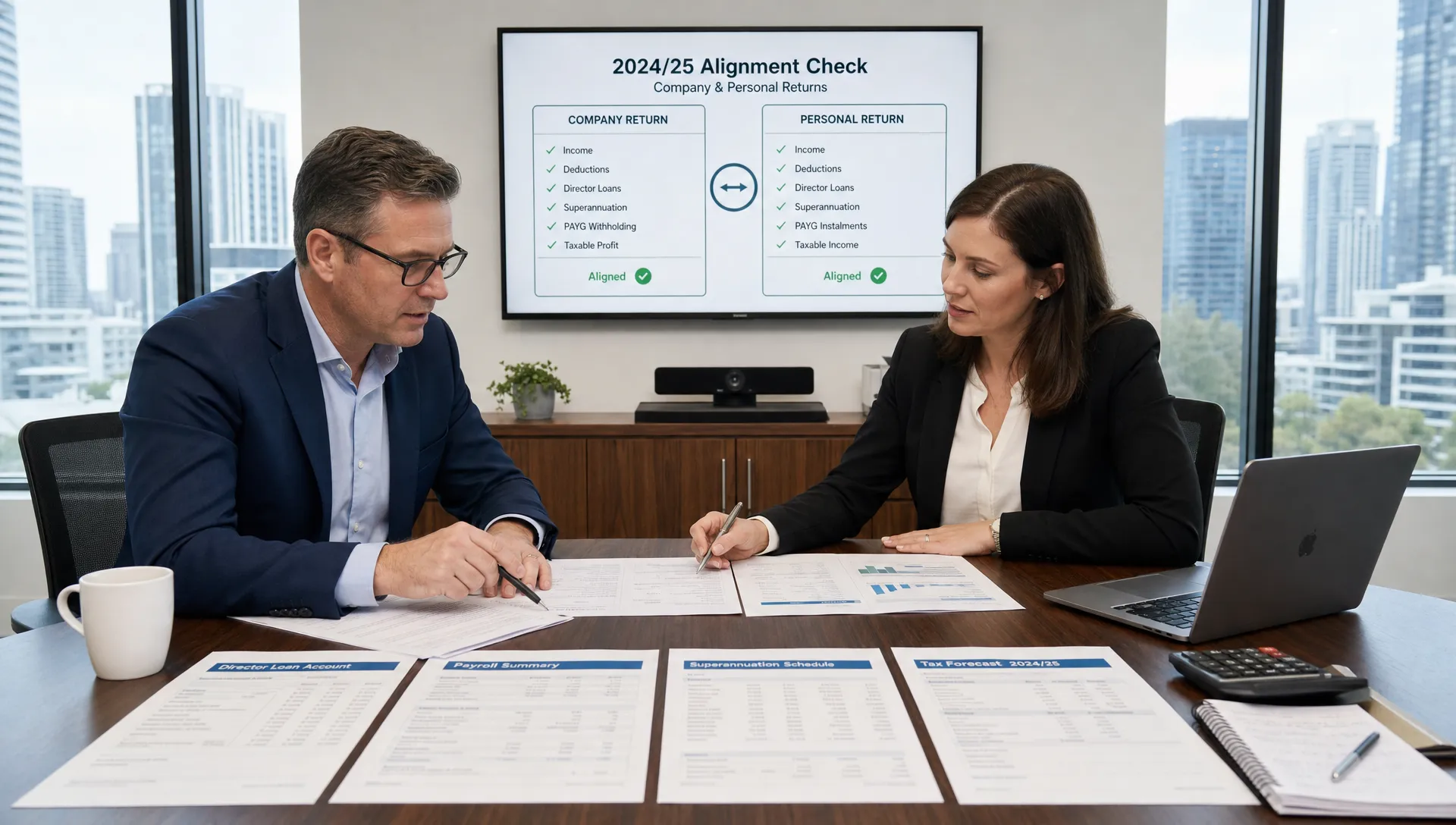
For Australian company directors, the annual tax return is not just a compliance document. It is a governance record, a cash flow planning tool and a risk signal to the ATO. When the company return, BAS, payroll, superannuation and director personal returns do not align, the issue is rarely confined to a single form.
In practical terms, the tax return policy Australia applies to directors is a self-assessment system backed by extensive data matching. The ATO receives information from banks, Single Touch Payroll, super funds, share registries, cryptocurrency platforms, property records and other government agencies. That makes accuracy a year-round discipline rather than a June or October exercise.
We approach director tax compliance as part of financial control. A well-prepared tax return should confirm that the business has reported correctly, paid key obligations on time and used its capital in a way that supports growth. For directors of SMEs, professional practices, property groups, technology companies and family-owned businesses, the rules below are the ones we would want reviewed before any return is lodged.
Start with the self-assessment framework
Australia’s tax system generally requires taxpayers to assess and disclose their own income, deductions and tax positions. The ATO can later review, amend and impose penalties or interest where a position is not reasonably supportable.
For directors, this matters because the company’s tax profile can affect personal risk. A director signs off on commercial decisions, oversees financial records and may be exposed to personal liability for certain company tax debts. Even where a registered tax agent prepares the return, directors cannot outsource governance entirely.
The practical standard is simple: if a transaction appears in the company’s accounts, there should be a clear tax treatment, supporting documentation and a commercial explanation. We see the strongest outcomes when directors treat the tax return as a board-level control process, not an annual administration task.
Rule 1: Separate the company return from the director’s personal return
A company is a separate legal taxpayer. It has its own Tax File Number, usually its own Australian Business Number and its own income tax return. The director, as an individual, also lodges a personal tax return that reports salary, director fees, dividends, trust distributions, rental income, capital gains, foreign income and other assessable income.
Problems arise when directors use company funds as if they were personal funds. Payments to personal credit cards, private travel, home renovations, family expenses or property deposits must be correctly classified. Depending on the facts, they may be salary, dividends, loans, reimbursements, fringe benefits or non-deductible drawings.
| Area | Company tax return impact | Director personal return impact | Director risk |
|---|---|---|---|
| Salary and director fees | Deduction if properly incurred and reported | Assessable income through STP reporting | PAYG withholding and super errors |
| Dividends | Franking account and retained earnings impact | Dividend income and franking credits | Incorrect franking or cash flow planning |
| Director loans | Division 7A review may be required | Possible deemed unfranked dividend | Personal tax liability and penalties |
| Business expenses | Deductibility and GST treatment must be supportable | Private component may be non-deductible or taxable | ATO adjustment risk |
| Payroll and super | PAYG, super and payroll records must reconcile | Salary data should match pre-fill information | Director penalty exposure |
Where companies sit within a wider structure involving trusts, SMSFs, property entities or investment companies, consistency becomes even more important. The tax return of one entity often creates income, deductions or balances in another.
Rule 2: Match company tax rates to remuneration strategy
For the 2025-26 income year, many Australian base rate entities are taxed at 25 percent, provided they meet the relevant aggregated turnover and passive income tests. Other companies are generally taxed at 30 percent. The rate matters, but it is only one part of the decision.
Directors often ask whether profits should be retained in the company, paid as salary, distributed as dividends or reinvested. The answer depends on personal marginal tax rates, franking credits, cash flow, superannuation strategy, lending requirements, asset protection, Division 7A exposure and future exit plans.
We do not view company tax as a standalone calculation. We model it alongside the director’s personal return, family group position and medium-term capital needs. For a broader overview of current rates, thresholds and planning considerations, we have outlined the key points in our guide to tax rates in Australia for 2026.
A director who focuses only on the company tax rate may save tax in one year but create a poor outcome later through trapped cash, unmanaged loans or inefficient dividend timing.
Rule 3: Reconcile BAS, GST and the company tax return
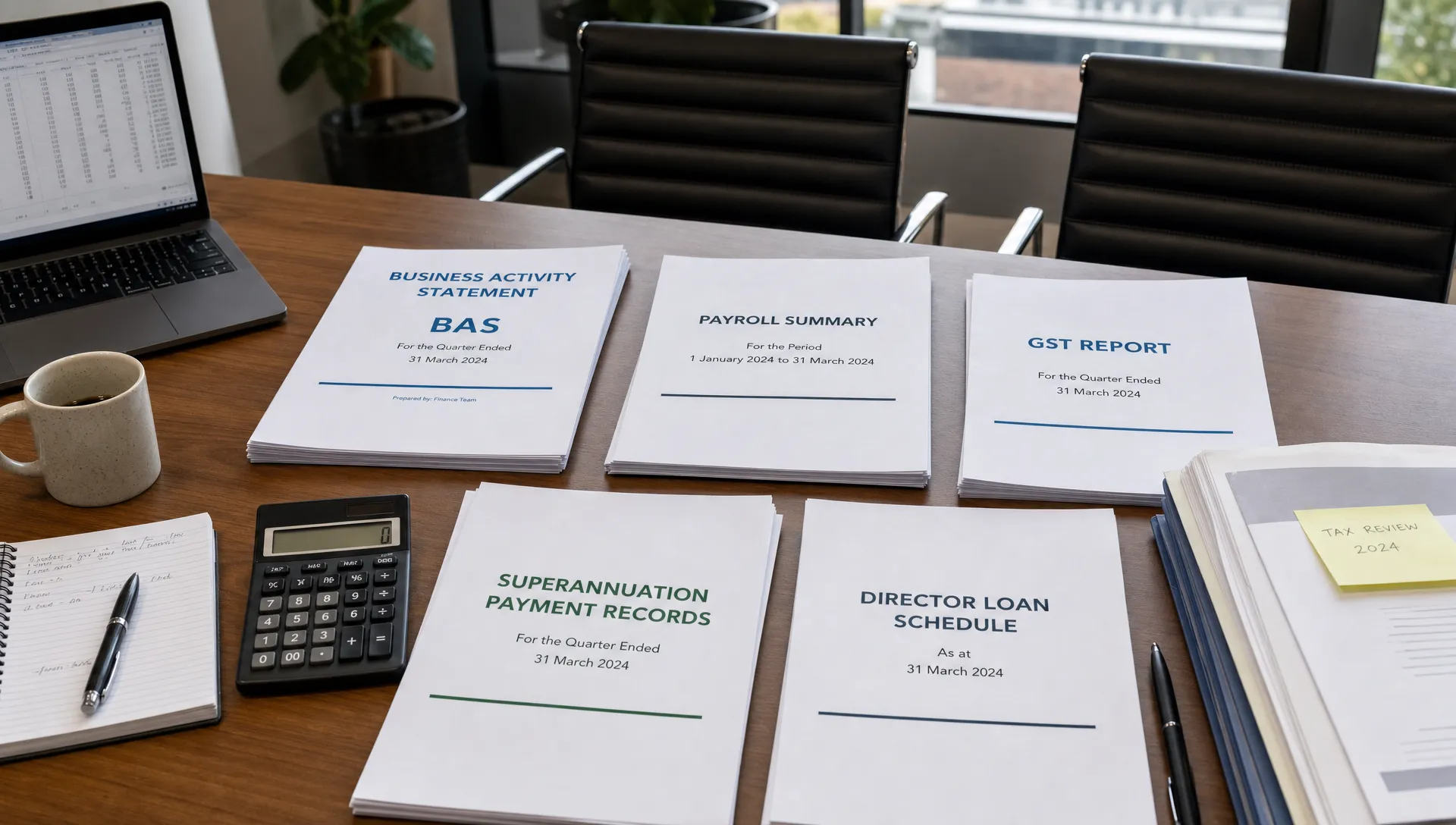
A company’s income tax return should reconcile to the BAS lodged during the year. The ATO can compare GST labels, PAYG withholding, taxable income, expense categories and payroll data. If BAS figures tell one story and the annual accounts tell another, the return becomes more likely to attract attention.
GST adds complexity because not every receipt is treated the same way. Businesses may have taxable sales, GST-free sales, input-taxed supplies, exports, reimbursements and mixed-use expenses. For example, a multi-location health provider, whether an allied health group or a dentist serving Ettalong and Kincumber, may need to distinguish between GST-free health services, taxable cosmetic services, payroll obligations and equipment claims.
This is where automation earns its place. Bank feeds, digital receipts and AI-assisted coding can reduce manual errors, but directors still need review controls. We recommend monthly reconciliation of GST payable or refundable, debtor balances, creditor balances and bank accounts. Leaving this until year-end increases the chance of duplicated income, missed expenses or incorrect GST claims.
We have also analysed common company tax return errors that trigger ATO attention, many of which start as small reconciliation gaps that compound over the year.
Rule 4: Director loans and Division 7A cannot be cleaned up casually
Division 7A is one of the most important private company tax rules for directors. Broadly, if a private company makes a loan, payment or debt forgiveness to a shareholder or an associate, the amount can be treated as an unfranked dividend unless it is repaid or placed under a complying loan arrangement within the required timeframe.
The risk is not limited to obvious loans. We regularly review balances that arise from director drawings, personal expenses paid by the company, related-party transfers, trust distributions and unpaid present entitlements. If these balances are not reviewed before lodgement, the tax cost can be significant.
A compliant Division 7A strategy requires more than a template loan agreement. Directors need to monitor minimum yearly repayments, interest, cash availability and the commercial reason for funds moving between entities. If the company is profitable but cash poor, the Division 7A position may expose a deeper working capital problem.
In our view, director loan accounts should be reviewed quarterly. AI-driven ledger monitoring can flag unusual withdrawals, related-party movements and balances that are trending toward risk before the tax return is prepared.
Rule 5: PAYG withholding, super and GST can become personal
Directors should never treat unpaid payroll or GST obligations as ordinary trade creditors. Under the director penalty regime, the ATO can pursue directors personally for certain unpaid company liabilities, including PAYG withholding, GST and Superannuation Guarantee Charge.
The timing of reporting matters. In some cases, prompt reporting may preserve options to remit a director penalty by taking action within the required timeframe. Where liabilities are reported late or remain unpaid for too long, the ATO may issue a lockdown Director Penalty Notice, which can remove practical escape routes such as administration or liquidation.
Superannuation deserves particular attention. The Superannuation Guarantee rate is 12 percent from 1 July 2025. Late super is not merely a timing issue. It can create Superannuation Guarantee Charge liabilities, lost deductions and director penalty exposure.
For amounts incurred from 1 July 2025, deductions for ATO general interest charge and shortfall interest charge are no longer available. That makes late payment and tax shortfalls more expensive from a cash flow perspective. Directors should build tax payment planning into rolling forecasts rather than treating ATO debt as flexible funding.
Rule 6: Personal Services Income rules can override the company structure
Many directors operate through companies in consulting, technology, creative, medical, legal, engineering and professional services sectors. A company structure does not automatically convert personal labour income into ordinary business profit.
The Personal Services Income rules may apply where income is mainly a reward for an individual’s personal efforts or skills. If the company does not satisfy the relevant tests or qualify as a personal services business, income may be attributed to the individual and certain deductions may be restricted.
This is a major issue for IT consultants, contractors, design professionals, locum practitioners, marketing consultants and other founder-led service businesses. We review contracts, invoicing patterns, client concentration, employee involvement, business premises, delegation and commercial risk. The tax return must reflect the substance of the arrangement, not just the legal structure.
Directors seeking to scale should view PSI risk strategically. If the goal is to build a saleable business, the operating model should not depend solely on the personal labour of one individual. Tax compliance and business value are connected.
Rule 7: FBT, cars and director benefits need early review
Fringe Benefits Tax operates on a separate year from 1 April to 31 March. Directors often overlook FBT because benefits may not look like salary. Company cars, car parking, entertainment, expense reimbursements, low-interest loans, housing support and private use of assets can all require review.
A vehicle used by a director is a common risk area. Logbooks, odometer records, business-use percentages and employee declarations should be maintained before the return is due. Reconstructing them later is rarely reliable.
Some benefits may be exempt or concessional if strict conditions are met. For example, certain work-related items or eligible low or zero emission vehicles may receive favourable treatment. The decision should be documented, particularly where a benefit is provided to a director or an associate.
FBT also affects income tax deductions, GST credits, payroll reporting and reportable fringe benefits. When we prepare year-end tax positions, we include FBT as part of the whole remuneration framework rather than a separate compliance problem.
Rule 8: Asset purchases and deductions need timing, evidence and commercial logic
Directors often accelerate purchases close to 30 June in the hope of reducing taxable income. That can be effective in some cases, but only when the asset is genuinely acquired, installed or ready for use within the relevant rules and the deduction method is available for that income year.
Capital allowances, depreciation, instant asset write-off rules and small business concessions can change. We therefore avoid generic advice such as “buy before 30 June” unless the director’s facts are clear. A rushed purchase that weakens cash flow or creates unused capacity may be poor strategy even if it produces a deduction.
Documentation matters. Invoices, finance contracts, delivery records, asset registers and usage records should support the claim. Repairs must be distinguished from capital improvements. Software subscriptions, development costs, plant and equipment, motor vehicles and fit-outs can all have different tax treatment.
For directors managing expansion, we connect asset planning to financing, debt covenants, GST cash flow and projected return on capital. A tax deduction should support a commercial decision, not justify one after the fact.
Rule 9: Losses, dividends and franking accounts must be monitored
Tax losses can be valuable, but companies must satisfy continuity of ownership or business continuity requirements before using them. Changes in shareholders, restructures, capital raises, mergers and succession events can affect whether prior-year losses remain available.
Franking accounts also require discipline. When a company pays franked dividends, it passes franking credits to shareholders. If the company over-franks or mismanages its franking account, it may face franking deficit tax or other adjustments.
For high-net-worth groups and family businesses, dividend strategy should be planned across the company, trust and individual levels. Directors should consider cash flow, franking credit availability, shareholder tax profiles and future transactions.
If you are preparing for growth, restructuring or succession, our article on company taxes in Australia and planning tips for directors expands on how to approach these issues before year-end.
Rule 10: Lodgement dates are not the same for every company
Company tax return due dates depend on the company’s circumstances, prior lodgement history, size, tax agent status and ATO lodgement program. Directors should not assume that the same date applies across all entities in a group.
Late lodgement can affect more than penalties. It may damage the company’s standing with the ATO, reduce access to favourable payment arrangements and increase audit risk. Late returns can also delay finance approvals, grant applications, tender submissions and due diligence for investors or purchasers.
We recommend maintaining an internal tax calendar that sits ahead of ATO deadlines. That calendar should include BAS, payroll, superannuation, FBT, income tax instalments, tax return preparation, ASIC obligations and board review points.
A disciplined lodgement calendar also improves strategic visibility. Directors can make decisions about dividends, staffing, debt reduction, acquisitions and capital expenditure using current data rather than historical estimates.
How digital workflows improve director tax governance
Modern tax compliance is no longer built around a shoebox of receipts and a spreadsheet at year-end. Directors now need real-time visibility across cash flow, tax liabilities, payroll, GST, debtors, creditors and related-party balances.
Our team uses AI-driven automation to streamline data capture, improve coding consistency and identify anomalies earlier. That does not remove professional judgement. It gives our accountants and strategic advisers better information, faster, so we can focus on interpretation, risk management and corporate growth.
For directors operating across Adelaide, Sydney, Melbourne and other Australian locations, integrated digital workflows also reduce fragmentation. Multi-city businesses need one source of truth for tax, BAS, payroll and management reporting. Without that, directors can make decisions based on incomplete or inconsistent financial data.
The strongest director tax process combines automation with senior review. Technology should surface the risk. A Chartered Accountant should interpret it in the context of the company’s strategy, structure and obligations.
Director tax return readiness checklist
Before lodging a company tax return, directors should confirm the following items have been reviewed:
- Bank accounts, credit cards, loan accounts and clearing accounts are fully reconciled.
- BAS figures reconcile to the profit and loss statement and balance sheet.
- PAYG withholding, STP reporting, wages and superannuation records agree.
- Director loans and related-party balances have been reviewed for Division 7A.
- FBT exposure has been assessed for cars, entertainment and private benefits.
- Asset purchases, depreciation and disposals are supported by evidence.
- Dividends, franking credits and retained earnings have been checked.
- Trust distributions, SMSF transactions and investment income are consistent across entities.
- Personal returns for directors reflect salary, dividends, capital gains and other income correctly.
- The company’s tax position has been considered against cash flow and growth plans.
This checklist is not just about avoiding penalties. It creates the financial clarity directors need to allocate capital, manage risk and plan with confidence.
Frequently Asked Questions
Do company directors need to lodge both a company tax return and a personal tax return? Yes. The company lodges its own tax return as a separate taxpayer, and the director lodges an individual return for personal income such as salary, director fees, dividends, trust distributions, capital gains and investment income.
Can the ATO make a director personally liable for company tax debts? In certain cases, yes. The director penalty regime can make directors personally liable for unpaid PAYG withholding, GST and Superannuation Guarantee Charge. Early reporting and payment planning are critical.
Are director loans automatically taxable? Not automatically, but they are high risk. A private company loan, payment or debt forgiveness involving a shareholder or associate may be treated as an unfranked dividend under Division 7A unless properly managed.
What records should directors keep for tax return purposes? Directors should keep invoices, contracts, bank records, payroll reports, BAS reconciliations, superannuation records, FBT evidence, loan agreements, asset registers and board minutes. Most tax records must generally be kept for at least five years.
How does automation help with Australian tax returns? Automation improves speed, consistency and visibility. It can help identify coding errors, unreconciled balances and unusual transactions earlier, allowing directors and advisers to address issues before lodgement.
Next steps for directors
If you are a company director, we recommend treating your next tax return as a governance review. Start with the company’s accounts, then connect BAS, payroll, superannuation, FBT, Division 7A, personal remuneration and cash flow forecasting.
Our team at Perfect Accounting & Tax Services supports directors, business owners and high-net-worth individuals across Australia with integrated tax, accounting and strategic advisory services. We combine 25 years of professional experience with AI-driven workflows to deliver greater accuracy, faster turnaround and clearer real-time financial visibility.
We work with clients across Adelaide, Sydney and Melbourne, including SMEs, professional practices, property groups, technology companies and national businesses. If you want to move beyond annual compliance and build a stronger financial control environment, contact our firm for a consultation and ask us about our automated accounting workflows.