
Lodging a tax return from home is now normal for many Australian taxpayers. For business owners, directors and investors, however, the question is not simply whether it is convenient. The real question is whether the return can be lodged securely, accurately and with enough evidence to withstand ATO review.
Our view is straightforward: yes, you can lodge your tax return from home safely, provided the process is controlled. A home lodgement becomes risky when security is loose, records are incomplete or complex tax matters are compressed into a last-minute online submission.
For a salary earner with straightforward income, ATO myTax may be appropriate. For a company director, trust beneficiary, landlord, SMSF trustee, crypto investor or business owner with BAS, GST, payroll, Superannuation and asset transactions, safe lodgement requires more than access to a laptop. It requires a disciplined pre-lodgement review.
What “safe” really means when lodging from home
A safe home lodgement has three dimensions.
First, there is cyber safety. Your TFN, identity details, bank account information, payroll data, investment records and business financials are highly sensitive. If those details are exposed, the damage can extend well beyond one tax return.
Second, there is tax accuracy. ATO pre-fill data is useful, but it is not a substitute for professional review. It may be incomplete, delayed or unable to identify whether a deduction is properly substantiated. For businesses, the key issue is often not one missing receipt, but whether GST, payroll, director drawings and profit allocations reconcile across the full financial system.
Third, there is audit readiness. A return is not safe just because the ATO accepts it on lodgement day. The stronger test is whether every material claim can be explained with records, working papers and commercial logic if the ATO reviews it later.
That is why we treat tax return at home lodgement as a digital workflow, not a casual online task.
The main risks of lodging a tax return from home
For professionals and business owners, the most common risks are predictable. They usually arise from rushed preparation, weak digital controls or over-reliance on pre-filled information.
| Risk area | Why it matters | Practical control |
|---|---|---|
| Identity security | TFN and myGov access can be targeted by phishing and credential theft | Use strong passwords, multi-factor authentication and secure networks |
| Incomplete ATO pre-fill | Some income or deductions may not appear, or may appear late | Reconcile against bank feeds, payroll records, investment statements and source documents |
| Home office claims | Work-from-home expenses require evidence and correct apportionment | Keep diaries, invoices and clear calculations based on current ATO guidance |
| Business and BAS mismatches | GST, BAS and income tax data must align | Reconcile bookkeeping files before lodging |
| Payroll and super errors | STP, PAYG withholding and Superannuation obligations can affect deductions and compliance | Review payroll reports, STP finalisation and super payment timing |
| Investment complexity | Shares, crypto, rental properties and employee share schemes can trigger CGT or income issues | Maintain transaction histories and cost base records |
| Director and trust issues | Division 7A, distributions and loans need technical review | Prepare working papers before lodgement, not after ATO questions arise |
A careful process turns these risks into manageable checks. A rushed process turns them into exposure.
Is ATO myTax safe for lodging from home?
ATO myTax is a secure government system and can be suitable for simple individual returns. The safety issue is usually not the platform itself. It is whether the taxpayer understands what has been pre-filled, what has not been captured and what needs manual adjustment.
For example, interest, dividends, private health insurance and salary information may be pre-filled. Rental property expenses, business deductions, work-related claims, foreign income, crypto disposals and capital gains often require deeper review. ATO data-matching capabilities are sophisticated, so inconsistencies between your return and third-party data can trigger follow-up.
We generally consider DIY myTax more appropriate where income is simple, deductions are modest and there are no business, investment or entity issues. If you are deciding whether to lodge yourself or seek help, our separate guide on when to DIY myTax and when to get help sets out the decision points in more detail.
For business owners and high-net-worth individuals, the lodgement platform is only the final step. The real work happens before submission.
A secure home lodgement checklist
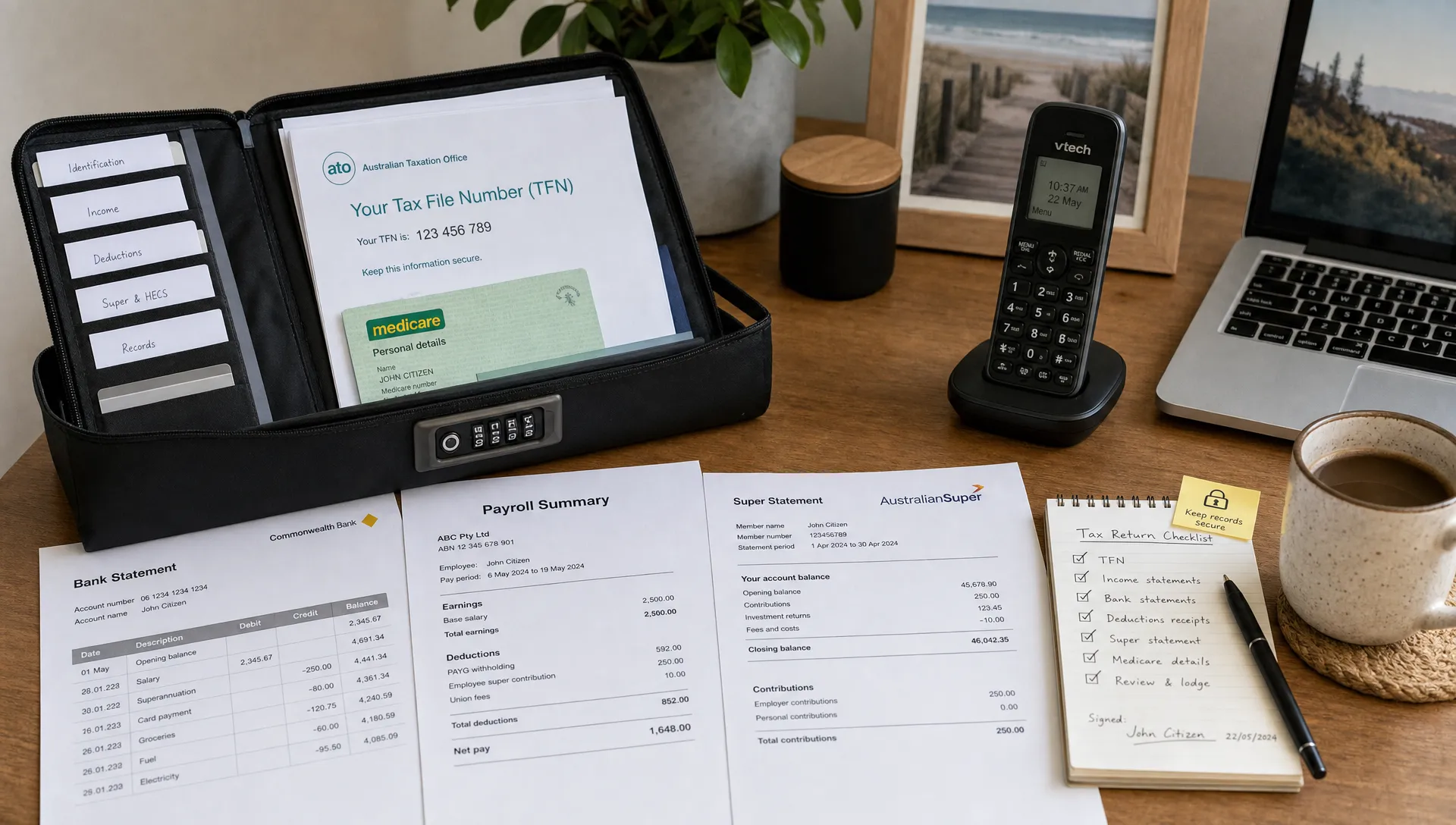
Before lodging from home, we recommend applying a structured checklist. This is not only about avoiding ATO attention. It is about creating reliable financial information for decision-making.
- Use a private, password-protected internet connection rather than public Wi-Fi.
- Confirm you are accessing ATO services through your myGov account or a secure registered tax agent process.
- Enable multi-factor authentication on myGov, email and accounting software.
- Avoid opening tax-related links from unexpected emails or SMS messages.
- Reconcile income against bank accounts, payroll records, platform statements and investment reports.
- Check deductions against invoices, receipts, diaries and business-use calculations.
- Review BAS, GST, payroll, STP and super records before finalising business income.
- Save copies of calculations, reports and supporting documents in a secure digital folder.
- Confirm bank account details before submission or refund release.
- Seek advice before lodging if there are capital gains, foreign income, trusts, companies, SMSFs or amended prior-year issues.
The strongest safeguard is evidence. We prefer to verify before we lodge, because correction after lodgement can be costly, slow and commercially disruptive.

Why diagnosis matters before lodgement
A safe tax return starts with diagnosis. We need to understand what actually happened during the financial year before we decide how it should be reported.
That principle applies across many professional services. For example, licensed drain specialists who inspect before recommending work demonstrate a useful evidence-first approach: inspect the condition, identify the cause, then recommend the solution. In tax, we apply the same discipline. We review the records, identify mismatches, test the assumptions and only then prepare the lodgement position.
This matters because the same bank transaction can have different tax treatments depending on context. A payment to a contractor may raise GST, PAYG withholding or super questions. A transfer to a director may be a reimbursement, wage, dividend, loan or Division 7A issue. A property expense may be deductible, capital in nature or subject to apportionment.
Home lodgement is safe when these distinctions are reviewed before submission.
Work-from-home deductions need careful handling
For many professionals, the phrase “tax return at home” also raises work-from-home deductions. This area is regularly misunderstood.
The ATO allows work-from-home deductions where there is a genuine connection to earning assessable income and the taxpayer keeps appropriate records. Depending on the circumstances, taxpayers may use a fixed rate method or an actual cost method. The right approach depends on current ATO rules, the type of work performed, the expenses incurred and the quality of evidence available.
For employees, common issues include home internet, electricity, phone use, stationery and depreciating assets such as office furniture or equipment. For business owners, the analysis can be broader, particularly where a home is also a principal place of business. Occupancy expenses, business-use apportionment and potential CGT implications require care.
We do not recommend guessing a percentage or recycling last year’s claim without review. A better approach is to maintain a work diary, preserve invoices and separate private use from income-producing use. If you operate through a company or trust, the treatment of home office costs should also align with your entity structure and reimbursement arrangements.
When professional help is safer than DIY lodgement
Professional help is not necessary for every taxpayer. It becomes strategically sensible when complexity, risk or opportunity increases.
| Situation | Home DIY may be reasonable | Professional review is safer |
|---|---|---|
| Salary and wages only | Yes, if pre-fill is complete and deductions are simple | If work-related claims are high or poorly documented |
| Sole trader income | Sometimes, if records are clean and GST does not apply | If there are BAS, GST, assets, losses or contractor issues |
| Company director | Rarely as a purely DIY exercise | Usually, due to loans, payroll, dividends and company tax interaction |
| Rental property investor | Sometimes for one simple property | If there are renovations, refinancing, short-stay income, CGT or mixed use |
| Trust beneficiary | Usually requires review | Distributions and streaming should be checked before lodgement |
| SMSF trustee | Not suitable for casual DIY | Compliance and audit requirements need specialist handling |
| Crypto or share investor | Simple holdings may be manageable | Active trading, DeFi, employee share schemes or CGT events need analysis |
| Late tax filer | Risk depends on years outstanding | Professional support helps manage ATO communication and penalties |
If you want to understand when a tax return becomes more than a compliance task, our article on when tax return filing services make strategic sense explains the commercial threshold.
Business owners need to reconcile beyond the return
For companies, trusts and sole traders, the income tax return is only one output of the financial system. It should reconcile with BAS lodgements, accounting software, payroll, bank feeds, invoices, inventory records and asset registers.
This is where many home lodgements fail. The return may be completed, but the underlying financial architecture remains inconsistent. GST may have been coded incorrectly. Director drawings may sit unreconciled. Superannuation may have been paid late. Work-in-progress may not be properly recognised. Private expenses may have slipped into business accounts.
From our perspective, the tax return should be a strategic checkpoint. It should help clarify margins, cash flow, tax provisioning and growth capacity. Accurate compliance becomes the foundation for better advisory decisions.
That is why our team uses digital workflows and AI-driven automation to improve speed, reduce manual error and identify anomalies earlier. Automation does not replace professional judgement. It gives us cleaner data, faster reconciliation and better visibility, so our advisory discussions are based on the real position of the business.
How a registered tax agent can support remote lodgement
A registered tax agent can help you lodge from home without treating the process as DIY. The difference is that preparation, review, communication and lodgement occur through secure professional channels.
For business clients, the ATO’s agent nomination and online services framework can also affect how an accountant is authorised to act. If you want a clearer understanding of how the ATO Tax Agent Portal works in practice, we have prepared a guide to the ATO Tax Agent Portal for Australian taxpayers and businesses.
A well-managed remote process should include identity verification, document collection, accounting file review, deduction testing, tax estimate preparation, approval before lodgement and secure record storage. For more complex clients, it should also include forward planning for PAYG instalments, cash flow, company tax, trust distributions and asset strategy.
Our integrated team supports clients across Australia, with service capability across Adelaide, Sydney and Melbourne. That national structure matters for growing businesses with cross-state payroll, multi-location operations, property portfolios or directors working remotely.
Red flags that make home lodgement unsafe
We would pause before lodging from home if any of the following apply:
- You have not reconciled bank accounts to 30 June.
- Your BAS reports do not match your accounting profit and loss.
- You have director loans, shareholder drawings or unpaid present entitlements.
- You sold shares, crypto, property or business assets during the year.
- You received foreign income or hold offshore assets.
- You changed business structure, brought in a partner or acquired another business.
- You have late returns, ATO debt or an audit letter.
- Your payroll, STP or super records are incomplete.
- You claimed significant work-from-home or motor vehicle deductions without records.
- You are unsure whether a cost is deductible, capital or private.
In these cases, the risk is not that you are lodging from home. The risk is that you are lodging without a complete technical review.
A practical process for safe tax return at home lodgement
We recommend a staged approach.
- Secure the access point: Confirm your device, email, myGov access and accounting software logins are protected with strong authentication.
- Collect source data: Download bank statements, payroll reports, investment statements, loan summaries, invoices, receipts and platform income reports.
- Reconcile before calculating: Match accounting records to bank feeds, BAS lodgements, payroll reports and year-end balances.
- Review tax treatments: Check deductions, home office claims, depreciation, CGT events, GST coding, super timing and entity-specific issues.
- Prepare a tax estimate: Understand the likely refund, payable amount or instalment impact before lodgement.
- Document the position: Save calculation notes and evidence so the file is defensible if the ATO reviews it later.
- Lodge through the right channel: Use myTax for simple returns or a registered tax agent process for complex personal, business or investment matters.
- Plan forward: Use the completed return to improve cash flow forecasting, tax provisioning and business strategy for the next year.
The final step is often the most valuable. A completed return should not sit in a drawer. It should inform pricing, asset purchases, financing decisions, succession planning and corporate growth.
Frequently Asked Questions
Can I lodge my tax return from home in Australia? Yes. Individuals can lodge through ATO myTax using myGov, or they can work remotely with a registered tax agent. The key is to use secure access, complete records and a review process suited to your level of complexity.
Is it safe to give my accountant documents online? It can be safe if the accountant uses secure document collection, identity verification and controlled communication channels. We do not recommend sending sensitive TFN, bank or payroll information through unsecured email without appropriate safeguards.
Should business owners lodge their own tax return at home? Some sole traders with simple records may manage their own lodgement, but company directors, trustees, employers, landlords and investors usually benefit from professional review. The risk is often in GST, payroll, CGT, Division 7A, trust distributions or incomplete reconciliations.
Does ATO pre-fill mean my return is already correct? No. Pre-fill is helpful, but it does not confirm that all income, deductions or tax adjustments are complete. It also does not assess whether your claims are substantiated or whether business records reconcile.
What records should I keep if I claim work-from-home expenses? Keep invoices, receipts, diary records, usage calculations and evidence showing the connection between the expense and your income. The correct method depends on your circumstances and current ATO requirements.
Can a tax agent help if I am interstate or overseas? Yes. Remote tax support is common, provided identity, authorisation and document workflows are managed securely. Our team supports clients nationally, including across Adelaide, Sydney and Melbourne.
Next steps: lodge from home with stronger controls
If you want to lodge from home safely, do not treat the return as a one-off form. Treat it as a controlled financial review.
Our team can help you assess whether DIY lodgement is appropriate, identify risk areas before submission and implement automated accounting workflows that improve accuracy throughout the year. For business owners, directors and high-net-worth individuals, we connect tax compliance with strategic advisory, cash flow management and long-term growth planning.
Contact Perfect Accounting & Tax Services to arrange a consultation with our Australian tax and accounting team. We can help you lodge securely, strengthen your records and build a more intelligent financial workflow for the year ahead.