

Business exits are not decided by headline sale price alone. In Australia, the interaction between company tax and personal tax often determines how much value owners actually keep after a sale, succession event, merger, restructure or wind-up. A transaction that looks attractive at enterprise value level can produce a very different outcome once CGT, Division 7A, franking credits, GST, superannuation and personal marginal rates are modelled properly.
We approach exit planning as a strategic advisory process, not an end-of-year tax exercise. For company directors, family-owned businesses, property groups, professional practices and high-net-worth shareholders, the right exit structure needs to be designed well before negotiations start. Clean accounting records, accurate BAS reporting and AI-driven tax modelling give owners the visibility to compare options before the ATO, a buyer or a financier starts asking difficult questions.
Why company tax and personal tax belong in the same exit model
A business exit usually creates tax consequences at two levels. The company may realise income, capital gains, balancing adjustments or GST outcomes. The owner may later receive dividends, capital proceeds, trust distributions, director loan repayments or superannuation contributions. Those layers must be assessed together because cash does not move from business value to personal wealth without tax friction.
In practical terms, company tax and personal tax should be modelled across the full transaction path. We do not only ask, “What tax will the company pay?” We ask, “What will the director, shareholder, partner or family group retain after all distributions, CGT concessions, debt repayments and future compliance obligations are dealt with?”
The company layer sets the transaction economics
At company level, the tax result depends on whether the exit involves an asset sale, share sale, business restructure, succession plan or staged divestment. A company selling business assets may pay tax on taxable income and capital gains before funds are extracted by shareholders. A company whose shareholders sell shares may not itself pay tax on the sale, but the buyer will scrutinise historical BAS, payroll, FBT, superannuation, director loans and ATO lodgement history.
The personal layer determines retained wealth
At personal level, the owner’s outcome depends on share ownership, cost base, residency, personal marginal rates, trust structures, superannuation strategy and access to CGT concessions. For owners with investment properties, foreign income, SMSFs, crypto portfolios or family trusts, exit proceeds can interact with an already complex tax profile. That is why we treat exit planning as a whole-of-wealth exercise.
Exit structure: asset sale, share sale or staged succession
The structure of the deal is usually the first major tax decision. Buyers often prefer asset purchases because they can select what they acquire and reduce inherited liabilities. Sellers often prefer share sales because they may access capital treatment and avoid transferring each individual asset. Neither option is automatically better.
When we compare exit structures, company tax and personal tax need to be tested against commercial reality. A lower sale price with cleaner tax outcomes may outperform a higher price that triggers trapped profits, adverse GST treatment, Division 7A complications or delayed earn-out tax issues.
| Exit pathway | Company level considerations | Owner level considerations | Strategic risk |
|---|---|---|---|
| Asset sale | Tax on trading profits, capital gains, depreciating asset adjustments, GST treatment | Later extraction of funds through dividends, capital returns or loan repayments | Double tax leakage if distributions are not planned |
| Share sale | Historical company tax, BAS, payroll, superannuation and FBT exposure reviewed by buyer | CGT on shares, small business CGT concessions, residency and cost base | Buyer may discount price for inherited compliance risk |
| Family succession | Valuation, debt forgiveness, asset transfers and possible CGT events | Estate planning, trust distributions, superannuation and beneficiary outcomes | Poor documentation can create ATO and family dispute risk |
| Management buyout | Vendor finance, earn-outs and working capital adjustments | Timing of proceeds, personal tax rates and retirement planning | Deferred payments may not align with tax liabilities |
Asset sales can create a second tax event
In an asset sale, the company may pay tax first. The remaining cash still belongs to the company until distributed or otherwise dealt with. If funds are later paid to shareholders, the payment may be a dividend, franked dividend, return of capital, loan repayment or liquidation distribution. Each category has different tax consequences.
This is where exit planning often fails. A director may negotiate a good price for plant, goodwill, customer contracts or intellectual property, then discover that extracting the proceeds personally is less efficient than expected. Early modelling helps us assess whether a pre-sale restructure, dividend strategy or liquidation pathway is appropriate.
Share sales shift the spotlight to due diligence
In a share sale, the buyer acquires the company with its history attached. That means company tax returns, BAS lodgements, Single Touch Payroll, superannuation guarantee, FBT, GST coding and director loan accounts become negotiation points. A buyer may seek warranties, indemnities or price reductions if records are incomplete.
For directors preparing for a share sale, our broader company tax planning tips for directors are a useful starting point because governance discipline before a transaction often protects valuation during due diligence.
Hidden tax items that reduce exit proceeds
The headline sale agreement rarely shows the full tax cost. We regularly see exit value reduced by unresolved shareholder loans, inaccurate GST treatment, unfranked profit extraction, unpaid superannuation, unrecognised FBT exposure or poor documentation of asset cost bases.
At this stage, company tax and personal tax modelling should move from broad estimates to scenario-based forecasting. We use structured data, reconciled ledgers and automation-assisted review processes to identify issues that can affect the sale price, settlement mechanics and the owner’s net position.
Division 7A and director loans
Division 7A is a common exit planning issue for private companies. If shareholders or associates have received loans, payments or forgiven debts from the company, those amounts may be treated as unfranked dividends unless properly managed. The ATO’s guidance on Division 7A is particularly relevant before a business sale because buyers and advisers will review related-party balances closely.
Before an exit, we review loan agreements, minimum yearly repayments, interest calculations and historical movements. Cleaning up director loan accounts late can be costly, especially if the company’s cash flow has already been committed to transaction expenses or debt reduction.
Small business CGT concessions
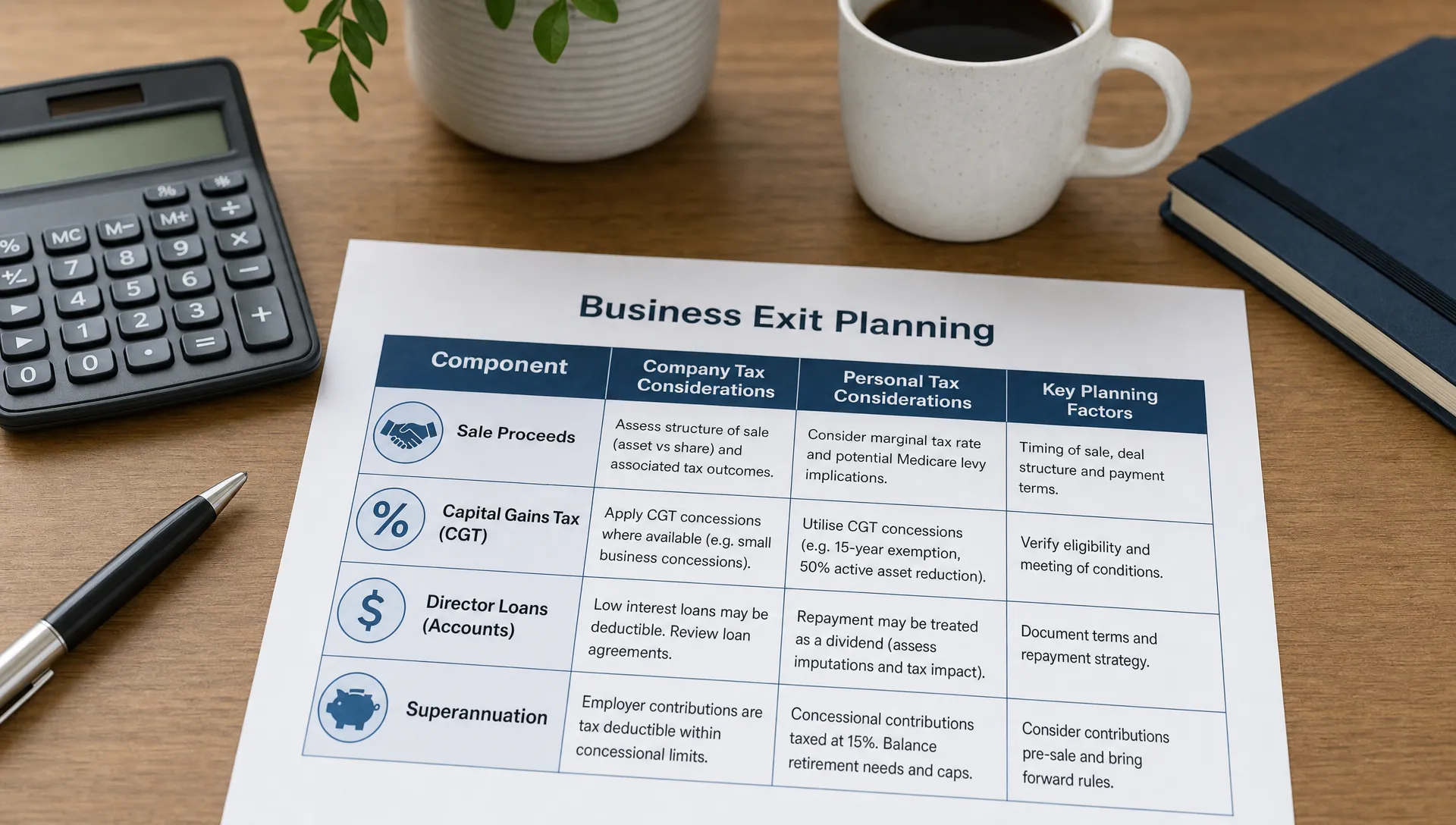
The small business CGT concessions can materially improve an owner’s after-tax result if eligibility conditions are met. The concessions can include the 15-year exemption, 50 percent active asset reduction, retirement exemption and rollover. Eligibility depends on factors such as turnover, net asset values, active asset tests, ownership periods and significant individual rules.
The ATO small business CGT concessions are technical and should be tested before a term sheet is signed. A small change in timing, ownership or asset mix can affect eligibility.
GST, going concern rules and settlement clauses
GST can be overlooked when parties focus on income tax. A sale of a business may be GST-free as a going concern if specific conditions are satisfied, including agreement in writing and the supply of everything necessary for the continued operation of the enterprise. The ATO provides detailed guidance on GST and the sale of a going concern.
Incorrect GST clauses can affect cash flow at settlement, BAS reporting and working capital adjustments. We prefer to review GST treatment before contracts are finalised, not after settlement when corrections are harder to negotiate.
Personal tax pressure points for owners and directors
For high-net-worth owners, company tax and personal tax planning often extends beyond the business itself. Sale proceeds may alter family trust distributions, Medicare levy surcharge exposure, Division 293 tax, investment income, SMSF strategy and estate planning. A transaction can also affect asset protection and future borrowing capacity.
A strong personal tax strategy considers the owner’s expected income across multiple years. If the deal includes an earn-out, vendor finance, restraint payment, employment contract or consulting arrangement, the timing and character of each payment must be separated. Not all receipts are capital in nature, and not all receipts qualify for concessional treatment.
Trusts, family groups and complex income
Many established Australian businesses operate through company and trust structures. These arrangements can be effective, but they require disciplined distribution resolutions, beneficiary loan management, TFN reporting and documentation. If an exit produces a large taxable gain, the trust deed, family group structure and beneficiary tax profiles need to be reviewed early.
Owners with multiple income sources should also consider how business exit proceeds interact with investment income, property gains, foreign income and SMSF interests. Our article on how personal tax accountants help with complex income explores this broader personal tax environment in more detail.
Superannuation and retirement planning
For some owners, a business exit is also a retirement event. Superannuation contributions may form part of the strategy, particularly where CGT retirement exemption rules are relevant. However, contribution caps, age-based rules, total super balance limits and timing requirements need careful management.
We do not treat superannuation as a last-minute parking place for sale proceeds. It should be integrated with CGT planning, cash flow needs, estate planning and the owner’s post-exit investment strategy.
Digital modelling improves exit readiness
Clean data allows company tax and personal tax assumptions to be tested before decisions become irreversible. Our team uses AI-driven accounting workflows to reconcile transactions, identify unusual ledger movements, review GST coding, detect payroll anomalies and surface tax risks earlier than traditional manual review cycles.
This is not automation for its own sake. Better data gives directors better negotiation power. If a buyer requests due diligence files, a clean digital accounting environment can help support valuation, reduce uncertainty and shorten response times. It also helps owners understand the likely after-tax outcome of different deal structures in real time.
What we review before an exit process begins
Before a business goes to market, we typically review the company’s lodgement history, BAS reconciliations, payroll and superannuation compliance, FBT exposure, fixed asset registers, related-party transactions, retained earnings, franking account and shareholder loan accounts. We also assess whether management accounts align with tax returns and whether add-backs used in valuation are properly supported.
If the business has recently restructured, expanded interstate, acquired another entity or changed ownership, the tax file should be reviewed before any exit conversation begins. Our guide on planning company tax filing after a major business change explains why those events can affect future reporting and transaction readiness.
Timing: what to address 12 to 24 months before exit
In our experience, company tax and personal tax planning is most effective when it begins at least 12 to 24 months before a proposed exit. Some issues, such as CGT concession eligibility, ownership structures, related-party balances and business valuation evidence, cannot always be fixed quickly.
The pre-exit period should be used to strengthen financial reporting, remove avoidable ATO risk and improve the quality of earnings presented to buyers. For larger SMEs and corporate groups, this may also involve virtual CFO support, board reporting, cash flow forecasting and internal control improvements.
| Timing | Strategic focus | Tax and accounting actions |
|---|---|---|
| 24 months before exit | Structure review | Assess asset ownership, trust deeds, shareholder agreements and CGT concession eligibility |
| 18 months before exit | Compliance clean-up | Reconcile BAS, payroll, superannuation, FBT, Division 7A and director loan accounts |
| 12 months before exit | Valuation readiness | Align management accounts, normalise earnings and document add-backs |
| 6 months before exit | Transaction modelling | Compare asset sale, share sale, earn-out, vendor finance and succession scenarios |
| Settlement period | Execution | Review contracts, GST clauses, completion accounts and post-sale distribution strategy |
Common exit scenarios we see in Australia
Business exits are not limited to a full third-party sale. We support directors and owners across Adelaide, Sydney, Melbourne and regional Australia through a range of transition events, including family succession, partner buyouts, shareholder disputes, business mergers, property development wind-ups and sale preparation for national expansion.
Each scenario creates different tax priorities. A family succession may require valuation evidence and estate planning. A professional practice sale may involve goodwill, restraint payments and deferred consideration. A property development exit may involve GST margin scheme issues, income versus capital classification and financing arrangements. A tech or SaaS exit may require careful review of intellectual property ownership, employee share arrangements and R&D documentation.
For owners operating across multiple states, payroll tax, workers compensation, land tax and state-based duties can also influence exit economics. Federal income tax is central, but it is not the only consideration.
Frequently Asked Questions
When should we start tax planning for a business exit? We recommend starting 12 to 24 months before a planned exit. Earlier planning gives us time to review structure, CGT concessions, Division 7A, GST, BAS, superannuation and financial reporting quality before a buyer or successor becomes involved.
Is an asset sale or share sale better for tax? It depends on the company’s assets, liabilities, retained profits, shareholder cost base, buyer requirements and eligibility for concessions. An asset sale may suit a buyer, but a share sale may produce a better result for some sellers. The after-tax outcome must be modelled.
How do company tax and personal tax affect the final sale proceeds? Company tax can reduce cash inside the entity before funds reach owners. Personal tax can then apply when owners sell shares, receive dividends, access trust distributions or extract proceeds. The combined result determines retained wealth.
Can AI help with exit planning? AI-assisted accounting workflows can improve reconciliation speed, identify anomalies and support real-time scenario modelling. Human judgement remains essential, especially for tax law interpretation, ATO risk assessment and transaction strategy.
Do small business CGT concessions apply automatically? No. Eligibility must be tested against specific rules, including active asset requirements, turnover or net asset thresholds and ownership conditions. We review eligibility before transaction documents are signed.
Next steps: build an exit plan around net value, not headline price
A successful exit plan should show what the owner keeps, not just what the buyer pays. We help directors, business owners and high-net-worth individuals build tax-aware exit strategies that connect compliance, financial reporting, transaction structure and personal wealth planning.
Our team can assist with:
- Pre-exit tax modelling for asset sales, share sales, succession and wind-ups
- Division 7A, BAS, GST, FBT, payroll and superannuation compliance reviews
- Small business CGT concession analysis and documentation support
- Virtual CFO reporting, due diligence preparation and buyer-ready financial packs
- AI-driven accounting workflows for faster, cleaner and more reliable reporting
With 25 years of professional experience and integrated service capability across Adelaide, Sydney and Melbourne, we bring a national perspective to Australian business exits. Contact Perfect Accounting & Tax Services to arrange a consultation and learn how our automated accounting workflows can support a more strategic, tax-efficient exit plan.