
When business owners search for “tax agents australia”, they are usually looking for more than someone to lodge a return. They need a registered adviser who can interpret ATO obligations, keep BAS and GST reporting accurate, manage payroll and Superannuation risks, and turn compliance data into better decisions. We see ATO compliance as a board-level discipline, not an annual administration task.
For company directors, SMEs, property groups and high-net-worth individuals, compliance pressure has increased because the ATO now receives far more data from banks, employers, software platforms and other government agencies. Small discrepancies can be identified faster than ever. The tax agents Australia businesses rely on must therefore combine technical tax knowledge with clean systems, disciplined workflows and strategic judgement.
Why ATO compliance is now a strategic business issue
ATO compliance is not only about avoiding penalties. It protects cash flow, director reputation, lending capacity and the integrity of business decisions. When GST, PAYG withholding, payroll, Superannuation Guarantee or FBT records are weak, the problem rarely stays contained within the tax function. It can distort margins, misstate profit and affect how management allocates capital.
The ATO has also become more data-led. Single Touch Payroll, bank data, contractor reporting, property transactions, super fund reporting and business activity statements create a detailed compliance trail. If your accounts do not reconcile with what the ATO can see, questions follow.
Our team works with businesses across Australia, including Adelaide, Sydney and Melbourne, to build compliance systems that support growth rather than slow it down. In practice, tax agents Australia business owners engage should help create a reliable financial operating environment, not just prepare documents after the fact.
How Tax Agents Australia Reduce ATO Compliance Risk
Registered tax agents are regulated by the Tax Practitioners Board. Before engaging any adviser, directors should confirm registration through the Tax Practitioners Board public register. Registration matters because it confirms the adviser is authorised to provide tax agent services and is subject to professional conduct obligations.
However, registration is only the baseline. For growing companies, the tax agents Australia businesses select should understand how tax law, accounting systems, commercial risk and ATO behaviour intersect. A technically correct position can still create risk if records are incomplete, reconciliations are weak or directors respond to the ATO without context.
Turning obligations into controlled workflows
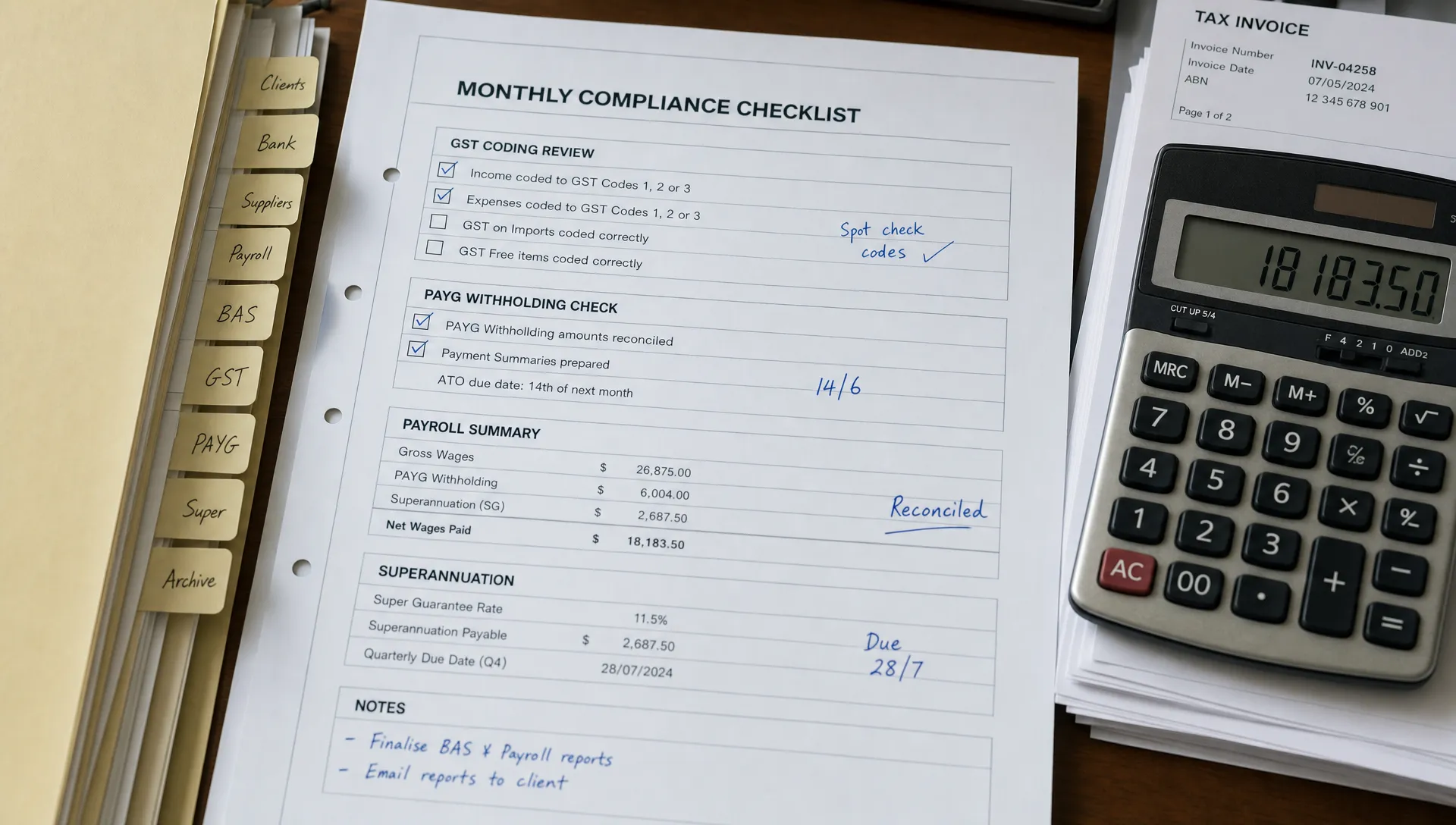
The strongest compliance outcomes come from repeatable processes. We map each obligation to the underlying accounting data, the approval pathway and the due date. This reduces reliance on memory and last-minute document searches.
| Compliance area | Common business risk | How a tax agent helps control the risk |
|---|---|---|
| BAS and GST | Incorrect GST coding, missed credits or overstated claims | Reconciles GST accounts, reviews coding rules and checks lodgement consistency |
| PAYG withholding | Payroll data not matching ATO records | Reviews payroll setup, STP reporting and PAYG liabilities |
| Superannuation Guarantee | Late payments or incorrect employee classification | Checks contribution timing, contractor arrangements and payroll categories |
| FBT | Benefits not identified or records not retained | Reviews vehicles, entertainment, employee benefits and declarations |
| Income tax | Unsupported deductions or timing errors | Tests source documents, accruals, depreciation and tax adjustments |
| Director loans | Division 7A exposure | Reviews loan accounts, repayments, agreements and private use transactions |
A well-run compliance workflow does not remove commercial judgement. It gives directors better information before decisions are made.
Key areas where businesses need disciplined tax support
Most ATO issues we see do not begin with deliberate non-compliance. They begin with growth, complexity and systems that have not kept pace. A sole trader becomes a company. A local business expands interstate. A director buys property through a trust. A contractor workforce grows. Each change creates new reporting obligations.
This is where tax agents Australia companies trust should ask structured questions before lodgement. Are GST accounts reconciled to the BAS? Does payroll reconcile to STP finalisation? Have director loan accounts been reviewed before year-end? Are private expenses clearly separated from business costs? Are trust distributions documented correctly?
For a deeper technical discussion of risk areas such as BAS, GST, payroll, FBT and Division 7A, our article on complex ATO obligations outlines how advisers help manage matters that often affect growing businesses and high-net-worth groups.
BAS, GST and cash flow visibility
BAS compliance is often treated as a quarterly deadline, but it is really a cash flow control system. If GST is coded incorrectly, management may overestimate available cash or miss legitimate input tax credits. We prefer to review GST treatment continuously, especially where businesses deal with mixed supplies, property, imports, exports or high transaction volumes.
The ATO guidance on record keeping for business makes clear that records must explain transactions and support the amounts reported. Digital records make this easier, but only if the accounting setup is accurate.

The role of AI and automation in ATO compliance
Automation has changed the standard of evidence available to directors. Bank feeds, digital invoices, OCR tools, payroll integrations and rule-based coding can reduce manual processing. Used properly, these tools improve speed and accuracy. Used poorly, they can create repeated errors at scale.
Our approach is to combine AI-driven automation with senior review. The tax agents Australia businesses need in the digital age should not simply accept what software produces. They should configure workflows, test exceptions, identify unusual transactions and reconcile outputs against ATO reporting obligations.
This matters because automation can identify patterns that manual review may miss. For example, recurring transactions posted to inconsistent GST codes, payroll categories mapped incorrectly for Superannuation Guarantee or supplier invoices without sufficient evidence can be flagged earlier. That gives directors time to correct issues before lodgement.
Real-time visibility supports strategic advisory
When compliance data is clean, advisory work becomes far more valuable. We can analyse profit margins, debtor trends, working capital, tax provisioning and expansion readiness with more confidence. This is where compliance becomes the foundation for Virtual CFO support and corporate growth planning.
For companies operating across Adelaide, Sydney, Melbourne and other Australian markets, consistent digital workflows are especially important. Multi-location teams need one source of financial truth. Without it, each branch or entity can develop its own habits, which increases ATO risk and weakens management reporting.
Responding to ATO contact without costly mistakes
ATO letters, review notices and audit queries should never be handled casually. A rushed response can create broader issues if the figures provided do not reconcile to lodged returns, BAS statements or payroll reports. Directors should first identify the exact issue, reconcile the relevant accounts and prepare a clear evidence file.
The tax agents Australia directors appoint should help manage both the technical response and the communication strategy. This includes determining whether the ATO has misunderstood the facts, whether an amendment is required or whether a voluntary disclosure may reduce penalties.
We have written separately about how to deal with the ATO without costly mistakes, including how to verify communications, avoid reactive answers and respond with properly reconciled information.
Documentation is your first line of defence
Good documentation does more than satisfy the ATO. It protects directors when staff change, software is migrated or business units expand. We encourage clients to maintain a digital audit trail for significant transactions, including contracts, invoices, loan agreements, motor vehicle records, payroll reports and board approvals.
For companies, common red flags include income mismatches, unsupported deductions, GST inconsistencies and director loan issues. Our guide to company tax return errors that trigger ATO attention explains these risk points in more detail.
What business owners should expect from a capable tax agent
A capable tax agent should be proactive, technically current and commercially aware. Lodgement is part of the role, but directors should expect more. We believe the tax agents Australia business owners engage should help them understand exposure before the ATO raises questions.
That requires strong year-round communication. Tax planning should not occur only after 30 June. Payroll settings should not be reviewed only when an employee complains. GST treatment should not be corrected only after a BAS review. Advisory discipline means issues are identified while there is still time to act.
Practical indicators of a strong advisory relationship
When assessing a tax agent, look beyond fee comparisons. The lowest-cost provider may be expensive if errors trigger amendments, penalties or management distraction. A stronger question is whether the adviser can improve financial control.
A business-focused tax agent should be able to demonstrate:
- Registration with the Tax Practitioners Board and experience with Australian business tax obligations
- Practical knowledge of BAS, GST, payroll, Superannuation, FBT and company tax
- Clear review procedures before lodgement
- Digital workflows that reduce manual errors and improve document retention
- Ability to explain tax risks in commercial terms for directors and owners
- Capacity to support growth, restructuring, financing, succession or interstate expansion
These capabilities are especially important for businesses with multiple entities, property holdings, trusts, SMSFs, contractor workforces or international dealings.
Frequently Asked Questions
Do all Australian businesses need a registered tax agent? Not every business is legally required to use a tax agent, but many should. If your business has GST, payroll, company structures, trusts, property holdings, FBT exposure or director loans, professional support can reduce risk and improve decision-making.
Can a tax agent deal with the ATO on our behalf? Yes, a registered tax agent can communicate with the ATO for authorised clients, lodge returns and BAS statements, request information, manage amendments and assist with reviews or audits. The quality of the response still depends on accurate records.
How does automation improve ATO compliance? Automation helps capture documents, reconcile transactions, apply coding rules and detect anomalies earlier. We still apply professional review because software can repeat incorrect assumptions if workflows are not properly configured.
When should directors seek tax advice during the year? Directors should seek advice before major transactions, restructures, asset purchases, dividends, trust distributions, hiring changes, interstate expansion or ATO correspondence. Early advice usually creates more options.
Can one adviser support businesses across multiple Australian cities? Yes. Our team supports clients nationally with integrated service capabilities across Adelaide, Sydney and Melbourne. Digital systems allow consistent workflows while our local knowledge helps address practical state-based and industry issues.
Next steps for stronger ATO compliance
If you are reviewing your finance function, start with a compliance health check. Confirm that BAS, GST, payroll, Superannuation, FBT, income tax and director loan accounts reconcile to source documents and ATO records. Then assess whether your systems give management timely information, not just year-end reports.
At Perfect Accounting & Tax Services, we combine 25 years of professional experience with AI-driven accounting workflows to help Australian businesses improve accuracy, speed and financial visibility. Our team supports SMEs, company directors and high-net-worth clients across Australia, with integrated capabilities in Adelaide, Sydney and Melbourne.
If you want to strengthen ATO compliance and convert your accounting function into a strategic advisory platform, contact our team for a confidential consultation. We can review your current processes, identify risk areas and show how automated accounting workflows can support corporate growth with greater control.