
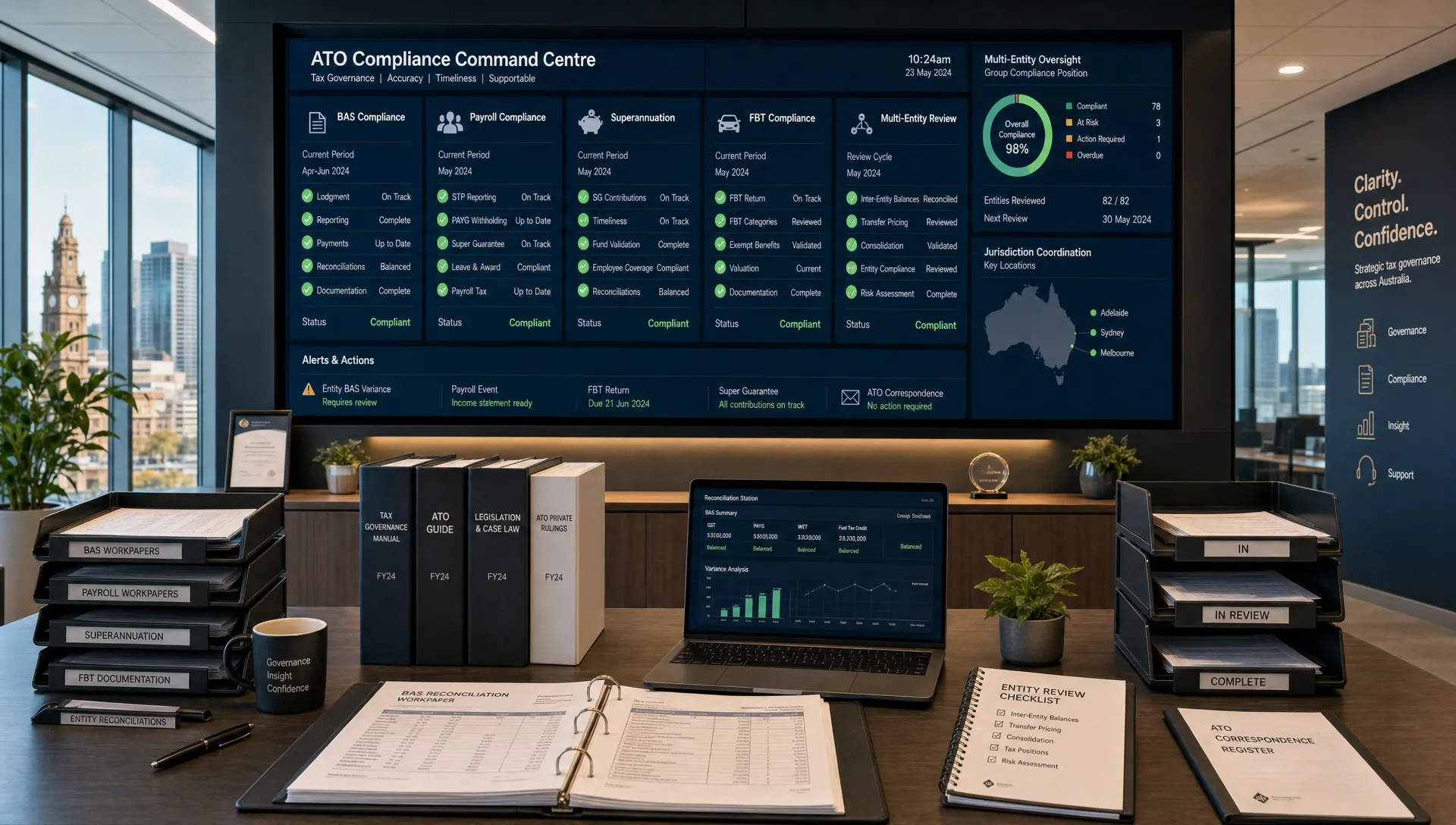
Complex ATO obligations rarely fail because a business owner does not care about compliance. They usually fail because the obligation map has become too dense for manual oversight. A growing company may be managing GST, BAS, PAYG withholding, Superannuation, FBT, director loans, trust distributions, contractor reporting and multi-entity tax planning at the same time. Add payroll complexity, property assets, cross-state operations or international transactions and the risk profile changes quickly.
This is where tax professional experts create value. We do not see ATO compliance as an isolated annual task. We see it as a governance system that protects cash flow, supports better decisions and gives directors confidence that the numbers behind the business are reliable.
For business owners, company directors and high-net-worth individuals, the objective is not just to lodge on time. The objective is to understand the tax position early, identify exposure before the ATO does and use accurate financial data as a platform for strategic advisory and corporate growth.
Why complex ATO obligations are now a board-level issue
ATO obligations now touch almost every part of a modern business. Payroll data is reported through Single Touch Payroll. GST and PAYG are reviewed through BAS and IAS lodgements. Superannuation obligations must be calculated, paid and reconciled. Contractors, motor vehicles, entertainment, staff benefits and director payments can all create tax consequences.
For directors, this is not merely administration. It is a risk management function. Weak tax governance can affect cash flow, access to finance, sale readiness, investor confidence and director exposure. A company that lodges late, miscodes GST or cannot substantiate deductions may still be profitable, but it is not financially controlled.
The ATO has also become more data-driven. Business activity statements, income tax returns, STP payroll records, third-party data and industry patterns can be compared at scale. When accounting systems are inconsistent, the ATO may identify mismatches before the business has a complete explanation ready.
Our view is simple: compliance should be engineered into the operating rhythm of the business, not repaired after year end.
What makes ATO obligations complex?
Complexity usually comes from a combination of structure, transactions and timing. A sole trader with basic income and expenses may have a relatively straightforward lodgement process. A company group with employees, contractors, multiple revenue streams, vehicles, related-party loans, finance arrangements and property holdings is different.
The following table shows where complexity often appears and how a tax professional helps convert it into a controlled process.
| Area of obligation | Common complexity | How tax professionals help |
|---|---|---|
| BAS and GST | Mixed taxable, GST-free and input-taxed supplies, incorrect GST coding, timing differences | Review transaction coding, reconcile BAS to the general ledger and test GST treatment before lodgement |
| PAYG withholding and STP | Payroll classification errors, allowances, termination payments, director wages | Align payroll settings with ATO reporting rules and reconcile payroll to accounting records |
| Superannuation | Missed contributions, incorrect ordinary time earnings, contractor super exposure | Review employee and contractor arrangements, monitor payment timing and support corrective action |
| FBT | Motor vehicles, entertainment, employee benefits, salary packaging | Identify reportable benefits, maintain substantiation and assess whether exemptions or concessions apply |
| Company tax | Division 7A, loans to shareholders, timing of income, private expenses | Separate business and private transactions, manage loan agreements and support defensible tax positions |
| Trusts and SMSFs | Distribution resolutions, investment income, compliance documentation | Coordinate tax planning, minutes, resolutions and lodgement requirements across entities |
| ATO reviews and audits | Information requests, data mismatches, poor documentation | Prepare evidence, manage communications and reduce the risk of inconsistent responses |
Each of these areas requires more than form completion. It requires diagnosis, documentation and a clear view of how one obligation affects another.
How tax professionals build an ATO obligation map
The first step in managing complex ATO obligations is to map the full compliance environment. We look at the entity structure, tax registrations, business model, revenue types, payroll arrangements, financing, related-party transactions and asset base.
This process usually identifies obligations that have been treated as separate tasks but should be managed together. For example, a company vehicle may affect GST credits, depreciation, FBT, employee contributions and payroll reporting. A contractor arrangement may affect GST, PAYG withholding, Superannuation and workers compensation risk. A trust distribution may affect family group tax planning, beneficiary cash flow and documentation requirements.
A proper obligation map gives directors three advantages. It clarifies what must be lodged, when it must be lodged and what evidence is needed to defend the position. It also reduces dependence on memory or last-minute document searches.
For more technical matters, the quality of advice depends on the adviser’s ability to diagnose facts before recommending action. We explain this standard in more detail in our guide on what an expert tax adviser should really deliver.
Turning bookkeeping into a strategic control system
Bookkeeping is often underestimated because it looks transactional. In complex ATO matters, it is the control layer that supports every lodgement, forecast and tax position.
If GST codes are wrong, BAS lodgements become unreliable. If payroll categories are poorly configured, STP reporting can become inconsistent. If director withdrawals are not reviewed during the year, Division 7A exposure may only become visible after the planning window has narrowed. If asset purchases are not captured properly, depreciation and GST claims may be misstated.
Our team uses digital workflows and AI-driven automation to improve the speed and consistency of this control layer. Automation can help classify recurring transactions, flag anomalies, match bank data and accelerate reconciliation. However, automation is not a substitute for professional judgement. It is most powerful when a qualified adviser designs the rules, reviews exceptions and interprets the commercial implications.
For a business owner, this creates real-time financial visibility. Instead of waiting until tax season to discover cash flow pressure or compliance gaps, directors can review the position throughout the year and make decisions with current data.

Managing BAS, GST and payroll with discipline
BAS and payroll obligations are high-frequency obligations, which means small errors can compound quickly. A single GST coding issue may affect several quarters. A payroll setup error may flow through STP, PAYG withholding and Superannuation calculations.
We focus on three disciplines: correct configuration, regular reconciliation and pre-lodgement review. Correct configuration ensures the accounting system reflects the tax profile of the business. Regular reconciliation ensures the general ledger, bank accounts, payroll records and ATO reports agree. Pre-lodgement review gives the adviser time to identify unusual movements, missing invoices or coding errors before the BAS is lodged.
This approach is particularly important for businesses with multiple sites or professional services operations. For example, a practice owner reviewing multi-location healthcare operations can quickly see how appointment volumes, staff rosters, equipment purchases, payment plans and consumables create tax data points that need disciplined accounting treatment. The same principle applies to veterinary clinics, allied health groups, fitness studios, dental practices and medical specialists across Australia.
For directors, BAS should never be treated as a quarterly formality. It is one of the most useful indicators of revenue quality, margin movement and cash flow strain.
Handling ATO reviews, audits and data mismatches
When the ATO raises a query, the quality of the first response matters. A rushed or incomplete explanation can widen the issue. A defensive response without proper evidence may create further questions. A technical answer that ignores commercial context may not resolve the underlying concern.
Tax professionals help by managing the process methodically. We review the ATO request, identify the relevant tax law and gather the evidence needed to support the position. We then prepare a response that is accurate, consistent and commercially coherent.
Common ATO review triggers include income mismatches, inconsistent GST claims, payroll reporting anomalies, late lodgements, unexplained private expenses, director loan issues and weak substantiation. Some of these issues can be resolved quickly. Others require amended lodgements, payment arrangements or formal representation.
We have written separately about how to deal with the ATO without costly mistakes, particularly where tax debt, review letters or unclear ATO communications are involved.
For company directors, the best audit response begins before the audit. Clean records, documented tax positions and a clear compliance calendar reduce both the likelihood of ATO attention and the cost of responding if attention arrives.
Complex structures require coordinated tax governance
High-net-worth individuals and growing business groups often operate through several entities. A structure may include trading companies, family trusts, bucket companies, SMSFs, investment entities and property holdings. Each entity may be compliant in isolation, yet the group can still have tax inefficiencies or governance gaps.
This is where tax professionals move beyond lodgement. We coordinate the group position across income tax, GST, trust distributions, Division 7A, FBT, capital gains tax, Superannuation and asset protection considerations. We also assess whether documentation supports the intended tax outcome.
For example, a family group may need trust distribution resolutions before 30 June, Division 7A loan documentation, company tax planning, PAYG instalment variation analysis and property cost base records. Missing one element can affect the entire group.
The same applies to business owners preparing for growth, investment or exit. Buyers and lenders usually look for clean financial records, reliable tax lodgements, payroll compliance and evidence that ATO obligations are under control. Tax governance becomes part of enterprise value.
From compliance to strategic advisory
We believe ATO compliance should be the foundation for strategic advisory, not the end of the relationship. Once the financial data is accurate, directors can use it for forecasting, funding decisions, margin analysis, remuneration planning and growth strategy.
This is where our virtual CFO approach becomes valuable. We can use reconciled accounting data to analyse working capital, identify tax cash flow peaks, model profit scenarios and prepare management reporting. The business gains a clearer view of what it can afford, what it should defer and where capital is being absorbed.
For cross-state businesses, this integrated approach is essential. Our team supports clients across Australia with coordinated service capability in Adelaide, Sydney and Melbourne. Whether a client operates a South Australian construction business, a Sydney professional services firm or a Melbourne manufacturing group, the principles are consistent: accurate records, timely lodgements, strong governance and forward-looking advice.
If your company is already seeing ATO queries or lodgement inconsistencies, it is also worth understanding the company tax return errors that trigger ATO attention so that the next lodgement cycle is stronger than the last.
Signs your ATO obligations need professional review
Not every business needs the same level of advisory support. However, certain signs indicate that your current system may no longer match the complexity of the business.
- BAS preparation depends heavily on manual adjustments or spreadsheet workarounds.
- Payroll, STP and Superannuation records do not reconcile cleanly to the accounts.
- Director drawings, shareholder loans or related-party payments are reviewed only after year end.
- The business has multiple entities but no consolidated view of tax cash flow.
- ATO correspondence is handled reactively rather than through a documented response process.
- Management accounts are prepared too late to influence decisions.
When these issues appear, the concern is not only compliance. The concern is that the business is making decisions without a reliable financial control environment.
Frequently Asked Questions
What ATO obligations are most often missed by growing businesses? BAS, PAYG withholding, Superannuation, FBT, TPAR, trust resolutions and Division 7A documentation are common risk areas. The specific exposure depends on the business structure, industry, payroll arrangements and transaction profile.
Can automation replace a tax professional? No. Automation improves speed, consistency and visibility, but professional judgement is still needed to interpret tax law, assess risk, manage ATO communications and design the right governance framework.
When should a company director seek help with ATO obligations? A director should seek help before complexity becomes urgent. Triggers include rapid growth, hiring staff, acquiring assets, expanding interstate, receiving ATO correspondence, restructuring entities or preparing for sale or investment.
How do tax professionals help during an ATO audit? We review the ATO request, verify the facts, gather records, assess the technical position and prepare a clear response. The goal is to resolve the matter efficiently while protecting the client from inconsistent or unsupported statements.
Is ATO compliance different for high-net-worth individuals? Yes. High-net-worth individuals often have trusts, companies, SMSFs, investment portfolios, property holdings and family transactions. These require coordinated tax planning and strong documentation across the whole group.
Next Steps: Build a stronger ATO compliance system
If your ATO obligations are becoming more complex, the solution is not simply to work harder at lodgement time. The solution is to build a better system around your financial data, tax calendar and governance processes.
Our team at Perfect Accounting & Tax Services brings 25 years of professional experience across accounting, tax and strategic advisory. We help businesses and high-net-worth individuals manage BAS, GST, payroll, Superannuation, FBT, complex tax planning, audit representation and multi-entity compliance. We also integrate AI-driven automation into accounting workflows so clients gain faster reconciliations, cleaner reporting and better real-time visibility.
From Adelaide to Sydney, Melbourne and across Australia, we work with directors who want more than historical tax reporting. We help turn compliance into a strategic asset.
To review your ATO obligations or learn how automated accounting workflows can improve accuracy and decision-making, contact our team at Perfect Accounting & Tax Services for a confidential consultation.