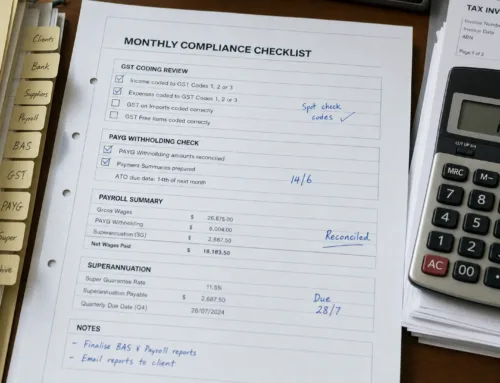


For business leaders searching for taxation services australia, the real question has moved beyond who can lodge a return. The stronger question is who can turn tax data into decision-grade financial visibility. Across companies, trusts, SMSFs and investment structures, we see tax compliance becoming a live management system rather than a once-a-year administrative event.
Our view is shaped by 25 years of advising Australian business owners, company directors and high-net-worth clients. The ATO is increasingly data-driven. Banks, payroll platforms, e-commerce systems and cloud ledgers now produce large volumes of financial information. When that information is structured well, tax work becomes the foundation for better cash flow, cleaner governance and more confident growth decisions.
Taxation Services Australia: financial visibility as the new benchmark
Tax visibility starts with reliable source data. That means reconciled bank feeds, correctly coded GST, current payroll records, accurate superannuation reporting and documentation that can withstand ATO review. It also means management reporting that directors can use before tax is due, not after cash has already left the business.
We approach tax as a control system. BAS, income tax, PAYG withholding, FBT, superannuation and payroll obligations should not sit in separate silos. They should connect to one financial operating model that shows what is happening now, what is likely to happen next and where intervention is required.
From compliance records to strategic data
The ATO's record keeping requirements make accurate records a legal necessity. For effective taxation services Australia clients need, those same records should also support commercial analysis. We use tax data to identify margin pressure, GST leakage, payroll risk, debtors that are weakening cash flow and tax liabilities that require early provisioning.
| Tax area | Visibility objective | Strategic value |
|---|---|---|
| BAS and GST | Track GST collected, credits claimed and timing of lodgement | Reduce surprises and protect working capital |
| PAYG withholding | Align payroll data with ATO reporting and cash reserves | Avoid payroll-related compliance gaps |
| Superannuation | Monitor contribution timing and employee entitlements | Reduce director risk and support workforce governance |
| FBT | Identify benefits, vehicles and reportable fringe benefits early | Prevent year-end adjustments becoming rushed corrections |
| Income tax | Forecast taxable income and instalments | Plan distributions, dividends and investment timing |
For business owners, visibility is not a luxury. It is the difference between reacting to an ATO notice and making controlled decisions with the right evidence already in place.
What AI-driven tax workflows change
AI is not a substitute for professional judgement. We use it as an automation layer that reduces manual friction, improves exception detection and gives our advisers more time to focus on strategic interpretation. In a tax environment where data volumes are rising, this distinction matters.
Automated workflows can classify transactions, match invoices, flag unusual GST coding, identify missing documents and highlight movements that require review. That does not remove the need for a Chartered Accountant's judgement. It makes that judgement more targeted.
Faster close, cleaner advice
A delayed month-end close weakens every tax conversation that follows. If the ledger is three months behind, BAS planning, cash flow forecasting and director reporting become retrospective. AI-assisted processing helps us shorten the gap between transaction activity and usable financial information.
This is why we see modern taxation services Australia firms provide moving towards connected workflows. The value is not simply faster lodgement. It is a cleaner advisory cycle where directors can see tax exposures, working capital pressure and funding needs before they become urgent.
Clients who want a broader view of this shift can also read our guide to modern tax filing services, which explains why proactive compliance now requires year-round data capture.
Where Australian businesses lose visibility before tax time
Most tax problems are visible long before lodgement. They appear as unreconciled transactions, unreviewed director drawings, inconsistent GST treatment, late payroll adjustments, untracked contractor payments or trust distributions that are not modelled until year-end.
We see this across industries, from construction and allied health to SaaS companies, hospitality groups, property investors and professional services firms. The pattern is rarely a lack of effort. It is usually a lack of system design.
Common blind spots we diagnose
Several issues create avoidable risk for Australian businesses:
- BAS is prepared from incomplete reconciliations rather than closed accounting periods.
- GST codes are applied inconsistently across mixed supplies, imports, online sales or property transactions.
- Payroll data is not reviewed against PAYG withholding, superannuation and award obligations.
- FBT exposure is assessed late, especially for motor vehicles, entertainment and employee benefits.
- Division 7A, trust distributions or shareholder loan movements are considered after cash has moved.
For taxation services Australia to produce live visibility, these blind spots must be addressed at the process level. We do not want clients discovering tax risk when the return is being signed. We want that risk surfaced during the month it arises.
Our article on tax-efficient accounting that improves cash flow expands on this point by showing how BAS, GST, PAYG, payroll and planning interact with working capital.
Building the data layer for AI-driven visibility
An AI-enabled tax function depends on structured, reliable and reviewable data. Automation performs best when the chart of accounts is designed properly, document capture is consistent and approval workflows are clear. Poor inputs still produce poor outputs, only faster.
We start by assessing the financial architecture. That includes accounting software, payroll systems, bank feeds, point-of-sale platforms, e-commerce integrations, loan accounts, asset registers and reporting packs. For groups operating across Adelaide, Sydney and Melbourne, we also look at whether entities are using consistent processes or creating fragmented local practices.
What we want the system to produce
A well-designed finance function should produce more than a tax return. It should support rolling cash flow visibility, GST forecasting, payroll compliance, management reporting and scenario planning. It should also create an evidence trail for ATO queries, finance applications, acquisitions, restructuring or succession planning.
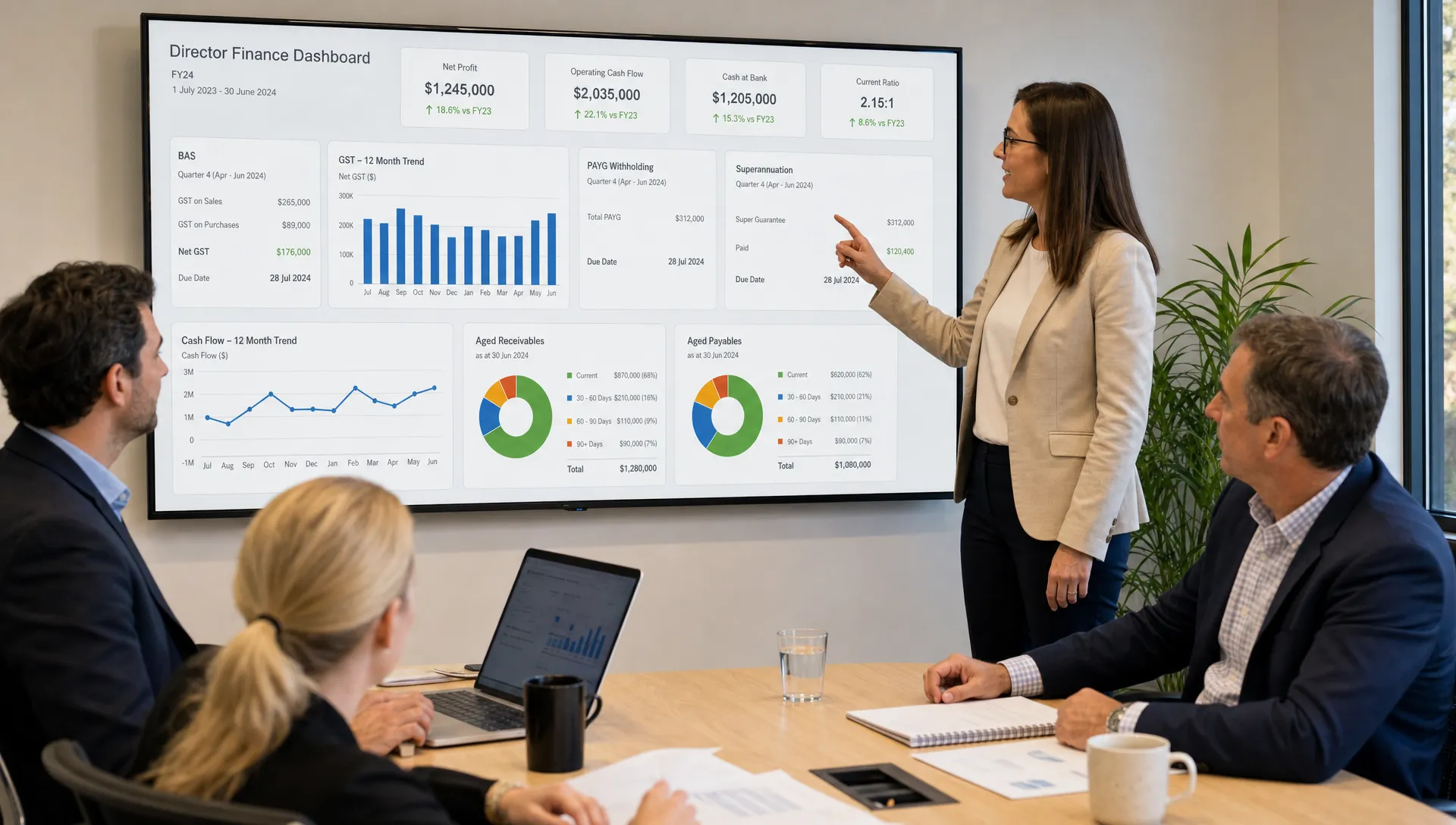
Tax data then becomes a strategic asset. Directors can see whether growth is improving profit or only increasing activity. Investors can separate rental yield from tax timing. Founders can understand how hiring, R&D, software subscriptions and capital expenditure affect both runway and tax planning.
Practical use cases for directors, investors and growing groups
AI-enabled taxation services Australia support is most valuable when it connects compliance with decisions. A director does not need a larger spreadsheet. They need clearer signals, timely controls and advice that reflects the commercial reality of the business.
For SMEs and private groups, the first use case is usually cash flow. We connect BAS cycles, PAYG instalments, payroll obligations and expected income tax liabilities so tax is provisioned progressively. This reduces the pressure of lump-sum liabilities and supports better funding conversations.
Advisory scenarios where visibility matters
| Scenario | What visibility improves | Advisory outcome |
|---|---|---|
| Scaling company | Margin, wages, GST and tax instalment tracking | Growth plans based on after-tax cash flow |
| Property investor | Interest, repairs, depreciation and ownership structure | Cleaner records and stronger tax planning |
| Multi-entity group | Intercompany loans, trust distributions and director accounts | Reduced leakage and clearer governance |
| High-net-worth family | Investment income, CGT events and estate considerations | More coordinated annual planning |
| National business | State-based operations, payroll, BAS timing and reporting consistency | Unified controls across locations |
For company directors, this visibility also supports risk management. If payroll obligations, superannuation timing or GST liabilities are not visible in real time, directors may not see the issue until cash has already been committed elsewhere.
We have covered the decision-making layer in more depth in our article on how a business services accountant supports better decisions, especially where management reports and forecasts are used alongside tax advice.
Governance, privacy and professional judgement still matter
Automation must be governed. We do not treat AI-generated classifications or alerts as final advice. They are inputs for review, not a replacement for professional accountability. Australian tax law still requires careful interpretation, documentation and context.
Well-governed taxation services Australia workflows should include human review, approval controls, secure document handling and clear audit trails. This is especially important for sensitive areas such as SMSFs, related-party loans, FBT, payroll, capital gains tax, private company distributions and cross-border arrangements.
ATO readiness is a design choice
An ATO review is easier to manage when the evidence is already organised. We aim to make source documents, reconciliations, tax calculations and management explanations accessible before they are requested. This is not only about compliance. It protects management time and reduces disruption.
For 2026 settings, directors also need to monitor policy and compliance changes that affect cash flow and reporting. Our update on business tax in Australia and what changed for 2026 provides a more specific discussion of current changes.
How to choose AI-enabled taxation support
When selecting an adviser, we recommend looking beyond lodgement capability. Ask how the adviser turns raw data into decision-ready reporting. Ask whether BAS, payroll, GST, income tax, FBT and cash flow are reviewed as one system. Ask how technology is governed and how professional judgement is applied.
We also suggest testing whether the adviser can operate nationally without losing local context. Our team supports clients across Australia, with integrated service capability in Adelaide, Sydney and Melbourne. That matters for businesses with multiple locations, remote teams or cross-state operations.
Questions directors should ask
Before engaging a tax adviser, directors should consider:
- Can our tax position be forecast before year-end?
- Are BAS and GST workflows linked to cash flow reporting?
- Do payroll and superannuation controls alert us to risk early?
- Can management reports explain tax outcomes, not just list them?
- Is AI used with proper review, security and accountability?
The strongest advisory relationships make tax data commercially useful. They help directors allocate capital, manage risk and make timely decisions with fewer blind spots.
Frequently Asked Questions
Do AI-driven taxation services Australia replace an accountant? No. AI improves speed, classification, reconciliation and exception detection, but professional judgement remains essential. We use automation to strengthen the advice process, not remove accountability.
How does financial visibility improve BAS and GST compliance? Current reconciliations and accurate GST coding reduce errors before BAS is lodged. They also help directors forecast GST cash flow, identify anomalies and respond to ATO queries with better evidence.
Can this approach help high-net-worth individuals and family groups? Yes. Structured tax data is valuable for investment entities, trusts, SMSFs, property portfolios and family companies. It supports CGT planning, distribution decisions, loan account management and annual tax strategy.
Is AI suitable for complex tax matters? AI is useful for organising data and identifying issues, but complex matters still require technical review. Areas such as Division 7A, FBT, SMSFs, restructures, CGT and cross-border arrangements need experienced tax advice.
How often should directors review tax visibility reports? We generally prefer monthly reporting for active businesses and more frequent reviews during growth, restructuring, acquisition planning or cash flow pressure. Waiting until year-end limits the options available.
Next steps: how we can help
Our role is to help clients turn tax compliance into a clearer operating system for growth. We review the current accounting environment, identify data gaps, improve BAS and GST workflows, assess payroll and superannuation controls and build reporting that supports better decisions.
For clients seeking taxation services Australia-wide, our approach combines technical tax knowledge with AI-driven automation and strategic advisory. We support SMEs, directors, investors and private groups across Adelaide, Sydney, Melbourne and the wider national market.
If your current tax process only tells you what happened after the fact, it is time to upgrade the workflow. Contact Perfect Accounting & Tax Services to arrange a consultation and learn how our automated accounting workflows can provide faster reporting, stronger compliance and clearer financial visibility.