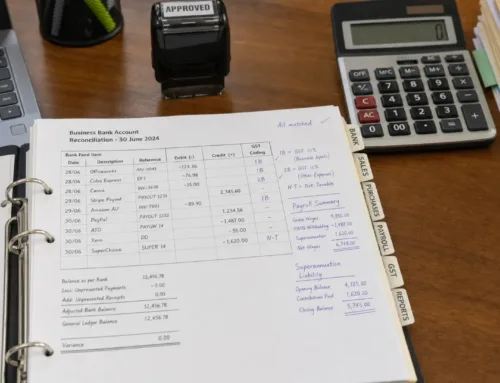


For Australian business owners, tax and accounting solutions should do more than satisfy the ATO and lodge annual returns. We see them as the operating system for confident growth, connecting BAS, GST, payroll, superannuation, tax planning and management reporting into one reliable view of financial performance.
When financial data is delayed or fragmented, directors make decisions with partial visibility. That can affect hiring, debt funding, stock purchases, property acquisitions, director distributions and expansion into new markets. Our role is to turn compliance data into strategic evidence, so business owners and high-net-worth individuals can act with discipline rather than instinct.
Why growth confidence starts with financial control
Growth is rarely held back by one tax return. It is more often held back by weak financial control, unclear cash flow and late visibility over obligations. A growing business needs to know its margins, BAS position, payroll exposure, PAYG withholding and upcoming income tax commitments before decisions are made, not after the quarter closes.
In practice, tax and accounting solutions give leaders the confidence to test expansion decisions against real numbers. That includes modelling the impact of hiring, asset purchases, financing, pricing changes, director remuneration and dividend timing before cash is committed.
The ATO expects businesses to keep accurate records, generally for five years, and those records must support the figures reported in returns and activity statements. The ATO record keeping guidance is a useful reminder that compliance quality begins long before lodgement. We take that further by using reliable records as the basis for forecasting, scenario planning and strategic advisory.
What modern tax and accounting solutions should deliver
Modern accounting should combine technical accuracy, automation and commercial judgement. The objective is not just to reconcile transactions. It is to create a financial system that supports compliance, protects cash and gives directors a clear path to growth.
| Accounting area | Compliance function | Strategic growth value |
|---|---|---|
| BAS and GST | Accurate activity statement preparation and GST coding | Better cash flow timing and fewer quarterly surprises |
| Payroll and superannuation | STP, PAYG withholding, TFN declarations and super obligations | Workforce scaling with stronger cost control |
| Management reporting | Monthly profit, balance sheet and cash flow review | Faster pricing, margin and investment decisions |
| Tax planning | Income tax, structure, deductions and timing analysis | Improved after-tax outcomes and capital allocation |
| FBT and benefits | Review of fringe benefits and reportable obligations | Cleaner remuneration planning for directors and teams |
| Governance records | Documented decisions, reconciliations and audit trail | Stronger lender, investor and ATO readiness |
When tax and accounting solutions connect these areas, the business gains a single source of financial truth. That matters for sole traders becoming companies, family-owned businesses professionalising their systems, property investors managing multiple entities and technology firms preparing for capital raises.
We have written separately about how stronger financial control improves decision quality. In this article, our focus is the growth effect: the way reliable accounting infrastructure gives business owners permission to move with confidence.
Turning compliance into a growth engine
Compliance is often treated as a cost centre. We see it differently. BAS, GST, payroll, superannuation and tax lodgements are recurring checkpoints that reveal how the business is really performing. If those checkpoints are handled manually, late or without analysis, valuable information is wasted.
The strongest tax and accounting solutions convert those checkpoints into advisory moments. A quarterly BAS review can highlight margin leakage. Payroll reporting can expose labour inefficiency. A tax planning session can identify whether profits should be retained, distributed, reinvested or used to reduce debt.
BAS, GST and cash flow timing
GST does not belong to the business, but poor GST discipline can distort available cash. We regularly see businesses overestimate free cash because BAS liabilities, PAYG instalments and superannuation payments are not built into working capital forecasts.
Sound systems separate operational cash from tax obligations. They also help identify whether GST coding, mixed-use expenses, private use adjustments or timing of invoices need closer review. For businesses with seasonal revenue, construction progress claims, e-commerce sales or property transactions, this can materially improve cash planning.
Our article on tax-efficient accounting that improves cash flow explores this in more detail, particularly around BAS timing, PAYG instalments and deductions.
Payroll, superannuation and workforce scale
Hiring is one of the strongest signals of growth, but payroll complexity increases quickly. Employers need accurate STP reporting, PAYG withholding, superannuation processing, leave liabilities and award or contract alignment. Where benefits are provided, FBT may also need review.
Automated payroll workflows reduce rework and improve consistency, but they do not remove the need for professional oversight. We review the accounting treatment, cash flow impact and compliance position so the business understands the full cost of each hiring decision.

Tax planning, structure and capital decisions
Tax planning should be prospective. Waiting until the end of the financial year limits the options available. Earlier planning allows directors and owners to consider timing of income, deductibility of expenses, asset acquisitions, entity structure, trust distributions, Division 7A considerations and the tax impact of financing decisions.
For high-net-worth individuals, SMSF trustees and property investors, structure matters even more. The right approach may involve companies, trusts, partnerships or individual ownership, depending on asset protection, succession, financing and tax objectives. We do not recommend structures in isolation. We model the commercial reality first, then align the tax position.
How automation changes the quality of advice
Digital transformation has changed what a business should expect from its accountant. Bank feeds, document capture, rule-based processing and AI-assisted exception checks can reduce manual handling and improve the speed of reporting. The strategic benefit is not simply efficiency. It is earlier visibility.
For directors, tax and accounting solutions supported by automation provide a faster feedback loop between transactions and decisions. If revenue slows, margins compress or payroll rises faster than sales, management should not wait until the next annual accounts to find out.
Our AI-driven processes are designed to streamline routine accounting workflows while leaving professional judgement where it belongs: interpretation, risk assessment, tax strategy and advisory. Automation can identify anomalies and accelerate reconciliations, but an experienced Chartered Accountant still needs to assess context, documentation and commercial intent.
This is where our 25 years of professional experience becomes important. We combine technical review with digital workflows, helping clients across Australia build finance functions that are accurate, scalable and ready for strategic discussion.
Applying the model to different growth profiles
A Melbourne-based creative agency does not have the same risk profile as a Sydney corporate services firm, an Adelaide construction business or a regional primary producer. Growth confidence comes from tailoring the accounting model to the operating reality.
For service businesses, we often focus on labour utilisation, contractor arrangements, GST treatment, cash collection and director remuneration. For property groups, we examine GST, financing, entity structures, land tax interactions, development timing and documentation. For technology and SaaS businesses, the focus may shift to revenue recognition, capitalisation decisions, investor reporting, research and development support and scalable systems.
Digital tax and accounting solutions improve this process because they create consistent data across entities, locations and reporting periods. That is particularly valuable for cross-state businesses operating between Adelaide, Sydney and Melbourne, where directors need unified reporting without losing local compliance awareness.
We also support family groups and high-net-worth individuals who need coordination across business entities, investment portfolios, trusts, SMSFs and estate planning discussions. In these situations, accounting is not a once-a-year task. It is a governance framework.
Governance, risk and board-ready decisions
Business growth increases scrutiny. Lenders want reliable accounts. Investors want disciplined reporting. The ATO expects consistency between BAS, tax returns, payroll reporting and supporting records. Directors also have duties to act with care and diligence, and ASIC provides guidance on company director responsibilities.
Good accounting systems create an audit trail for key decisions. That includes reconciled accounts, documented tax positions, loan agreements, minutes where appropriate, payroll records and evidence supporting deductions. If a review or audit occurs, the business should be able to respond with confidence.
The right tax and accounting solutions also reduce key-person risk. If only one person understands the accounts, the business is exposed. We prefer documented workflows, clear approval processes and management reporting that can be understood by owners, directors, finance teams and external advisers.
This governance layer becomes critical during acquisitions, succession planning, capital raising, restructuring or exit preparation. Buyers and financiers pay attention to clean financial data. Poor records can slow due diligence, reduce valuation confidence and create avoidable negotiation pressure.
Warning signs your accounting model is holding growth back
Many capable businesses outgrow their accounting systems before they realise it. The warning signs are usually visible in cash flow pressure, reporting delays and decisions made without reliable forecasts.
Common indicators include:
- BAS lodgements are technically completed, but they do not lead to cash flow insight
- Monthly accounts are delayed by weeks or rely heavily on manual spreadsheets
- Directors receive profit figures but not balance sheet or cash flow analysis
- GST, PAYG instalments, superannuation or income tax payments create recurring surprises
- Multiple entities, locations or revenue streams are not consolidated clearly
- The business is preparing for finance, investment, acquisition or exit without board-ready accounts
If these issues are present, the priority is not to replace one software file with another. The priority is to redesign the finance workflow so compliance, reporting, tax planning and advisory operate as one system.
For businesses comparing advisers, our guide on choosing tax services that support business growth outlines what to look for beyond basic lodgement support.
Frequently Asked Questions
How often should growth businesses review their tax position? We generally recommend structured tax planning before year end, plus quarterly reviews aligned with BAS cycles. Fast-growing businesses, property groups and companies with complex payroll or financing should review more often.
Can automation replace an accountant? No. Automation improves speed, consistency and visibility, but it cannot replace professional judgement. We use AI-driven workflows to reduce manual processing so our team can focus on tax strategy, governance, cash flow and commercial advice.
What records does the ATO expect Australian businesses to keep? Businesses should keep records that explain transactions, support tax positions and allow income, deductions, GST and payroll obligations to be verified. Records generally need to be retained for five years, though some matters may require longer retention depending on the circumstances.
When should a business consider Virtual CFO support? Virtual CFO support is useful when directors need forward-looking cash flow forecasts, management reporting, board packs, lender reporting, pricing analysis or strategic guidance but do not need a full-time internal CFO.
Do tax and accounting solutions matter for high-net-worth individuals? Yes. High-net-worth individuals often need coordinated advice across companies, trusts, property, investments, SMSFs and succession planning. The value comes from integrating compliance with long-term asset protection, tax efficiency and governance.
Next steps: build a more confident growth model
Confident growth starts with financial clarity. At Perfect Accounting & Tax Services, we help Australian business owners, company directors and high-net-worth individuals move from reactive compliance to strategic financial control.
Our team provides integrated accounting, tax planning, BAS and payroll support, Virtual CFO services and AI-driven automation across Australia, with coordinated capabilities in Adelaide, Sydney and Melbourne. We bring 25 years of professional experience to the systems, structures and decisions that shape corporate growth.
If your accounts are accurate but not yet strategic, or if your business is scaling faster than your financial systems, contact our firm for a consultation. We can review your current workflow, identify compliance and reporting gaps and show how automated accounting processes can give you greater accuracy, speed and real-time financial visibility.