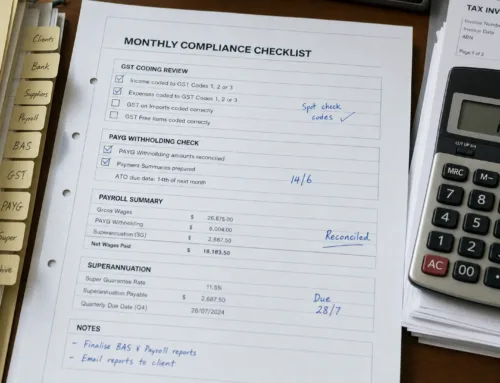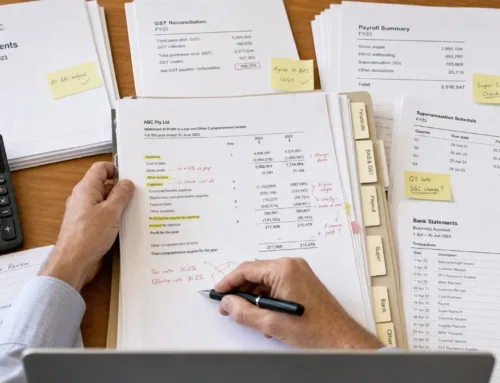


A late tax return is rarely just a missed deadline. For business owners, directors, property investors and high-net-worth individuals, it often signals a deeper problem: incomplete records, fragmented systems, unreconciled BAS, missing invoices, unclear director loans, or transactions spread across multiple entities.
The good news is that records can usually be rebuilt. The process must be disciplined, evidence-based and aligned with Australian Taxation Office requirements. We never recommend estimating income or claiming deductions without support. Instead, we rebuild the financial story from available primary records, corroborating documents and digital data sources.
In our experience, the best approach is to treat the late tax return as a financial reconstruction project, not a last-minute lodgement exercise. Done properly, it can reduce ATO risk, restore compliance and create a stronger accounting system for future growth.
Why record reconstruction matters for a late tax return
When a tax return is overdue, the ATO may already hold data about your income, wages, interest, dividends, private health insurance, government payments, Single Touch Payroll information, managed fund distributions and sometimes business-related data.
For businesses, the ATO may also compare your tax return against BAS lodgements, GST labels, PAYG withholding, superannuation reporting, third-party payment data, contractor reports and industry benchmarks. If your reconstructed return does not align with these data points, the risk of ATO queries increases.
The ATO’s record-keeping guidance generally requires taxpayers to keep records for five years, and records must explain the transactions and be in English, or readily convertible into English. You can review the ATO’s guidance on record keeping for business for the core principles.
For a late tax return, proper reconstruction helps you:
- Lodge a return that is complete and defensible.
- Identify missed income before the ATO raises it.
- Claim legitimate deductions without overreaching.
- Reconcile GST, BAS, payroll and superannuation obligations.
- Quantify tax payable, refunds, penalties and cash-flow impacts.
- Rebuild financial visibility for banking, investors or strategic planning.
Start with the exact scope of the problem
Before collecting receipts, we first define the compliance scope. A late individual tax return is very different from a late company return with outstanding BAS, payroll, director loans and trust distributions.
The initial review should confirm:
- Which income years are overdue.
- Which entities are involved, such as individual, company, trust, partnership, SMSF or related entities.
- Whether BAS, PAYG withholding, FBT, TPAR or payroll tax obligations are also outstanding.
- Whether the taxpayer is registered for GST, and from what date.
- Whether there are ATO debts, payment arrangements, default assessments or audit correspondence.
- Whether records were lost, never kept properly, or are sitting across multiple platforms.
This scope matters because lodging one overdue return without addressing linked obligations can create further discrepancies. For example, a company return may show revenue that does not reconcile to BAS. A director’s personal return may depend on wages, dividends, trust distributions or Division 7A positions that have not been properly finalised.
Step 1: Obtain ATO and government-held data
The first practical step is to gather what the ATO already knows. This gives us a baseline and prevents avoidable mismatches.
Depending on the taxpayer, relevant sources may include:
| Source | What it can help confirm | Why it matters |
|---|---|---|
| ATO pre-fill data | Salary, interest, dividends, managed funds, private health insurance and government payments | Helps identify income already reported to the ATO |
| ATO activity statement account | BAS lodgements, GST amounts, PAYG instalments and PAYG withholding | Helps reconcile business income tax to BAS reporting |
| Income tax account | Prior year assessments, debts, credits, refunds and interest | Helps quantify total exposure |
| STP reporting | Wages, PAYG withholding and superannuation data | Helps rebuild payroll records |
| ASIC records | Company details, officeholders and historical changes | Relevant for directors and corporate groups |
| Superannuation clearing house records | Super paid for employees | Helps identify late or unpaid superannuation obligations |
Where a client has multiple entities, we map each entity separately. This avoids mixing personal, company, trust and investment transactions, which is one of the most common problems in late lodgement files.
Step 2: Rebuild bank and payment records
Bank records are usually the backbone of a reconstructed tax return. They are not enough on their own to prove every deduction, but they are essential for identifying income, expenses, transfers, loan movements and unexplained cash flows.
We typically obtain full statements and, where possible, CSV exports for all relevant accounts. This may include business bank accounts, personal accounts used for business, credit cards, loan accounts, offset accounts, merchant facilities and foreign accounts.
For modern businesses, payment records may also sit outside the bank. We may need to extract reports from Stripe, PayPal, Square, Shopify, Amazon, eBay, Uber, Airbnb, booking platforms, practice management systems, point-of-sale tools or industry-specific software.
A key part of our AI-driven workflow is transaction classification. We use automation to accelerate pattern detection, identify recurring suppliers, flag unusual items and compare bank data against accounting ledgers. Human review remains essential, particularly for tax treatment, GST coding, private use and related-party transactions.
Step 3: Reconstruct income carefully
Income reconstruction should be conservative, complete and well documented. Understated income is one of the fastest ways to attract ATO attention.
For businesses, income may be reconstructed from:
- Sales invoices and debtor ledgers.
- Bank deposits and merchant settlement reports.
- E-commerce platform reports.
- Point-of-sale summaries.
- Customer remittance advices.
- Contracts, statements of work and retainer agreements.
- Cash register summaries and till records.
- Government grants, rebates or insurance proceeds.
For investors and high-net-worth individuals, income may include rental income, trust distributions, dividends, interest, foreign income, capital gains, cryptocurrency disposals, employee share scheme amounts or partnership distributions.
We do not simply treat every deposit as taxable income. Some deposits may be loan proceeds, capital contributions, GST refunds, transfers between accounts, director repayments or private reimbursements. However, every non-income deposit should be explained and supported.
Step 4: Reconstruct deductions without guessing
A late tax return can create pressure to “catch up quickly”, but deductions should never be guessed. The ATO generally expects evidence showing what was purchased, when it was purchased, who supplied it, the amount paid and how it relates to assessable income.
Common deduction sources include supplier invoices, email receipts, bank transactions, credit card statements, accounting software attachments, lease agreements, insurance schedules, finance contracts, subscription portals and payroll reports.
Where an invoice is missing, we often contact suppliers for copies. Many suppliers can reissue invoices or provide account statements. For recurring expenses, such as rent, software subscriptions, telecommunications or insurance, the provider’s portal may hold historical invoices.
For mixed-use expenses, apportionment is critical. This includes motor vehicle costs, home office expenses, mobile phone bills, internet, travel, entertainment and property expenses with private or capital components. A payment appearing in the bank account does not automatically make it fully deductible.
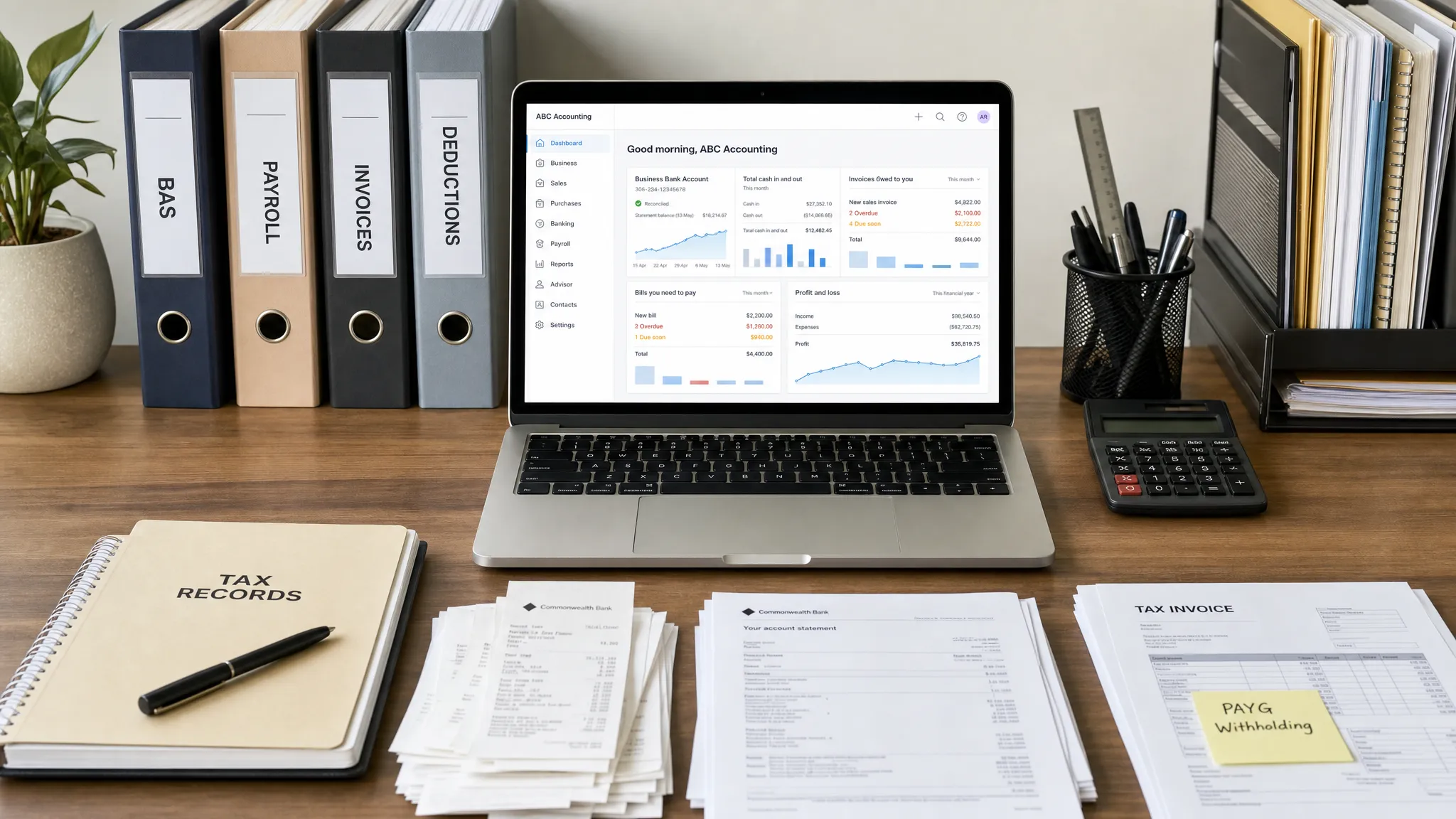
Step 5: Reconcile GST, BAS and income tax
For GST-registered businesses, a late tax return cannot be finalised properly unless BAS and GST records are reviewed. Income tax and GST are connected, but they are not identical.
Key reconciliation points include:
| Area | What to check | Common issue |
|---|---|---|
| Sales | GST sales per BAS compared with accounting revenue | BAS lodged from bank deposits but tax return prepared from invoices |
| Purchases | GST credits compared with deductible expenses | GST claimed without valid tax invoices |
| Timing | Cash versus accrual reporting | Sales and expenses reported in different periods |
| Private use | GST adjustments for non-business use | Full GST credits claimed on mixed-use costs |
| Capital assets | GST on equipment, vehicles and fit-out | Asset purchases treated incorrectly as normal expenses |
For GST credits, tax invoices are particularly important. If the GST-inclusive purchase is more than $82.50, the business generally needs a valid tax invoice to claim a GST credit.
Late BAS can also affect cash flow. If GST, PAYG withholding or PAYG instalments remain unpaid, the ATO may apply general interest charge. Since ATO interest deductibility rules have changed for the 2025-26 year onward, the commercial cost of delay now requires even closer attention.
Step 6: Rebuild payroll and superannuation records
Payroll is a high-risk area in late lodgement work. Directors often focus on income tax first, but unpaid superannuation, PAYG withholding errors and payroll reporting gaps can be more serious.
We usually rebuild payroll using STP reports, payroll software, bank payments, employment contracts, timesheets, payslips, superannuation clearing house records and employee leave records.
The key is to verify:
- Gross wages and salaries.
- PAYG withholding reported and paid.
- Superannuation guarantee obligations.
- Superannuation actually paid and received by the fund.
- Director salaries and bonuses.
- Contractor versus employee classifications.
- Fringe benefits and reportable fringe benefits, where relevant.
If superannuation was paid late or not paid, the Superannuation Guarantee Charge regime may apply. This requires careful handling because late super is not simply fixed by making a normal contribution after the due date.
Step 7: Rebuild asset, loan and balance sheet records
For companies, trusts and larger sole trader businesses, the balance sheet is essential. A tax return prepared only from profit and loss transactions can miss significant issues.
We reconstruct asset and loan records from purchase invoices, finance agreements, chattel mortgage documents, lease schedules, settlement statements, depreciation schedules, insurance policies and prior-year accounts.
Important areas include:
| Record area | Why it matters |
|---|---|
| Fixed assets | Determines depreciation, instant asset write-off eligibility and capital gains tax consequences |
| Motor vehicles | Requires business-use evidence, finance details and possible FBT review |
| Loans | Separates deductible interest from private or capital borrowings |
| Director loan accounts | Helps manage Division 7A risk for private companies |
| Stock and work in progress | Affects taxable income and margin analysis |
| Trust distributions | Must align trust resolutions, beneficiary reporting and tax returns |
For private companies, director loan accounts need particular attention. If personal expenses, withdrawals or related-party payments were processed through the company, Division 7A consequences may arise. These issues should be identified before lodgement, not after an ATO review.
Step 8: Special records for property, investments and digital assets
Late tax returns often become complex when the taxpayer owns property, shares, crypto assets or foreign investments.
For rental properties, we rebuild records using agent statements, lease agreements, bank loan statements, interest summaries, council rates, water rates, strata levies, insurance invoices, repair invoices and depreciation reports. We also separate repairs from capital improvements, because the tax treatment is different.
For shares and managed funds, we use broker statements, dividend statements, annual tax statements, contract notes and capital gains reports. Where shares were transferred, inherited or acquired through employee share schemes, cost base evidence becomes critical.
For cryptocurrency and digital assets, we need exchange transaction histories, wallet addresses, transfer records, staking or yield reports and AUD conversion data. The key issue is not only sale proceeds. It is also establishing cost base, timing and whether transactions were investment, trading or business-related.
For foreign income, Australian tax residency must be reviewed first. Australian tax residents generally need to report worldwide income, with foreign income tax offsets considered where appropriate.
Step 9: Validate the reconstructed return before lodgement
Once records are rebuilt, we perform a review before lodging the late tax return. This is where compliance becomes strategic advisory.
The review should test whether the return is internally consistent, commercially reasonable and aligned with ATO data. We compare taxable income to bank movements, BAS labels, payroll records, loan movements, prior years and industry patterns.
A strong pre-lodgement review should answer these questions:
- Does reported income reconcile to bank deposits and platform data?
- Do GST amounts reconcile to BAS and accounting records?
- Are deductions supported and correctly apportioned?
- Are wages, PAYG withholding and superannuation consistent with STP and payroll records?
- Are related-party transactions documented?
- Are capital purchases treated correctly?
- Are private expenses excluded or adjusted?
- Is there a tax debt, refund or payment plan requirement?
This review helps reduce ATO risk and gives the owner or director a clearer view of financial health. In many cases, it also reveals cash-flow leakage, pricing issues, poor expense controls or outdated accounting systems.
What if records are missing or destroyed?
If records are genuinely missing, the priority is to reconstruct them from third-party sources. Banks, suppliers, customers, platforms, insurers, agents, brokers and government portals often hold enough data to rebuild a reliable file.
Where exact records cannot be recovered, we document the reconstruction method and retain supporting evidence. This may include supplier statements, statutory declarations, calendar records, emails, photographs, contracts, appointment books or contemporaneous notes. However, this should be used carefully. ATO acceptance depends on the quality of evidence and the reasonableness of the position.
We also recommend creating a file note explaining:
- Why the records are missing.
- What steps were taken to recover them.
- Which sources were used to reconstruct them.
- What assumptions were made.
- Which claims were excluded due to insufficient support.
This approach is more defensible than lodging a return based on estimates alone.
How automation improves late tax return reconstruction
Digital transformation has changed how we approach late lodgements. Traditional record reconstruction relied heavily on manual sorting, spreadsheets and client memory. That is slow and prone to error.
Our team uses AI-supported accounting workflows to accelerate data capture, identify transaction patterns, detect anomalies and build cleaner working papers. This improves speed, but more importantly, it improves the quality of review.
Automation can help with:
- Extracting transaction data from bank feeds and CSV files.
- Categorising recurring suppliers and customer receipts.
- Matching invoices to payments.
- Identifying duplicate claims.
- Flagging missing GST invoices.
- Separating transfers from income.
- Building dashboards for tax payable, GST and cash-flow exposure.
The strategic benefit is real-time visibility. Once the late return is lodged, the same workflow can become a monthly reporting system. That means the business owner moves from retrospective compliance to forward-looking decision-making.
A practical record reconstruction checklist
Use this checklist as a starting point before a consultation:
| Category | Documents to gather |
|---|---|
| ATO records | Notices of assessment, activity statements, ATO debt letters, payment plans and pre-fill data |
| Bank records | Statements, CSV exports, credit cards, loan accounts and merchant settlements |
| Income | Invoices, platform reports, rental statements, contracts and remittance advices |
| Expenses | Supplier invoices, receipts, subscriptions, leases, insurance and finance documents |
| GST and BAS | BAS copies, GST working papers, tax invoices and accounting software reports |
| Payroll | STP reports, payslips, payroll summaries, super payment records and employment contracts |
| Assets | Purchase invoices, depreciation schedules, finance agreements and sale documents |
| Investments | Broker statements, dividend records, crypto reports, managed fund tax statements and CGT records |
| Entity records | Trust deeds, company accounts, ASIC details, resolutions and related-party loan records |
If you cannot gather everything, do not delay indefinitely. A structured partial file is still useful. We can identify the gaps and prioritise the records that matter most.
Common mistakes to avoid
The most costly errors usually happen when a taxpayer tries to lodge quickly without rebuilding the underlying records.
Common mistakes include claiming deductions from memory, ignoring BAS discrepancies, treating transfers as income, missing cash or platform income, claiming GST credits without valid tax invoices, overlooking superannuation shortfalls, failing to review director loans, and not separating private expenses from business costs.
Another common mistake is lodging the oldest return without considering later years. If the same accounting problem affects multiple years, a coordinated lodgement plan is usually safer. It allows tax payable, penalties, cash flow and ATO communication to be managed strategically.
Frequently Asked Questions
Can I lodge a late tax return if I have lost my receipts? Yes, but you need to reconstruct the records as far as possible using bank statements, supplier invoices, platform reports, emails and other supporting evidence. We do not recommend claiming deductions without a defensible basis.
Will the ATO penalise me for a late tax return? The ATO may apply penalties and general interest charge depending on the circumstances, the length of delay and whether tax is payable. A proactive lodgement strategy and clear communication can help manage the position.
Can bank statements prove my deductions? Bank statements help prove payment, but they may not prove the business purpose, GST treatment or deductibility of an expense. Invoices, contracts, notes and other documents may still be needed.
What if my BAS is also overdue? BAS should be reviewed alongside the income tax return. GST, PAYG withholding and income tax figures need to reconcile, otherwise the ATO may query the mismatch.
Should I lodge the return myself through myTax? For simple salary-only returns, myTax may be sufficient. For business income, property, investments, GST, payroll, companies, trusts or missing records, professional support is usually advisable.
Next steps: how we can help
If you have a late tax return and incomplete records, the first step is not panic. It is diagnosis.
Our team at Perfect Accounting & Tax Services helps business owners, directors, investors and high-net-worth individuals rebuild records, assess ATO exposure and lodge with a clear compliance strategy. With 25 years of professional experience, we combine technical tax knowledge with AI-driven automation to improve accuracy, speed and financial visibility.
We support clients across Australia, with integrated service capability in Adelaide, Sydney and Melbourne. Whether you need one overdue return completed or several years of business records reconstructed, we can help you move from late compliance to stronger financial control.
Contact our team today to arrange a consultation and learn how our automated accounting workflows can help rebuild your records, finalise your late tax return and create a more reliable financial system for the future.